Updated: September 30, 2026
Russian strikes Kyiv September 2026
Russian strikes Kyiv September 2026 escalated into a combined missile-and-drone assault that killed at least three people, wounded seven and damaged the capital's power grid. The barrage sent 188 drones toward Ukraine, forced neighboring states to scramble jets and sharpened fears that Moscow is opening another winter campaign against electricity and heat.
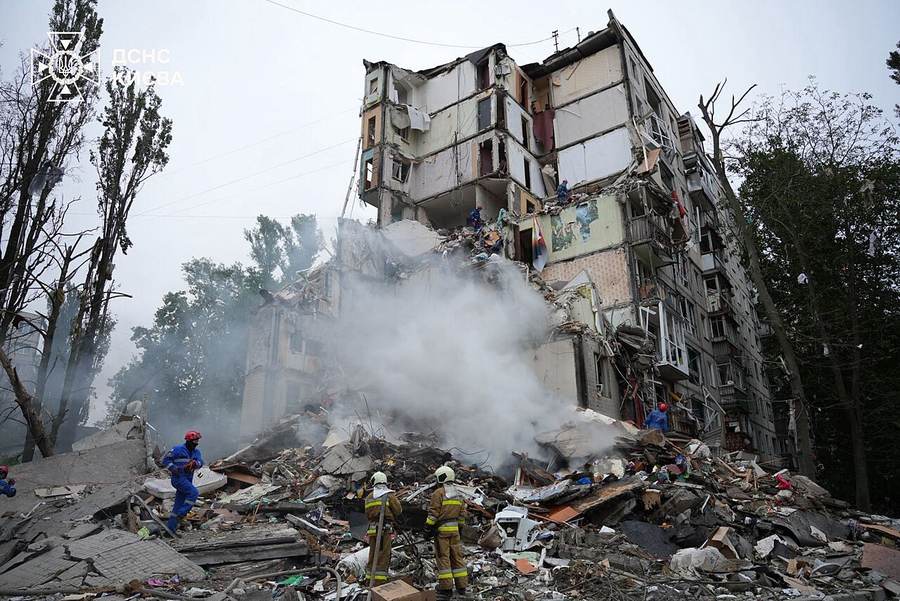
Three killed and seven injured as the toll rose
The first verified morning count did not hold. Reuters reported that at least three people were killed, including a child, and seven were injured across Kyiv and the surrounding region. The Kyiv City Military Administration said two people were killed and four injured in the capital. In the Kyiv region, three people were injured, including another child.
In Vyshhorod, north of Kyiv, rescuers found a child born in 2012 under the rubble of a destroyed home. Emergency crews tried to save him, but he died. Mayor Vitali Klitschko later said a KyivTeploEnergo utility driver was killed when a warehouse was struck while municipal specialists were working at the site.
Casualty reporting continued to move through the day. The confirmed three-death, seven-injury count is the basis for this update, while later reports cited a fourth death after the warehouse strike. The distinction matters: early wartime counts are snapshots, and rescue work, hospital reports and the classification of separate daytime impacts can produce different totals before authorities reconcile them.
Preliminary information from Klitschko also put strike debris on the grounds of an unnamed Western embassy in the central Shevchenkivskyi district. He said emergency services were sent to inspect the site. There was no report in the cited accounts that embassy personnel were hurt.
A saturation attack built around 188 drones
Ukraine's Air Force said the attack combined several ballistic and anti-ship missiles with 188 drones, including jet-powered systems, and that the Kyiv region was the principal target. It reported five missiles and 155 drones intercepted or electronically suppressed, with strikes recorded at 18 locations.
The headline interception rate looks high: 155 of 188 drones is roughly 82 percent. But saturation warfare is designed around the remainder. On the Ukrainian count, 33 drones were not listed as intercepted or suppressed; even if only a fraction reach critical nodes, they can force outages, ignite fires and compel defenders to spend more expensive interceptors. The five-day rhythm also prevents crews, radars and repair teams from fully resetting between waves.
Jet-powered drones tighten that equation further. They cross defended airspace faster than propeller-driven Shahed-type aircraft and compress the time available to classify, assign and engage a target. Russia benefits if Ukraine fires a scarce missile at a cheaper drone; it also benefits if Ukraine holds fire and a drone gets through. Kyiv's answer depends on a layered mix of mobile guns, electronic warfare and low-cost interceptors, reserving Patriot-class weapons for ballistic threats.
Power damage turns an air raid into a winter warning
BBC-credited reporting quoted DTEK, Kyiv's main energy provider, as confirming damage to the power grid and interruptions to supply. The company said engineers restored electricity to 8,000 households and called it “another difficult night for the capital.” The speed of restoration shows a repair system hardened by years of attack; it does not show that the underlying network escaped serious damage.
The winter logic is deliberate. Last year's strikes on the energy sector produced widespread blackouts while temperatures fell as low as minus 20 degrees Celsius. A grid can absorb one repaired substation or reroute around one damaged line. Repeated attacks are different: they consume spare transformers, exhaust specialist crews and turn short local outages into a cumulative national shortage just as heating demand rises.
That is why an energy strike can have more strategic value than its immediate blackout count suggests. Moscow can force Ukraine to distribute air defenses across generation plants, substations, hydroelectric facilities, data centres and cities. Kyiv must protect all of them; an attacker needs only to find the thinnest layer on a given night.
What Russia claimed it hit — and what Ukraine confirmed
Russia's Defence Ministry described the operation as a “massive missile and drone strike.” Moscow said it hit the De Novo data centre in Kyiv, which it portrayed as a major internet-traffic exchange supporting Ukraine's armed forces; the Kyivska power substation near Nalyvaikivka; the Kyiv hydroelectric power plant in Vyshhorod; the Trypilska thermal power plant; and an energy-storage facility in Horenychi.
The ministry also claimed strikes on port infrastructure in Izmail and an industrial complex in the Odesa region, saying those sites supported military cargo and fuel movements. These are Russian battlefield claims, not independent findings. Reuters said it could not verify the target list. Ukrainian authorities and DTEK confirmed grid damage and civilian destruction, but the public reporting cited here did not independently establish that every facility Moscow named was struck or that each served the military function Russia alleged.
The separation between claim and confirmation is essential. Moscow gains a military narrative by labeling communications, energy and port facilities as war-supporting infrastructure. Kyiv gains diplomatic leverage by documenting homes, businesses, utilities and civilian deaths. Both narratives shape foreign support, but neither substitutes for independently verified damage assessments.
The blast radius reached NATO's edge
Romania and Poland scrambled military aircraft to protect their airspace during the Russian barrage. Flights at Poland's Lublin and Rzeszow airports were temporarily suspended. A drone also crossed into Moldova's airspace and exploded near the village of Hirbovet, according to the regional reporting cited below.
None of those actions means NATO entered the war. They show how a dense mixed salvo near alliance borders raises the cost of remaining outside it: radar operators must quickly decide whether a track will stay over Ukraine, cross a border by accident or present a direct threat. Every incursion or near-incursion also increases pressure for more persistent air patrols and clearer rules for defending allied airspace.
Ukraine struck back across Russia's energy belt
Ukrainian drones damaged private houses in Russia's Samara region, an oil-producing and refining hub roughly 1,100 kilometres by road southeast of Moscow, the regional governor said. Ukrainian strikes had also hit fuel depots in the Krasnodar region earlier in the week. Reuters said it could not independently verify all battlefield accounts.
Kyiv's strategic case is that attacks on refineries, depots and military logistics raise the economic cost of Russia's war and force Moscow to pull air defenses away from the front. Critics answer that reciprocal attacks on energy infrastructure normalize a widening campaign in which civilians and essential services on both sides carry the risk. The asymmetry remains: Russia can launch larger salvos, while Ukraine relies on deep strikes to impose selective costs.
Sanctions target the procurement chain, not tonight's launchers
The United States announced sanctions on 13 individuals and entities in Russia, Hong Kong, China and Pakistan over procurement networks for Iranian weapons. The list included MG-Flot, whose vessels Washington says transport weapons for Russia's Defence Ministry, and JSC Experimental Design Bureau Named After A.S. Yakovlev.
The timing exposes the gap between financial pressure and battlefield effect. Sanctions can complicate shipping, insurance, banking and access to components, but they do not remove drones already built or missiles already stockpiled. Their value will be measured over months in slower procurement and higher replacement costs; Kyiv has to survive the nightly arithmetic now.
Why this matters
This was the fourth major strike on Kyiv in five days. The September 28 daytime attack killed at least nine people and wounded more than 80, striking apartment buildings, offices, data centres and the National Academy of Sciences. The introduction of more jet-powered drones is helping Russia sustain pressure beyond the old pattern of discrete overnight raids and toward near round-the-clock attacks.
The deliberate energy-war logic is attritional. Russia does not need to black out all of Kyiv in one night. It can win smaller exchanges by making Ukraine spend scarce interceptors, forcing repeated repairs and keeping households uncertain about heat and power. Ukraine's 82 percent reported drone interception rate is substantial, but saturation means the meaningful number may be the 33 drones not reported stopped and the 18 impact locations. Defense is judged by what leaks through.
Who benefits and who loses? Moscow benefits from any diversion of Ukrainian air defenses from the front and from the political anxiety created by winter outages. Kyiv benefits diplomatically when civilian casualties and cross-border spillover remind European governments that the war's security costs do not stop at Ukraine's border. The clearest losers are households, utility workers and businesses on both sides of the expanding deep-strike contest.
Critics of Russia argue that the documented civilian deaths and residential damage undermine its claim of a narrowly military target set. Critics of Ukraine's response warn that strikes on Russian refining regions may encourage escalation and complicate calls to shield energy systems. Kyiv replies that a unilateral restraint would leave Russia free to dismantle its grid.
What happens next
The first scenario is a sustained winter campaign: repeated mixed salvos against generation, transmission and local distribution, calibrated to destroy replacement equipment faster than Ukraine and its partners can supply it. The counter is not simply more high-end missiles; it is cheaper point defense, dispersed generation, protected substations and faster repair.
The second is a narrow diplomatic bargain. Zelenskyy's proposal for a reciprocal energy truce offers a testable form of restraint: Moscow stops striking Ukraine's grid and food-export infrastructure, and Kyiv halts attacks on Russian energy sites. The obstacle is verification and trust. Each side defines military-supporting infrastructure broadly, and each has an incentive to blame ambiguous damage on the other.
The third is a firmer NATO airspace posture without direct participation in the war: more combat air patrols, temporary airport closures when threat tracks approach and tighter coordination with Moldova. That posture can reduce the chance of an accidental border breach becoming a crisis, but it cannot solve Ukraine's interceptor shortage.
For Kyiv, the central question is no longer whether another winter assault is coming. The September 30 strike suggests it may already have begun.
Related coverage
Sources
- Reuters — revised casualty toll, Kyiv City Military Administration and Mayor Vitali Klitschko reporting (September 30, 2026)
- BBC News reporting, republished by Europe Says — power-grid damage, DTEK restoration and winter context (September 30, 2026)
- DTEK statement, as quoted in BBC-credited reporting — 8,000 households restored after “another difficult night for the capital” (September 30, 2026)
- Ukraine's Air Force, reported by ANTIKOR — 188 drones, five missiles and 155 drones intercepted or suppressed (September 30, 2026)
- Russia's Defence Ministry claims, reported by Reuters — claimed communications, energy, port and industrial targets (September 30, 2026)
- Reuters syndication — later toll, embassy debris, Moldova incursion and regional airspace response (September 30, 2026)