War · Africa
Nearly three-quarters of the civilians the United Nations has verified killed in Sudan this year died by drone, according to figures released in Geneva on Tuesday — 2,230 deaths documented between January and October, over 1,630 of them caused by drones, in a toll the UN itself says is certainly incomplete.
GENEVA, November 17, 2026 — Sudan drone war deaths now account for nearly three-quarters of all the civilian killings the United Nations has verified in Sudan this year, according to figures released by the UN human rights office on Tuesday and reported by Reuters. The office, known as OHCHR, said it had confirmed 2,230 civilian deaths in Sudan’s civil war between January and October 2026, and that over 1,630 of those people — nearly three-quarters of the verified toll — were killed by drones. The figures came in a UN statement issued alongside a new UN report on the first half of the year, and the UN was explicit that they are a floor, not a ceiling: the true scale of the loss of life, it said, is likely higher. UN High Commissioner for Human Rights Volker Türk condemned what he called the warring parties’ “brazen disregard for the laws of war,” saying the violations documented may amount to war crimes — a condemnation directed, throughout, at both sides of the war, not at one army or one militia.
Track it live: Africa wars tracker — Sudan and the continent’s other conflicts, followed day by day; and the wars tracker — every conflict Signal Post News is tracking, in one place.
What we know
- The verified toll: the UN human rights office said on Tuesday that it had confirmed 2,230 civilian deaths in Sudan between January and October 2026. These are UN-verified figures, as reported by Reuters and set out in the OHCHR release; they count only deaths the UN was able to document.
- The drone share: over 1,630 of the 2,230 — nearly three-quarters — were killed by drones, according to the UN statement. In January–June, the period covered by the UN report itself, 1,390 civilians were killed and over 80 per cent of them died by drone. In the following four months, another 840 were killed, about 520 of them by drones.
- Where: Kordofan accounted for more than two-thirds of the documented casualties, according to the OHCHR release, and Darfur for most of the rest. In White Nile state, at least 41 people were killed during the reporting period.
- What is being hit: in the first half of the year the report documented drone strikes on markets (39), civilian vehicles (20), fuel tankers and depots (17) and health facilities (16), and the UN statement said drones are increasingly targeting the facilities that ensure human survival, such as water sources and power supplies.
- The blackout campaign: the OHCHR release attributed 29 drone strikes between October 20 and November 4 to the Rapid Support Forces (RSF), hitting electricity and fuel facilities across 11 states and causing blackouts that disrupted dialysis, surgery, clean water and food production. It is the only part of Tuesday’s figures the UN assigned to a single party; the overall drone toll was not attributed to either side.
- The warning: Türk said “the facts speak for themselves,” that the violations may amount to war crimes, and that the parties must protect civilians — “the world is watching.”
The toll, period by period
The architecture of Tuesday’s release matters, because the headline number is really two numbers joined together. The UN report published on Tuesday covers January to June 2026. For that period, according to the OHCHR release, the UN documented 1,390 civilians killed, with over 80 per cent of them — more than four in every five documented deaths — killed by drones. Alongside the report, a UN statement updated the count for the four months since June: another 840 civilians killed between July and October, about 520 of them by drones. Added together, the two periods produce the January–October totals the UN led with on Tuesday: over 2,230 civilians confirmed killed, over 1,630 of them by drones.
Read as a curve, the figures describe a weapon that defined the war’s killing early and never relinquished that role. The drone share of documented deaths was at its highest in the first half of the year, above 80 per cent; in the July–October period it eased to roughly six in ten, even as the absolute number of documented deaths remained in the hundreds every month. Nothing in Tuesday’s release suggests the drone campaign is shrinking. What changed across the year, on the UN’s account, is partly what the drones are being aimed at — a shift, documented below, from the battlefield’s edge toward the infrastructure of civilian survival.
One caution belongs with every figure in this article, and the UN itself attaches it: these are verified deaths, not an estimate of all deaths. OHCHR counts the killings its monitors can document, in a war where large areas cannot be reached, communications are cut for weeks at a time, and many deaths are never reported to anyone in a position to record them. The office said the true figures are likely higher. The 2,230 should therefore be read the way the UN presents it — as the documented minimum of a larger, uncounted loss.
Where the dying is concentrated
The geography of the toll is as lopsided as its method. According to the OHCHR release, the Kordofan region — the central Sudanese states where the army and the RSF have fought some of the war’s most contested ground this year — accounted for more than two-thirds of all documented casualties. Darfur, in the west, accounted for most of the remainder. In White Nile state, to the south-east of Khartoum, at least 41 people were killed during the reporting period, the release said.
That concentration tracks the war’s logic in 2026. Kordofan sits between the army-held east and centre and the RSF’s western strongholds; its towns, roads and oil infrastructure have changed hands and been fought over repeatedly, and it is precisely the kind of contested, front-line-fluid territory in which long-range drones are most useful to both armies. Darfur, largely under RSF control, has seen a different pattern: strikes and attacks landing on a civilian population that has already endured siege, displacement and, in places, famine conditions. The pattern of individual strikes behind the aggregate figures has run through this newsroom’s coverage all autumn — a single army drone strike on the West Kordofan village of Abu Qalb, for example, killed 15 people including four children playing football, as we reported in Sudan Army Drone Strike in West Kordofan Kills 15, Including Four Children Playing Football.
What the drones are hitting
The report’s first-half target counts read like an inventory of civilian life. In January–June, according to the OHCHR release, documented drone strikes included 39 on markets, 20 on civilian vehicles, 17 on fuel tankers and depots, and 16 on health facilities. Markets are where Sudanese civilians buy food; civilian vehicles are how they move between towns, flee fighting and reach hospitals; fuel is what runs the generators, water pumps, mills and trucks that keep a besieged population alive; and health facilities are where the wounded from every other category of strike are taken. A strike pattern that runs through those four categories is not, in the main, a pattern of attacks on military formations that missed. It is a pattern that lands, repeatedly, on the systems a civilian population depends on.
The UN statement made the same point in general terms: drones, it said, are increasingly targeting facilities that ensure human survival, such as water sources and power supplies. That sentence is the bridge between the report’s first-half documentation and the autumn’s most consequential development — the turn toward the electricity grid.
The blackout strikes
Between October 20 and November 4, according to the OHCHR release, 29 drone strikes attributed to the RSF hit electricity and fuel facilities across 11 Sudanese states. The release said the strikes caused blackouts that disrupted dialysis treatment, surgery, clean water supplies and food production — a list worth reading slowly, because it describes what a modern electricity grid actually is in a country at war. Dialysis machines do not run on goodwill; when the power goes, treatment stops, and kidney patients die on a schedule measured in days. Surgery stops or proceeds by generator and torchlight. Water treatment and pumping stop, and clean water gives way to whatever can be carried from a river or a well. Bakeries, mills and cold storage stop, and food production contracts in places where the UN’s food-security monitors are already warning of famine risk.
The attribution in that passage is precise, and this article keeps it exactly as the UN made it: those 29 strikes, in those sixteen days, against that category of target, were attributed by OHCHR to the RSF. It is the only side-specific attribution in Tuesday’s figures. The wider toll — the 2,230 verified deaths, the 1,630 killed by drones — was presented by the UN as the product of a war with two warring parties, both of which operate drones, both of which the UN has accused of violations, and neither of which the headline figures single out. Readers who see the aggregate drone toll assigned to one side, anywhere, are reading a claim Tuesday’s release does not make.
“The facts speak for themselves”
Volker Türk’s statement accompanying the report did not hide behind the statistics. “The facts speak for themselves,” the UN human rights chief said. He condemned the warring parties’ “brazen disregard for the laws of war,” said the violations documented in the report may amount to war crimes, and closed with a sentence aimed over the heads of the generals at the governments and publics watching the war from outside: “The parties to the conflict must protect civilians and uphold their international law obligations — the world is watching.”
Two features of that condemnation are easy to miss and important to keep. The first is its address: it is directed at “the parties to the conflict” — the Sudanese Armed Forces (SAF) under General Abdel Fattah al-Burhan and the paramilitary Rapid Support Forces under General Mohamed Hamdan Dagalo, known as Hemedti — who have been at war since April 2023. The UN’s legal language on Tuesday was not a verdict on one party. The second is its legal register. “May amount to war crimes” is the formulation UN human rights officials use when the documented pattern — attacks on markets, hospitals, civilian vehicles and survival infrastructure, at this scale, over this period — meets the threshold at which individual criminal responsibility becomes the relevant question, and when the evidence is being assembled with future accountability in mind. It is not a conviction. It is a notice.
A war remade by drones
The report’s own summary of what has changed in Sudan is worth quoting in full, because it explains the statistics better than the statistics explain themselves: “The increased use of … drones emerged as one of the defining features of the conflict in the Sudan, enabling parties to extend their reach far beyond areas of territorial control and front lines.” A drone does not need a front line. It does not need the army that launches it to hold the town it strikes, or the road to it, or anything in between. In a war fought across a country the size of Sudan — where the SAF holds the east and much of the centre, the RSF holds most of Darfur and contests Kordofan, and hundreds of miles of desert and scrub separate the garrisons — that reach converts every market town, fuel depot and power station in the country into a target that can be struck on any given day, by an enemy that may be nowhere near it.
Both sides have stepped up their drone operations in recent months, Reuters reported, and the escalation has been visible in this newsroom’s coverage as a quickening rhythm of individual strikes: markets in Darfur, a dormitory in El Obeid, power stations in the south-east, a village football game in West Kordofan. Tuesday’s figures are the first UN accounting to total that rhythm across most of a year, and the total reframes the individual stories: what looked, incident by incident, like a tactic has become, in aggregate, the war’s principal documented method of killing civilians.
The escalation curve has markers along it, each belonging to its own period and its own UN statement, and they should not be blended into one another. In October, Türk warned that drone strikes had killed 306 people in the first three weeks of that month alone — a separate, earlier UN warning, covering a different and shorter period, which we reported at the time in Sudan Drone Strikes: 306 Killed in Three Weeks, UN Says. Tuesday’s release is consistent with the direction of that warning — its July–October update records about 520 drone deaths across four months, within which October was, on the earlier statement, an especially lethal month — but the two figures come from different statements and different counting periods, and this article keeps them labelled as such.
Behind the reach is a supply question that Tuesday’s release did not address, and that this article does not pretend it did. Earlier UN and New York Times reporting has described foreign-supplied drone systems on both sides of this war — Iranian- and Turkish-made systems in the army’s hands, and Chinese-made drones used by the RSF — and the accountability debate in Geneva and New York increasingly runs through the suppliers as well as the operators. Tuesday’s report and statement made no new supplier findings. What they establish is the use, the targets and the toll; the question of whose factories stand behind the toll remains, as it was before Tuesday, a matter of prior reporting and continuing investigation.
Beyond the drone toll
The drone figures lead Tuesday’s release, but they are not the whole of the report. The OHCHR release said the report also documents sexual violence, reprisals, unlawful killings and arbitrary detention — the ground-level repertoire of a war in which civilians are punished for where they live, who they are perceived to support, or simply for being reachable. Those findings matter to the drone story rather than sitting beside it: a population being subjected to reprisals and detention on the ground, and to strikes from the air, has no direction left in which safety lies, which is one reason Sudan’s displacement figures continue to climb even in areas far from any front line.
The hunger backdrop is tightening at the same time. The release noted an October alert from the Integrated Food Security Phase Classification (IPC), the UN-backed food-security monitoring system, warning of rising famine risk in Darfur and Kordofan — the same two regions that account for the overwhelming majority of the documented deaths. The connection is mechanical, not rhetorical: the report documents strikes on markets, fuel and food production; the IPC warns of famine risk in the same geography; and the blackouts the UN attributes to the late-October strikes disrupted, among other things, food production itself. A war that kills civilians directly, in other words, is also degrading the systems that keep the surviving civilians fed.
What a verified toll can and cannot say
It is worth being exact about what kind of number 2,230 is, because both the war’s defenders and its critics will misuse it in the coming days. It is not an estimate. The UN did not model Sudan’s mortality, survey households, or extrapolate from a sample; it counted deaths its human rights monitors were able to document and verify, case by case, in a country where monitors cannot go everywhere and where, in the most violent areas, they often cannot go at all. Every part of that method pushes the number down relative to the truth: deaths in besieged or cut-off areas go unrecorded; deaths recorded by no hospital, no family member willing to speak, and no functioning local authority simply vanish from the ledger. That is why the UN pairs the figure with its standing caveat that the true figures are likely higher, and why the honest way to cite Tuesday’s numbers is the way the UN issued them — 2,230 civilians confirmed killed, over 1,630 of them by drones, as a documented minimum.
The same discipline applies in the other direction. Monitors and research groups publish their own Sudan tolls, built by different methods over different periods, and some are far higher than the UN’s verified count. Those figures are not interchangeable with Tuesday’s, and this article does not merge them: each belongs to its source and its period. What the UN’s method buys, in exchange for its conservatism, is defensibility — a toll assembled to a standard intended to survive scrutiny in accountability proceedings, which is precisely the future Türk’s “may amount to war crimes” language points toward.
What happens next
Three things follow from Tuesday, none of them quickly. The first is documentation: a UN report that names target categories, periods and, in one passage, a responsible party is a building block for the war-crimes accountability Türk invoked, and the detailed record behind the headline figures now sits in the UN system where investigators can use it. The second is protection of infrastructure: the release’s account of dialysis wards and water systems going dark under blackout strikes gives aid agencies and diplomats a specific, documented demand — that electricity and fuel facilities be treated as the civilian survival infrastructure the laws of war already say they are — to press on both parties and on the states that supply them. The third is the toll itself, which will rise. The UN’s next update will count the deaths of November and December in a war that, as of Tuesday, shows no sign of the ceasefire that has been negotiated over, and collapsed, repeatedly since 2023. Türk’s closing words were addressed to the parties. They were also, plainly, a marker laid down for everyone else: the world is watching, and now it has the numbers.
Sources
- Reuters, November 17, 2026 (Emma Farge, Geneva) — “Drones account for nearly three-quarters of Sudan war deaths this year, UN says”: the UN human rights office’s confirmation of 2,230 civilian deaths in Sudan so far this year, of whom over 1,630 were killed by drones; the January–June report period and the statement updating the toll since June; the UN’s assessment that the true scale of loss is likely higher; High Commissioner Volker Türk’s condemnation of the warring parties’ “brazen disregard for the laws of war” and his statement that the violations may amount to war crimes; the report’s finding that the increased use of drones is a defining feature of the conflict, extending the parties’ reach beyond front lines; the statement’s finding that drones increasingly target facilities that ensure human survival, such as water sources and power supplies; and the context that the SAF and RSF have fought since April 2023 and both have stepped up drone strikes in recent months. All death figures in this article are UN-verified or UN-statement figures as reported by Reuters and the OHCHR release; they are not independently confirmed by Signal Post News.
- UN Human Rights Office (OHCHR) press release, Geneva, November 17, 2026, distributed via APO Group — “Sudan: UN report details deadly civilian impact of surge in drone strikes”: the period breakdown (January–June: 1,390 killed, over 80 per cent by drones; the following four months: another 840 killed, about 520 by drones; January–October total: over 2,230 killed, over 1,630 by drones) and the UN’s statement that true figures are likely higher; Kordofan accounting for more than two-thirds of documented casualties, Darfur for most of the rest, and at least 41 killed in White Nile; first-half strike counts (39 on markets, 20 on civilian vehicles, 17 on fuel tankers and depots, 16 on health facilities); the 29 drone strikes attributed to the RSF that hit electricity and fuel facilities across 11 states between October 20 and November 4, causing blackouts that disrupted dialysis, surgery, clean water and food production; the IPC’s October alert on rising famine risk in Darfur and Kordofan; the report’s documentation of sexual violence, reprisals, unlawful killings and arbitrary detention; and Türk’s statements, including “The facts speak for themselves” and “The parties to the conflict must protect civilians and uphold their international law obligations — the world is watching.”
- Signal Post News, related coverage: Sudan Drone Strikes: 306 Killed in Three Weeks, UN Says (the separate October UN warning, covering the first three weeks of October 2026); Sudan Army Drone Strike in West Kordofan Kills 15, Including Four Children Playing Football.
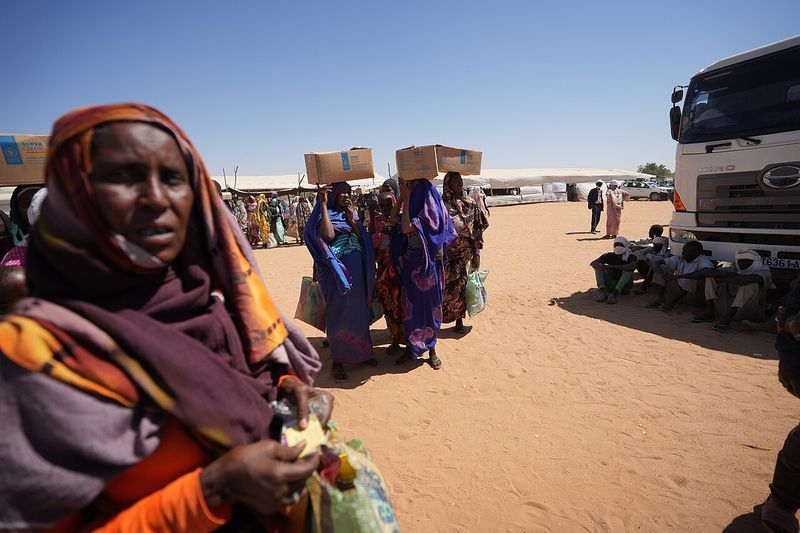
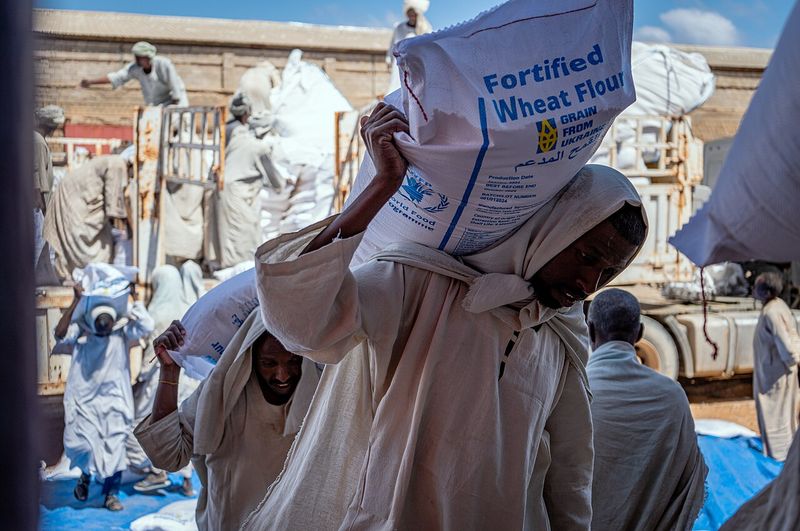
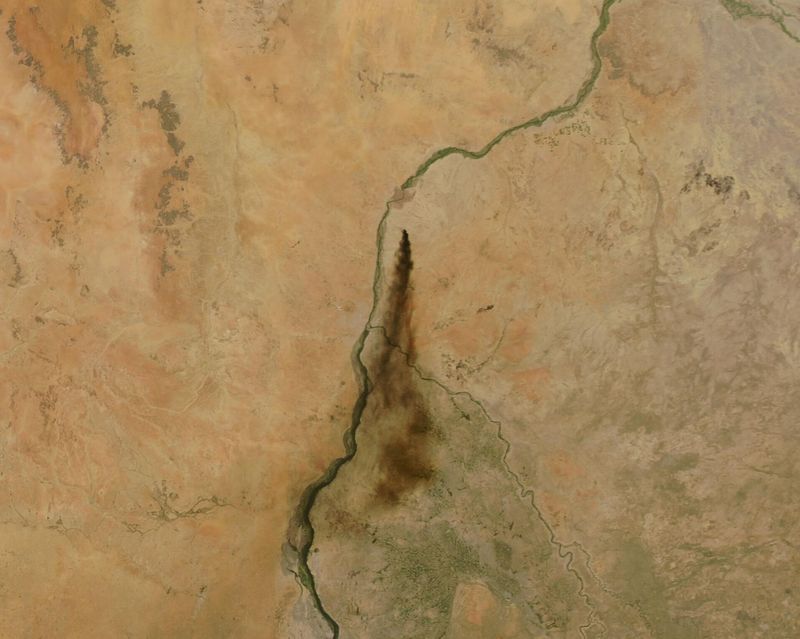
- Photos: Sudanese refugee women carrying food aid at Adré, Chad, by the Foreign, Commonwealth & Development Office via Wikimedia Commons (CC BY 2.0); porters moving WFP wheat flour at Port Sudan, by WFP / Abubaker Garelnabei via Wikimedia Commons (CC BY 4.0); a NASA MODIS satellite image of the Al-Jaili refinery fire north of Khartoum, by the MODIS Land Rapid Response Team, NASA GSFC, via Wikimedia Commons (public domain) — each credited in its caption. All are file photographs; none depicts the events of 2026 described in this article.