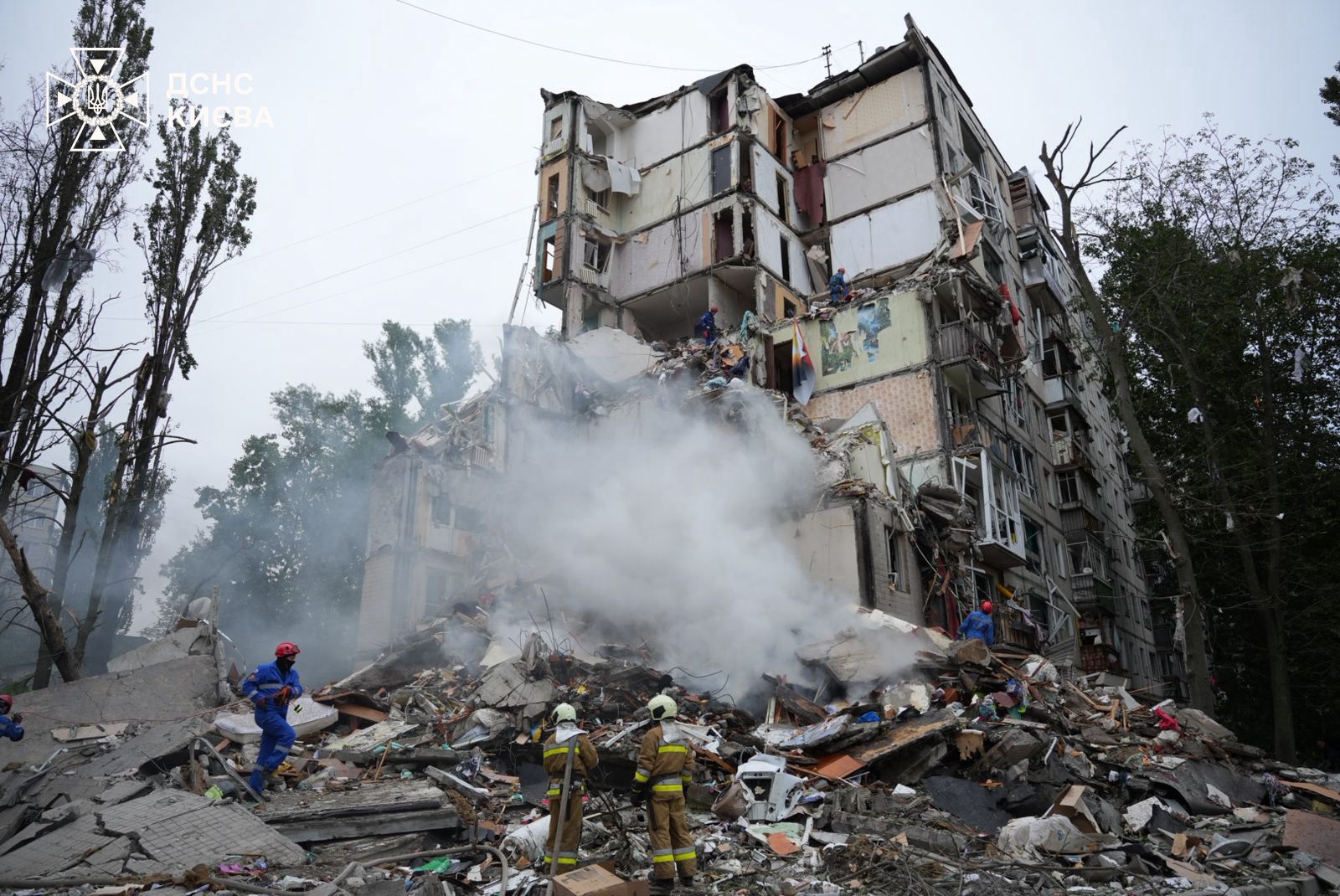
KYIV — The Russia Kyiv ballistic missile attack overnight on September 24 killed two people and injured six, according to officials cited in reports from Kyiv. In a separate attack on a farm in the Kharkiv region, officials reported six people killed and eight injured. The two official tallies amounted to eight dead and 14 wounded across the incidents, but wartime casualty figures can change as emergency crews complete searches and hospitals update local authorities.
The reports describe a night in which the immediate damage inside Ukraine and the security response beyond its borders unfolded together. Czech Gripen fighters scrambled over Poland as the attack developed, authorities said, but did not use force. That distinction matters: an allied combat-aircraft launch is a precautionary response, not evidence that NATO entered the fighting or that a weapon was engaged over Polish territory.
Signal Post News has not independently verified the casualty totals, weapon trajectory or military target claims. The figures here remain attributed to officials, and this report separates those reported facts from analysis of the attack’s broader implications.
What officials reported in Kyiv and Kharkiv
The Kyiv casualty report — two killed and six injured — placed the capital at the center of another overnight alert. Reporting described the weapon as ballistic, a category that gives civilians and air-defense crews less reaction time than slower airborne threats. The publicly reported facts establish a deadly strike and an emergency response; they do not, by themselves, establish the intended target or explain whether all damage came from the incoming weapon, interception debris or secondary effects.
In the Kharkiv region, officials said a separate strike hit a farm, killing six people and injuring eight. The location changes the human and economic stakes. Farms are workplaces as well as critical links in food production, and an attack can affect families, employees, livestock, machinery and the next stage of the harvest even when the full extent of physical damage is not yet public.
The Kyiv and Kharkiv numbers should be read as two distinct local reports, not a single-attack count. Together they show why national totals can obscure what happened on the ground: one incident struck the country’s capital; the other struck a rural workplace in a border region repeatedly exposed to wartime attack.
Czech Gripens scrambled over Poland — and did not use force
Czech Gripen fighter jets scrambled over Poland during the Russian attack, but authorities said the aircraft did not use force. The response illustrates how attacks on Ukraine create operational consequences across NATO’s eastern flank even when no alliance weapon is fired.
A scramble can serve several purposes: verifying radar tracks, improving identification, protecting national airspace and shortening the time needed to respond if a threat crosses a border. It does not prove that an incursion occurred. In this case, the reported absence of force is as important as the launch itself because it places the event on the deterrence-and-monitoring side of the line rather than the combat side.
For Poland and the Czech Republic, the practical burden is persistent readiness. Every alert consumes flying hours, maintenance capacity and personnel attention. For Moscow, the regional effect may add pressure without requiring a direct encounter with NATO. That is analysis of the incentives created by repeated alerts, not evidence of Russia’s intent in this specific strike.
Wadephul calls for an immediate ceasefire beginning in the Black Sea
German Foreign Minister Johann Wadephul called for an immediate ceasefire beginning in the Black Sea. His proposal points toward a limited, geographically defined starting point rather than waiting for a comprehensive settlement of every military and political dispute.
A Black Sea ceasefire could be narrower than a nationwide halt but still consequential. Commercial shipping, port operations and food exports depend on predictable maritime access. A verified pause at sea could reduce risk to crews and cargo and create a practical test of whether both sides can observe limited rules while wider negotiations remain unresolved.
The hard questions would be enforcement and scope. Negotiators would need to define which vessels and facilities are protected, how an incident is investigated, what counts as a violation and what happens after one. Without monitoring and a response mechanism, even an immediate ceasefire could become another disputed claim rather than a durable reduction in violence.
Why the September 24 attack matters
Analysis: The strategic significance lies in three connected pressures. First, a Russian ballistic missile strike on Kyiv forces Ukraine to protect a dense civilian capital against a fast threat with limited warning. Second, the Kharkiv farm strike shows that danger is not confined to ministries, military installations or major cities. Third, the Czech air response demonstrates that the defensive footprint of the war extends beyond Ukraine’s border even when NATO aircraft do not fire.
The timing also sharpens the contrast between battlefield action and diplomacy. Wadephul’s Black Sea proposal describes one possible off-ramp; the overnight casualties show how quickly the human cost grows while the terms, verification and sequence of a ceasefire remain unsettled.
For Ukraine, the immediate objective is protecting people and preserving air-defense capacity. For Russia, continued long-range attacks can sustain military pressure and force Ukraine to distribute defenses across many possible targets. For neighboring NATO states, the priority is preventing spillover and miscalculation. Civilians bear the clearest loss: deaths, injuries, disrupted work and repeated nights under alert.
What the numbers mean — and what they do not
The reported toll of two killed and six injured in Kyiv, plus six killed and eight injured at the Kharkiv farm, is a snapshot. It measures confirmed human harm according to officials at a particular moment. It does not capture all secondary costs, such as trauma, interrupted transport, lost work, damaged productive capacity or the expense of maintaining air-defense and emergency-response readiness.
Nor do the numbers settle military effectiveness. Casualty reports cannot show whether a strike reached its intended target, whether defenses intercepted other weapons or what Russia sought to accomplish. Those are separate questions requiring evidence that was not available in the cited public reporting.
Who gains, who loses
Analysis: There is no clear “winner” in the immediate record. Russia may gain coercive leverage if repeated attacks compel Ukraine and neighboring states to commit scarce defensive resources. Ukraine can limit that leverage when warnings, interception and emergency services reduce casualties and restore essential functions quickly. NATO members may reinforce deterrence by showing they can put aircraft in the air without escalating to weapons use.
The direct losses are less ambiguous. Families lost relatives in Kyiv and at the Kharkiv farm, according to officials. Injured people face recovery, and local services must absorb the burden. The wider public pays through disrupted sleep, damaged property, emergency costs and pressure on transport, agriculture and power networks.
What happens next
The first question is whether Kyiv and Kharkiv authorities revise the casualty totals or provide more detail about the damage. The second is whether military authorities release evidence clarifying the weapon types, trajectories and interception results. Any such claims should remain attributed until independently corroborated.
The third question is diplomatic: whether Wadephul’s call develops into a defined Black Sea proposal with participants, monitoring and enforcement. A political statement is not yet a ceasefire. Progress would require both sides to accept the same geography, protected activities and consequences for violations.
Finally, Poland and other NATO members will assess whether the Czech Gripen scramble reflected a routine precaution or a change in the regional risk picture. The fact that no force was used lowered the immediate escalation risk, but repeated alerts increase the importance of disciplined identification and communication.