Another Strong Quake Rocks Panama as Aftershocks Pass 350 Under a State of Emergency
Track it live: Live earthquakes tracker
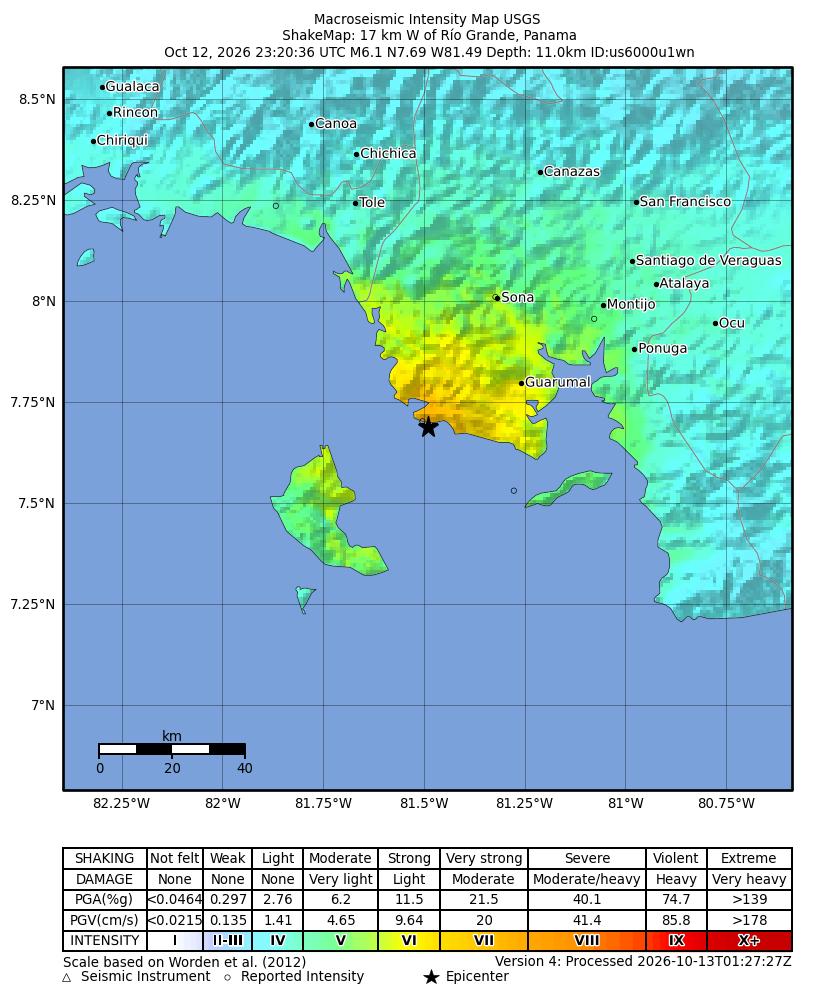
The Panama earthquake aftershocks entered a fourth day on Monday with a jolt strong enough to stand on its own as a news event anywhere else. The U.S. Geological Survey (USGS) put the preliminary magnitude at 6.1, striking at about 6:20 p.m. local time at a shallow depth of roughly 10 kilometres (6 miles), about 18 kilometres (11 miles) west of Río Grande in the country's southern region. The European-Mediterranean Seismological Centre (EMSC) read the same event slightly differently — magnitude 6.0 at a depth of 35 kilometres — a normal spread between agencies in the first hours, and a reminder that early numbers are estimates, not verdicts. There were no immediate reports of new casualties or damage from Monday's quake, officials said, but it landed on a country already sleeping outdoors in large numbers because people are afraid to go back inside.
That fear has a denominator now. Panama's emergency operations director, René García, told CNN that more than 300 aftershocks had been recorded since Friday; the UN's humanitarian coordination office, OCHA, put the count at more than 350 in its situation update as of Monday, October 12. Most are small. Several have not been: a magnitude 6.6 aftershock followed the mainshock on Friday itself, and Monday's 6.1 shows the sequence is still capable of producing damaging shaking three days later, not merely trembling itself out.
What the numbers actually say
Start with the scale of the original event, which our earlier report covered as it happened — the magnitude 7.7 mainshock of Friday, October 9, which struck at 12:56 p.m. local time with its epicentre around 39 kilometres north-west of Tonosí in Los Santos province, at a shallow depth the USGS put at 12.6 kilometres, and which shook with severe intensity (Modified Mercalli VIII) around Tonosí. Magnitude comparisons are logarithmic, and they matter for reading Monday's quake correctly: a 7.7 releases roughly 250 times the energy of a 6.1. Monday's aftershock was therefore no second mainshock — but a 6.1 at 10 kilometres deep, under towns whose buildings are already cracked, is a serious event in its own right, roughly comparable in energy to earthquakes that have caused real damage in the region in past years.
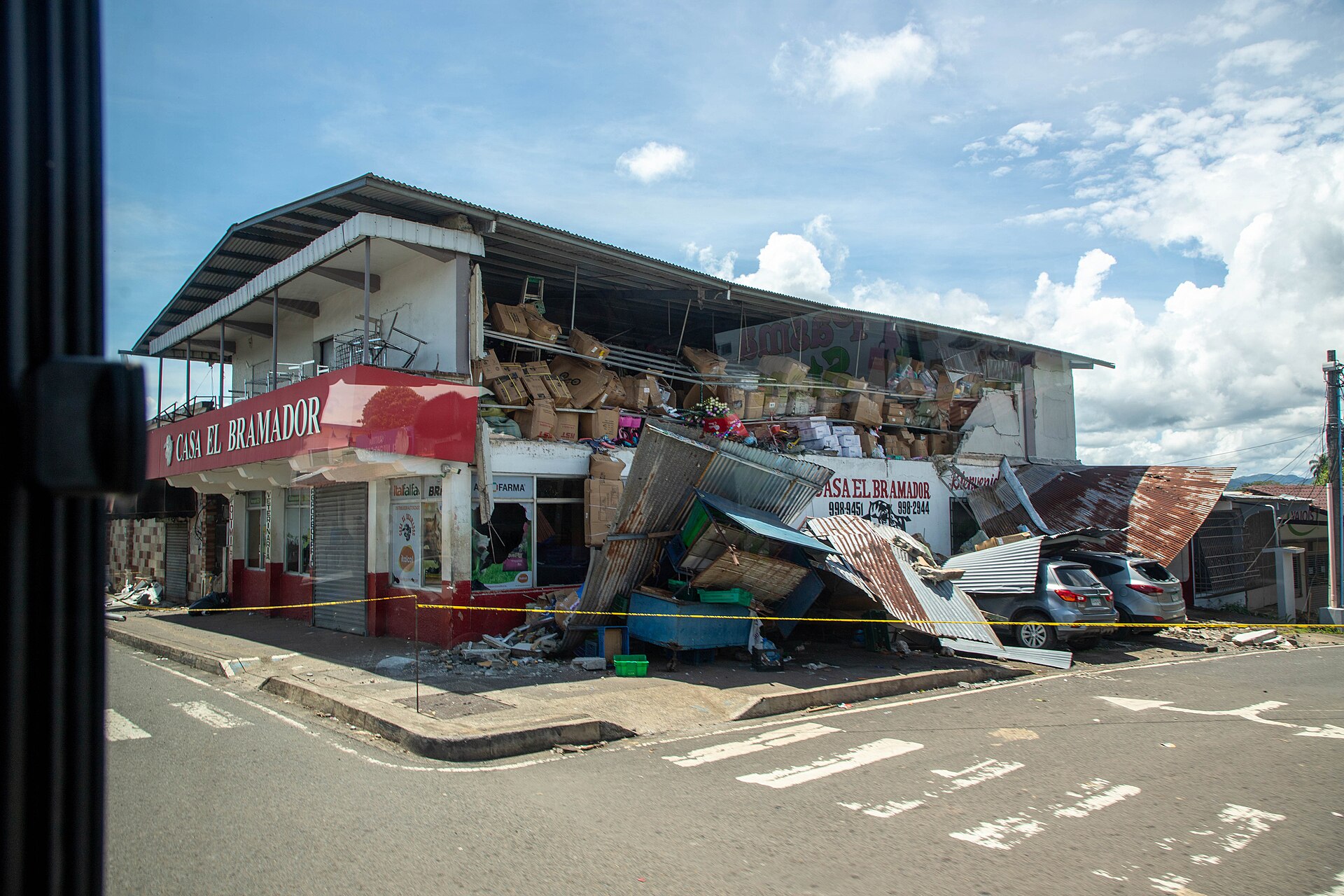
The damage ledger, meanwhile, needs to be read as a moving assessment, not a final toll — and the movement itself is information. On Saturday, Panama's civil protection agency SINAPROC was reporting 426 damaged homes and 419 affected schools. By Monday, OCHA's update, drawing on the authorities' widening field assessments, listed some 1,250 damaged homes, 619 schools, 29 health facilities and 16 bridges. That near-tripling of the homes figure in two days does not mean the shaking suddenly tripled the destruction; it means assessment teams reached communities that Friday's damage — landslides, cracked roads, at least 14 damaged bridges in Veraguas and Los Santos alone — had cut off. Expect the numbers to keep rising for days, and treat any outlet presenting them as final with suspicion.
The human figures have, so far, held remarkably steady against that destruction: 27 people injured, and — as of every official update through Monday — no deaths and no one reported missing. More than 800 people were in shelters, OCHA said, and many more were staying with relatives or sleeping outside. Several hospitals were still treating patients in tents. The bridge over the Oria River remained closed, with aid reaching communities around Tonosí by air and road.
An emergency run on logistics, not headlines
The government declared a national state of emergency on Saturday, October 10. The declaration lets Panama allocate up to $100 million in relief funds without breaching its 2026 fiscal deficit target of 3.5 percent of GDP, the economy ministry said — a detail that tells you the response is being run as a budget operation as much as a rescue one. President José Raúl Mulino visited the affected areas, delivered aid and called for urgent repairs to roads and bridges so relief can move. Classes were suspended nationwide on Monday so engineers could inspect damaged school buildings — with 619 schools now on the affected list, that inspection programme, not the shaking, is what will decide when Panamanian children go back to class.
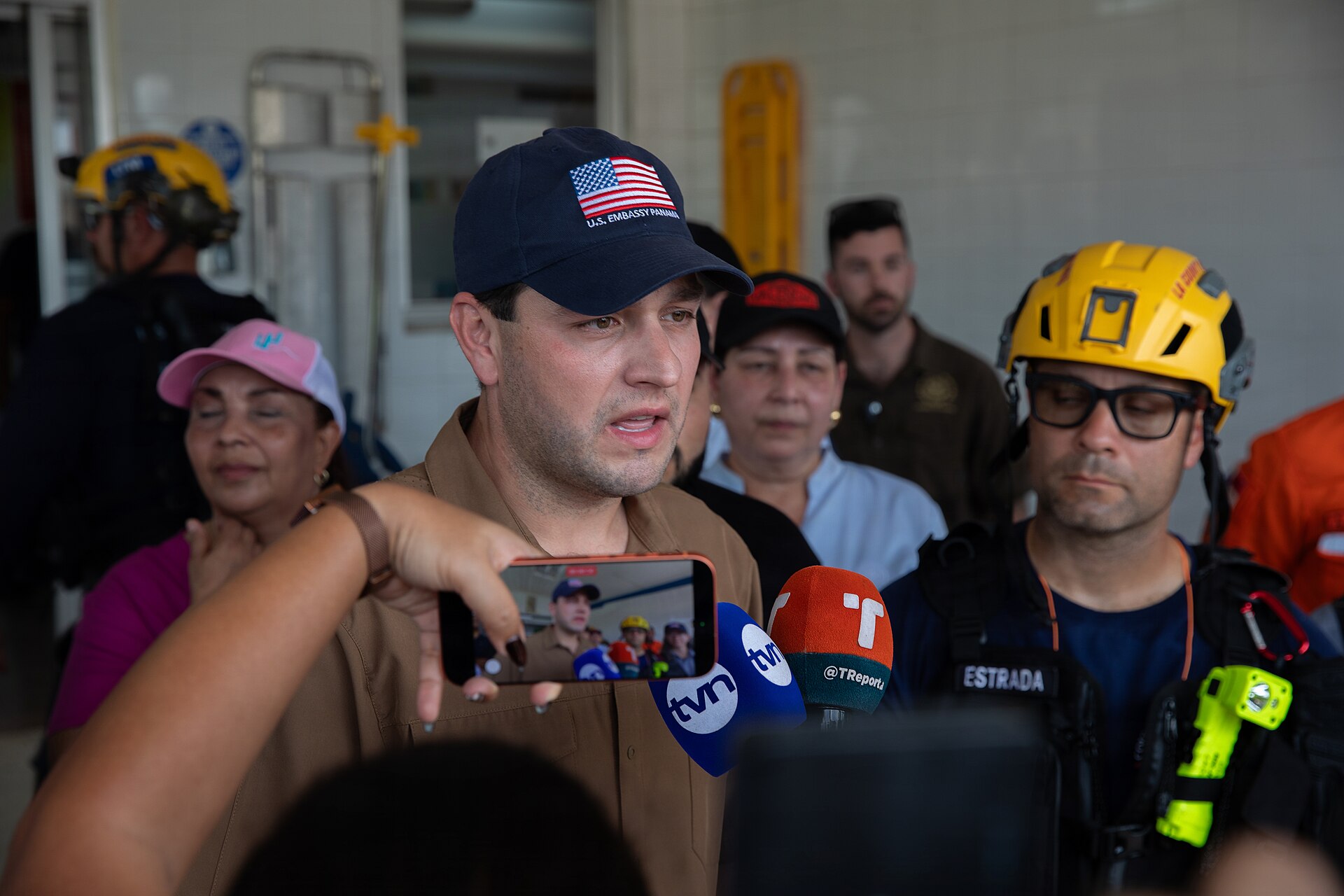
Outside help has begun to arrive in the specific, unglamorous forms disaster response actually takes. The United States pledged $5 million in assistance and is sending a 20-member team to help with rescue operations and infrastructure assessments, U.S. Ambassador Kevin Marino Cabrera said; U.S. Army civil-affairs soldiers were on the ground in Soná, Veraguas, by Sunday, and U.S. helicopters have delivered food into the affected zone. In Tonosí, the town closest to the epicentre, residents spent a second day without running water or electricity, and a town park became a makeshift camp, soup kitchen and field clinic, with healthcare workers cooking for displaced families while aftershocks kept rolling through.
Why this matters
An aftershock sequence is a second disaster layered on the first, and Panama is now living inside that logic. Every strong aftershock — Monday's 6.1, Friday's 6.6 — resets the clock: buildings that survived the mainshock in a weakened state face fresh loads, engineers cannot certify a school or a bridge while the ground is still producing magnitude-6 events, and families make rational decisions to sleep in parks and plazas that, multiplied across provinces, become a displacement crisis without a single new collapse. Seismologists at the University of Panama's Institute of Geosciences, whose director Nestor Luke told Reuters the aftershocks were decreasing in magnitude and spacing out, attribute the rupture to the Azuero-Soná fault system — but a decreasing trend is a statistical statement, not a promise, and Monday evening was the proof.
There is also a wider reason the world watches Panama shake. The Panama Canal kept operating — the Canal Authority said shipping was unaffected — and Tocumen airport, after brief safety checks earlier in the sequence, connects the Americas' air traffic. A disaster that had closed either would have become a global logistics story within hours. That it has not is partly luck of geography: the epicentres have been in the rural centre-south, not under the canal zone. But 1,250 damaged homes and 619 damaged schools in a country of about 4.5 million people is, proportionally, a national-scale event — and heavy rain forecast for the worst-hit areas threatens the classic post-earthquake cascade of landslides onto cracked roads and water into weakened structures.
Finally, note what Panama is demonstrating about disaster accounting. The gap between Saturday's 426 homes and Monday's 1,250 is not incompetence or inflation; it is what honest assessment looks like when the damage zone is rural, mountainous and partially cut off. The countries that recover fastest are usually the ones whose numbers climb early and transparently, because relief money, inspection teams and shelter capacity all follow the count. Our earthquake safety explainer sets out what residents in the affected provinces should do while the sequence continues.
What happens next
Expect the aftershocks to continue for weeks, decaying in frequency if the sequence behaves as such sequences usually do — with the standing caveat, demonstrated on Monday, that individual events above magnitude 6 remain possible. The practical milestones to watch are inspections, not tremors: how quickly engineers can clear or condemn 619 schools, whether the Oria River bridge and the damaged Veraguas and Los Santos bridges reopen to relief traffic, and whether the forecast rain triggers landslides in the hills above Tonosí. The $100 million emergency envelope will also be tested against the final damage count, which — on the trend of the last two days — has not finished climbing. Signal Post News will update this story as SINAPROC, the USGS and the UN publish new figures.
Sources
Associated Press via The Business Standard (Oct 13, 2026) on the Monday magnitude 6.1 earthquake; Reuters via The Business Standard (Oct 12, 2026) on aftershocks, the state of emergency and the relief fund; UN Office for the Coordination of Humanitarian Affairs (OCHA), Latin America & Caribbean situation update via ReliefWeb (as of Oct 12, 2026); Livemint and CNN reporting on EMSC readings and emergency operations statements; U.S. Geological Survey event data and ShakeMap for the October 12 Río Grande earthquake.