War · Thailand · Myanmar border
The Myanmar fighting Thailand border crisis reached a Thai family’s home before dawn on Thursday, when a stray round from clashes around Min La Pan village in Myanmar’s Myawaddy township landed in a house in Ban Huai Mahawong, Mae Sot district, injuring a 55-year-old woman, and Thai soldiers answered with warning shots across the Moei River — the most serious moment yet in a week of spillover along the Tak province frontier.
Track it live: https://signalpostnews.com/tracker/wars
The fighting began at about 5:00 a.m. local time on Thursday, October 29, 2026, when Myanmar military troops from several infantry battalions clashed with Karen armed groups around Min La Pan village in Myawaddy township, Kayin (Karen) State, according to Thai military statements and Thai news reports. The village sits directly across the Moei River border from Ban Huai Mahawong, in Mahawan subdistrict, Mae Sot district, Tak province, and residents on the Thai side reported continuous gunfire and explosions from before dawn. It was one of those rounds — believed to be a 60mm mortar or grenade — that crossed the river and landed in a Thai home, in the clearest case yet of Myanmar war spillover Thailand has faced this month.
Inside the house was Lamyong Dalah, 55, who was sheltering there as the battle raged across the river. She was injured by shrapnel and taken to Mae Sot Hospital, Channel 7 HD News and Khaosod English reported. Her house caught fire after the round landed; reports say she tried to fight the flames before rescuers reached her and took her to hospital. Thai officials confirmed one house hit and one person injured as the core incident. The Thaiger, in a report headlined by wider damage, said shells from the fighting damaged 20 Thai homes in the border area — a broader count that Signal Post News presents as that outlet’s reporting, alongside the single confirmed house strike given by officials on the ground.
Mae Sot shell Myanmar fighting: a home hit as the battle raged across the river
The geography explains the danger. Along this stretch of the Moei River, Thai villages and Myanmar villages face each other at close range, and the fighting around Min La Pan was not distant artillery but a close battle between Myanmar infantry and Karen fighters holding ground near the riverbank. When mortars and grenades are fired at that distance, a round that misses, overshoots or fragments can land in Thailand within seconds. Thai reports described the round that hit the Mae Sot house hit mortar incident as a single stray projectile, not a deliberate strike on Thai territory — a distinction Thai commanders have been careful to maintain even as their public warnings have hardened over the past week.
For Ban Huai Mahawong, Thursday morning followed a now-familiar drill: families woken by explosions, village security teams moving through the dark, and residents calculating whether to shelter at home or flee toward Mae Sot town. What was new was the fire. A house burning in the village, with its injured owner trying to douse the flames herself, turned an abstract border incident into the image that has dominated Thai coverage of the morning — and the reason Thursday’s spillover, rather than the week of rounds before it, has drawn statements from the top of the Thai armed forces.
Thailand Myanmar border warning shots: the Thai response
Thai troops warning shots Myanmar: two rounds under the rules of engagement
At about 6:00 a.m., an hour after the fighting began, the Rajamanu Task Force of the Naresuan Force fired two warning rounds — an illuminating round and a smoke grenade — under Thailand’s rules of engagement, the Thai Army said. The rounds are signals, not strikes: illumination to show the Thai position is alert and watching, and smoke to mark the line that fire must not cross. At the same time, the task force coordinated with the Mae Sot district administration, Border Patrol Police Unit 346 and village security teams to hold 24-hour security around the affected communities, according to the army’s account carried by Channel 7 HD News.
Gen Nattapong Prawkaew, a senior Thai commander, confirmed that the army is prepared to handle the border situation, with procedures in place to assess incidents and to protest weapons entering Thailand through the border coordination mechanism that links Thai and Myanmar authorities. That protest channel matters: Thailand’s doctrine on this frontier is to answer spillover with warnings and diplomacy first, reserving stronger measures for repeated or deliberate violations — a ladder of escalation Bangkok has now climbed one rung at a time for seven straight days.
A week of spillover: the October incidents
Thursday’s shell was the latest in a dated series of cross-border incidents, each attributed here to the Thai military statements and Thai outlets that reported them:
- October 22 — Four mortar shells from fighting in Myanmar landed in the Mae Sot area, damaging homes; a Myanmar woman was slightly injured.
- October 24–25 — Stray rounds injured two Thai villagers, including a 68-year-old man. Gen Ukrit Boontanon, Thailand’s Chief of Defence Forces, warned of stern measures and raised the possibility of evacuations.
- October 26 — The Rajamanu Task Force set out a four-part response: military readiness, diplomacy through the border coordination mechanism, civilian protection and humanitarian help.
- October 27 — Residents of Mae Ku King protested after shells landed in their community; some families relocated and schools for migrant children temporarily closed.
- October 29 — A stray round hit a house in Ban Huai Mahawong, injuring Lamyong Dalah, 55; the Rajamanu Task Force fired two warning rounds at about 6:00 a.m.
Read together, the timeline shows a pattern rather than an accident: at least four separate days of cross-border fire in eight days, Thai injuries on two of them, and an official Thai response that has escalated in language each time — from damage reports, to a defence chief’s warning, to a published four-part doctrine, to warning rounds fired within an hour of Thursday’s first explosions.
Background: the Myanmar civil war border Thailand cannot seal
Myawaddy clashes Karen army: the fight across the river
Myanmar’s civil war, running since the military’s 2021 coup, pits the junta’s forces against the Karen National Union and allied resistance groups across Kayin State. Myawaddy is the prize on this stretch of frontier: it is Myanmar’s key trade town opposite Mae Sot, and control of it and the roads behind it has changed hands and been contested repeatedly. The same war has drawn Signal Post News coverage far beyond the border — from junta airstrikes on displacement camps in Rakhine State to Iranian jet fuel reaching the junta disguised as diesel — but it is at Mae Sot that the war most directly touches a neighbouring state, because the front line and an international border are the same line: the Moei River.
Thailand is not a party to the war, and its position, stated repeatedly by its commanders, is neutrality enforced at the border: Thai soil, Thai homes and Thai citizens are not a battlespace, whoever fires the round. The difficulty is that neutrality does not stop a mortar. Kayin State’s fighting has repeatedly sent stray fire across the Moei through October 2026, and each incident tests how long a warning-and-protest doctrine can hold against a war that does not answer to Bangkok.
Why this matters
For Thai villagers, the stakes are immediate and physical. Communities such as Ban Huai Mahawong and Mae Ku King live within mortar range of a foreign war; in one week they have absorbed damaged homes, two sets of injuries, a protest, relocated families and closed schools for migrant children. Thursday’s fire showed how a single round can take a family’s home in minutes, and the 68-year-old injured over the weekend and Lamyong Dalah on Thursday are evidence that sheltering indoors — the standard advice — is not always protection enough.
For the Thai military, Thursday was a doctrine performed in public. The two warning rounds were fired fast, they were non-lethal, and they were announced with the rules of engagement attached — a message addressed as much to Myanmar’s commanders as to Thai voters. But doctrines depreciate: Gen Ukrit’s weekend warning of “stern measures” and possible evacuations, followed within days by another Thai injury, means the next incident will be judged against a higher Thai promise. Each repetition raises the cost of answering the next round with smoke and light alone.
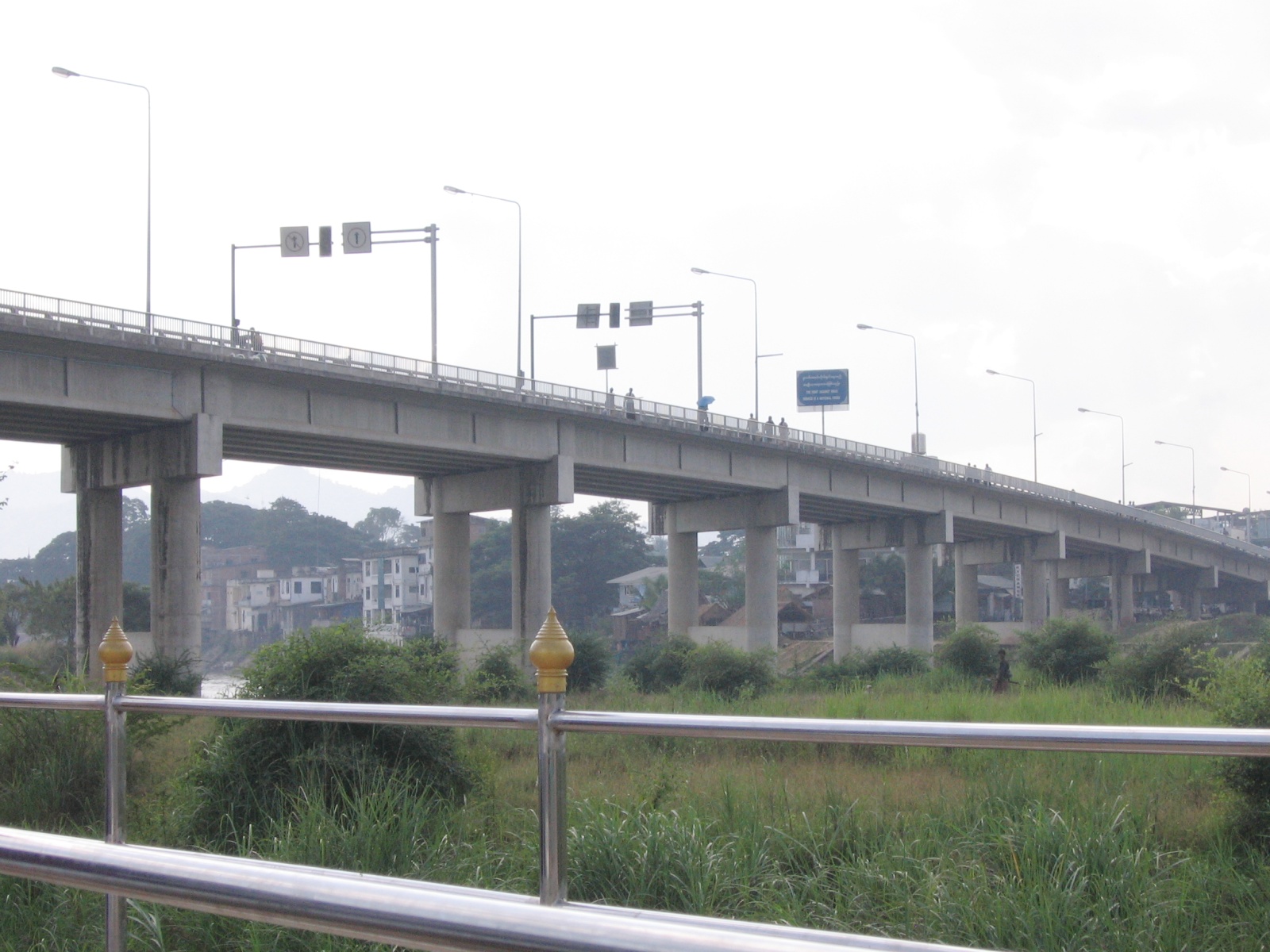
For Myanmar civilians, the same fighting that endangers Thai villages is fought through their own. Clashes around Myawaddy displace Karen families toward the river, and Thailand’s border is where many of them seek safety; the temporary closure of schools for migrant children on the Thai side this week is a small measure of how completely the war now organises life on both banks. And for trade, the Mae Sot–Myawaddy crossing — the Friendship Bridge in the photograph above — is one of the busiest gates between Thailand and Myanmar. Fighting that closes or threatens the crossing interrupts commerce that towns on both sides depend on, giving Bangkok an economic reason, alongside the humanitarian and sovereignty cases, to want the guns around Myawaddy moved back from the river.
What happens next
The immediate test is the protest Thailand says it will lodge through the border coordination mechanism, and whether Myanmar’s local commanders pull their fire back from the riverbank villages. The Rajamanu Task Force’s four-part framework — readiness, diplomacy, civilian protection, humanitarian help — remains the stated plan, now backed by 24-hour security coordination with district officials, Border Patrol Police Unit 346 and village teams. If the pattern of the past week holds, the scenarios are three: the fighting around Myawaddy ebbs and the border quiets; the clashes continue and stray fire crosses again, pushing Thailand toward the evacuations its defence chief has already raised; or a round causes deaths on Thai soil, which would force the “stern measures” Bangkok has so far described but not defined. Which of those arrives first depends on a battle Thailand does not control — and that, more than any single shell, is the problem Thursday morning exposed.
Sources
- Channel 7 HD News, October 29, 2026 — Midday news report from Mae Sot: continuous gunfire and explosions from about 5:00 a.m. as Myanmar troops fought armed groups around Min La Pan village, Myawaddy township, opposite Ban Huai Mahawong; the stray round believed to be a 60mm mortar that landed in a Thai house, injuring Lamyong Dalah, 55, who tried to fight the fire at her home before being rescued and taken to Mae Sot Hospital; and the Rajamanu Task Force response at 6:00 a.m.
- Channel 7 HD News, October 29, 2026 — Thai soldiers fire warning shots after shells from Myanmar land in Thailand: the two warning rounds (illuminating round and smoke grenade) under the rules of engagement, the 24-hour security coordination with Mae Sot district administration, Border Patrol Police Unit 346 and village security teams, and Gen Nattapong Prawkaew’s confirmation that the army is prepared to handle the border situation and protest weapons entering Thailand through the border coordination mechanism.
- Khaosod English, as reported October 29, 2026 — Myanmar army–Karen clashes spill across the border injuring a Thai woman: Myanmar military troops from several infantry battalions engaging Karen fighters around Min La Pan village in Myawaddy township, Kayin State, and the shell strike on the house in Ban Huai Mahawong, Mahawan subdistrict, Mae Sot district, Tak province.
- The Thaiger, October 29, 2026 — “Thai troops fire warning shots after Myanmar fighting damages 20 Thai homes”: Thai troops fired two warning rounds along the Myanmar border in Tak province early on October 29 after fighting across the border sent shells into the Mae Sot area; The Thaiger’s wider damage count is attributed to the outlet in the article above.