Gaza commercial goods halt: commercial trucks stopped entering the territory from Israel this week after COGAT said merchants had suspended shipments — a shutdown that Israel's crossing authority, Gaza's Hamas-run government and the territory's own transport union each explain in a way that puts the blame somewhere else.
Gaza's Markets Go Dark: The Trucks Stopped Coming
Track it live: Israel–Gaza war map — follow the conflict and the crossings on the live map, and see all active conflicts on the live war tracker.
On Wednesday, COGAT — the Israeli defence ministry body that oversees the crossings into Gaza — announced that commercial goods were no longer entering the territory. On Thursday, the head of Gaza's private transport union, Nahed Shhaibar, told the Associated Press that not a single commercial truck had entered from Israel that day. Between those two statements sits almost everything about this story that is contested — except the empty road itself, which nobody disputes.
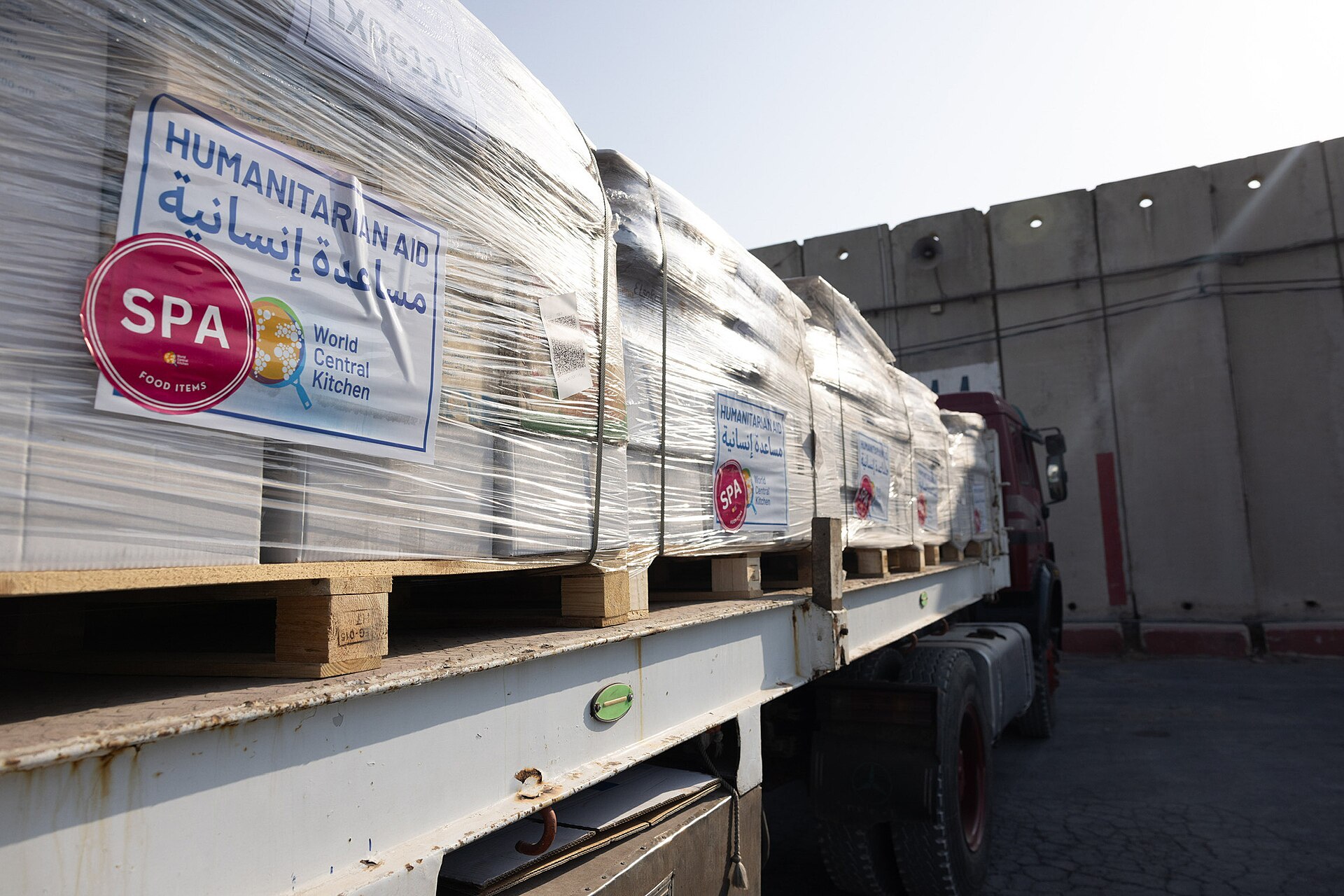
What did still move on Thursday matters as much as what did not. Humanitarian aid trucks entered, Shhaibar said, and commercial goods also arrived from Egypt through an Israeli-controlled crossing. The halt, in other words, is specific: it is the commercial flow from Israel — the larger of the two commercial channels, and the one that stocks Gaza's market stalls rather than its aid warehouses — that has stopped. The question consuming all three parties is who stopped it, and each has produced an account in which the decisive act belongs to someone else.
Three accounts of one empty road
COGAT's account places the cause inside Gaza. The crossing authority said Gazan merchants had stopped coordinating commercial shipments because of demands it attributed to Hamas: a fee of 10,000 shekels — about $3,220 — per truck, and a further demand that merchants hand over 30 percent of their sales in cash. On COGAT's telling, the merchants balked at the terms, coordination collapsed, and the trucks stopped. Israel's role in this version is that of gatekeeper to a gate that, for now, nobody is asking to use — and the party taxing Gaza's food supply is the movement that rules it.
The Gaza government's account accepts that a payment exists and rejects everything about how COGAT describes it. Hamas and the government it runs in Gaza denied the extortion account; officials told Al Jazeera the payment was a voluntary contribution to a national fund for people in need, naming widows and orphans, and a finance ministry official also described the fund as helping to pay civil servants. Cash, the officials said, was encouraged because Gaza suffers an acute cash shortage — not imposed as a condition of moving goods. The government's word for COGAT's version was disinformation.
The truckers' account rejects the premise shared by both of the others. Shhaibar, whose union represents the private transport sector that physically moves the goods, told AP the merchants never stopped anything: Israel imposed the restrictions. On his telling, the gate was closed from the Israeli side, and the fee story is a justification assembled after the fact. It is worth noting what each account quietly assumes. COGAT's assumes the merchants had a real choice and exercised it. The Gaza government's assumes a payment can be voluntary inside a territory governed by an armed movement. The union's assumes the party that controls the physical crossing controls the outcome. Readers have heard all three assumptions before, in other forms, throughout this war.
What can be established independently of any of them is narrower: no commercial trucks crossed from Israel on Thursday; aid trucks did; a smaller commercial flow from Egypt did; and the commercial channel from Israel matters enough — to merchants, to officials, to 2.1 million consumers — that all three parties moved within a day to fix the blame for its absence on someone else.
The numbers do not agree either
Even the scale of what has been lost depends on who is counting. COGAT said daily truck totals would now fall to about 300 — roughly half the normal flow, on its arithmetic. Diplomats cited by Reuters say far fewer than 600 trucks normally enter Gaza in total. Shhaibar put the usual total near 300 trucks a day, of which about two-thirds were commercial. These figures cannot all be right, and the space between them is itself a finding: a year into a ceasefire whose central promise was the normalisation of Gaza's supply lines, there is still no single trusted ledger of what enters the territory. Each side counts in the way that best supports its account of the halt — a high baseline makes the shutdown look like Israeli pressure; a low one makes the missing trucks look like a rounding error.
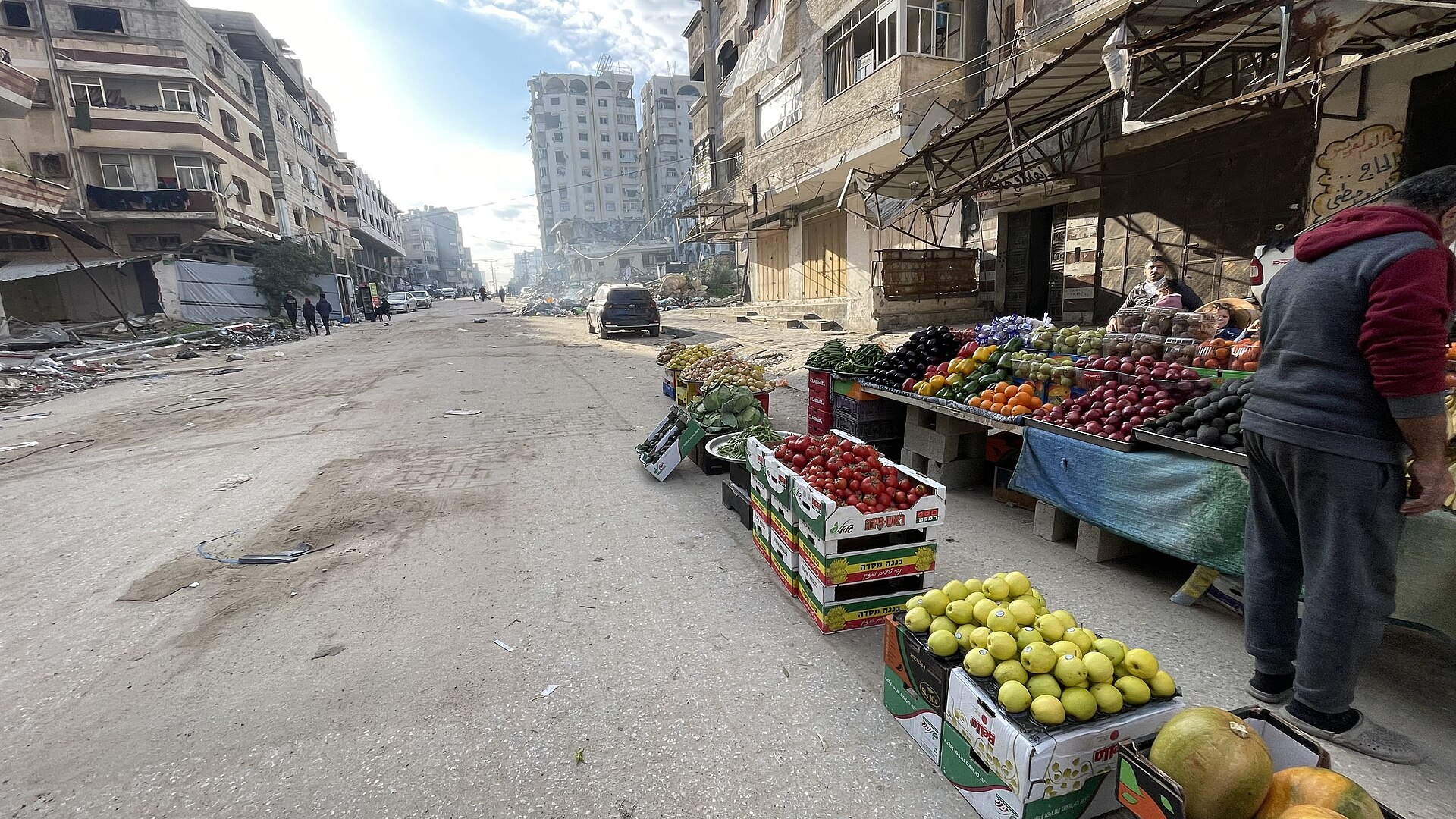
The cargo, at least, is not in dispute, and it differs sharply by channel. Aid convoys deliver staples — flour, cooking oil, shelf-stable rations — through United Nations and NGO warehouses. Commercial trucks deliver nearly everything else a functioning society consumes: fresh vegetables, fruit, meat, eggs, cooking gas refills, clothing, shoes, blankets, household goods. Aid is engineered to keep people alive at subsistence. Markets are where a population actually lives. Shaina Low of the Norwegian Refugee Council made the distinction to Reuters this week: functioning markets are essential alongside aid, precisely because aid mainly supplies staples. A halt that leaves aid untouched can therefore still strip the territory of most of what makes food a diet rather than a ration — and of the livelihoods of everyone in the chain from importer to trucker to stallholder.
Why this matters
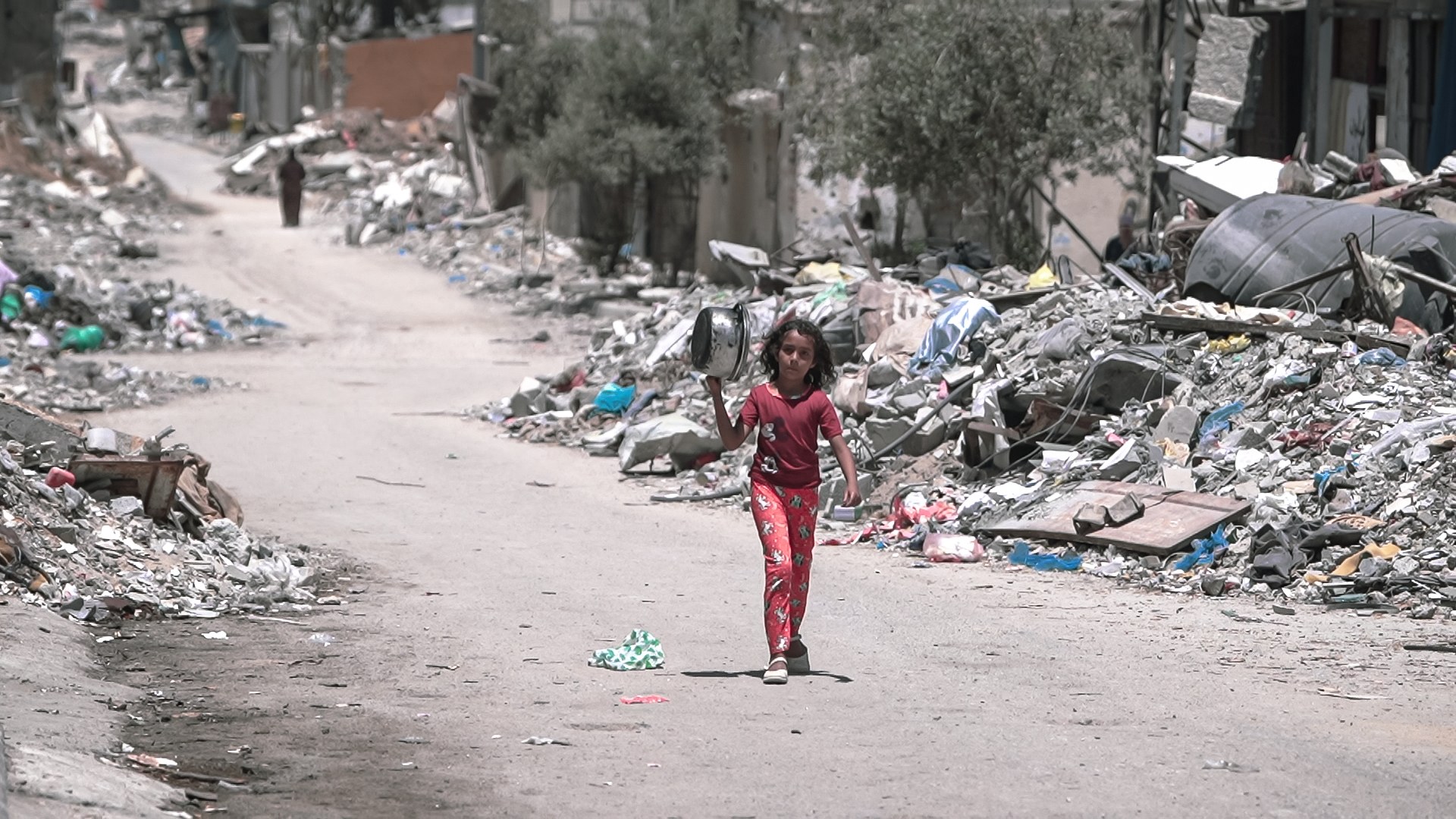
Start with the exposure. Gaza's roughly 2.1 million residents, most of them still living in makeshift shelters a year after the ceasefire, are aid-dependent to a degree few populations on earth match. A global hunger monitor warned in July that more than two-thirds of them could face acute hunger by the end of the year if conditions deteriorated. A commercial shutdown pushes in exactly that direction — not by stopping calories outright, but by removing the freshness, variety and protein that aid pipelines are not built to deliver, and by idling the one part of Gaza's economy that had begun, however haltingly, to employ people again.
Then consider the calendar. The halt lands in mid-October, as the territory turns toward winter. Among the goods commercial trucks carry are winter clothing and blankets; among Gaza's housing stock, a year after the war, are tents and tarpaulin shelters that leak in the first heavy rain. A supply dispute measured in days in June is an inconvenience. The same dispute measured in weeks in November is a cold-weather emergency arriving on schedule. Every party to the argument knows this, which is one reason the argument is being conducted so loudly and so fast.
And beneath the dispute about a fee sits the dispute the fee is really about: who taxes Gaza. A per-truck payment at the territory's gates — whether it is a levy, an extortion or a charitable contribution — is an act of governance, a claim that the authority collecting it is the authority that rules the economy inside the fence. The ceasefire left Hamas administering Gaza's interior while Israel controls its perimeter and Egypt watches its southern gate. That arrangement was always going to generate fights exactly like this one: not over territory, but over the mundane instruments of rule — fees, funds, coordination lists, manifests. Whoever wins this argument will have demonstrated something real about who governs Gaza a year after the war was supposed to have ended.
A ceasefire that stalled
The halt arrives at the ceasefire's first anniversary, and the anniversary has not been kind to the agreement's ambitions. As this site's review of the deal's first year found, the ceasefire holds on paper — and almost nothing else has worked: reconstruction has barely begun, the disarmament of Hamas has not happened, and Israel's withdrawal remains partial and contested. Even the quiet has been relative; strikes have repeatedly punctured it, for reasons each side explains with its own claims about who broke the terms first.
The crossings were supposed to be the ceasefire's most tangible dividend — goods flowing, markets reopening, a civilian economy restarting under transitional arrangements that were announced with fanfare and then never fully built. Instead, the crossings have become the arena in which the unfinished war is now conducted: by coordination and fee and announcement rather than by fire. That is a better arena than the previous one by every humanitarian measure. It is also, on this week's evidence, an arena in which a single disputed payment can darken the markets of an entire territory in forty-eight hours, with no mechanism — no joint committee, no agreed ledger, no arbiter — capable of switching the lights back on.
Who gains, who loses
Critics of Israel argue that the halt functions as leverage whatever its proximate cause: a territory whose food supply can be halved by a coordination dispute is a territory living under pressure, and they note that on the truckers' account the restrictions were imposed by the party that physically controls the crossings. Israeli officials and their supporters answer that COGAT's account describes the extortion of merchants by an armed group, that Israel cannot be expected to underwrite a supply system in which Hamas taxes every truck that feeds the territory it misruled into war, and that the humanitarian floor — aid — continues to enter, which they offer as proof the intent is not starvation but standards.
Critics of Hamas argue that a payment described as voluntary, demanded at a chokepoint in a territory the movement rules by force, is voluntary in name only, and that whatever it is called it operates as a levy on food in a hungry place. The Gaza government's defenders answer that any administration must raise revenue to pay civil servants and support widows and orphans, that the cash handling reflects a real and acute cash shortage rather than coercion, and that a state which has restricted Gaza's economy for years is poorly positioned to lecture anyone about the price of goods at its markets.
The merchants, notably, have no public defender, and they are absorbing the loss today: trucks idle, stock unsold, contracts unmet, perishables rotting wherever they were loaded. It was into that vacancy that Nickolay Mladenov, director of the Board of Peace, stepped this week, calling coercion and threats against merchants unacceptable and urging the rapid deployment of the National Committee for the Administration of Gaza, supported by the International Stabilization Force — the transitional bodies the ceasefire designed for exactly this problem and has not yet produced. His intervention identifies the true missing party to the dispute. Three authorities can each stop Gaza's trucks. A year after the ceasefire, there is still no agreed authority that can start them again.
What happens next
Three endings are available, and they are not equally likely. The first is the quiet fix: the payment dispute is negotiated down — through Egyptian or Qatari intermediaries, through a revised coordination mechanism, through a face-saving redefinition of the fee — and the trucks resume within days. Crossing shutdowns in Gaza have historically tended to end this way, because every party's public position ultimately depends on goods moving for somebody. The merchants go back to work poorer, the authorities each claim the other blinked, and the underlying question is deferred to the next dispute.
The second ending is the long halt. Commercial stocks are drawn down, fresh food prices spike beyond the reach of families with no income, and aid agencies — already stretched across a caseload of millions — are pressed to fill a commercial gap their pipelines were never designed to fill. In that version, the hunger monitor's July warning stops being a projection and becomes the winter's news, and the argument over a 10,000-shekel fee is remembered as the moment a manageable shortage became a crisis.
The third ending is the structural one: the halt becomes the occasion to force the ceasefire's transitional machinery — the National Committee, the stabilization force, an agreed crossing regime with published numbers — from paper into the gates. It is the only ending that changes the structure rather than the mood, and on the evidence of the ceasefire's first year it is also the least likely on any short timeline. What to watch, in the meantime, is unglamorous and decisive: whether commercial entries resume and at what daily count; whether any party begins publishing verifiable crossing data, since the absence of an agreed ledger is part of the story; and whether the Egypt-side commercial channel expands — a shift that would quietly redraw who supplies Gaza, and who taxes the supplying.
A year after the guns mostly stopped, Gaza's war has narrowed to a question of trucks. By the standards of the two years that preceded it, that is an improvement worth naming. It is also a measure of how completely ordinary life there still hangs on decisions taken at a gate — and on which of three explanations the world chooses to believe about why the gate is shut.
Sources: Reuters reporting of October 15, 2026 (COGAT's announcement, diplomat estimates of truck flows, and statements from the Norwegian Refugee Council and Board of Peace director Nickolay Mladenov); Associated Press reporting via the Washington Examiner (Gaza private transport union head Nahed Shhaibar); Al Jazeera (Gaza government officials' response). The central facts in dispute — the nature of the per-truck payment and which party halted the shipments — are contested, are attributed in the text to the parties that stated them, and could not be independently resolved from public sources; truck-flow figures differ by source and are presented as given.