The most telling military exercise in Europe this autumn involved no tanks and no jets. In mid-September, near the northern Finnish city of Rovaniemi, roughly 100 kilometres from the Russian border, the Finnish armed forces detonated explosive charges against bomb shelters to test whether structures built for another era could withstand what they called "modern warfare threats" — the first such tests Finland has run since 1992, with eight Ukrainian experts flown in from Kyiv to watch. It was a small explosion with a large meaning. As Europe prepares its citizens for war — not as a metaphor, but as a planning assumption — the work is increasingly being done not in barracks but in mailboxes, supermarkets and school halls, in the form of survival brochures, shelter maps and lessons in packing a bag and leaving home.
Track it live: Follow the conflicts driving Europe's preparedness drive on our live wars tracker.
The scale of it is easiest to grasp country by country. Between them, Finland, Poland, Estonia, Latvia and Lithuania share more than 3,500 kilometres of land border with Russia and its ally Belarus. Every one of those governments — and Sweden, Norway, France, Ireland and Britain behind them — now tells its citizens, in writing, how to survive the opening days of a catastrophe: how much water to store, where to shelter, what to do when the sirens sound and the phone networks die. A Le Monde investigation published on Monday, October 26, surveying the northern and eastern flank, describes societies being methodically reorganised around a single question its officials now ask in public: how does a state make sure it does not collapse in the face of an attack? "The main lesson we learned from this is that society itself can become a battlefield," Mikael Frisell, director general of Sweden's Civil Defence and Resilience Agency, told the newspaper.
A continent reading the same instructions
Sweden wrote the template. In 2018, 4.8 million Swedish households received a small booklet, "If Crisis or War Comes," listing supplies to stock and telling readers to be able to hold out for a week without outside help. A new edition, sent to some 5.2 million households in November 2024 and nearly twice the size, dropped the euphemisms: it states plainly that "an armed attack against Sweden cannot be ruled out," and carries the line Swedes have been taught since the Cold War — if Sweden is attacked, "we will never give up," and any information that resistance has ceased is false. In January 2026 the campaign moved from the kitchen table to the workplace: Stockholm began distributing a companion brochure to around 130,000 workplaces with five or more employees, and asked every such company to prepare for "the worst-case scenario."
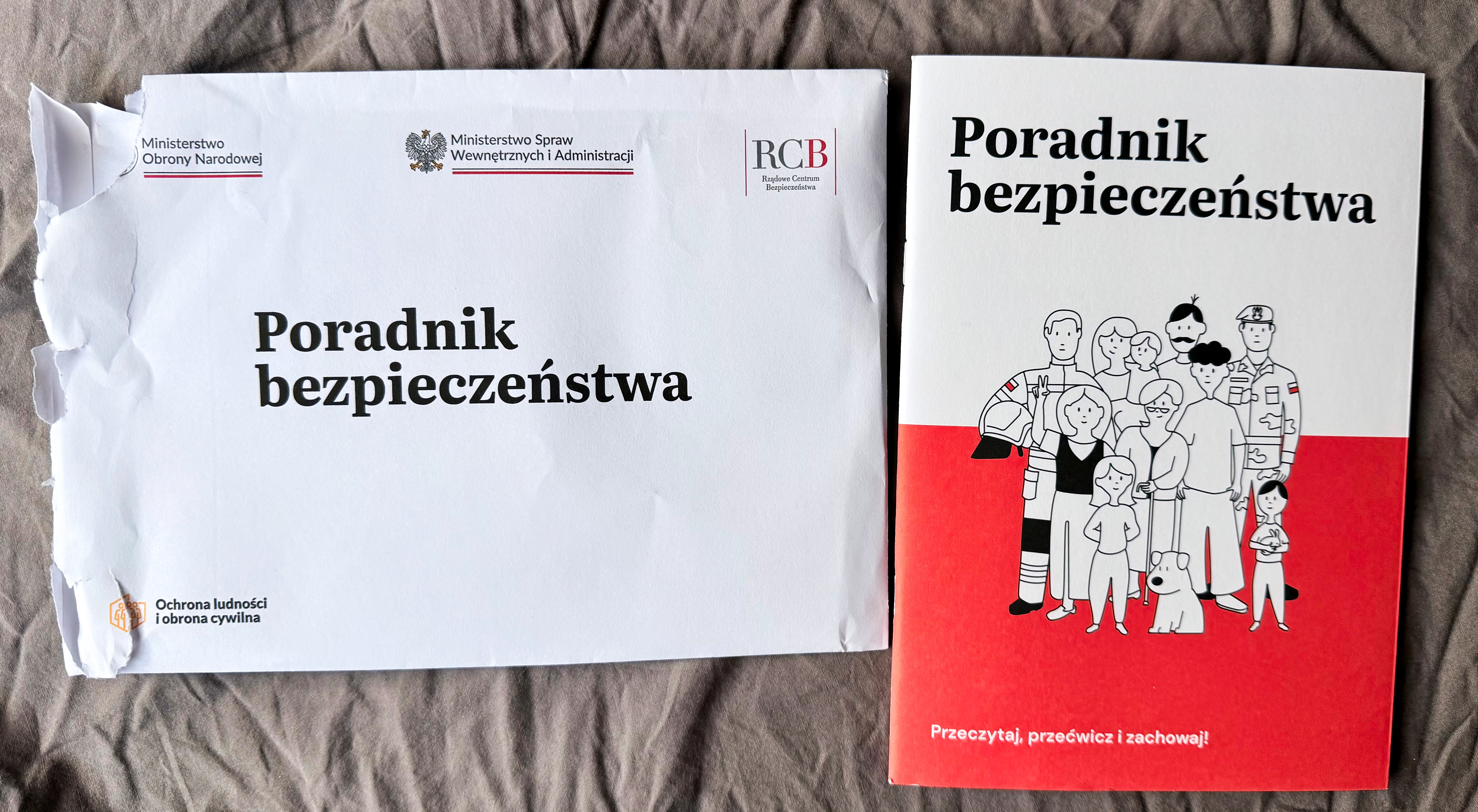
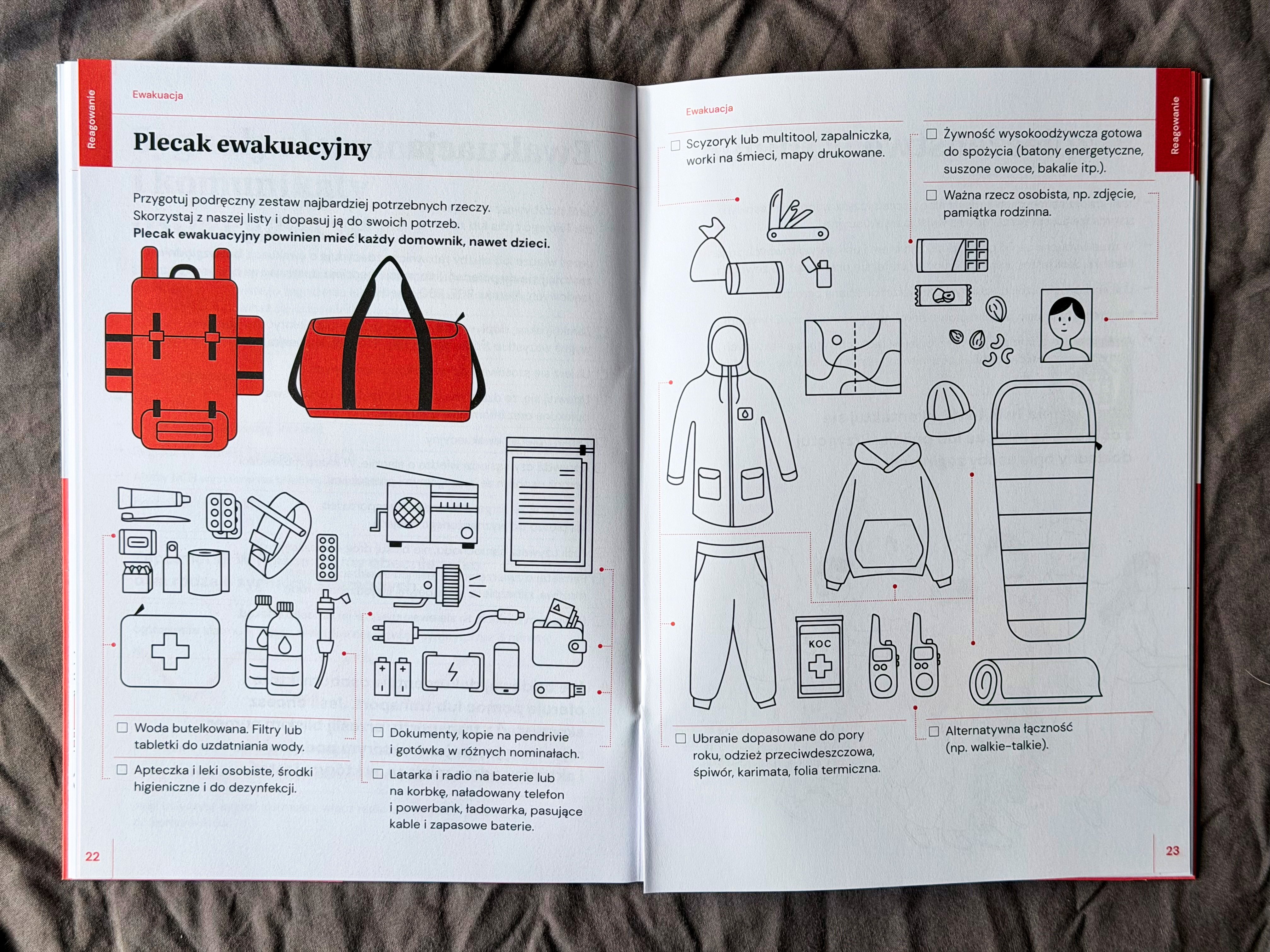
Poland has gone furthest, fastest. At the end of 2025 and the beginning of 2026, the government printed and delivered its "Poradnik bezpieczeństwa" (Safety Guide) to nearly 17 million households — effectively every home in the country, starting with the eastern regions bordering Russia and Belarus. The roughly 50-page guide is unusually explicit for a peacetime document: it explains what to do in an air raid (get to shelter; if caught outside, lie flat, ideally in a depression, and protect your head), how to pack an evacuation bag for every family member including children, and how to cope with blackouts, cyberattacks, sabotage and even nuclear incidents. The same content lives in the government's mObywatel phone app, which in October 2026 added step-by-step air-raid instructions, and in an official shelter map listing tens of thousands of verified locations with offline access. Alongside the paper, Poland's 2025 civil defence law created a national training system — the Academy of Population Protection and Civil Defense — which more than 400,000 people had already attended by September 2026, according to Le Monde.
France, which has no land border with Russia at all, published its own version on November 26, 2025. The 20-page "Tous responsables" ("Everyone Responsible") guide, first announced by President Emmanuel Macron in his Bastille Day address, opens with the words "every day, you witness a world in crisis" and walks readers through wildfires, floods, industrial and nuclear accidents, cyber disruption, disinformation and terrorism. Its core instruction is the one now repeated across the continent: assemble a survival kit good for at least three days — six litres of water per person, non-perishable food, medication, a torch, a battery radio, cash and copies of key documents — learn the national SAIP sirens (three repeated signals of one minute and 41 seconds), and expect the FR-Alert system to push instructions to every phone. Norway, meanwhile, quietly doubled its expectation: in May 2024 its Directorate for Civil Protection (DSB) raised the recommended period a household should be able to fend for itself from three days to seven, and lifted the drinking-water guidance from nine litres per person to twenty, before mailing an updated brochure to every Norwegian home that autumn. Ireland joined the list in September 2026 with its "Be Emergency Ready" booklet — though Irish reporting on the campaign says officials softened explicit 72-hour language after audience research found the unexplained advice made people anxious, a small episode that captures the political tightrope every one of these governments is walking.
Above the national efforts sits Brussels. The European Commission's Preparedness Union Strategy, launched in March 2025, set the common floor: every EU citizen should be able to maintain essential supplies — food, water, medicine — for a minimum of 72 hours, and the Commission has repeated the 72-hour guidance in updated advice this October. Commissioner Hadja Lahbib has defended the figure as grounded in existing emergency-preparedness guidelines and international best practice, meant for short disruptions to services and supply chains. What began as a Nordic habit is now, formally, the policy of a union of 450 million people.
Shelters, stockpiles and the return of total defence
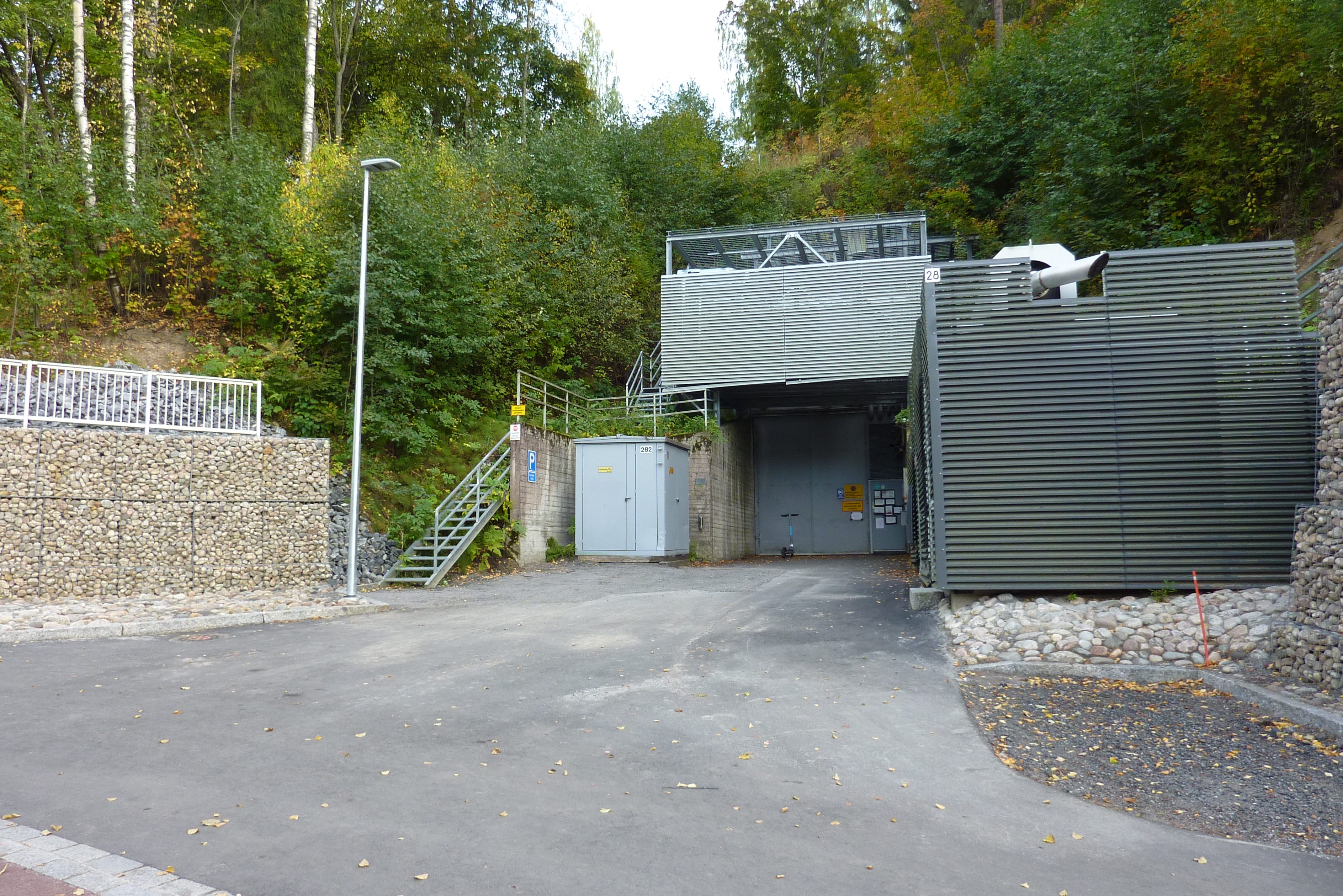
The brochures are the visible tip of something heavier. Poland is renovating a Cold War shelter network that now counts some 86,000 shelters able to hold nearly 25 million people out of a population of 38 million, and its 2025 law obliges cities to provide shelter for at least half the people in their territory, with protected space required in new public and multi-family buildings from 2026. Sweden counts 64,000 shelters for seven million of its ten million people, the inheritance of the "total defence" model it abandoned in the late 1990s and began reviving in 2015. Finland — the country European officials most often cite as the model — has 50,500 shelters with room for 4.8 million of its 5.6 million citizens, and in September announced a €400 million programme to build underground hospitals by 2030.
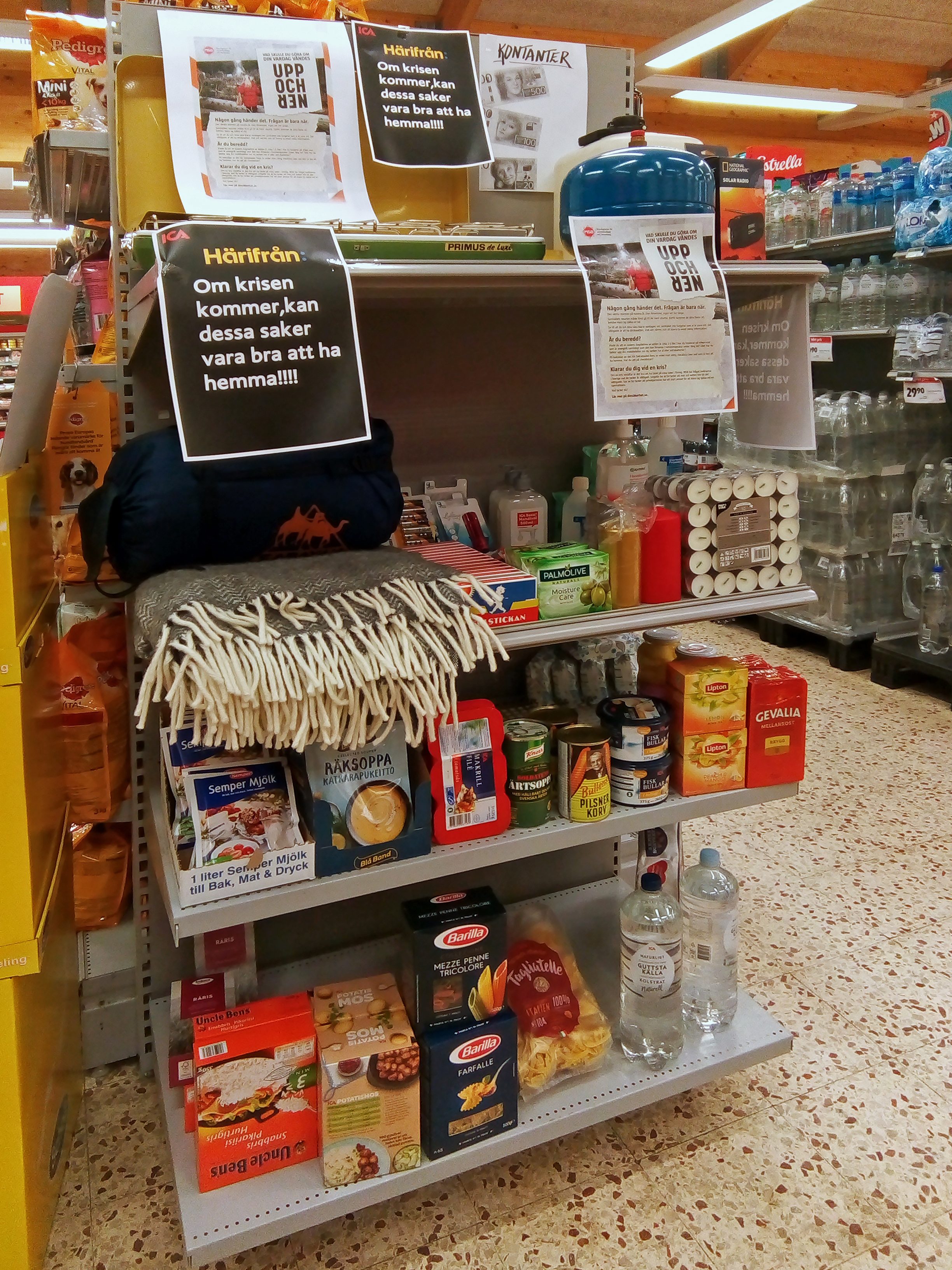
The stockpiling is just as concrete. Finland's National Emergency Supply Agency has raised the country's strategic grain reserves to cover nine months of consumption, up from six before 2022, and — a lesson taken directly from watching Russia's campaign against Ukraine's power grid — is building a network of 300 emergency supermarkets fitted with backup generators, so food distribution survives a blackout. Poland allocated nearly 34 billion zlotys (about €7.8 billion) to civil protection across 2025–26 and announced on October 6 that more than 102 billion zlotys will follow between 2027 and 2031. Sweden's civil defence budget has risen from 2.7 billion kronor in 2022 to 12.9 billion kronor in 2026, and half a million Swedes have been formally notified of the civilian roles they would be conscripted into if war came. In Lithuania, schools and non-profit groups run sessions teaching first aid, go-bag packing and how to live without electricity. Latvia's defence ministry has built mobilisation planning that assumes businesses are part of the war effort, and Estonia's security doctrine, published in May, puts "economic security and vital services" formally on a par with military defence. The Baltic states have gone one step further than anyone: rehearsing departure itself. In October 2025 Lithuania practised evacuating people from 30 municipalities, and Poland has pledged to receive up to one million Baltic refugees at a reception centre being built near the border town of Lazdijai — planning, in the open, for the possibility that preparation might not be enough.
Britain is running the same playbook
None of this is a mainland-only story. Britain's government has spent the autumn making the same argument in the same sequence: first the soldiers, then the public. General Sir Roly Walker, the head of the Army, warned that political leaders would soon need a "frank conversation" with the public about preparing for war and consenting to sacrifices — a warning Signal Post News covered as he made it in his address to troops at Catterick. Defence Secretary Wes Streeting then put a date on it, telling the public Britain has a little over 1,000 days to be ready to "fight and win" a war against an adversary able to attack by 2030 — the warning at the centre of our Streeting report, whose "Be Ready" household guidance — three litres of water per person per day, tinned food that needs no cooking, torches, charging packs and cash at home in case payment systems fail — mirrors the Swedish and Polish lists almost item for item. The household campaign itself, with British families told to hold at least three days of supplies, is the subject of our earlier Be Ready report. Read together, the British, Swedish, Polish and French documents are close to interchangeable — which is precisely the point. This is no longer five national quirks. It is a continental standard being set in real time.
Why this matters
The deeper significance is a change in what European states believe war would look like — and who it would happen to. The officials running these programmes say, on the record, that Ukraine taught them a state's survival depends less on the first week of fighting than on whether its society keeps functioning through it: whether the grid's failure cascades into food, water, payments and panic, or is absorbed by households that were told what to expect. That is the logic behind the odd specificity of the checklists. Cash matters because card networks are a target. Battery radios matter because phone networks are a target. Three days, or seven, is roughly how long officials judge it takes for state machinery to reorganise after a systemic shock — the household is being asked to hold the line for exactly that gap. In deterrence terms, governments argue, a population that cannot be panicked or starved into pressure is harder to coerce: resilience is meant to raise the price of hybrid attack — the cable cuts, cyber intrusions, sabotage and disinformation that Western officials attribute to Russia below the threshold of open war — and to make the threat of it less useful.
There is also a harder-headed economic story. The same documents that tell families to store water tell companies to plan for mobilisation, and finance ministries are moving real money: Poland's civil-protection commitments, Sweden's near-fivefold civil defence budget increase since 2022, Finland's underground hospitals. Former Finnish president Sauli Niinistö, in a report to the European Commission in October 2024, argued that 20 percent of the EU's multiannual budget should be devoted to security and crisis preparedness — a figure that would have been unutterable in polite Brussels company a decade ago. Who gains and who loses is already visible. Winners include the construction and engineering firms rebuilding shelter networks, the food and logistics companies being written into emergency-supply systems, and the frontline states whose threat assessments now drive EU policy. The costs fall on households asked to spend money and cupboard space on insurance they hope never to use, on local councils handed legal shelter obligations, and on governments that must keep the message calibrated between two failures: say too little and be blamed for complacency; say too much and be blamed for fear.
Moscow's answer: "No intention of attacking anyone"
Russia's government rejects the premise of the entire build-up, and its position deserves to be stated as it states it. President Vladimir Putin has repeatedly denied any plan to attack European or NATO states, saying in Beijing in September 2025 that "Russia has never had, does not have, and will never have any intention of attacking anyone," and dismissing claims of invasion plans as "horror stories" and "hysteria." Foreign Minister Sergey Lavrov told the UN General Assembly that Russia does not intend to attack NATO or EU members, that Moscow has repeatedly proposed legally binding security guarantees, and that Western governments have ignored those offers — while warning that any aggression against Russia would meet a decisive response. At an October 21, 2026 briefing, Foreign Ministry spokeswoman Maria Zakharova pointed to NATO's own accelerated military build-up and "military mobility" corridors toward Russia's and Belarus's borders, said the alliance was "intentionally creating threats" to Russian and Belarusian security, and noted what she called the alliance's disregard for Moscow's repeated statements of "the absence of any intentions or motives to initiate military actions" and its proposal to put mutual security guarantees on paper.
European governments give their own stated reasons for pressing ahead, and they are specific rather than general: Russia's full-scale invasion of Ukraine in 2022, which none of these states treats as a closed episode; a pattern of hybrid incidents — severed undersea cables, airspace violations, sabotage plots and cyberattacks — that Western officials attribute to Russian services; and intelligence assessments, cited by defence chiefs in several capitals, that Russia could rebuild offensive capacity against a NATO state within years of any Ukraine settlement. Between those two accounts sits the unresolved argument of the decade: each side describes its own preparations as defensive and the other's as escalation, and the brochures landing on European doormats are what that argument looks like when it reaches a kitchen table. Critics inside Europe add a third view — that governments risk normalising a war footing, frightening the public (the Irish booklet episode), or spending on theatre rather than capability. Supporters answer that a leaflet is the cheapest insurance a state can buy, and that Ukraine's experience argues for buying it early.
What the numbers imply
Put the shelter figures side by side and a map of European seriousness emerges. Finland can shelter about 86 percent of its population; Sweden about 70 percent; Poland about two-thirds — ratios no other large states in the world currently match, and all three are products of geography: these are the countries that would have hours, not weeks, of warning. The money ratios tell a similar story of acceleration — Sweden's civil defence spend up roughly fivefold in four years, Poland committing the equivalent of tens of billions of euros across the decade — but the compliance numbers warn against reading leaflets as readiness. Norway's own survey work found the share of households storing drinking water rose from 21 percent in 2017 to 47 percent in 2024: better, and still less than half. Threat perception is highest where the border is closest — YouGov polling cited across European media found majorities naming Russian military pressure as a leading threat in Lithuania (57 percent), Denmark (62 percent) and Poland (51 percent) — which suggests the eastern flank's governments are pushing on an open door, while western publics, the ones Paris, Dublin and London are now addressing, remain the persuadable middle. The gap between a guide delivered and a household prepared is, in the end, the number every one of these programmes will be judged by.
What happens next
The likely path is normalisation. Sweden's campaign has already entered its next phase — the workplace brochure, the company worst-case plans, the half-million named civil conscripts — and Poland's shelter-building obligations bite on new construction from 2026, embedding preparedness in building codes where no future government can quietly repeal it. The EU's budget negotiation will test Niinistö's 20 percent ambition and, with it, whether preparedness becomes a funded European competence or stays a patchwork of national efforts of wildly uneven depth. Three scenarios follow. In the first, the one officials plan for, nothing happens — and the programmes are judged, unfairly or not, as expensive peace-of-mind. In the second, a hybrid crisis rather than an invasion — a regional blackout, a cable-cutting campaign, a payments failure — puts the checklists to their first real test, and the states that drilled their publics cope visibly better than those that did not. In the third, the worst one, the eastern flank's evacuation plans stop being paper. What is already certain is the direction of travel: a generation of Europeans who grew up assuming security was something the state quietly provided is being told, in official print, that it is partly their own job now. Finland tested that message against explosives in September. The rest of the continent is reading it off the page.
Sources
Le Monde, "Facing Russia, northern and eastern European countries prepare their societies for war" (October 26, 2026) — lemonde.fr. French Government (Service Public), "All responsible — the practical guide to preparing for crisis situations" (published November 26, 2025) — service-public.gouv.fr. Norwegian Directorate for Civil Protection (DSB), "Self-preparedness" guidance — dsb.no. AFP via The Nation, "Sweden, Finland urge residents to be ready for war" — nation.lk. The Munich Eye, "Poland Distributes Nationwide Crisis Guide to Prepare Citizens for Potential Conflict" (January 31, 2026) — themunicheye.com, and "Putin Denies Plans for Aggression Against Europe" — themunicheye.com. Russian Foreign Ministry briefing by spokeswoman Maria Zakharova, October 21, 2026 (statement text). European Commission, Preparedness Union Strategy (March 2025) and 72-hour household guidance. File photographs: Olgierd Rudak, W.carter and Mac Dreamstate, via Wikimedia Commons.