War · Ukraine · Russia
Russia sent 227 attack drones into Ukraine overnight — more than a third of them jet-powered — and by morning the electricity was out in seven regions, with the Kyiv region hit hardest. Ukraine answered the same night with a drone wave of its own, and by dawn a fire was burning at an industrial site in Afipsky, the southern Russian town that hosts one of the country’s largest oil refineries.
Track it live: Ukraine war map — Live Global Trackers
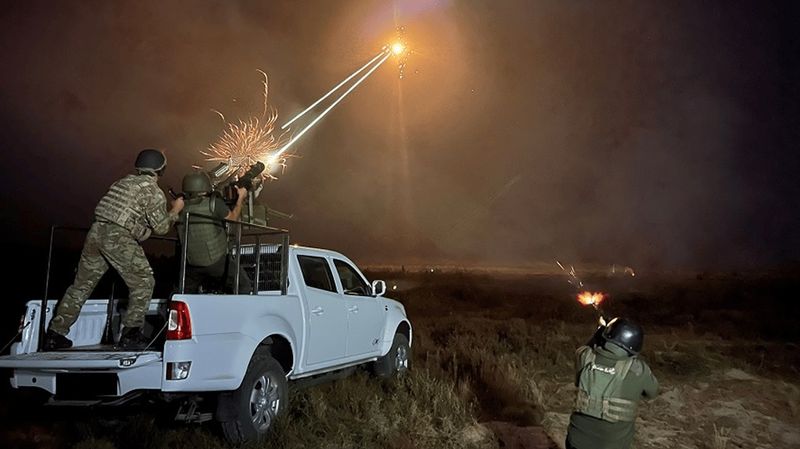
Kyiv, Ukraine — The Russia 227 drones Ukraine attack began at 18:00 on Thursday evening, November 5, and was still under way when Ukraine’s Air Force published its morning tally: 227 attack drones launched overnight, of which air defences had shot down or suppressed 196 by 08:00 local time on Friday, with strikes recorded at 14 locations and falling debris at eight more. Within hours, Ukraine’s energy ministry confirmed the human meaning of those numbers — new power outages across seven regions, and a grid in the Kyiv region damaged heavily enough to force restrictions on the network itself.
Every number in this story comes from an official source on one side of the war, and each is attributed to the body that issued it. Ukraine’s Air Force reported the incoming raid and the interceptions; Ukraine’s energy ministry reported the outages; Russia’s Defence Ministry and a Krasnodar regional headquarters reported the return strike and the fire in the south. Where a claim has not been independently confirmed — above all, whether the Afipsky oil refinery itself was hit — this report says so.
What happened overnight
According to the Ukrainian Air Force, the Russian drone attack of November 6, 2026 began at 18:00 on November 5 and built through the night. The 227 drones included Shahed-type strike drones alongside Gerbera and Parodiya decoy drones — cheap imitations flown to draw fire, exhaust interceptors and confuse radar operators about which contacts are real. They were launched from Orel, Kursk, Millerovo and Primorsko-Akhtarsk in Russia, and from occupied Donetsk and from Crimea, including Hvardiiske and Cape Chauda, the Air Force said.
By the Air Force’s preliminary 08:00 tally, Ukrainian air defences had shot down or suppressed 196 drones — the Ukraine air defence 196 drones figure includes aircraft, anti-aircraft missile units, mobile fire groups, electronic-warfare teams and interceptor drones working the same sky. About 15 drones were still in Ukrainian airspace when the tally was published, and the Air Force was explicit that the count was preliminary and the attack still ongoing. Strikes were recorded at 14 locations, with falling debris reported at eight more — a reminder that even a successful interception rains wreckage on whatever is below.
Jet-powered Shahed drones: 86 of the 227
The detail in the Air Force report that matters most for the winter ahead is the mix. Of the 227 drones, 86 were jet-powered models — about 38 percent of the raid — and 70 of the 196 drones brought down or suppressed were jet-powered, the Air Force said. Jet-powered Shahed drones fly far faster than the propeller-driven originals that have defined this war’s night sky, and speed changes the defensive maths in two ways. It compresses reaction time: a mobile fire group that once had minutes to track a slow, loud propeller drone by sound and searchlight now has a fraction of that window. And it pushes engagements upward in cost, toward the missile interceptors Ukraine can least afford to spend, because gun teams and jamming are least effective against the fastest targets. A raid in which nearly two drones in five arrive at jet speed is not simply a bigger raid; it is a more expensive one to stop.
The power cuts, region by region
Deputy Energy Minister Artem Nekrasov said the strikes caused new power outages in seven regions — the Ukraine power outages seven regions list runs Vinnytsia, Dnipropetrovsk, Zhytomyr, Zaporizhzhia, Kyiv, Kharkiv and Chernihiv — Reuters reported. The outages are the latest product of Ukraine energy infrastructure strikes that have made generation plants, substations and transmission nodes the most consistently attacked target set of the autumn.
Kyiv power outage November 2026: the capital region took the worst of it
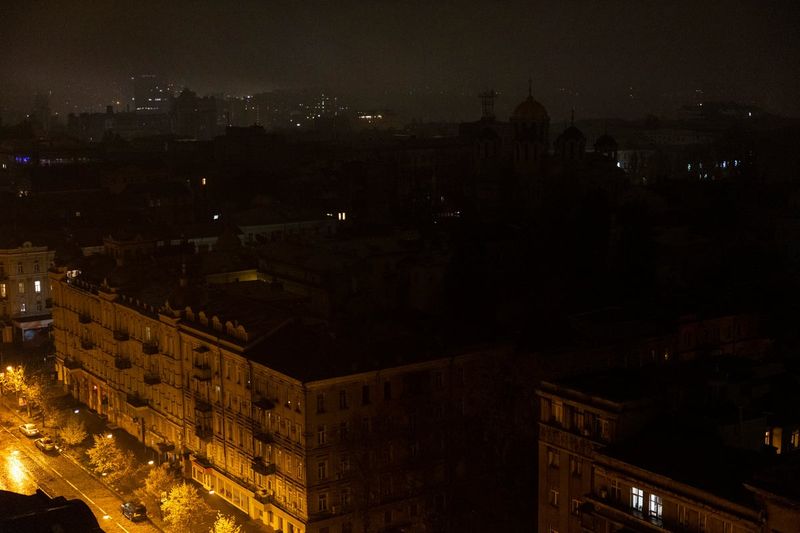
Nekrasov said the situation was most difficult in the Kyiv region, where heavy damage forced restrictions on the network — the grid operator limiting flows to keep a damaged system stable rather than risk a wider collapse. The Kyiv power outage in November 2026 is therefore not only a story of homes without light; it is a story of a regional network being run deliberately below capacity to protect what remains of it. The Air Force report also noted that an energy facility was struck in Bila Tserkva, a city in the Kyiv region south of the capital; the extent of that damage was not specified in the report.
The other six regions
Beyond the capital region, outages were reported in Vinnytsia in west-central Ukraine, Dnipropetrovsk and Zaporizhzhia in the south-east, Zhytomyr west of Kyiv, and Kharkiv and Chernihiv in the north and north-east — a spread that maps onto the raid’s geography, with drones arriving from launch sites north, east and south of the country. Officials did not publish a single combined figure for households affected in the initial reports, and restoration timelines varied by region; what the ministry’s statement establishes is breadth — seven regional grids damaged in one night — rather than a uniform depth of failure in each.
The return strike: Afipsk, and what is and is not confirmed
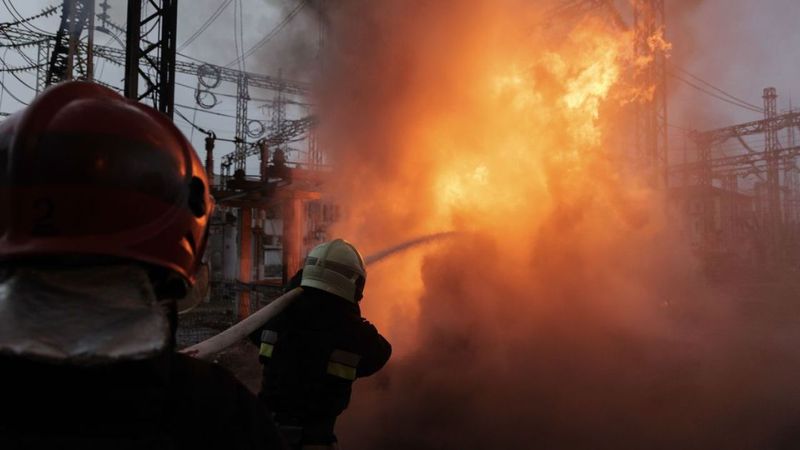
The same night ran in both directions. Russia’s Defence Ministry said its air defences intercepted 142 Ukrainian drones over nine Russian regions, Crimea and the Black and Azov seas. In Krasnodar region, the regional operational headquarters said falling drone debris started a fire at an enterprise in Afipsk, in Seversky District, and reported no casualties. The headquarters did not name the facility. Reuters reported a fire at an industrial facility in Afipsky, the town that hosts the Afipsky oil refinery.
Whether the refinery itself was hit is reported but not independently confirmed, and the distinction matters. The Russian outlet ASTRA’s OSINT analyst said eyewitness photographs showed the refinery’s reservoir park — its tank farm — on fire. Kyiv Post, reporting the same indications, said it could not independently verify that the refinery was struck. Signal Post News therefore reports the Afipsky refinery drone strike as a reported fire at an industrial facility in the refinery town, with open-source analysis pointing to the refinery’s reservoir park — not as a confirmed hit on the plant. Afipsky is one of southern Russia’s largest refineries, with an annual capacity of about 7.2 million tonnes, according to Kyiv Post — which is why even an unconfirmed report of a fire there carries weight for Russian fuel supply.
Why this matters
The first reason is seasonal. November is when Ukraine’s energy war stops being an abstraction: heating demand rises, daylight shrinks, and every substation lost in autumn is a substation missing in January. President Volodymyr Zelenskyy has said that every Ukrainian power plant has been damaged in the war — a grid with no undamaged margin, being struck again at a rate of hundreds of drones a night, weeks after Russia’s 433-drone barrage cut power across the country on the first night of the month. The 227-drone raid was roughly half that size, and it still darkened seven regions.
The second reason is technological. The rising jet-powered share — 86 of 227 on Friday night — is Moscow adapting to the defence that beat the propeller Shahed: slow drones gave Ukraine’s cheapest layers, the gun trucks and jammers, time to work. Faster drones tax exactly those layers. Each shift in the mix reopens the cost-exchange problem at the heart of the air war: a one-way attack drone is cheap to build in numbers, while the interceptors best suited to fast targets are scarce, expensive and needed for ballistic threats as well. Ukraine’s answer has been to industrialise its own cheap defences, including interceptor drones; Russia’s answer has been speed and volume together. Friday night was both trends in a single raid.
The third reason is symmetry. Ukraine’s campaign against Russian refineries is the mirror of Russia’s campaign against Ukraine’s grid: each side is attacking the energy system the other society runs on, and each describes its own strikes as military and the other’s as something else. A night that ends with seven Ukrainian regions dark and a fire reported at a major Russian refining town is that symmetry in its purest form.
Context and background
Friday’s raid sits inside an autumn energy campaign that has been building for weeks. Ukrainian and international tallies have recorded strikes on energy facilities across the country since the start of the season, and the November 1 barrage — 433 drones, outages in at least eight regions — set the tempo that Friday’s 227 followed. Nor was the grid the week’s only ledger of harm: the same morning, rescuers in Komyshuvakha entered a fifth day of work at the bombed aid distribution point where the confirmed death toll rose to 53.
The diplomatic clock is running alongside the military one. The United States has announced Ukraine–Russia talks in Abu Dhabi on November 10–11, four days after this raid. Nightly barrages in the run-up to talks are a familiar feature of this war: each side arrives at the table having demonstrated, in the most literal way, what it can still do to the other. Whether the energy campaign becomes a bargaining chip in Abu Dhabi — a pause on grid strikes has been discussed in earlier rounds without holding — is one of the open questions the talks now carry.
Who benefits, who loses — and what critics on each side say
Moscow says its strikes target military and energy infrastructure supporting Ukraine’s armed forces. Kyiv and its partners say the grid campaign targets civilians ahead of winter, pointing to the timing, the season and the civilian systems — heating, water, hospitals — that depend on the same electricity. Both positions are stated here as their holders state them; the reported facts are the outages themselves, in seven regions, on the word of Ukraine’s energy ministry.
The losses are concrete on both sides. Ukrainian households in seven regions lose power, heat and predictability at the start of winter, and Ukrainian repair crews lose the one resource the campaign is designed to deny them: time between raids. Russia, if the Afipsky reports are borne out, loses refining capacity it has repeatedly had to defend and repair; even unconfirmed, the fire report underlines that no major Russian energy site within drone range is beyond reach. Critics of Ukraine’s refinery campaign argue it raises fuel prices without changing the front line; its defenders answer that fuel is the front line’s supply chain. Critics of Russia’s grid campaign argue it has hardened rather than broken Ukrainian resolve across three winters; its defenders in Moscow frame it as pressure on Kyiv’s war economy. The empirical record so far supports one narrow conclusion: neither campaign has yet forced the other side to stop.
What happens next
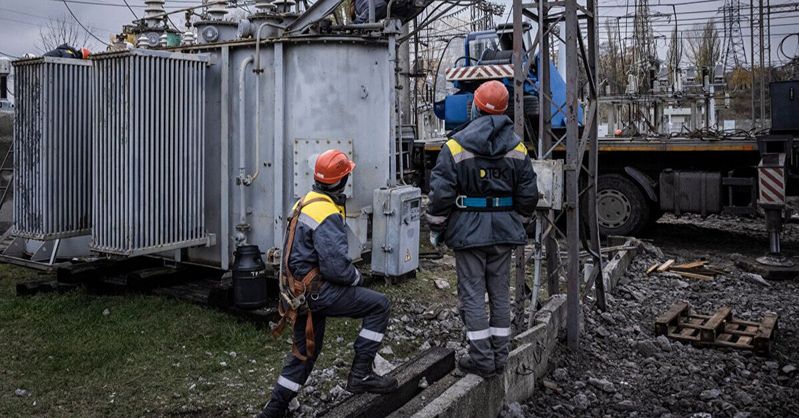
Three scenarios frame the coming days. The first is continuation: nightly raids in the low hundreds, with the jet-powered share watched as the key indicator — if 38 percent becomes the norm rather than the spike, Ukraine’s defensive economics worsen measurably before mid-winter. The second is the repair race: grid crews restoring the Kyiv region’s network and the six other damaged regions faster than the next raid can re-damage them, a contest that has defined every winter of this war and that Friday’s restrictions in the capital region show is already being run at the margin. The third is diplomacy: the Abu Dhabi talks on November 10–11, where an energy-strike pause — even a partial, time-limited one — would be the first test of whether the autumn campaign has created leverage either side is willing to cash in. Watch, in the meantime, for Ukraine’s next Air Force tally: whether the 15 drones still aloft at 08:00 changed the strike count, and whether the Afipsky fire is confirmed, denied or quietly left unaddressed by Moscow.
Read next: Komyshuvakha aid point bombing: death toll rises to 53 · Russia fires 433 drones in one night, cutting power across Ukraine · Germany proposes an extra €100 million for Ukraine’s infrastructure
Sources
Reporting based on the Ukrainian Air Force’s November 6, 2026 tally of the overnight raid; Reuters’ November 6, 2026 report on the outages, citing Deputy Energy Minister Artem Nekrasov; Reuters reporting, via Devdiscourse, of the fire at an industrial facility in Afipsky; and Kyiv Post reporting, via EuropeSays, on the Afipsky refinery reports, which it said it could not independently verify. Russian figures are those of Russia’s Defence Ministry and the Krasnodar regional operational headquarters. Sources: Reuters, November 6, 2026 — Russian strikes cause new outages in 7 Ukrainian regions; Reuters via Devdiscourse — Fire breaks out at industrial facility in Russian town in Krasnodar region; 112.ua — Ukrainian Air Force report, November 6, 2026; Kyiv Post via EuropeSays — Afipsky refinery reports.