War · World · Ukraine
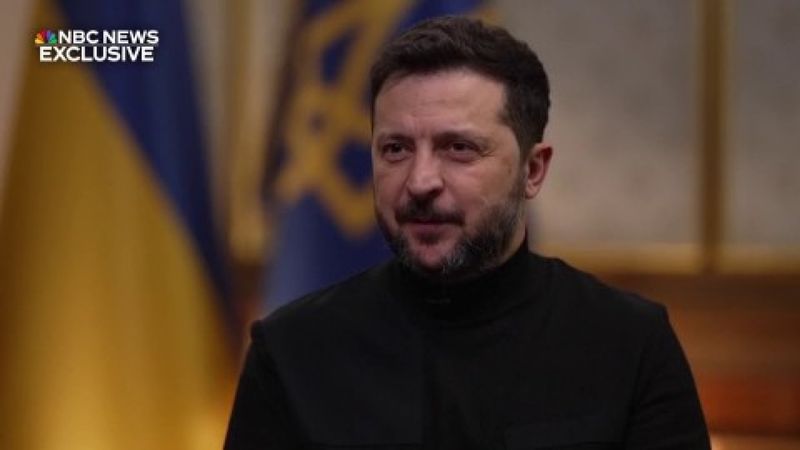
The Zelenskyy Trump Putin Xi meeting does not include Zelenskyy — and that, in the Ukrainian president’s telling, is precisely the point he wants the world to notice. In an exclusive NBC News interview aired on Wednesday, he argued that Donald Trump, Vladimir Putin and Xi Jinping have enough combined power to end the war in a single sitting, and he named the test that would prove they mean it: Washington and Beijing acting together on sanctions against Russia.
KYIV, November 18, 2026 — Ukrainian President Volodymyr Zelenskyy has said the war in Ukraine could be ended in a single meeting between US President Donald Trump, Russian President Vladimir Putin and Chinese President Xi Jinping, if the three leaders wanted to end it. The remarks, made in an exclusive NBC News interview with chief foreign correspondent Richard Engel that aired on Wednesday, November 18, came less than a day before Trump, Putin and Xi are due to hold the first trilateral meeting of its kind in Shenzhen, China, on Thursday, November 19, on the sidelines of the APEC summit. Zelenskyy is not attending the Shenzhen meeting. Asked what he would say to the three leaders if he were in the room, he said they have “enough power to stop Putin” in one meeting — a formulation that places the burden of the war’s continuation not on Ukraine’s resistance or Russia’s army, but on the choices of the three men who will sit down without him.
Track it live: Ukraine War Map — live tracker
What Zelenskyy actually proposed: the sanctions test
Strip away the headline and Zelenskyy’s argument is a conditional, not a prediction. He did not say the Shenzhen meeting will end the war. He said it could — and he specified the mechanism. If China and the United States imposed sanctions on Russia, or credibly threatened to do so together, he said, “that’s the end of the war.” The logic is economic as much as military: Russia’s war effort runs on revenue and supply chains that run, directly or indirectly, through both American financial power and Chinese trade. A joint squeeze, in Kyiv’s argument, is the one form of pressure Moscow cannot route around, because there is no third economy large enough to absorb it.
“Enough power to stop Putin”
The sharper edge of the interview was directed at intent. Zelenskyy suggested that if Trump and Xi fail to apply that joint pressure, it could show that they do not really want the conflict to end. That is a claim about motive, and it should be read as one side’s position — Kyiv’s — rather than as a finding of fact. But as diplomacy it is deliberate: it converts Thursday’s meeting from a photo opportunity into a pass-fail test, defined in advance by the leader who was not invited. Whatever emerges from Shenzhen, Zelenskyy has already supplied the yardstick his government will use to judge it publicly.
It is also worth being precise about what he did not propose. He did not ask for Ukraine to be given a seat in Shenzhen at the last minute, did not condition his argument on territorial terms, and did not name a ceasefire line. The proposal, such as it is, is about pressure first and terms later — pressure, specifically, that only Washington and Beijing can generate together. Whether that reading of Russia’s economic resilience is correct is contested by analysts on all sides; what is not contested is that it is now the stated Ukrainian theory of how this summit could matter.
Why the timing matters: the eve of Shenzhen
The interview did not land in a vacuum. On Wednesday, Trump and Putin shook hands in Shenzhen with Xi looking on — their first face-to-face encounter since Alaska in August 2025 — ahead of Thursday’s formal trilateral. Signal Post News covered that moment as Trump and Putin shook hands in Shenzhen as Xi looked on, the three leaders pictured together for the first time. The APEC summit runs November 18–19, and the trilateral sits on its sidelines: three nuclear powers, one room, and an agenda that US officials have described inconsistently in the run-up.
Mixed signals on what Thursday is even about
That inconsistency matters, and it should be reported as what it is — reported signals, not settled fact. US officials have given differing indications of whether Ukraine is on Thursday’s agenda at all, with nuclear arms control framed in some briefings as the summit’s first item. If Ukraine is discussed, Zelenskyy’s interview is an attempt to shape the discussion from outside the room. If it is not discussed, the interview is an attempt to make that omission itself the story. Either way, the timing — aired Wednesday, meeting Thursday — is the message: Kyiv moved first, on the record, in an American network interview aimed squarely at the two capitals whose pressure Zelenskyy says is decisive.
Nothing about Ukraine without Ukraine
Running underneath the sanctions argument is the older principle Kyiv has repeated since the first weeks of the full-scale invasion: no decisions about Ukraine without Ukraine. Zelenskyy restated it in the interview and again on Telegram on Wednesday: “Ukraine’s issues must be decided with Ukraine’s participation, and Europe’s issues with Europe’s participation.” The second half of that sentence is doing quiet work — it binds Ukraine’s claim to Europe’s, at a moment when European governments are themselves outside the Shenzhen room.
The Yalta parallel Kyiv keeps raising
Kyiv has a historical shorthand for its fear, and it has used it for weeks. In October, Foreign Minister Andrii Sybiha warned that a three-power meeting risks deciding Ukraine’s future over its head — the “Yalta” concern, a reference to the 1945 conference where the wartime great powers redrew Europe’s map with the affected nations largely absent. Signal Post News examined that warning in Zelenskyy’s Yalta warning over a Trump-Europe-Russia security deal. The parallel is an analogy, not an equivalence — Shenzhen is a summit, not a peace conference with a map on the table — but analogies are how governments warn. Kyiv’s point is procedural before it is territorial: a settlement negotiated without the country being settled is, in its view, neither legitimate nor durable, because the absent party retains every incentive to reject it.
Critics of Kyiv’s position, including voices in Moscow and some in Washington, argue the opposite: that great-power bargains have ended wars before, that Ukraine’s maximal conditions prolong the fighting, and that a framework agreed by the powers capable of enforcing it is a precondition for — not a substitute for — Ukrainian assent. Zelenskyy’s interview does not engage that argument directly. It sidesteps it, deliberately, by shifting the question from who decides to who pressures: whatever the three leaders decide about process, he is saying, the sanctions lever is theirs to pull or not pull, and history will record which they chose.
The Berlin follow-on: briefings, the Coalition of the Willing and €45 billion
If Shenzhen is where Ukraine is absent, Berlin is where Kyiv intends to be present — within hours. Zelenskyy said US representatives will attend meetings in Berlin on Thursday, November 19, and brief Ukraine on Trump’s talks in China. He said Washington now also supports a full European presence in the negotiations — a shift Kyiv has sought, since a European seat converts Europe from funder to party. And he said the Coalition of the Willing, the grouping of states backing Ukraine’s security, will also meet in Berlin on Thursday, with new support packages being prepared, mainly for Ukraine’s defence and energy sectors.
Putting the €45 billion in context
The money track moved on Wednesday too. Zelenskyy welcomed European Commission President Ursula von der Leyen’s proposal for a coordinated support instrument under which the EU could provide Ukraine with up to €45 billion — about $52 billion — in financial aid, supplementing the Ukraine Support Loan and covering much of Ukraine’s budget and defence needs in 2027. He urged the European Parliament and the EU Council to approve it quickly, and thanked partners including the UK, Canada, Japan and Norway. The number deserves context rather than applause or dismissal: €45 billion is not a battlefield fund but a state-survival fund — the difference, for 2027, between a Ukrainian government that can pay salaries, pensions and energy bills while fighting, and one financing the war by emergency improvisation. Its significance for Thursday is indirect but real: the stronger Kyiv’s 2027 financing looks, the less a Shenzhen framework built on Ukrainian exhaustion is worth, because exhaustion is the premise such a framework would rely on.
Wednesday’s Kyiv diary filled in the rest of the picture Zelenskyy presented. He said he was briefed on Black Sea security and grain export routes, including intelligence on Russian plans — a reminder that the war’s economic front, the corridor that feeds Ukraine’s exports and much of the world’s grain trade, runs whether or not Shenzhen talks about it. He also met Portuguese Foreign Minister Paulo Rangel in Kyiv, thanking Lisbon for a $50 million contribution to the PURL programme, the mechanism through which partners fund US-made equipment for Ukraine. Set against €45 billion, $50 million is small; set against the argument of the day, it is the point — support arriving in many currencies, from many capitals, none of them in the Shenzhen room.
Why this matters
Analysis. Zelenskyy’s interview is best understood as an attempt to set the terms of judgment for a meeting he cannot attend, and its strengths and weaknesses both follow from that. Who benefits if his framing holds? Kyiv, first: it enters Thursday with its test already published, so a Shenzhen outcome short of joint sanctions pressure can be characterised as a choice rather than a constraint. European governments benefit too — the Berlin follow-on, with an American briefing and a Coalition of the Willing meeting the same day, gives Europe a structured way back into a process that a three-power format excludes it from, and the €45 billion instrument gives that return financial weight.
Who loses? Potentially, the summit’s hosts and guests alike, if the meeting produces warmth without pressure: Trump would face the charge, pre-written by Zelenskyy, of not really wanting the war ended; Xi would face the same charge in a form Beijing rarely has to answer publicly; and Putin — the one leader Zelenskyy’s framing treats as the object rather than the author of events — benefits precisely if the other two decline the test, because a Shenzhen that ends in handshakes and arms-control language leaves Russia’s position on the ground untouched. That asymmetry is the interview’s real argument: inaction in Shenzhen is not neutral. It is, Kyiv contends, a result — for Moscow.
Critics on each side will answer in kind. Supporters of the trilateral format say only the three leaders in that room command the levers — American finance, Chinese trade, Russian forces — that a settlement requires, and that public ultimatums from outside narrow the space for the private bargaining summits exist for. Skeptics of Kyiv’s sanctions theory note that Russia has absorbed years of Western sanctions without collapsing its war effort, and question whether even a joint US-China squeeze would be swift enough to deserve the phrase “the end of the war” — a caution that applies to Zelenskyy’s claim as a claim, however effective it is as pressure. And skeptics of the summit itself note the unresolved agenda question: with US officials signalling differently on whether Ukraine is even an item, Thursday may produce a meeting about Ukraine in everything but its communique. No finalised prisoner-exchange figure should be read into any of this; none has been confirmed, and this article states none.
What happens next
Thursday, November 19, now carries two meetings on two continents, and the sequence between them is the story. In Shenzhen, Trump, Putin and Xi hold their trilateral. Three broad scenarios cover the plausible outcomes. In the first, the leaders emerge with language on Ukraine that includes a pressure mechanism — sanctions coordination, a deadline, a joint statement with terms — and Zelenskyy’s test is, on its face, met; the argument then moves to enforcement. In the second, Ukraine is addressed in general terms — peace is desirable, talks should continue — without a mechanism; Kyiv will call that a failure of will, Washington and Beijing will call it a first step, and both characterisations will be available because both were prepared in advance. In the third, Ukraine is barely mentioned at all, with nuclear arms control and bilateral business dominating; that outcome would hand Kyiv its strongest talking point and its weakest practical position simultaneously.
Then comes Berlin, where US representatives brief Ukraine on the China talks, the Coalition of the Willing convenes, and the support packages for defence and energy are prepared. Berlin is where Thursday’s words get their first audit: what was actually said about Ukraine, what was promised, and what Europe and Ukraine are expected to accept. Zelenskyy’s Wednesday also leaves a paper trail to watch — the €45 billion instrument’s path through the European Parliament and Council, and the Black Sea and grain briefings that proceed regardless of summitry. Follow the wider picture across all of Signal Post News’ conflict coverage via the wars tracker, and for the military balance behind the diplomacy, see our reporting on Russia’s missile stocks and Europe’s Patriot debate. The war, as Zelenskyy took care to remind his audience, will be decided by whether three men in Shenzhen want it decided. Thursday will show what they want.
Related coverage
Zelenskyy’s Yalta Warning: Kyiv Fears a Security Deal Decided Without Ukraine
EU’s Kubilius on Russia’s Missile Stocks and the Patriot Swap Debate
Sources
- NBC News — exclusive interview with President Volodymyr Zelenskyy by chief foreign correspondent Richard Engel, aired Wednesday, November 18, 2026: “Zelenskyy says sanctions from U.S. and China would force Russia into a ceasefire” (youtube.com): the war could end in a single Trump-Putin-Xi meeting if the leaders wanted; the three have “enough power to stop Putin”; joint US-China sanctions or the threat of them would be “the end of the war”; failure to apply that pressure could show Trump and Xi do not really want the conflict to end; no decisions about Ukraine without Ukraine.
- Bytes Europe, November 18, 2026 — summary of the NBC interview and President Zelenskyy’s Wednesday statements (byteseu.com): the Telegram restatement that Ukraine’s issues must be decided with Ukraine’s participation and Europe’s with Europe’s; US representatives to brief Ukraine in Berlin on Thursday; Washington’s support for a full European presence; the Coalition of the Willing meeting in Berlin with defence and energy support packages; welcome for the proposed EU instrument of up to €45 billion ($52 billion) for 2027 supplementing the Ukraine Support Loan; thanks to the UK, Canada, Japan and Norway; Black Sea security and grain-route briefings; the meeting with Portuguese Foreign Minister Paulo Rangel and Lisbon’s $50 million PURL contribution.
- NBC News — “Here’s the Scoop” podcast coverage of the Engel-Zelenskyy interview (Apple Podcasts): discussion of the interview and the Shenzhen trilateral context.
- Signal Post News, November 18, 2026 — Trump and Putin handshake in Shenzhen with Xi looking on, first face-to-face since Alaska in August 2025, ahead of the Thursday trilateral on the sidelines of the APEC summit (November 18–19). Kyiv’s “Yalta” concern was raised by Foreign Minister Andrii Sybiha in October. US officials have given differing signals on whether Ukraine is on Thursday’s agenda, with nuclear arms control framed as the summit’s first item; those signals are reported as such, not as settled fact. No finalised prisoner-exchange number has been confirmed, and none is stated in this article.
- Photo and video: NBC News — interview still and interview video via YouTube, credited in place.