War · Europe · Ukraine
Ukraine is running short of the only interceptors that can reliably stop a ballistic missile, just as Russia doubles the number it fires. Brussels’ answer is a swap: European countries hand over Patriot missiles from their own stockpiles now, and take Ukraine’s contracted 2028–29 deliveries in repayment.
Track it live: Ukraine war map tracker · Wars tracker
BRUSSELS — The Russia 2,000 ballistic missiles Ukraine warning that the European Union’s defence chief delivered on Wednesday came with a mechanism attached, because the warning alone describes a defeat. Andrius Kubilius, the European Commissioner for Defence, called Ukraine’s shortage of ballistic-missile interceptors “a major problem” in remarks reported by Rapporteur, and put numbers on both sides of it: Russia, he estimated, will launch about 2,000 ballistic missiles at Ukraine this year, roughly double the approximately 1,000 it fired last year, with Russian production still rising — while the United States, the source of the PAC-3 interceptors that can stop such missiles, produces about 700 of them a year.
Those three numbers — 2,000 incoming, production climbing, 700 interceptors a year to share among every Patriot operator on earth — are the whole argument of the proposal Kubilius spent Wednesday advancing. Ukraine has interceptors on order. Its contracted deliveries simply arrive in 2028 and 2029, and ballistic missiles do not wait for delivery schedules. The swap is designed to move missiles through time: from European stockpiles to Ukrainian launchers now, and from Ukraine’s future delivery slots back to European stockpiles later.
The proposal
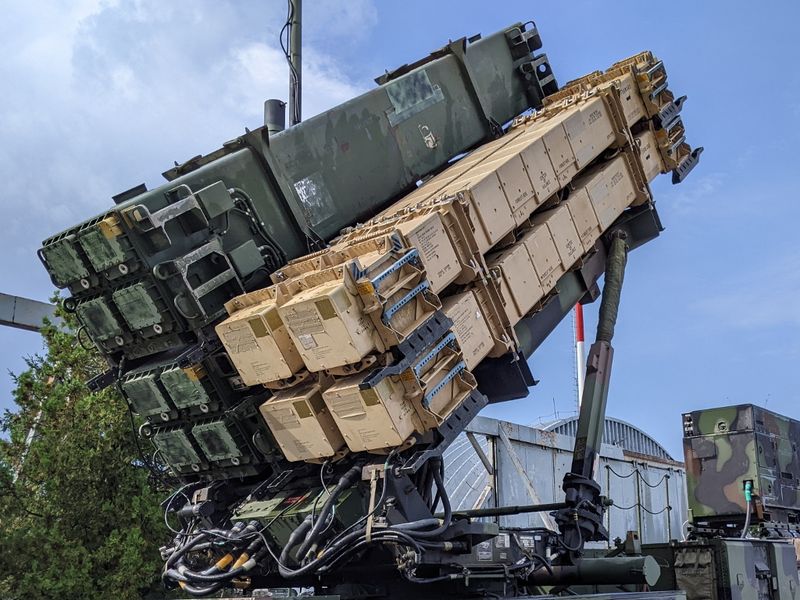
The mechanics are simple to state and hard to execute. EU member states that operate Patriot would transfer PAC-2 and PAC-3 interceptors from their existing stocks to Ukraine immediately. In return, they would be repaid from the deliveries Ukraine itself has contracted for 2028–29 — taking Kyiv’s place in the production queue rather than waiting at the back of it. No new production is required for the first move, and no donor is asked to give anything away permanently. What is being lent, in effect, is time.
Kubilius was candid that the Commission cannot order any of this. “Our task now is really to look and to try to speak with member states in order to convince them,” he said — a sentence that locates the proposal exactly where it lives, in persuasion rather than authority. Interceptors in national stockpiles belong to national governments, several of which are already uneasy about their own holdings, and the swap asks them to accept a thinner magazine today against a contractual promise about 2028.
The idea did not originate in Brussels. It is, in substance, the appeal President Volodymyr Zelenskyy made a day earlier, on November 17, to the Ramstein-format meeting of Ukraine’s backers, as Signal Post News reported in our coverage of the Ramstein air-defence meeting. “Ukraine needs Patriot and IRIS-T interceptors from the stocks you already have right now,” Zelenskyy told them. “This is not a donation. It’s an exchange.” Kubilius’s press point was the European Commission picking up that framing and carrying it into the capitals where the missiles actually sit. Around the swap sit two longer-term efforts: licensed production of the older PAC-2 interceptor planned in Germany, which would put a European production line behind the missile for the first time, and joint EU-Ukrainian counter-ballistic projects known as FREYJA and Bliksem EXO, aimed at giving Europe and Ukraine an interceptor of their own rather than a permanent dependence on an American production line.
The arithmetic
It is worth doing the maths slowly, because the headline numbers both overstate and understate the problem, and precision matters here. Two thousand ballistic missiles does not mean Ukraine needs 2,000 Patriot interceptors, for two reasons that pull in opposite directions. The first is that not every ballistic missile is engaged by a Patriot at all. Ukraine’s air defence is layered: IRIS-T and SAMP/T systems, guns, electronic warfare and sheer geography all take parts of the wider missile and drone campaign, and commanders choose which incoming tracks to spend scarce interceptors on. The second reason is grimmer. Ballistic missiles are the hardest targets in the sky — they fall at several times the speed of sound on steep trajectories — and of the systems Ukraine fields, only Patriot, and to a more limited extent SAMP/T, can engage them at all. IRIS-T, for all its quality against cruise missiles and aircraft, cannot substitute in that role. The ballistic fight is therefore concentrated on the smallest magazine Ukraine has.
Two interceptors, one missile
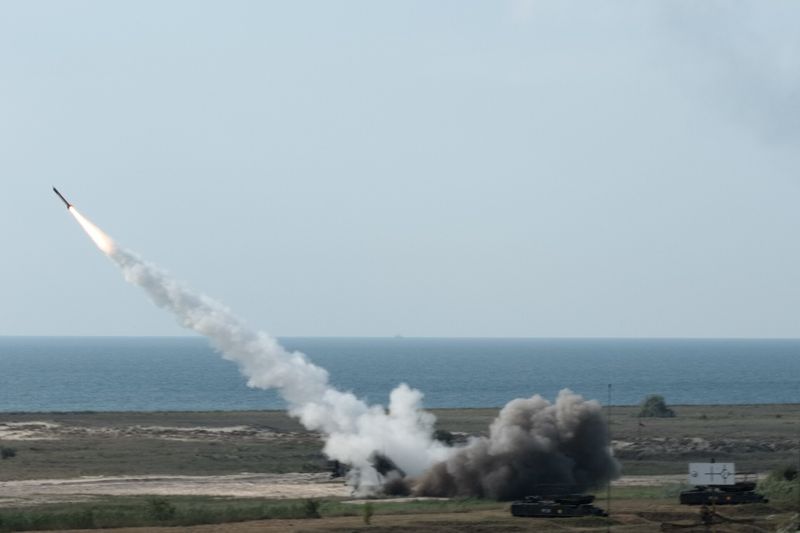
Doctrine makes the arithmetic worse. To raise the probability of a kill against a ballistic target, defenders commonly fire two interceptors at a single incoming missile. Apply that to Kubilius’s figures and the shape of the crisis appears: if even a fraction of Russia’s roughly 2,000 ballistic launches are engaged by Patriot at two interceptors per engagement, Ukraine’s requirement runs into the thousands — against total American PAC-3 production of about 700 a year, a figure that must also replenish U.S. stocks and supply every other Patriot operator from Germany to Japan. Russia, meanwhile, is moving the other side of the equation: a launch rate that has doubled in a year implies a production base that has been expanded to sustain it. One side’s output curve is rising steeply. The other side’s is essentially flat. The swap does not change either curve; it tries to stop the gap between them from becoming decisive this winter.
Why money isn’t the bottleneck
None of this is, in the usual sense, a funding problem. Ukraine has contracts. The United States has approved the sales — including the possible sale of 500 PAC-3 MSE interceptors at an estimated $2.1 billion that Signal Post News covered in our report on the 500-missile PAC-3 approval. The constraint is industrial time: interceptor production lines cannot be surged the way artillery-shell lines were, each PAC-3 MSE is a precision weapon built in limited numbers, and the queue of paying customers stretches years into the future. Ukraine’s own contracted deliveries land in 2028–29 not because anyone chose that date maliciously, but because that is where the queue ends.
The delivery record shows what the queue means in practice. Zelenskyy said in October, as reported at the time, that Ukraine had received only 24 U.S. Patriot interceptors in the preceding three months — a trickle set against a launch rate approaching 2,000 a year. Brussels is working the financing side in parallel: at the same press point, Kubilius set out the proposed €45 billion 2027 instrument, of which €25 billion would be military support, which Signal Post News has covered separately in our report on the proposed €45 billion loan for Ukraine. But money arriving in 2027 buys missiles that arrive later still. The swap exists precisely because the financial instrument and the physical problem run on different clocks.
Why this matters
Ballistic missiles are Russia’s chosen instrument against the things Ukraine cannot move: power stations, substations, district heating plants, bridges and the rail junctions behind the front. As winter closes in, that campaign is aimed at the energy system — at making Ukrainian cities cold and dark in the months when cold and dark do the most damage. Interceptor scarcity therefore does not translate into military losses in the abstract. It translates into triage, conducted nightly: this power plant defended, that one left open; Kyiv’s government quarter covered, a provincial city exposed. Every unintercepted missile compounds the damage faster than repair crews can clear it, and the grid Ukraine is defending this winter is the same grid already patched from last winter’s campaign.
The swap’s significance, if it happens, is that it converts paper into defence. Ukraine’s 2028–29 delivery slots are real assets that currently protect no one; European stockpiles are real missiles protecting countries that are not under ballistic attack. Moving the missiles forward and the slots backward is the rare proposal in this war that makes both parties better off in the dimension that matters — time — which is why it has travelled from a Zelenskyy appeal to a Commission campaign in 24 hours. It would also set a precedent with a long tail: stockpile lending against future production, as a standard instrument of alliance logistics, rather than an improvisation.
The sceptical capitals
The obstacles are equally concrete. A member state that hands over PAC-3s today accepts a thinner shield over its own bases and cities until Ukraine’s slots repay it in 2028–29 — and several European Patriot operators already judge their holdings thin against their own planning scenarios, in a period when NATO’s eastern flank is being reinforced, not relaxed. Repayment depends on American production staying on schedule and on export approvals aligning years from now, which asks defence ministries to treat a future queue position as equivalent to a missile in a bunker. Some capitals will also ask, quietly, whether a swap structured around Ukraine’s contracts leaves them holding the risk if the war, or American politics, changes before 2028. Kubilius’s formulation — convince, not compel — acknowledges that the Commission has answers to none of these objections except the arithmetic itself: 2,000 missiles are coming whether Europe’s stockpiles move or not, and the only question the swap poses is where the interceptors that exist will be standing when they arrive.
What happens next
The proposal now enters the phase where such ideas either acquire named countries or quietly fade. Watch for the first member state to attach a number to a transfer, for Germany’s PAC-2 licensed-production plans to firm up timelines, and for the FREYJA and Bliksem EXO projects to move from names in a press point to funded programmes with delivery dates. The next Ramstein-format meetings will test whether Zelenskyy’s “exchange” framing has converted any of the governments that heard it on November 17. And over it all runs the winter itself: Russia’s energy campaign will generate the engagement statistics that make the argument better than any commissioner can. If the launch rate Kubilius cited holds, Ukraine will face the heaviest ballistic winter of the war with the thinnest interceptor magazine of the war — unless the missiles in Europe’s bunkers start moving east.
Sources
Sources: Rapporteur, November 18, 2026 — rapporteur.com; Radio Free Europe/Radio Liberty, reporting of Commissioner Kubilius’s figures — rferl.org; European Commission, press point, Brussels, November 18, 2026 — commission.europa.eu.