No deal was announced and none was expected. But on the eve of the first US–China–Russia trilateral, a red-carpet handshake in Shenzhen produced the defining image of the week — and, the BBC reported, the first photograph of the three leaders together as a trio.
Track it live: Wars tracker
SHENZHEN, November 18, 2026 — The Trump Putin Xi meeting Shenzhen week produced its defining moment on Wednesday evening, when Vladimir Putin approached Donald Trump on a red carpet ahead of the APEC leaders’ family photo and gala banquet, and the two men shook hands. Trump was standing with Xi Jinping and Peng Liyuan; the leaders exchanged pats on the shoulder and a few words, with Xi looking on, in video released by the Kremlin pool via Telegram and reported by the BBC News live blog in entries headlined “Trump, Putin and Xi seen together for the first time” and “Trump and Putin meet in China.” The BBC reported it as the first time Xi, Trump and Putin have been pictured together as a trio — a claim this article attributes to the BBC, and one that needs a precision note: the three have attended the same summits before, including APEC in Vietnam in 2017, so this is a first joint picture of the three together, not the first time they have been in the same room. It was also the first in-person Trump–Putin meeting since their Alaska summit in August 2025, the BBC and DW reported. Nothing was agreed on Wednesday evening, and nothing had been expected to be.
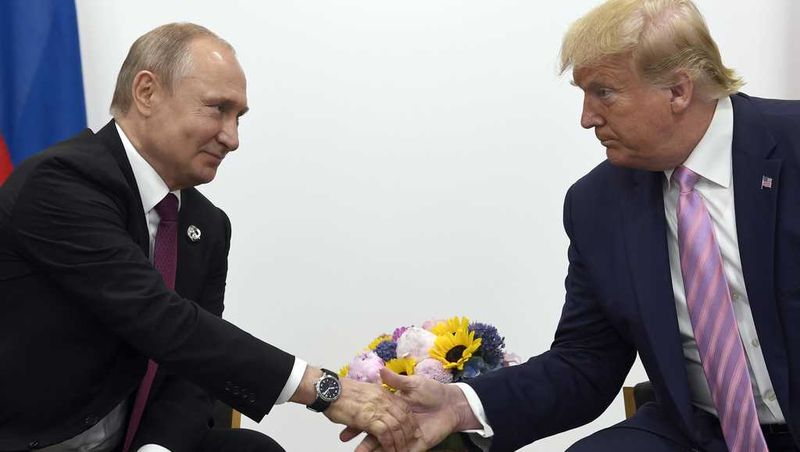
The red-carpet moment and the APEC family photo Shenzhen 2026
The sequence, as reported, was choreography with one unscripted-looking step. The family photo placed Xi and Peng front and centre, with Trump next to Xi, to his right, and Putin also in the front row, to the left of Peng, per DW’s account of the released APEC family photo. It was around that staging — ahead of the photo and the banquet — that Putin crossed to Trump for the Trump Putin handshake Shenzhen cameras were waiting for: a handshake, shoulder pats, a few exchanged words, Xi looking on. The brevity matters. This was not a bilateral meeting, and no readout followed; its content was the image itself, distributed first by the Kremlin pool, which is itself a fact about who wanted the picture seen, and how quickly.
Banquet stagecraft: “America the Beautiful” and the spot of honour
The evening’s staging, as reported by the New York Post, was deliberate in the way summit banquets are deliberate. Classical musicians performed “America the Beautiful” as Trump arrived. Xi gave Trump the spot of honour beside him in the group photo and at the head table. Putin approached Trump for the handshake ahead of the meal. And Xi opened by calling for maintaining the “Asia-Pacific miracle” — the host’s framing of a week Beijing has staged, from Xi’s precedent-breaking tarmac greeting of Trump, as a demonstration that the centre of diplomatic gravity can be organised from Shenzhen. Russian state media, for its part, hailed a “historic handshake,” the BBC reported — Moscow’s reading of the same few seconds, in which the Russian president appeared not as an isolated figure but as one of three principals in the host’s frame.
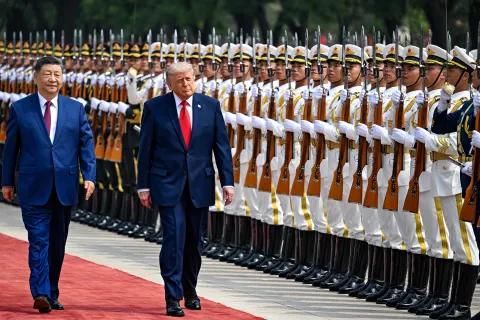
Context: how Shenzhen week was staged
The handshake landed at the end of a carefully sequenced set of arrivals, covered on this site as they happened. Putin was greeted on arrival not by Xi but by Cai Qi, and told APEC chief executives he expects “big potential benefit” from Thursday, Reuters reported — the arrival choreography detailed in our coverage of Putin’s arrival in Shenzhen for the trilateral. In the Xi–Putin bilateral, Xi told his guest, per AFP: “My old friend, it’s symbolic that this is our 50th personal meeting.” The week’s formal centrepiece was confirmed in our earlier reporting that the White House confirmed the first-ever Trump–Xi–Putin meeting for November 19. Behind the pageantry sits a harder backdrop this site has also covered, including the Kerch Bridge strike — a reminder that the Ukraine war, the first expected topic on Thursday, continued while the banquet was being seated.
Why this matters
Analysis: a handshake is not a policy, and this article treats Wednesday’s as evidence about staging and signalling, not about outcomes. Three readings compete, and each should be weighed on its own. First, normalisation: for Moscow, the image of Putin greeted warmly by the US president, with China’s leader beside them, is the deliverable — it contradicts the isolation narrative without requiring any concession. Second, leverage: for Washington, being courted visibly by both hosts and guest burnishes the claim that every road to a Ukraine settlement runs through the US president — a claim Kyiv hears very differently. Third, authorship: for Beijing, the picture’s composition is the message — the two other leaders in Xi’s frame, in Xi’s city, on the eve of a meeting format that has never existed before. Which reading history keeps depends entirely on Thursday, and on whether anything follows it.
Kyiv’s warning: the Zelenskyy new Yalta warning
The sharpest dissent came from the capital not in the photograph. President Volodymyr Zelenskyy warned the trilateral could become a “new Yalta” — “We don’t want to have Yalta 2.0,” he said, in remarks reported by RFE/RL — invoking the 1945 conference at which great powers settled Europe’s map over the heads of the nations on it. Ukraine has urged Trump and Xi to pressure Putin, The Times reported. The fear is specific, not rhetorical: a format in which the three nuclear powers discuss the Ukraine war with Ukraine absent invites exactly the carve-up analogy, and Kyiv’s public warning is best read as an attempt to raise the political price of any such outcome before the meeting starts, rather than as a prediction that one has been decided.
Who benefits, who loses — on the optics alone
On optics alone, all three men in the frame gained something they wanted: Putin, presence; Trump, centrality; Xi, authorship of the setting. The losers in the frame are those outside it: Ukraine, discussed but not seated; and, arguably, the APEC agenda itself, whose economic programme has been comprehensively upstaged by a handshake. That accounting is about pictures. The substantive ledger — territory, sanctions, arms control — did not move on Wednesday, and any report implying otherwise would be ahead of the evidence.
Thursday’s trilateral: the Trump Xi Putin trilateral Thursday
The meeting that matters is Thursday’s: the first-ever US–China–Russia trilateral, reportedly at Kylin Villa on Thursday afternoon and expected to last about an hour, per BBC and The Times reporting — “reportedly” is the operative word, and the Shenzhen trilateral Kylin Villa details have not been officially published. Expected topics, per Trump’s departure remarks and subsequent reporting: the Ukraine war; the US–Iran war; nuclear arms, including a successor to the New START treaty, which lapsed in February; trade; and artificial intelligence. The precise agenda is not public, and the White House has played down hopes of a breakthrough. The data points that give the format its weight are stark: three leaders who between them command the world’s three largest nuclear arsenals; a Trump Putin first meeting since Alaska now followed, within a day, by a three-way one; and a 50th Xi–Putin personal meeting folded into the same week.
Scenarios and what to watch
Three scenarios frame Thursday. In the first, a framework statement: language on Ukraine talks, nuclear risk reduction or AI guardrails that all three can sign — significant as precedent even if thin on enforcement. In the second, a photo with a communiqué gap: warm words, no agreed text, each capital briefing its own version — the base case, given the White House’s expectation management. In the third, a bilateral harvest: the trilateral produces little, but the week’s margins — US–China trade understandings, a US–Russia channel on a New START successor — carry the substance. The watch list: whether a joint text exists at all; whether Ukraine is described as a party or as a topic; any mention of New START’s successor by name; and whether a second trilateral is scheduled, which would convert an event into an institution. Nothing has been agreed yet, and this article will treat Thursday’s claims with the same attribution discipline applied to Wednesday’s picture.
Sources
Sources: BBC News live blog, November 18, 2026 — entries “Trump, Putin and Xi seen together for the first time,” “Trump and Putin meet in China” and “Apec family photo released”: the red-carpet handshake as Trump stood with Xi and Peng, the first-pictured-together-as-a-trio report, the first in-person Trump–Putin meeting since the August 2025 Alaska summit, Russian state media’s “historic handshake” framing, and the reported Kylin Villa trilateral timing. Video: Kremlin pool via Telegram. Reuters, November 2026 — photo and wrap-up coverage; Putin’s arrival greeting by Cai Qi and his “big potential benefit” remark to APEC CEOs. DW, November 18, 2026 — family photo positions (Xi and Peng front and centre; Trump to Xi’s right; Putin front row, to the left of Peng) and the Alaska reference point. The Times, November 2026 — the reported Thursday trilateral and Ukraine’s urging that Trump and Xi pressure Putin. New York Post, November 18, 2026 — banquet stagecraft: “America the Beautiful” on Trump’s arrival, the spot of honour beside Xi, and Xi’s “Asia-Pacific miracle” opening. AFP via reporting of the Xi–Putin bilateral — Xi’s “50th personal meeting” remark. RFE/RL — Zelenskyy’s “We don’t want to have Yalta 2.0” warning. Still photographs in this article are file photographs from earlier summits and are captioned as such; the Shenzhen handshake itself is a moving-image moment distributed by the Kremlin pool.