War / Ukraine
Track it live: Ukraine war map — follow the front lines and strike reports on our live tracker
The Zelenskyy Madrid summit energy aid appeal came with a list. Addressing the Ibero-American Summit in Madrid on Thursday, Ukrainian President Volodymyr Zelenskyy appealed for urgent help to rebuild and maintain Ukraine’s war-damaged energy infrastructure — transformers, cables, generators and other electrical equipment. He said Russia has damaged every power plant in Ukraine through missile and drone attacks, and that Ukraine’s energy workers carry out constant repairs simply to prevent a nationwide blackout, Reuters reported.
The specificity was the point. This was not a general call for solidarity of the kind wartime leaders routinely make at summits. Kyiv arrived in Madrid with named equipment matched to named countries, and with a second offer running alongside the request: cooperation with Ukraine on defence technology — drones, electronic warfare and air defences — fields in which Ukraine’s wartime industry now has hard-won expertise to trade. Zelenskyy also held talks on boosting Kyiv’s air defences, the other half of the energy equation: every interceptor that stops a missile or drone is a substation that does not need rebuilding.
A list written country by country
Ukraine is seeking transformers from Brazil, Mexico, Argentina and Colombia; cables from Chile; and electrical equipment and generators from Spain, according to Reuters’ account of the appeal. Read as a map, the list is deliberate. The four transformer asks go to the largest economies of Latin America — countries with substantial electrical industries, big domestic grids of their own and, in several cases, manufacturers able to build or release heavy electrical equipment. Chile, one of the world’s great copper economies, is asked for the product copper becomes: cable. Spain, the host, is asked for the equipment its own electrical sector produces and for generators, the fastest-moving item in any winter emergency.
The defence-technology invitation cuts the other way. Ukraine is not only asking; it is offering — partnership in drone production, electronic warfare and air-defence technology developed under fire since 2022. For Latin American governments that have kept a careful distance from the war’s military supply chains, energy equipment plus technology cooperation is a different proposition from shipping weapons: it is framed as civilian survival infrastructure on one side and industrial partnership on the other.
Sanchez: an “aggressor and a victim”
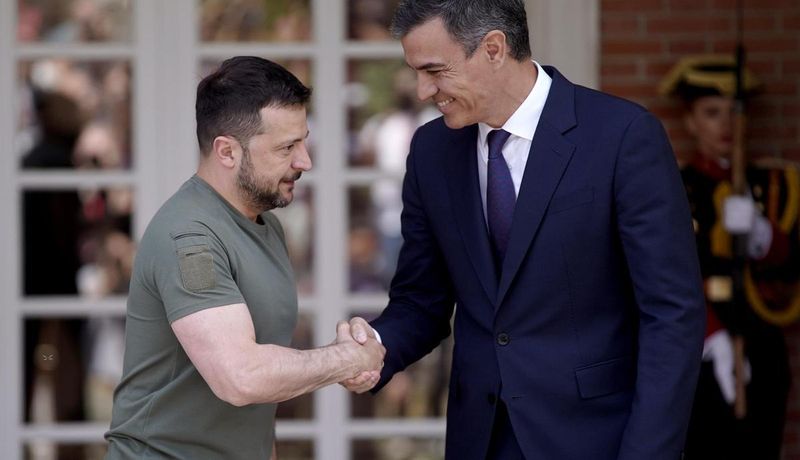
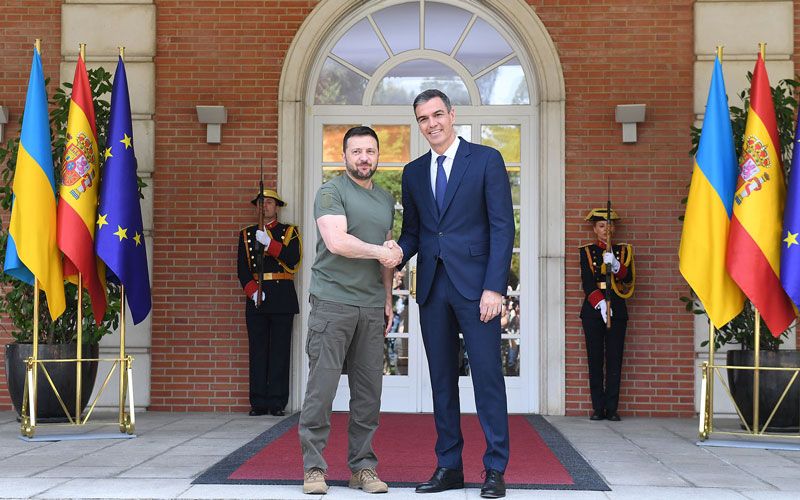
Spain’s prime minister, Pedro Sanchez, gave the appeal the clearest political endorsement heard at the summit. Ukraine deserved support, Sanchez said, because there was an “aggressor and a victim” in the war, because Russia was violating international law, and because backing Kyiv is also in Europe’s own interest, Reuters reported. It was the host setting the terms on which the summit was being asked to respond: not charity, but a legal and strategic obligation.
The Madrid trip itself had come together at short notice. Zelenskyy travelled unexpectedly to Spain — a visit he announced on his own Telegram channel, Reuters reported on November 4 — to meet Sanchez and other leaders gathered for the Ibero-American Summit. The timing matters. The summit appearance comes days before US-mediated three-way talks in Abu Dhabi on November 10–11, and in the middle of an autumn in which Ukraine’s energy system has again become the central target of Russia’s strike campaign.

Why this matters
Energy is the winter front line
Zelenskyy’s central claim in Madrid — that Russia has damaged every power plant in Ukraine — describes a war that has moved decisively onto civilian infrastructure. A damaged power plant is not an abstraction in November: it is heating that fails in apartment blocks, water pressure that drops, hospitals and rail networks running on rationed supply, and repair crews working, in Zelenskyy’s own description, constantly, to keep the whole system from tipping into a nationwide blackout. Berlin’s finance ministry, in a separate proposal reported the same day, put the cumulative loss at up to 80% of Ukraine’s power generation capacity since the 2022 full-scale invasion. Whether measured plant by plant or in lost capacity, the direction is the same: Ukraine enters this winter with the least generating margin of the war, and the Madrid appeal is what that arithmetic looks like when it is turned into diplomacy.
The supplier map moves across the Atlantic
For nearly four years, Ukraine’s energy lifeline has run through Europe and the United States — the EU, the G7 and funds such as the Ukraine Energy Support Fund. Madrid widens that map. Latin America’s largest states have so far been, at most, peripheral suppliers in this war, and several have guarded their neutrality carefully. An appeal made in Spanish, at an Ibero-American summit, on Spanish soil, reframes energy aid as a transaction those governments can defend at home: grid equipment for a country whose lights are being shot out, plus access to Ukrainian defence technology, rather than enlistment in a Western military effort. If even part of the list is filled, Ukraine’s repair supply chain becomes harder for any single strike campaign — or any single donor’s politics — to break.
Transformers are the hardest item on the list
Not all electrical equipment is equal, and the Madrid list is ordered, whether by design or not, from hardest to fastest. Large power transformers are among the most difficult industrial goods in the world to source at short notice: they are heavy, custom-built to the specifications of the grid they serve, and typically manufactured to order over many months, with utilities worldwide already queueing for them. A country cannot simply buy one off a shelf; it must find a utility or manufacturer willing to release a compatible unit, then move a machine weighing well over a hundred tonnes across an ocean and a continent. Cables are simpler and quicker. Generators are fastest of all — mass-produced, shippable in days, capable of keeping a hospital, school or pumping station alive through an outage — but they burn fuel, serve one building at a time and cannot replace a grid. Zelenskyy’s list, in other words, asks different countries for help on three different clocks: generators for this winter’s emergencies, cables for this winter’s repairs, and transformers for the grid Ukraine will still need next winter.
How we got here
Russia’s autumn energy campaign has been building for weeks. In our reporting of the 433-drone barrage that cut power across Ukraine, a single night’s launches knocked out electricity for hundreds of thousands of people as the heating season opened — one salvo in a pattern of strikes on generation and distribution that Ukrainian officials say is designed to break the grid before the coldest months. Moscow says its strikes target military and logistics infrastructure and denies deliberately targeting civilians; the blackouts that follow them are a matter of record either way.
Madrid was not the only energy file moving on Thursday. The same day, Berlin proposed an extra €100 million for Ukraine’s power, water and schools, in the Germany infrastructure package covered in our reporting — money aimed at decentralised generation, battery storage and repairs, and explicitly framed as a response to intensified Russian attacks. Italy, meanwhile, is finalising its 13th military aid package for Ukraine, with air-defence interceptors reported among the possible contents. The pattern across all three stories is the same week viewed from three capitals: interceptors to stop the strikes, money to repair the damage, and now, in Madrid, a direct appeal for the physical hardware of repair itself.
Who gains, who pays, what critics say
Kyiv gains most if the list is filled: a broader, more politically diverse supplier base for the equipment its grid consumes every week, and a Madrid stage on which the energy war was described, by the summit’s host, in the legal terms Ukraine itself uses. Spain gains a central diplomatic role — the European country physically hosting Ukraine’s appeal to the Spanish- and Portuguese-speaking world — and Sanchez gains a summit moment consistent with his government’s position since 2022. The Latin American governments named gain visibility and a potential technology partnership, but they also carry the real costs: suitable transformers are utility assets, not warehouse stock, and releasing one means a domestic operator running its own grid with less spare capacity.
The critics’ case is about the distance between an appeal and a delivery. Summit asks produce statements faster than hardware; no quantities, values or delivery dates were attached to the Madrid requests in Reuters’ reporting, and a transformer promised in November may still be on a ship when the coldest weeks arrive. Sceptics will also note that several of the governments Zelenskyy addressed have resisted taking sides in this war, and that an energy appeal — however civilian its framing — asks them to spend political capital they have so far declined to spend. Supporters answer that this is exactly how bottlenecks break: not with one large pledge from the usual donors, but with many smaller, specific ones from suppliers nobody had asked before — and that the only version of this appeal guaranteed to fail is the one never made.
What happens next
The next test is diplomatic. On November 10–11, Ukrainian and Russian delegations are due in Abu Dhabi for US-mediated three-way talks — a setting in which the state of Ukraine’s grid is not background but leverage. A country whose cities stay lit and heated through the winter negotiates from endurance; a country sliding toward blackout negotiates against a clock. That is one reason the Madrid appeal, the Berlin money and the Abu Dhabi talks belong in a single story: each is an attempt to change what Ukraine’s winter looks like before the negotiators sit down.
Three scenarios follow from Madrid. If the named governments convert the appeal into confirmed shipments quickly — generators and cable first, transformers on the longest clock — Ukraine’s repair crews gain the one resource they cannot improvise: compatible heavy equipment, arriving before the grid’s hardest weeks. If the response is warm words and slow process, the same equipment arrives in spring, useful for reconstruction but irrelevant to the winter it was requested for, because winter energy aid is perishable in a way most aid is not. And if strikes continue to outpace repairs while Abu Dhabi produces no de-escalation, Thursday’s list becomes the first of a series — a standing, widening procurement map that Kyiv will keep expanding until the hardware arriving each month exceeds the hardware being destroyed.
What to watch is specificity: named shipments, quantities and dates from Brasilia, Mexico City, Buenos Aires, Bogota, Santiago and Madrid. The appeal has been made in public, country by country and item by item — which means its success or failure will be measurable in public too.
Related coverage
Russia Fires 433 Drones in One Night, Cutting Power to Hundreds of Thousands Across Ukraine
Zelenskyy Offers Trump a Swap: Patriots for One Month, and Ukraine Pauses Refinery Strikes
Sources
Reuters, “Ukraine’s Zelenskiy appeals for energy infrastructure aid at Madrid summit,” November 5, 2026 — https://www.reuters.com/world/americas/ukraines-zelenskiy-appeals-energy-infrastructure-aid-madrid-summit-2026-11-05/ · Reuters, “Zelenskyy in Spain to meet Sanchez, other leaders at Ibero-American summit,” November 4, 2026 — https://www.reuters.com/world/zelenskyy-spain-meet-sanchez-other-leaders-ibero-american-summit-2026-11-04/