Houthi strikes Saudi airports

JAZAN / NAJRAN — Houthi strikes Saudi airports in two southern cities damaged civilian aviation facilities and wounded three people, Saudi Arabia’s General Authority of Civil Aviation said. The attacks on King Abdullah bin Abdulaziz International Airport in Jazan and Najran International Airport occurred Monday evening amid a widening Saudi-backed offensive in Yemen. Riyadh responded not only with military operations, but by announcing the activation of the Mecca Defense Alliance with Turkey and Pakistan.
The confirmed facts are narrower than some claims circulating around the attack. Saudi authorities acknowledged damage at the two airports and three injuries. Houthi military spokesman Yahya Saree separately claimed attacks on King Khalid International Airport in Riyadh, an Aramco refinery in Rabigh, Abha airport, Khamis Mushait, Najran and Jizan. Saudi authorities had not confirmed every target in that list when this report was prepared. That distinction matters: a claim of launch is not the same as independently verified impact.
Why this matters: civilian airports and collective defense
This escalation combines two signals that are more consequential together than separately. The first is the demonstrated ability to damage operating civilian airports inside Saudi Arabia. The second is Riyadh’s decision to move from bilateral coordination toward an announced collective-defense mechanism involving two militarily capable partners.
Airports are unusually sensitive targets because their military and civilian functions can overlap. Jazan’s airport is dual-use, but it also serves ordinary passengers. Najran is likewise part of the kingdom’s civilian network. Even limited damage can trigger runway inspections, aircraft diversions, crew-positioning problems and insurance reviews. Three wounded people may sound small against a decade of war, yet the operational message is large: defensive systems did not prevent every weapon or fragment from reaching public infrastructure.
Activation of the Mecca Defense Alliance raises a different question. A Saudi response conducted alone remains a familiar part of the Yemen conflict. A response framed as collective deterrence with Turkey and Pakistan creates uncertainty about what counts as an attack on the alliance, what support each partner has promised and how quickly advisory, air-defense, intelligence or combat capabilities could move into the kingdom. Ambiguity can deter, but it can also produce miscalculation.
What happened at Jazan, Najran and Aden
Saudi authorities confirm damage and injuries
The Wall Street Journal and Reuters reported that Saudi civil-aviation authorities said both airports were damaged and three people were wounded. Public details about the exact weapons, points of impact and duration of any flight disruption remained limited.
Reuters also reported that two Houthi missiles targeted Aden airport, according to Aden’s security department, which said there were no casualties. The Saudi-led coalition said it intercepted a ballistic missile headed toward Khamis Mushait and identified launch threats from areas including Sanaa, Saada and Amran. Those accounts show the conflict moving in both directions across Yemen’s domestic front lines and the Saudi border.
The Houthi rationale and the Saudi response
The Houthis present their attacks as retaliation for Saudi-led military operations and support for Yemen’s internationally recognized government. They say Saudi airspace and infrastructure are part of the battlefield while the coalition strikes Houthi-held territory. The group also warned international airlines to halt flights in Saudi airspace, while excluding Mecca and Medina from that warning.
Saudi Arabia and the Yemeni government describe the Houthis as an armed movement threatening cities, trade routes and internationally recognized state authority. Riyadh says its latest operations support government forces and protect strategic waterways. Yemen’s government argues that military pressure is necessary to reverse Houthi territorial gains and restore national institutions. Critics of the coalition counter that renewed air operations risk repeating patterns in which civilians and essential infrastructure absorb much of the cost.
How Houthi strike capability changed the war
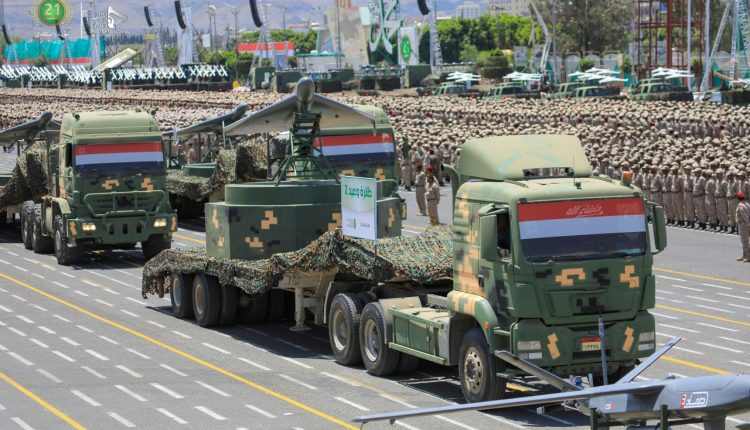
The Yemen conflict’s cross-border dimension is not new. After the Houthis seized Sanaa in 2014 and a Saudi-led coalition intervened in 2015, the group gradually expanded from shorter-range rockets to ballistic missiles, cruise missiles and long-range one-way attack drones. Earlier strike waves reached airports, oil facilities and urban areas across southern and central Saudi Arabia. The 2019 attack on the Abqaiq and Khurais oil facilities, claimed by the Houthis but attributed by the United States and Saudi Arabia to Iran, showed how a relatively small number of weapons could temporarily shake global energy markets.
The present wave differs in three ways. First, the targets include two named civilian airports damaged in one evening. Second, the attacks coincide with intense ground and air fighting in Yemen rather than a contained exchange. Third, Saudi Arabia is signaling that the answer may involve partners outside the long-standing Arab coalition.
Houthi capabilities have also become harder to reduce through interception alone. Drones can approach at low altitude; ballistic missiles compress decision time; mixed salvos can force defenders to choose which track receives the most expensive interceptor. Even a high interception rate can leave debris, near misses and occasional impacts. That arithmetic favors the attacker when the political objective is disruption rather than the destruction of a hardened military target.
Civilian aviation faces a risk problem, not just a damage problem
The Houthis’ warning to airlines changes planning even if no additional airport is hit. Carriers and regulators must weigh uncertain intelligence against the consequences of a wrong decision. The European Union Aviation Safety Agency warned operators about increased risk, including the possibility that civil aircraft could be misidentified during a period of heightened military activity.
Airlines have several choices: suspend routes, avoid selected airspace, add fuel for longer diversions, alter departure times or keep flying under enhanced monitoring. Each imposes cost. A route change can ripple through crew hours, connection banks and aircraft availability. The most exposed airports may face cancellations first, but the perception of a wider Saudi airspace threat can affect hubs far from the border.
The central aviation question is therefore not whether Jazan and Najran can repair visible damage. It is whether operators believe the next launch could target another civilian field, whether air defenses can distinguish and defeat mixed threats, and whether military responses could create new hazards in crowded airspace.
Turkey and Pakistan enter the deterrence equation
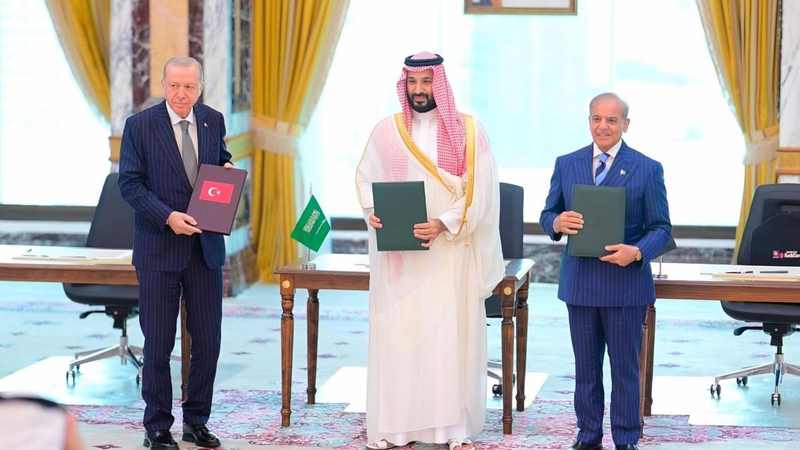
Saudi Defense Minister Khalid bin Salman said Saudi Arabia, Turkey and Pakistan would activate collective deterrence under the Mecca Defense Alliance. Newsmax reported that the three countries condemned attempts to target Mecca, Medina and Saudi civilian and economic facilities, and agreed on rapid deployment to the kingdom.
Turkey brings NATO-standard planning, a large defense industry and experience with drones, air defense and expeditionary operations. Pakistan brings a large military, long-standing defense ties with Riyadh and strategic weight as a nuclear-armed state. Neither role automatically means direct combat in Yemen. The lower-rung options are extensive: radar and early-warning support, air-defense crews, intelligence sharing, logistics, training and visible exercises.
Supporters of the alliance argue that a broader defensive shield could make attacks less likely by showing the Houthis that pressure on Saudi territory will not isolate Riyadh. Critics see escalation risk: additional militaries, command chains and rules of engagement create more points at which an interception, launch warning or retaliatory strike can be misread. Pakistan and Turkey must also balance regional relationships, domestic public opinion and the danger of being drawn into an open-ended war.
What the numbers reveal — and what they do not
The confirmed airport toll is three wounded people, two damaged airports and no reported deaths. That is evidence of limited immediate casualties, not evidence of limited strategic effect. In infrastructure warfare, the ratio between human harm and economic disruption can be large. A weapon that damages a terminal or forces a runway closure can interrupt thousands of journeys without producing a mass-casualty event.
The broader Yemen numbers show why a narrow focus on the Saudi side is incomplete. The UN migration agency said more than 184,000 people were displaced between August 1 and October 4, including nearly 21,800 in the week ending October 3 and another 6,474 on October 4 alone. WHO figures cited in October 6 reporting put the latest fighting’s toll at least 959 killed and more than 4,200 wounded. Those totals are not directly comparable to the airport injuries: one measures a discrete attack, the others a widening campaign. Together they show how tactical exchanges accumulate into a humanitarian emergency.
The displacement curve is particularly revealing. The UN said weekly displacement increased 26 percent from the previous week, and roughly 45 percent of assessed households at three sites in Marib had been displaced before. Repeat displacement means families often begin the next flight with fewer savings, fewer possessions and weaker support networks. Even if cross-border missile attacks stop, that damage continues.
What happens next
Scenario one: a managed but violent exchange
Saudi Arabia could intensify strikes against launch sites, storage areas and command networks while the Houthis answer with sporadic attacks designed to demonstrate reach. Turkey and Pakistan could keep their contribution primarily defensive. This would be the most containable path, but it still carries danger for civilians and aviation because each exchange creates pressure to restore deterrence.
Scenario two: a regional air and maritime escalation
If attacks spread to major Saudi hubs, oil infrastructure or Red Sea shipping, the conflict would acquire a wider economic footprint. Insurers could raise war-risk premiums; carriers could reroute; shippers might reconsider the Bab el-Mandeb corridor; and oil traders could price in the possibility of disruption at Saudi export facilities. The market impact would depend less on rhetoric than on sustained physical damage and shipping delays.
Scenario three: alliance deployment becomes operational
A visible deployment of Turkish or Pakistani air-defense systems, aircraft or personnel could strengthen Saudi defenses. It could also make any subsequent Houthi strike a test of three governments’ credibility. The key variables would be mandate, basing, command authority and whether the deployment is limited to Saudi territory.
The diplomatic off-ramps
De-escalation is still possible. The most practical sequence would begin with a reciprocal halt to attacks on civilian airports and other nonmilitary infrastructure, followed by protected humanitarian access and localized ceasefires around displacement routes. Oman and UN mediators remain important because they have channels to the Houthis and to regional capitals. A broader arrangement would need security assurances for Saudi Arabia, an end to cross-border launches, and a Yemeni political process that addresses Houthi power as well as the claims of the internationally recognized government and other local forces.
None of those steps resolves the war by itself. But the alternative — treating damaged civilian airports as just another entry in a decade-long exchange — misses the moment. The Mecca Defense Alliance makes the next round harder to isolate. The Houthi airport strikes make ordinary passengers part of the risk calculation. Both sides say their actions are defensive responses to the other’s escalation. That symmetry of justification is precisely how a conflict widens without either side claiming it chose a wider war.
Sources
- The Wall Street Journal, October 6, 2026: Houthi strikes damage two Saudi airports
- Reuters, October 6, 2026: two Saudi airports targeted as fighting escalates
- Reuters, October 7, 2026: missiles target Aden airport as fighting intensifies
- Newsmax, October 6, 2026: Saudi Arabia activates collective defense with Turkey and Pakistan
- UN News, October 5, 2026: more than 184,000 displaced in Yemen
- World Health Organization, September 10, 2026: Yemen’s health system faces renewed conflict