Saudi Arabia confirmed Monday-night attacks on the Jazan and Najran airports, wounding three — the first verified Houthi strikes on Saudi aviation in this escalation. Wider rebel claims against Riyadh and an Aramco refinery remain unverified as Saudi-backed forces push toward Mokha and the Bab el-Mandeb Strait.
JAZAN / SANAA — The Houthi Saudi airport strikes confirmed by Riyadh on Tuesday mark the sharpest escalation yet in Yemen's rapidly widening war: Saudi Arabia's General Authority of Civil Aviation said attacks on Monday evening targeted King Abdullah bin Abdulaziz International Airport in the Red Sea city of Jazan and Najran International Airport in the kingdom's south, injuring three people and causing limited damage. The authority said it was assessing the damage and taking measures to ensure the safety of passengers and staff and the security of civil aviation.
The airport strikes landed as Saudi-backed Yemeni government forces pressed a major counteroffensive along the Red Sea coast after weeks of Houthi advances. Riyadh stepped up airstrikes in support of the campaign — the coalition says around 100 warplanes are involved — while Yemeni officials said pro-government forces had retaken the town of Dhubab, just north of the Bab el-Mandeb Strait, along with the towns of Bab and Hadeid. Witnesses reported seeing government tanks entering the towns. The Yemeni government also claimed its forces had captured the port city of Mokha, but Reuters and AFP sources could not confirm full capture — a reminder that in this war, the first casualty of every advance is often the map.
This is the moment the Yemen war stopped being a one-sided air campaign and became a two-way exchange with consequences far beyond Yemen's borders. A verified strike on two civilian airports — injuring three people, however slightly — does something that months of territorial fighting could not: it puts international civil aviation, and therefore the global travel and insurance industries, directly inside the conflict zone. The European Union Aviation Safety Agency's warning about the "increased risk of misidentification of civil aircraft" is the kind of language that reprices war-risk insurance within days and reroutes flight schedules within weeks. The Houthis' parallel warning to international airlines — avoid Saudi airspace except over Mecca and Medina — is designed to make that threat feel operational, not theoretical.
The deeper significance is geographic. As the Wall Street Journal put it, Yemen has become "the most active battlefield in the wider conflict with Iran," and the Bab el-Mandeb Strait is its strategic prize — a chokepoint in the global energy network. Whoever controls the coast overlooking that 18-mile-wide strait holds leverage over one of the world's most important shipping lanes. That is why a ground offensive around Dhubab and Mokha, a port city few outside the region had heard of a month ago, is now moving oil markets.
How we got here
Yemen's civil war had been grinding at a lower intensity for years when the latest escalation began. In mid-September, Houthi forces seized the port city of Mokha (Mocha) and the island of Mayyun in under 48 hours, giving them control of nearly the entire Yemeni Red Sea coastline and a vantage point over the strait itself — a move that sent immediate shock waves through energy markets. Over the weekend, Presidential Leadership Council chairman Rashad al-Alimi announced a major military operation against the Houthis, and on Monday the internationally recognized government's forces launched what the coalition calls Operation Dawn of Yemen, with heavy air cover from roughly 100 Saudi-led fighter jets.
The political scaffolding hardened at the same time. On Monday, ministers and military commanders from Saudi Arabia, Turkey and Pakistan met in Riyadh under the Makkah defence pact — the agreement signed on August 7, 2026 by Recep Tayyip Erdoğan, Crown Prince Mohammed bin Salman and Shehbaz Sharif, under which an attack on one is treated as an attack on all. That followed the pact committee's October 5 meeting in Riyadh and builds on the tripartite pact's earlier discussions of Iran and the Houthis. On Monday the three countries agreed Turkey and Pakistan would provide "military forces and capabilities" to Saudi Arabia. Riyadh is no longer fighting this war alone — or at least, it no longer wants to be seen fighting it alone.
What was hit — and what was only claimed
Discipline about evidence matters here, because both sides are running information operations alongside their military ones. Here is what is confirmed, and what is not.
The confirmed strikes: Jazan and Najran
Saudi Arabia's own aviation authority confirmed the Monday-evening attacks on the two southern airports, close to the Yemeni border. Three people suffered minor injuries; the damage was described as limited or material, and the authority said it was assessing the impact and securing the civil-aviation system. The Jazan airport is a dual-use facility in a Red Sea city — a legitimate target in the Houthis' framing, a civilian aviation site in Riyadh's. The distinction matters because airports sit in a grey zone that makes EASA's misidentification warning more than boilerplate.
The unverified claims: Riyadh, Rabigh, Abha, Khamis Mushait
Houthi military spokesman Yahya Saree claimed a far wider operation on Monday night: ballistic and cruise missiles and drones aimed at King Khalid International Airport in Riyadh — which he said hit its target and disrupted air traffic — an Aramco refinery in Rabigh in the Mecca region, which he said caught fire, plus Abha airport, the Khamis Mushait military base, the Akfa camp in Asir, and other "sensitive sites" in Najran and Jazan. Saudi Arabia has not confirmed any of these, and Reuters reported they "could not be immediately verified." That said, there are fragments consistent with a real incident over Riyadh: the aviation monitor FlightsRadar24 said flights to and from the capital's main airport were "on hold" on Tuesday and the airport's website was inaccessible; two Riyadh residents told The National they heard explosions on Monday in the early evening; and the U.S. mission urged Americans to remain vigilant amid the "potential for aerial drone or missile attacks." Fragments are not confirmation — but they are worth watching.
Saree said the attacks answered 60 Saudi airstrikes in the preceding 24 hours and put the total since the escalation began at 1,576 — his numbers, unverified. His broader message was aimed at the world, not just Riyadh: "Saudi airspace has now become a theater for our operations," and international airlines should steer clear except over the holy cities of Mecca and Medina.

The coastal offensive: Dhubab, Mokha and the road to the strait
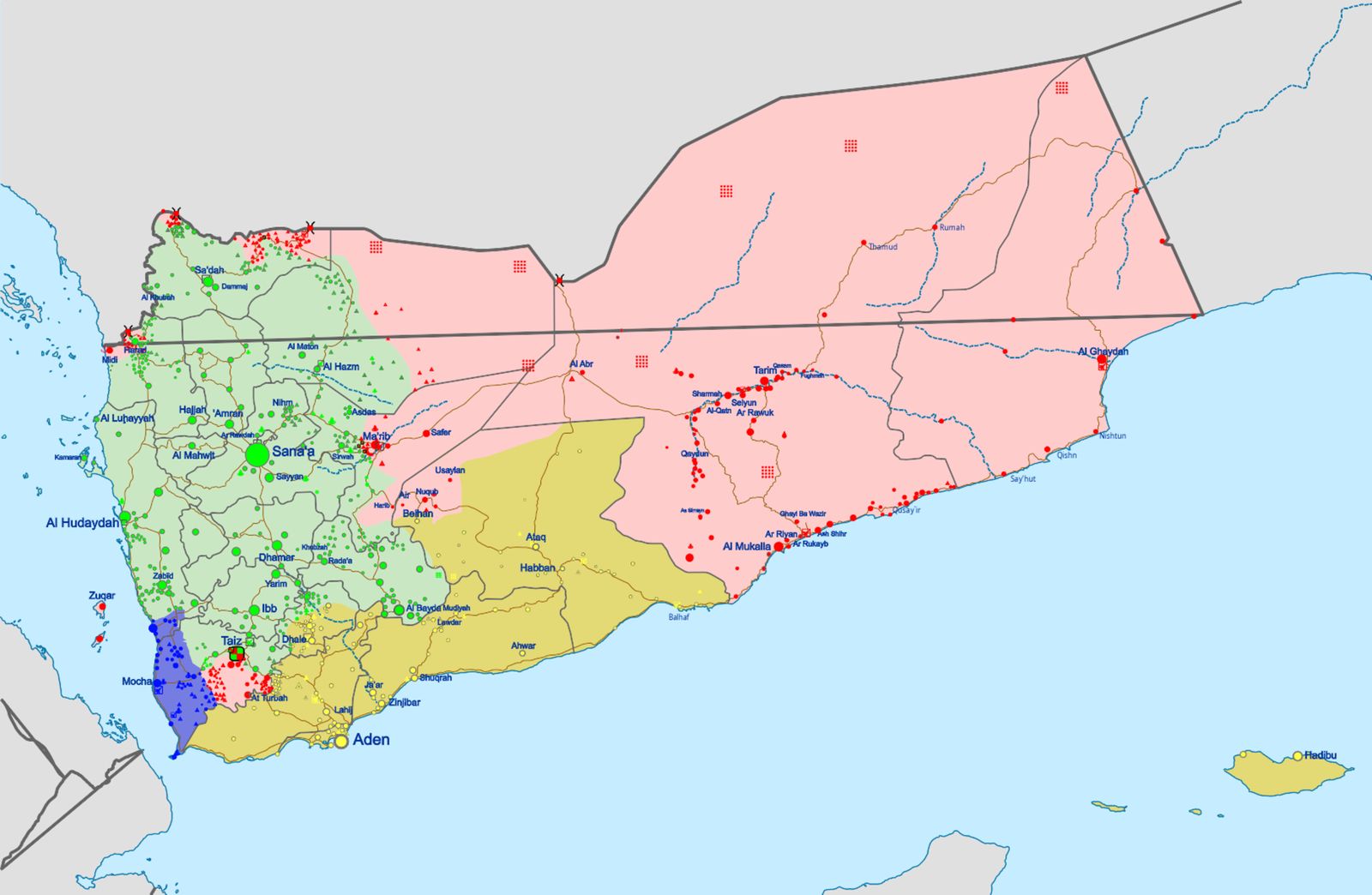
On the ground, the Saudi-backed offensive is the largest government operation in years. Yemeni officials, speaking on condition of anonymity because they were not authorized to talk to reporters, said forces from the National Shield, the Giants Brigades and the Tihama Resistance retook Dhubab — the town directly north of the Bab el-Mandeb Strait — plus Bab and Hadeid, with witnesses seeing government tanks entering the towns. The government's Defense Ministry went further and declared Mokha captured; but four government sources told Reuters the forces had only reached the city's outskirts late Monday, with Houthi fighters retreating into the highlands, and AFP's military sources would not confirm the capture either. The coalition's naval forces separately said they destroyed weapons depots and warehouses containing explosive-laden boats and naval mines in Hodeidah province, aiming to deny the Houthis the ability to threaten vessels in the strait and the Red Sea.
This follows the reported retaking of Dhubab district and an earlier cycle of Houthi missile attacks that injured a resident in Asir and damaged a school in Najran — each round now larger than the last.
The numbers behind the stakes
Strip away the claims and counter-claims and the arithmetic of this war is stark. The Bab el-Mandeb Strait has historically carried about 12 percent of global trade, including roughly 12 percent of maritime oil shipments — 6 to 7 million barrels a day — and about 8 percent of LNG trade. Before the Houthis began attacking vessels in late 2023, around 9 million barrels of oil passed through the strait daily, according to the Center for Strategic and International Studies; the violence more than halved that flow. International Energy Agency estimates put 2025 traffic at roughly 4.2 million barrels a day — about 5 percent of global oil production. The International Crisis Group counts more than 25,000 vessels and some $700 billion of cargo passing through in a normal year.
The alternative route tells you why markets flinch: diverting around the Cape of Good Hope adds roughly ten to fourteen days to an Asia–Europe voyage, plus fuel, plus war-risk premiums that reprice within days of any change in control. Saudi Arabia has been piping some 4 million barrels a day across the peninsula to its Red Sea ports precisely to avoid the Strait of Hormuz — making Bab el-Mandeb, in a real sense, the kingdom's backup energy artery. A war fought on both sides of that artery is not a local war for oil traders.
The human numbers are smaller but should not be minimized: three minor injuries at the Saudi airports is the confirmed toll so far. The Houthi-run Health Ministry claimed two people, including a child, were killed and seven wounded in Saudi airstrikes near Sanaa on Monday — claimed, and independently unverified. Three injuries versus a claim of two dead: the fog around casualty figures is itself part of the war.
Who gains, who loses
The Houthis gain reach. Even unverified claims against Riyadh's airport force the kingdom to spend on air defense and force airlines to price risk; a verified hit on two southern airports proves the threat is real. Their airline warning is leverage manufactured from thin air — but in aviation, leverage manufactured from thin air still moves markets.
The Saudi-backed Yemeni government gains territory — if the gains hold. Retaking Dhubab and pressing toward Mokha would loosen the Houthis' grip on the strait, which is exactly the outcome Riyadh, Europe and Washington want. The risk is the familiar one: advances announced on Monday have a habit of becoming contested front lines by Friday.
Saudi Arabia gains allies but absorbs risk. The Turkey-Pakistan commitment under the Makkah pact internationalizes its defense, but every Houthi missile that lands — or is merely claimed to have landed — tests the credibility of that shield. Civilian airports under attack is also a domestic political problem for a kingdom selling itself as a safe, modern destination.
Airlines and energy markets are the losers whatever happens next. EASA's misidentification warning is the industry's nightmare scenario in writing: the Houthis have hit aircraft on the ground before, though never a commercial airliner in flight. And every escalation around the strait is a tax on global trade that lands, eventually, in consumer prices.
What the reactions reveal
U.S. Secretary of State Marco Rubio said the Saudi-backed counterattack was expected — "they have a right to defend themselves" — and noted the U.S.-Saudi defense agreement without detailing coordination. European Commission President Ursula von der Leyen condemned the attacks as destabilizing the region and "undermining global energy security" — Brussels framing this first as an energy problem, which tells you where Europe's anxieties sit. The U.S. mission's vigilance advisory to its citizens in the kingdom is the quietest but most concrete signal: Washington believes the aerial threat to Saudi cities is real and ongoing.
What happens next: three scenarios
1. The strait is secured. If government forces consolidate around Dhubab and take Mokha — and the claims can be independently verified — Houthi leverage over shipping diminishes, war-risk premiums ease, and oil markets exhale. This is Riyadh's plan and Washington's hope.
2. The exchange escalates. The Houthis answer the air campaign with more strikes on Saudi airports, energy facilities and military bases; airlines begin avoiding Saudi airspace in practice rather than just in warnings; EASA advisories harden into restrictions. The war becomes a war of attrition between Saudi airpower and Houthi missiles — expensive for everyone, decisive for no one.
3. The front lines freeze around a new status quo. The government holds some coastal ground, the Houthis keep missile reach, and Bab el-Mandeb becomes a permanently risk-priced chokepoint — like the Strait of Hormuz has been at various points: open, but never cheap. For global trade, a permanently expensive strait is arguably worse than a briefly closed one.
Watch for three things in the coming days: whether Mokha's capture is independently confirmed or quietly walked back; whether Riyadh confirms or denies the claimed strikes on its capital's airport and the Rabigh refinery; and whether Turkey's and Pakistan's promised "forces and capabilities" materialize as hardware on the ground or remain a communiqué. In this war, the announcements arrive first and the evidence arrives later — if it arrives at all.
Sources
- Reuters: Two Saudi airports targeted on Monday as fighting with Yemen's Houthis escalates (Oct 6, 2026)
- The Wall Street Journal: Yemen's Houthi Rebels Strike Two Airports in Saudi Arabia (Oct 6, 2026)
- The National: Saudi airports attacked as Yemen's west coast battle intensifies (Oct 6, 2026)
- Associated Press: A Saudi-led coalition says its fighter jets are bombing Yemen's Iran-backed Houthi rebels (Oct 6, 2026)