Virtual Biology Initiative
Science / Biotechnology
The Virtual Biology Initiative is an unusually large wager on a simple diagnosis: biology's biggest artificial-intelligence bottleneck is not the model. It is the data. The US government, Meta, Google DeepMind, Isomorphic Labs and the Chan Zuckerberg Biohub announced a roughly $1.8 billion coalition on October 7 to produce open, standardized biological datasets and train models that can predict how cells behave under disease, treatment and environmental stress.
The ambition is often described as a “virtual cell,” but the phrase should not be mistaken for a perfect digital duplicate of human life. The practical target is a family of models that can forecast how specific cells change when a gene is switched off, a protein is altered or a candidate drug is introduced. If those forecasts become reliable, researchers could reject weak ideas in software before committing years of laboratory work and clinical development.
That is the attraction—and the danger. A model that narrows experiments could compress drug-development timelines. A model trusted beyond its evidence could send scientists confidently in the wrong direction. The initiative therefore rises or falls on the diversity, quality and accessibility of the measurements beneath it.
Why the announcement matters
Modern biology produces extraordinary quantities of information, but much of it is fragmented by laboratory, instrument, disease, tissue and experimental protocol. One project measures gene activity in immune cells; another maps proteins in tumors; a third records how organoids respond to thousands of perturbations. Those datasets may be excellent individually and still be difficult to combine.
General-purpose models improve when they encounter broad, consistently labeled examples. Biology has not yet assembled the equivalent at the required scale. Existing cell atlases cover hundreds of millions of cells, according to reporting on the initiative. The architects say useful general models may need observations numbering in the billions or trillions, with enough context to distinguish cell type, developmental stage, tissue environment, genetic background and experimental conditions.
The coalition is designed to attack the entire pipeline at once: government supercomputers and scientific instruments, nonprofit laboratories that can generate experiments at industrial scale, technology companies that know how to train large models, and a commitment to release the resulting datasets for wider research. That combination, rather than any one algorithm, is the real news.
How the $1.8 billion is assembled
The headline figure combines new commitments with major existing resources, so it should not be read as a single $1.8 billion check.
Meta, Google DeepMind and Isomorphic Labs: $300 million
The three companies are jointly committing $300 million. Meta brings experience building large-scale open models and data infrastructure. Google DeepMind brings the research lineage behind AlphaFold, which transformed protein-structure prediction. Isomorphic Labs, spun out of DeepMind to focus on drug discovery, represents the commercial end of the chain: turning model outputs into therapeutic programs.
Their participation signals that the industry sees biological datasets as strategic infrastructure. It also creates the initiative's sharpest governance question. Commercial funders are expected to receive limited embargo periods in which they can work with data before broad public release. That head start is part of the bargain for private capital, but its duration and scope will determine whether “open” means genuinely shared infrastructure or a delayed handoff after the most valuable insights have been captured.
Department of Energy: more than $500 million
The Department of Energy plans to contribute more than $500 million over five years through the Genesis Mission launched after President Donald Trump's November 2025 executive order. DOE's role is not incidental. Its national laboratories operate exascale supercomputers, advanced imaging facilities and automated laboratories suited to the enormous cycle of experiment, measurement, model training and validation.
In this vision, “self-driving” laboratories do not replace biologists. They automate repetitive experimental loops: a model proposes the most informative next perturbation, robotic systems run it, imaging and molecular instruments record the response, and the new result returns to the model. The efficiency gain comes from choosing better experiments, not merely conducting the same ones faster.
NIH and Biohub: data coordination and laboratory scale
The National Institutes of Health will coordinate access to more than $500 million worth of previous federal investments in biological datasets. That is a reminder that part of the coalition's value already exists; the challenge is making it interoperable, documented and useful for training across institutions.
The Chan Zuckerberg Biohub says it has committed $500 million since April to the effort and its experimental platform. Biohub sits at the center because the project needs more than cloud computing. It needs fresh, systematically generated measurements with controls, replication and metadata strong enough to support causal claims.
What a virtual cell would actually do
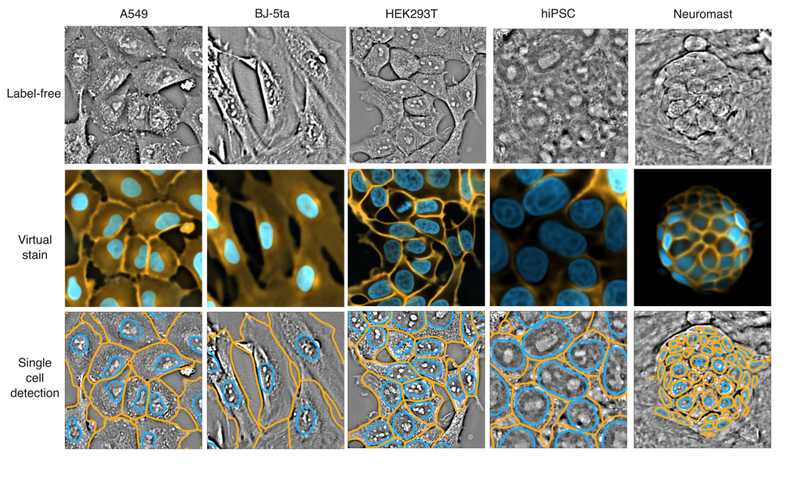
A cell is not a static diagram. It is a changing system in which genes, proteins, metabolites, membranes and neighboring cells interact over time. The same drug can help one cell type, harm another and do nothing to a third. Even genetically similar cells can respond differently depending on their environment and history.
A useful virtual-cell model would absorb multiple forms of evidence—gene expression, protein abundance, microscopy, spatial location and experimental perturbations—then predict a response that has not yet been measured. A scientist might ask what happens when a particular gene is disabled in a liver cell carrying a disease mutation, or which molecular intervention could reverse a cancer cell's resistant state.
The model's value would not come from producing a vivid animation. It would come from ranking hypotheses accurately enough to change which experiments researchers run. That is why the first benchmark is not whether a model can describe a known cell. It is whether it can predict an unseen intervention in a different laboratory and remain correct when conditions shift.
The initiative's public timetable reflects the difficulty. Organizers aim to release a first dataset in about a year and produce genuinely predictive models within five years. Even then, success would be incremental: useful forecasts in defined biological settings, not a universal simulation of the human body.
Why DeepMind and Isomorphic Labs matter
AlphaFold proved that machine learning could solve a scientific problem that had resisted decades of conventional computation. By predicting protein structures from amino-acid sequences, it gave researchers a powerful map of molecular shape. But structure prediction is only one layer of biology. A protein's shape does not by itself reveal how a cell will react when dozens of pathways change at once.
Virtual-cell modeling is therefore a harder sequel. It moves from relatively stable molecular structure toward dynamic, context-dependent behavior. DeepMind's presence brings credibility in scientific model design; Isomorphic Labs brings pressure to convert prediction into drug candidates; Meta adds large-model engineering and open-model experience. None can substitute for experiments that reveal whether a forecast is causal or merely correlated.
The collaboration also changes competitive dynamics. Biological data generated with public money and nonprofit laboratories can become an input to valuable commercial products. A well-designed arrangement can reward companies for contributing expertise while preserving a broad research commons. A poorly designed one can socialize data-generation costs while privatizing the earliest, most profitable discoveries.
The open-science bargain—and its embargo
The strongest case for the initiative is that high-quality biological data behaves like public infrastructure. Once standardized and released, the same dataset can support thousands of experiments, including work by universities and startups that could never afford to generate it independently. Open benchmarks also make competing models easier to compare and scientific claims easier to reproduce.
The commercial embargo complicates that ideal. A temporary exclusive window may be reasonable compensation for private funding, especially if the alternative is no funding at all. But the details matter: how long the window lasts, which datasets it covers, whether derived models must be shared, and whether independent researchers can audit the methods while the embargo is active.
Transparency should extend beyond the release date. The coalition will need clear documentation of sample provenance, consent, demographic representation, experimental failures and batch effects. A model trained on abundant cell lines from narrow populations can appear broadly capable while performing poorly on underrepresented groups or rare diseases.
The wider race to build biology foundation models
The announced coalition does not operate alone. NVIDIA, the Arc Institute and Tahoe Therapeutics are among the organizations linked to the broader push. Their roles span computing, open biomedical research and large-scale perturbation datasets. The competition is increasingly about who can connect three scarce assets: experimentally meaningful data, enough compute to train across modalities, and teams able to validate predictions in real laboratories.
That race could produce a “flight simulator for medicine”—a system researchers use to test possible interventions before touching a patient or committing to a costly trial. The analogy is useful only up to a point. Aircraft operate under well-characterized physical laws. Human biology contains feedback loops, evolutionary pressure and individual variation that no current model captures completely.
Still, even imperfect simulation can be valuable if uncertainty is measured honestly. Drug discovery loses enormous time and money on compounds that fail late. A model that rejects a fraction of those failures earlier, or identifies an overlooked target for a rare disease, could justify the investment without ever becoming a complete digital human.
Who wins, who could lose
Likely winners include academic laboratories that gain access to datasets and benchmarks beyond their own budgets; patients with diseases poorly served by today's trial-and-error pipelines; startups able to build specialized tools on shared data; and federal laboratories whose instruments and computing capacity become part of a nationally coordinated program.
The most exposed groups are those missing from the data. If samples overrepresent certain ancestries, tissues or disease stages, the resulting models may reproduce those gaps at scale. Smaller research groups could also lose influence if access to early data, compute and validation facilities concentrates decision-making among a few corporate and institutional partners.
Workers in conventional discovery labs are unlikely to disappear, but their roles may shift. Models can prioritize experiments; they cannot decide whether an unexpected result is contamination, measurement error or a new mechanism without human judgment. The near-term change is more likely to be a premium on scientists who can move between wet-lab biology, data engineering and model evaluation.
Four risks that could derail the plan
1. Scale without comparability
A trillion measurements are not useful if laboratories label them differently or if hidden protocol changes dominate the signal. Standardization is less glamorous than model training, but it may be the coalition's most important product.
2. Correlation mistaken for mechanism
Models can learn patterns that predict an outcome without identifying why it happens. In medicine, a confident shortcut can fail when moved to a new hospital, population or disease context. Prospective experiments must remain the standard for deciding whether a prediction generalizes.
3. Open data narrowed by commercial capture
Embargoes that are too long or broad could leave public researchers perpetually behind. Clear release schedules, independent governance and public reporting on who receives early access would make the arrangement more credible.
4. A five-year promise meets federal politics
Large science programs cross budget cycles, leadership changes and shifting priorities. DOE's five-year commitment and NIH coordination will require sustained appropriations, durable interagency agreements and protections against fragmented procurement. The technical plan can be coherent and still be weakened by inconsistent funding.
What happens next
The first milestone is expected in roughly one year: a dataset large and standardized enough for outside researchers to inspect, benchmark and challenge. That release will reveal whether the coalition's commitment to openness survives the practical work of consent, licensing, quality control and commercial embargoes.
Over the following years, the meaningful scorecard will be experimental. Can a model predict the effect of a perturbation it has never seen? Does that prediction reproduce in another laboratory? Does it work across cell types and genetic backgrounds? Can it identify a candidate intervention that succeeds more often than existing methods?
If the answer is yes in even a narrow set of diseases, the Virtual Biology Initiative could change how research questions are chosen. If the answer is no, the datasets may still become a durable public asset. The coalition's most defensible outcome is not a digital replica of life by 2031. It is a better empirical foundation on which the next generation of biology can be built.
Sources
- Reuters: US government and technology companies join $1.8 billion virtual-biology push
- Chan Zuckerberg Biohub: Virtual Biology Initiative expansion
- Techstrong.ai: Federal and industry partners launch Virtual Biology Initiative
- Analytics Insight: funding and partnership overview
- Startup Fortune: what a virtual-cell model could mean for medicine
- Unite.AI: Biohub, DOE and NIH investment breakdown
- Bioengineer.org: coalition and open-data goals
- AI Weekly: partners and initiative timeline