War · Middle East · Iran
The United States and Iran exchanged fire directly on Tuesday for the first time in this five-day Gulf crisis. US strikes Qeshm Island — American fighter jets firing precision munitions at an Islamic Revolutionary Guard Corps missile launch site in the Strait of Hormuz — came hours after Iran’s third drone attack in five days against Bahrain, where the IRGC said it had targeted a US military radar at Sheikh Isa Air Base. What happened to that radar is disputed, and the dispute is the story in miniature: CENTCOM says every drone was intercepted without damage and has labelled the IRGC’s radar-hit claim false, while no US damage assessment for the Qeshm strike has been released at all.
Track it live: Iran war tracker — https://signalpostnews.com/tracker/iran-war — and the wars tracker — https://signalpostnews.com/tracker/wars — for the Qeshm strike, the Bahrain interceptions and the Hormuz shipping war as they develop.
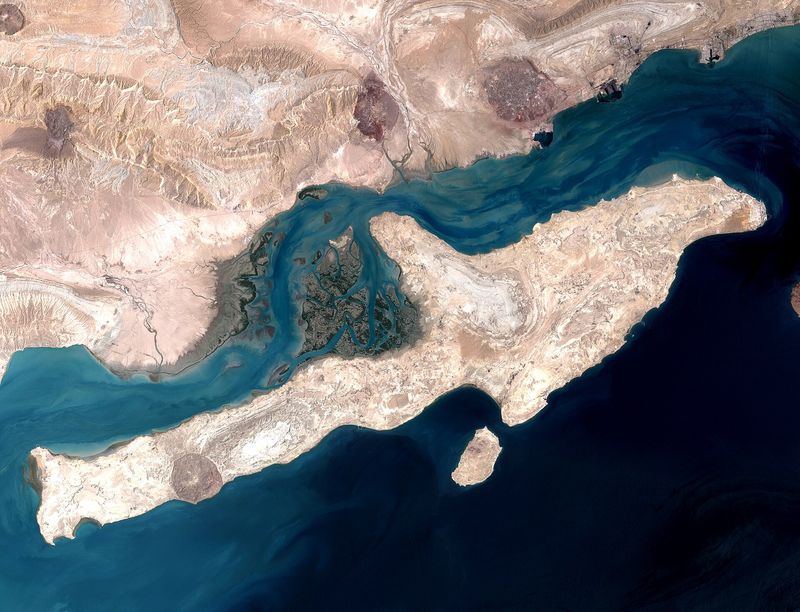
QESHM ISLAND, Strait of Hormuz, November 17, 2026 — US fighter jets fired precision munitions on an Islamic Revolutionary Guard Corps (IRGC) missile launch site on Qeshm Island on Tuesday, a US military official said, describing the operation as self-defence undertaken in response to IRGC aggression targeting US personnel and assets. The US strikes Qeshm Island mission was Washington’s answer, delivered the same day, to the third Iranian drone attack on Bahrain in five days — an attack in which the IRGC said its combat drones targeted a US military radar system at Sheikh Isa Air Base. On the outcome of that attack there is no agreement, and this article keeps the two accounts separate, because they cannot honestly be merged. US Central Command (CENTCOM) said multiple Iranian one-way attack drones launched toward Bahrain were intercepted without any damage to US equipment or injury to American personnel, and it labelled the IRGC’s radar-hit claim false. The Bahrain Defence Force said its air defences intercepted and destroyed the incoming attacks before they reached their targets, and reported no casualties or damage. The radar, on the American and Bahraini account, was not hit. On the Iranian account, it was targeted. Targeted is a claim about intention; hit would be a claim about fact, and no fact of a hit has been established by anyone outside Tehran’s own statements.
The Qeshm strike carries the same discipline in the opposite direction. The United States has released no damage assessment for the missile launch site it struck, and this article does not supply one: the site was struck, on the US account, with precision munitions by fighter jets, and what those munitions achieved is, as of publication, unassessed in public. Iranian media, citing a Hormozgan provincial official, said the US attack caused no damage to residential, commercial or critical infrastructure areas, and residents reported hearing five to six explosions on Tuesday evening, Iran’s IRNA news agency reported. That is the Iranian account of the strike’s effects, attributed here as such; it addresses civilian and critical infrastructure, and it neither confirms nor denies military damage at the launch site itself. Between an American strike with no published assessment and an Iranian statement about infrastructure, the verified residue is deliberately thin: jets flew, munitions fell, explosions were heard, and neither capital has yet shown the world what was destroyed — if anything was. In a war that has repeatedly turned on the gap between claims and proof, Tuesday’s exchange was fought, on both sides, inside that gap.
What happened on Tuesday
The day’s sequence, as the primary statements and the wire reporting establish it, ran in two movements, one over Bahrain in the morning and one over Qeshm Island by evening. Earlier on Tuesday, the IRGC announced that its combat drones had targeted a US military radar system at Sheikh Isa Air Base in Bahrain. Bahrain’s own morning followed the pattern this newsroom documented in its first report of the day: warnings to residents, explosions heard in Manama, and then the official accounting. That accounting, when it came in full, came from two directions at once. CENTCOM stated that multiple Iranian one-way attack drones launched by the IRGC toward Bahrain had been intercepted without any damage to US equipment or injury to American personnel, and it labelled the IRGC’s claim to have struck the radar false. The Bahrain Defence Force’s General Command stated that Bahraini air defences had intercepted and destroyed the incoming attacks before they reached their targets, that air-raid alerts had been issued to residents, and that no casualties or damage were reported. Our full report on the morning’s interceptions and the radar claim is here: Bahrain Intercepts Iranian Drones as Tehran Claims US Radar Target at Sheikh Isa.
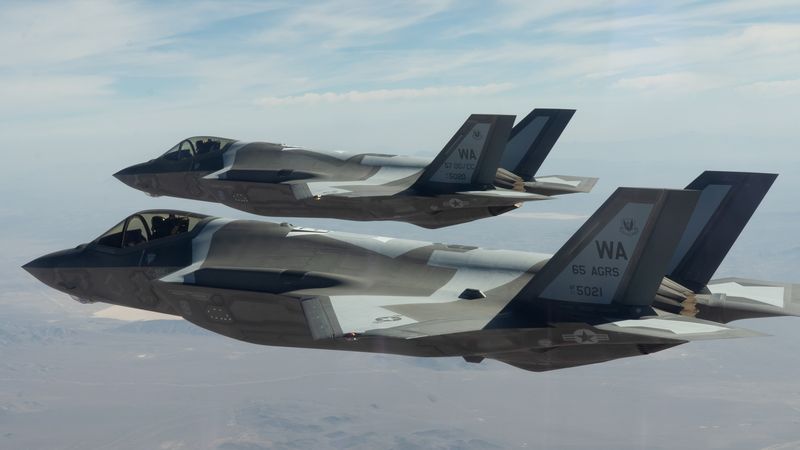
The second movement came hours later and hundreds of miles north-east, at the mouth of the Gulf. A US military official, speaking to Reuters and CBS News, said US fighter jets had fired precision munitions on an IRGC missile launch site on Qeshm Island, the long Iranian island that sits in the Strait of Hormuz itself, and characterised the strike as a self-defence operation mounted in response to IRGC aggression. USA Today’s account of the same briefing carried the same elements: fighter aircraft, precision munitions, a missile launch site, self-defence. Iranian media then carried Tehran’s first account of effects: the Hormozgan provincial official’s statement, via Iranian outlets, that residential, commercial and critical infrastructure had not been damaged, and IRNA’s reporting of five to six explosions heard by residents on Tuesday evening. No US damage assessment accompanied the American announcement, and none had been published by the time this article was written. The exchange — drones intercepted over Bahrain, jets over Qeshm — took place, Reuters noted, despite ongoing talks between Iran and the mediators Oman and Qatar, a juxtaposition that has defined this war’s diplomacy for months: the conversation and the shooting proceeding on parallel tracks, each apparently unable to stop the other.
The five-day pattern: November 13, 15 and 17
Tuesday’s Bahrain attack was not an isolated launch, and the Qeshm strike cannot be understood outside the rhythm that preceded it. On Friday, November 13, the IRGC claimed an attack on a US early-warning radar facility in Bahrain; CENTCOM answered that it had intercepted two Iranian drones with no damage. On Sunday, November 15, Bahrain said its air defences intercepted several Iranian aerial attacks, and the IRGC claimed six drones had targeted a US air-defence radar at the Al-Rifaa helicopter base. On Tuesday, November 17, the pattern completed its third iteration: a launch at Bahrain, a named radar — this time at Sheikh Isa — and, on the defending side’s account, a clean interception with no damage and no injuries. Three attacks in five days, three radar claims, and, on the verified record, zero confirmed hits. This newsroom’s account of the first round, with the Hormuz tanker claims of the same day handled under the same evidentiary discipline, is here: Iran Guards Claim US Radar Strike in Bahrain as Hormuz Tankers Are Hit.
What changed on Tuesday was not the pattern but the response to it. Friday’s and Sunday’s rounds were answered, on the record, with words: interception statements, a false label, and, on Monday, a condemnation delivered by Secretary of State Marco Rubio in a call with Bahrain’s foreign minister. Tuesday’s round was answered with precision munitions on Iranian territory — or, more precisely, on the Iranian island that guards the strait through which the week’s other war, the tanker war, is being fought. The escalation is real but it is also, so far, carefully bounded: the American strike was framed by its own author as self-defence, aimed at a missile launch site rather than at the radar war’s mirror image, and unaccompanied by any claim of destruction that Washington would later have to defend. Tehran’s public response, in turn, was a provincial official’s no-infrastructure-damage statement rather than a new threat. Both capitals, in other words, fired and then described their fire in the most limited language available to them. Whether that discipline is a ceiling or merely a pause is the question the next round, if there is one, will answer.
Why this matters
Analysis. Begin with geography, because Qeshm is not an incidental target. The island lies in the Strait of Hormuz, the narrow waterway between Iran and the Arabian Peninsula through which roughly a fifth of the world’s oil consumption passes. A missile launch site on Qeshm does not merely threaten the Gulf’s air bases; it sits astride the energy artery whose security is the premise of the entire American position in the region. Striking it therefore sends two messages in one sortie: retaliation for Bahrain, addressed to Tehran, and reassurance about the strait, addressed to every shipping desk, insurer and energy ministry watching a week in which a tanker was struck twice off Khasab and its crew left unaccounted for — the subject of our companion report, Hormuz Tanker Struck Twice, Crew Unaccounted For After Second Hit Off Khasab. A launch site in the strait is both a military asset and a piece of leverage over world oil, and a strike on it is priced by both audiences at once.
Second, the cycle itself. After a Gulf lull that had lasted roughly two months, the Bahrain rounds restarted a tit-for-tat rhythm — and Tuesday added the element the rhythm had been missing: direct American fire on an Iranian military site in answer to an Iranian launch at an American host. Escalation ladders are climbed one reciprocal rung at a time, and the significance of a rung is measured less by its size than by the precedent it sets for the next one. The precedent set on Tuesday is that a drone attack on Bahrain, even one intercepted without damage, can now draw a strike on Iran itself. That lowers the threshold for the next exchange in both directions: Tehran knows the price of a launch has risen, and Washington knows it has publicly attached that price to launches that, on its own account, did no harm. If a fourth Bahrain round comes and no Qeshm answer follows, the silence will be read as carefully as Tuesday’s strike was.
Third, the framing war, which both sides are plainly fighting as deliberately as the air war. Washington’s word was self-defence; CENTCOM’s word for the radar claim was false; Manama’s account was interception before impact, no casualties, no damage. Tehran’s framing cast its drones as a response and its island as undamaged where it matters to civilians. Every one of those formulations is an attempt to keep the exchange inside the category of the limited and the defensive — to fire, in effect, without declaring that a new phase has begun. The Oman and Qatar mediation track is the institutional version of the same effort, and it continued, per Reuters, through the very day of the exchange. The danger in such carefully worded cycles is not that either side wants the wider war; it is that the wording only controls the intentions of the side doing the wording. Interceptors miss, munitions stray, crews are unaccounted for — the strait has supplied an example of each failure mode this week already — and a cycle built on precision language can be broken by a single imprecise outcome.
Context and background
The war that produced Tuesday’s exchange began on February 28, 2026, with US-Israeli strikes on Iran, and its Gulf chapter has run through blockade, mine-clearing disputes and a tanker war that has repeatedly closed and reopened the question of whether shipping can move safely through Hormuz. Qeshm Island has been part of that chapter from early on. The island hosts Iranian military sites positioned over the strait’s traffic separation scheme, and it has been struck before in this war — including US operations on the island earlier this month that this newsroom covered on November 2 and November 7. Tuesday’s strike is therefore not the opening of a new front but the reopening of an existing one, against a target set American planners have visited before. That history cuts both ways analytically: it means the strike fits an established pattern of pressure on Iran’s strait-side missile infrastructure, and it means Tehran has had repeated occasion to disperse, harden or duplicate exactly the kind of launch capacity that was struck — one more reason the absence of a US damage assessment matters, and one more reason no claim about the site’s destruction should be made without one.
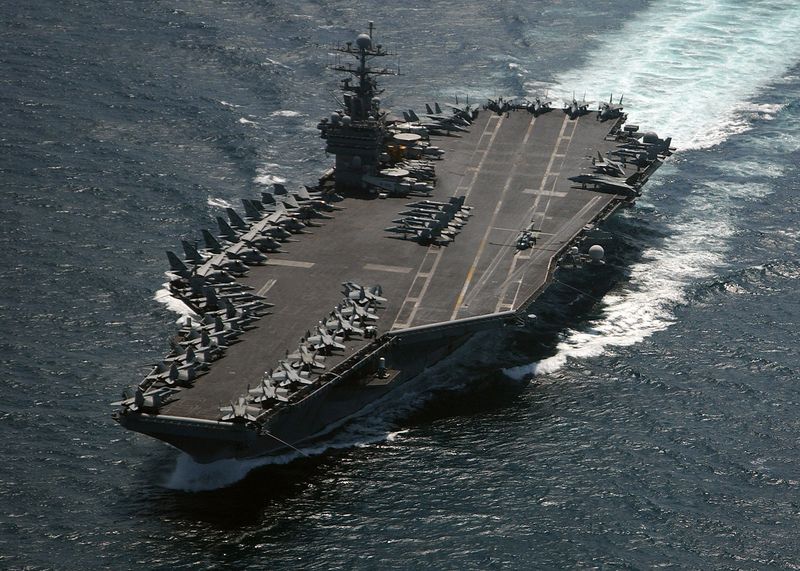
The shipping context is the week’s other constant. The strait carries about a fifth of global oil consumption and a comparable share of liquefied natural gas, and the days surrounding Tuesday’s exchange have been among the most dangerous of the autumn for the crews who move it: a third US carrier strike group arriving in the region, tankers hit in sequence, and, on Tuesday itself, the twice-struck tanker off Khasab whose crew’s status remained unconfirmed. The Bahrain drone campaign and the Qeshm strike are sometimes reported as separate stories — an air story and a sea story. They are one story. The radars Tehran keeps naming are part of the sensor architecture that protects the hosts of American sea power; the launch sites Washington keeps striking are part of the missile architecture that holds the strait at risk; and the strait is where both architectures meet the world economy. Tuesday simply made the unity visible in a single day’s headlines.
Multiple angles
The American angle is deterrence restored at a chosen price. On Washington’s account, its personnel and equipment were attacked for the third time in five days, its ally’s defences and its own statements absorbed the first two rounds, and the third drew fire — limited, military, and framed as self-defence. The restraint in the framing is part of the policy: a damage assessment withheld, a target described by function rather than by effect, a legal characterisation offered in place of a threat. The Iranian angle is retaliation answered and absorbed. On Tehran’s account, its drones targeted an American radar in response to American conduct it has protested all week, and the American answer fell on Qeshm without damaging the island’s civilian or critical infrastructure — a formulation that simultaneously denies Washington a visible success and avoids conceding a military loss. The Bahraini angle is the host’s exposure, now with an American strike attached to it: the kingdom’s skies were the battlefield in the morning, its air defences supplied half the interception account, and its residents spent another day inside the warning-and-all-clear cycle that has become the rhythm of hosting American power in this war.
The mediators’ angle is the narrowest and may be the most consequential. Oman and Qatar have kept a channel open through exchanges that were supposed, in the logic of mediation, to make further exchanges less likely. That the channel survived a day on which both principals fired is evidence for its durability; that the firing happened anyway is evidence about its limits. The market and shipping angle is exposure without, so far, a verdict: this article states no Tuesday oil price, because none is in the verified reporting it relies on, and the strait’s traffic will deliver its own judgement in transits attempted, delayed or declined over the coming days. Each of these angles is presented here as its holder presents it. Signal Post News takes no side among them; it notes only that the verified facts — interceptions claimed by two governments, a strike acknowledged by its author, damage unassessed by anyone in public — are considerably narrower than any of the frames built on them, and it has written this article to the width of the facts.
Data in context
The numbers that can be stated with confidence about this five-day sequence fit in a short ledger, and their shortness is itself the finding. Three claimed Iranian drone attacks on Bahrain in five days: Friday November 13, Sunday November 15, Tuesday November 17. Zero casualties and zero damage reported by Bahrain or the United States across Tuesday’s exchange, on either side of it: CENTCOM reported no damage to US equipment and no injuries to American personnel from the drones, and the Iranian provincial account reported no damage to residential, commercial or critical infrastructure from the strike. Five to six explosions were reported heard by Qeshm residents on Tuesday evening, per IRNA. One missile launch site was the stated target of the US strike, and no damage assessment for it has been released. Around the ledger sit the week’s larger figures: a third US carrier strike group arriving in the region, and a strait carrying roughly a fifth of the world’s oil consumption past the island that was struck. A crisis in which the confirmed numbers are this small, and the unconfirmed claims this large, is a crisis being fought substantially in the space between the two — which is why this newsroom counts only what can be counted, and labels the rest.
What happens next
The first marker is documentary. A US damage assessment for the Qeshm strike — or a CENTCOM statement describing effects — would convert Tuesday’s most consequential unknown into a fact, and would tell Tehran, and everyone else, how Washington intends the strike to be read: as a one-for-one answer now closed, or as the first entry in a new ledger. Its continued absence will be read too. The second marker is behavioural: whether a fourth Bahrain round follows, and on what interval. The five-day pattern ran on a two-day beat — Friday, Sunday, Tuesday. A launch on Thursday would confirm the beat and force the question Tuesday posed in its sharpest form: does an intercepted attack draw another strike on Iran, and if so, at what target, and with what cumulative effect on the mediation track? Silence through the end of the week would suggest, though not prove, that the Qeshm answer was received as the price of the third round rather than the opening of a fourth.
The third marker is diplomatic. The Oman and Qatar channel continued through Tuesday’s fire; whether it can convert a one-day exchange into a renewed pause depends on whether both capitals prefer the limited language they used on Tuesday to the alternatives. The fourth marker is at sea: the status of the twice-struck tanker’s crew off Khasab, the routing guidance of the maritime authorities, and the willingness of owners and insurers to keep sending hulls through a strait whose northern island was struck by fighter jets on Tuesday evening. The exchange of November 17 was, by the standards of this war, small: drones intercepted, a launch site struck, no casualties reported by either government, and no damage confirmed by anyone. Wars, however, are rarely widened by the exchanges that look large at the time. They are widened by small exchanges that teach each side the other’s thresholds — and by the next small exchange, which tests whether the lesson was learned correctly. The Gulf has now run that experiment three times in five days. What Tuesday added is the knowledge that the United States will answer in kind, on Iranian ground, at the mouth of the strait. What nobody yet knows is what that answer destroyed, and whether it will be the last one the week requires.
Related coverage: Bahrain Intercepts Iranian Drones as Tehran Claims US Radar Target at Sheikh Isa (Tuesday morning’s interceptions and the radar claim) · Hormuz Tanker Struck Twice, Crew Unaccounted For After Second Hit Off Khasab · Iran Guards Claim US Radar Strike in Bahrain as Hormuz Tankers Are Hit (the November 13 round) · Iran war tracker · Wars tracker
Sources
Reuters, November 17, 2026 — reporting from Dubai: the US and Iran exchanged fire on Tuesday, with the US striking an Iranian missile launch site on Qeshm Island after Iran said it targeted a US military radar system in Bahrain, despite talks between Iran and mediators Oman and Qatar; a US military official described precision munitions fired by US fighter jets in response to IRGC aggression; Iranian media citing a Hormozgan provincial official reported no damage to residential, commercial or critical infrastructure. CBS News, live updates, November 17, 2026: US precision strikes on an IRGC missile site on Qeshm Island, described by a US military official as self-defence; CENTCOM’s statement that the Bahrain attack drones were intercepted. USA Today, November 17, 2026 — “US strikes missile launch site on Iran’s Qeshm Island”: US fighter jets, precision munitions, self-defence, per a US military official. US Central Command (CENTCOM), statement, November 17, 2026: multiple Iranian one-way attack drones launched toward Bahrain were intercepted without any damage to US equipment or injury to American personnel; the IRGC radar-hit claim labelled false. Bahrain Defence Force General Command, statement, November 17, 2026: Bahraini air defences intercepted and destroyed the incoming attacks before they reached their targets; air-raid alerts issued; no casualties or damage reported. IRNA, November 17, 2026: residents reported five to six explosions on Qeshm Island on Tuesday evening. The morning’s Bahrain interceptions are as reported in this newsroom’s earlier coverage: Reuters, November 17, 2026, on the Bahrain interceptions and the Sheikh Isa radar claim. No US damage assessment for the Qeshm strike had been released at publication, and no claim in this article states that the missile site was destroyed or that the Sheikh Isa radar was hit; both outcomes are reported exactly as the responsible authorities have characterised them. Photographs: NASA satellite view of Qeshm Island, U.S. Air Force F-35A fighters, and U.S. Navy aircraft carrier in the Persian Gulf (U.S. Navy photo 050322-N-4308O-171), all public domain via Wikimedia Commons; all are file photographs and none depicts Tuesday’s strike or interceptions.