War · U.S. Military
US boat strike Pacific: a go-fast vessel was destroyed in the Eastern Pacific on Oct. 27 and five people were killed, U.S. Southern Command said — pushing one outside tally of the campaign to 243 dead, with no evidence for this strike released publicly and no one aboard identified.
Track it live: Live Global Trackers — Wars
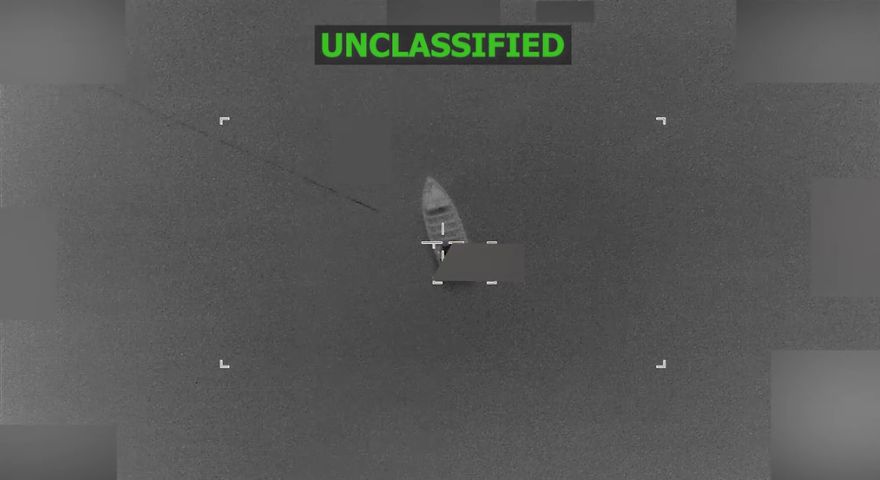
EASTERN PACIFIC — On Oct. 27, under the direction of U.S. Southern Command, Joint Task Force Western Hemisphere executed a lethal kinetic strike on a go-fast vessel operating along established narco-trafficking routes in the Eastern Pacific, SOUTHCOM said in a statement posted on X on Tuesday. Five people were killed.
SOUTHCOM said confirmed intelligence showed the vessel was actively involved in drug trafficking, and it described those killed as “narco-terrorists.” The command released no evidence publicly to support that account, and it did not identify the five people who were killed, according to Reuters and USNI News, which both reported the strike on Tuesday. The still image SOUTHCOM released shows the vessel from above, in a targeting view, in the moments before it was hit.
That combination — a lethal strike announced in a short public statement, a characterization of the dead offered without names, and evidence described but not shown — has become the recurring shape of this campaign. Tuesday’s announcement followed it exactly, and it landed in the middle of three arguments that have run alongside the strikes since they began: an argument about the numbers, an argument about whether the strikes are working, and an argument about whether they are lawful.
Two tallies, and no official running total
The first argument is about arithmetic, and it is worth handling carefully, because the figures in circulation do not come from the same place. USNI News, which has tabulated the strikes as they are announced, puts the total number of people killed in the Southern Command strike campaign at 243 with Tuesday’s five deaths included. Reuters, in its report of the same strike, puts the toll differently: it reports that the strikes in the Caribbean and the Eastern Pacific since September 2025 have killed more than 230 people.
Those are different tabulations, compiled by different news organizations working from the same stream of official announcements, and neither of them is an official running total published by SOUTHCOM itself. The command announces strikes one at a time; it does not maintain a public cumulative count that outside tallies can simply be checked against. The gap between 243 and “more than 230” is therefore not, on its face, a contradiction — it is what happens when a campaign is counted by the people covering it rather than by the institution running it. What both figures agree on is the scale: well over two hundred people killed at sea in a campaign that is now in its second year.
Tuesday’s strike was at least the third deadly SOUTHCOM strike this month. An Oct. 4 strike in the Caribbean killed four people, according to earlier reporting — a pace of roughly one lethal strike every week to ten days in October alone, on the public record.
The administration’s case — and what the overdose data show
President Donald Trump’s administration has made its case for the campaign in consistent terms: it says the vessels struck since September 2025 were transporting narcotics, and it has touted the strikes as a factor in lowering fatal overdoses in the United States. On that telling, the boats are not a law-enforcement problem to be managed but a supply line to be cut, and cutting it saves American lives.
The publicly available data do not currently show that effect. Data from the Centers for Disease Control and Prevention do not show a noticeable decrease in overdoses since the first strike was announced in September 2025, USNI News reported, citing CDC figures — and overall U.S. overdoses have been decreasing since September 2023, two years before the first boat was struck, which makes it difficult to attribute any recent movement in the numbers to a campaign that began in the autumn of 2025.
There is also a route problem in the administration’s account, and it is a matter of official record rather than opinion. Fentanyl — the drug driving the American overdose crisis — typically enters the United States through the U.S.-Mexico border in passenger vehicles, with supplies often originating in China, according to Government Accountability Office reports. A go-fast vessel destroyed in the Eastern Pacific is, by geography, on a different route: whatever such a vessel carries, its destruction does not directly interrupt the border-crossing traffic that the GAO describes as fentanyl’s usual path into the country. Supporters of the strikes do not generally dispute the geography; their argument is broader — that disrupting maritime trafficking raises costs and constricts supply overall. The data check stands on its own terms either way: the specific benefit the administration has claimed, a visible fall in overdoses since September 2025, is not visible in the CDC numbers as reported.
The critics: ‘unlawful extrajudicial killings’
The legal argument is sharper than the statistical one. Human Rights Watch, Amnesty International and independent United Nations experts have called the strikes unlawful extrajudicial killings, according to Reuters. The American Civil Liberties Union has described the administration’s assertions against the people targeted as “unsubstantiated, fear-mongering claims,” Reuters reported.
The most formal version of that criticism came in September, when the United Nations found reasonable grounds to believe the killings constituted murder under international law, and warned that the campaign could amount to crimes against humanity, as the finding was reported at the time. That is the language of international criminal law applied to a policy its authors describe in the language of counter-narcotics — and the distance between those two vocabularies is, in the end, the whole dispute. The administration’s position treats the people on the boats as combatants in an armed conflict with cartels it has designated as terrorist organizations. Its critics treat them as suspects in a crime, entitled to arrest and trial rather than a missile. Both positions cannot be right about the same facts, and the facts that would settle much of the argument — what each vessel carried, and who was aboard — are precisely the facts that have not been released.
A second track: working with allies
Running alongside the strike campaign is a quieter diplomatic one. Last month, Secretary of State Marco Rubio said the United States would work with regional allies as the “most effective” way to take on trafficking, the Associated Press reported, via USNI News. That formulation — interdiction as a shared, allied enterprise — describes the model that preceded the strikes for decades: partner navies and coast guards stopping vessels, seizing cargo and arresting crews. Rubio’s remarks did not announce an end to the strikes, and Tuesday’s strike shows they have not ended. But they point to a second track existing in parallel, and whether it grows or remains rhetorical is one of the open questions hanging over the campaign.
Why this matters
A lethal-force-at-sea campaign does something larger than destroy individual vessels: it normalizes a new default. For decades, the standard response to a suspect boat in the Caribbean or the Eastern Pacific was interdiction — stop the vessel, board it, seize what it carried and arrest the people aboard, who then faced prosecution and could, in court, contest what the government said about them. A strike replaces every step of that sequence with a single irreversible one. Once that substitution is made often enough, it stops looking like an exception and starts looking like policy.
Destruction also destroys the record. A sunk vessel takes its cargo with it — the cargo that could prove what it actually carried. It takes its navigation data, its communications, and the physical evidence that could establish who was aboard and what they were doing. In an interdiction, the evidence is the point: it is what a prosecution is built from, and it is what allows an official claim to be tested. In a strike, the claim is all that remains, and it cannot be tested afterward by anyone outside the chain of command that made it. That asymmetry — not any single strike — is what the legal fight is really about, and that fight is now moving toward the courts even as the strikes themselves continue on their own tempo.
Background: a campaign that began in September 2025
The campaign began in September 2025, when the administration announced its first lethal strike on a vessel it said was trafficking narcotics, and it has continued since across two bodies of water — the Caribbean and the Eastern Pacific — under Southern Command, with Joint Task Force Western Hemisphere executing strikes like Tuesday’s. Signal Post News has followed the campaign as it has widened, including a Caribbean strike earlier this month that marked the campaign’s 71st hit, and the legal battle over its justification, including a federal judge’s rejection of the administration’s bid to keep its secret boat-strike memo sealed. Read together, that coverage traces the same arc Tuesday’s strike extends: a tempo of strikes that has not slowed, a death toll counted by news organizations because no official count is published, and a legal justification that remains, in large part, out of public view.
What happens next
Four questions will decide where this goes. The first is in the courts: challenges to the secret legal justification for the strikes are working through the judiciary, and each ruling narrows or widens the space the administration has to operate in. The second is in Congress, where scrutiny of the campaign — its legal basis, its evidence standards and its results — has grown with the toll and is unlikely to shrink while the strikes continue. The third is evidentiary: whether the government ever releases, for any individual strike, the intelligence it says it holds — the cargo, the identities, the basis for the “narco-terrorist” designation applied to people who are never named. And the fourth is operational: whether the allied-interdiction approach Rubio described last month changes the tempo of the strikes, supplements them, or simply runs alongside them. Tuesday’s announcement, five more people the public cannot name, suggests that for now the campaign’s rhythm is unchanged.
Sources
Reuters, “US military says it struck vessel in Eastern Pacific, killing five” (Oct. 27, 2026); USNI News, “U.S. Forces Kill 5 in Strike on Suspected Narco Boat” (Oct. 27, 2026); U.S. Southern Command statement on the Oct. 27 strike, posted on X (Oct. 27-28, 2026); CDC overdose data and Government Accountability Office reporting on fentanyl routes, as cited by USNI News.