
Washington banned transactions with the Hague court and threatened its service providers, just hours after the Nobel Committee honored Navi Pillay — a former ICC judge — for defending international law. The collision of the two events tells you everything about the state of global justice.
THE HAGUE — The US sanctions ICC Nobel Peace Prize story became a direct institutional confrontation on Friday: the Trump administration sanctioned the International Criminal Court itself only hours after Navi Pillay, an 85-year-old former ICC judge, received the 2026 Nobel Peace Prize for her defense of international law.
The order marks a sharp escalation. Washington had already penalized individual prosecutors and judges. This time, it moved against the court as an institution, barring transactions and warning companies that supply banking, technology, legal, travel and other services that their own exposure may depend on whether they continue doing business with the ICC.
Secretary of State Marco Rubio framed the decision in uncompromising terms: “President Trump will never allow the International Criminal Court to prosecute Americans. That is why, today, the United States is sanctioning the International Criminal Court. We will ban transactions with this rogue court, cutting off their resources and crippling its ability to operate.”
Why this matters
The decisive change is the target. Sanctioning named officials can freeze their assets, constrain their travel and complicate their personal finances. Sanctioning the court itself can reach the operational plumbing of an international institution: accounts, insurance, software, cloud hosting, payroll, vendors, contractors and outside counsel. Even companies not directly covered by U.S. law may pause service rather than test the boundaries of American enforcement.
That is why the timing carried as much symbolic force as the legal order. The Nobel Committee presented Pillay’s award as a defense of courts and judges facing political attack. Washington answered within hours with the broadest American pressure measure yet against the ICC. Each side cast its move as protection of a legal order; each defined the threat differently.
For the Trump administration, the danger is an international court asserting authority over citizens or allies of countries that never joined it. For the court and its supporters, the danger is a powerful non-member using financial leverage to obstruct investigations authorized by the court’s member states. Friday’s collision moved that argument from speeches and personal penalties into institutional survival.
How the U.S.–ICC feud reached this point
The ICC was created in 2002 to prosecute genocide, crimes against humanity and war crimes when national systems cannot or will not act. It is based in The Hague and counts 125 member states, including every European Union country and every NATO member except the United States and Turkey.
Washington’s conflict with the court stretches across administrations, but two cases drove the latest escalation. The first was an investigation into alleged abuses by U.S. personnel in Afghanistan, a matter the court later closed. The second was the ICC’s 2024 issuance of arrest warrants for Israeli Prime Minister Benjamin Netanyahu and former defense minister Yoav Gallant over alleged war crimes in Gaza. Israel rejects the allegations and, like the United States, is not an ICC member.
Rubio has described the administration’s policy as a campaign to dismantle what it views as an illegitimate threat. Before Friday, the United States had sanctioned 13 ICC personnel. In a September speech to the United Nations General Assembly, Trump urged member states to leave the court, arguing that it lacked jurisdiction over the United States and had become hostile to American sovereignty.
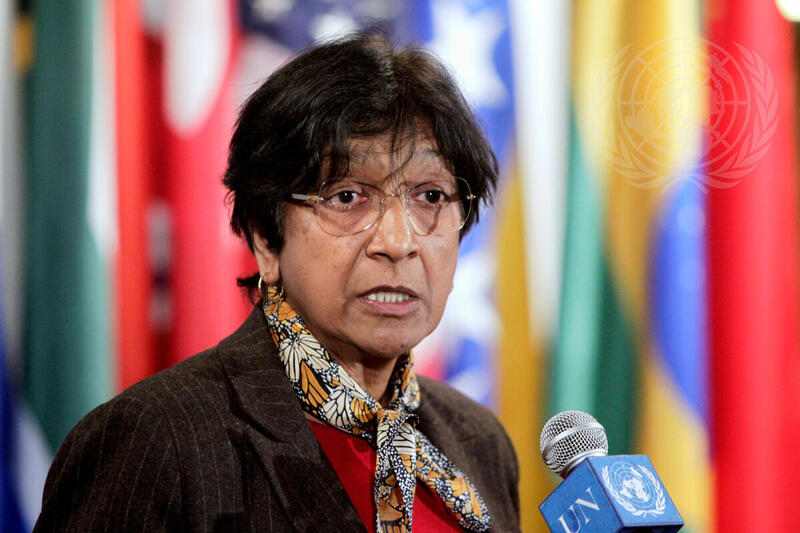
Navi Pillay’s career and the Nobel Committee’s message
Pillay’s biography made the same-day sequence especially pointed. A South African anti-apartheid lawyer, she became the first woman to open a law practice in Natal in 1967. As a judge on the tribunal for Rwanda, she helped establish that rape and sexual violence can constitute acts of genocide. She later served on the ICC Appeals Chamber from 2003 to 2008 and as United Nations High Commissioner for Human Rights from 2008 to 2014.
More recently, Pillay chaired the United Nations commission of inquiry on the occupied Palestinian territory. That commission concluded that Israel committed genocide in Gaza. Israeli leaders deny that conclusion. Gaza health officials say more than 74,000 Palestinians have been killed, including more than 18,000 children; those figures are cited in the wider legal and political dispute over the conduct of the war.
The Nobel Committee said Pillay’s award was intended as a reminder that the rule of law supports peaceful dispute resolution at a moment when courts and judges face political pressure. The choice also denied Trump a prize he had openly sought. The Oslo award ceremony is scheduled for December 10.
Two legal theories, one financial pressure point
The administration’s case
The White House argument begins with consent. Neither the United States nor Israel ratified the Rome Statute that created the court. Administration officials say the ICC therefore cannot claim authority over their citizens and leaders without violating national sovereignty. From that perspective, sanctions are a defensive tool meant to deter what Washington considers jurisdictional overreach.
That position resonates with sovereignty advocates and with Israel’s government, whose sitting prime minister faces an ICC warrant. It also gives Trump’s political base a vivid example of the administration confronting a multilateral body it says is unaccountable to American voters.
The critics’ case
Supporters of the court answer that alleged crimes committed on the territory of a member state can fall within ICC jurisdiction even when the accused comes from a non-member state. They warn that punishing the institution because of its cases turns financial power into a veto over judicial independence.
The hours-after-Nobel timing deepens those optics. Critics see retaliation against a court on the same day the world’s most prominent peace award honored one of its former judges. ICC Deputy Prosecutor Nazhat Shameem Khan said the pressure should be rejected and that the court’s investigations and prosecutions would continue.
Israel’s foreign ministry, meanwhile, sharply attacked Pillay’s selection, accusing her of hostility and falsehoods. That response underscores how the prize and the sanctions sit inside the same dispute over Gaza, accountability and who gets to define legitimate justice.

Who benefits — and who absorbs the cost
Israel’s government gains immediate political backing. The move reinforces Washington’s rejection of the warrants against Netanyahu and Gallant and raises the practical cost of pursuing them. Sovereignty advocates also gain a precedent showing that membership and consent can be defended with economic tools, not only diplomatic objections.
The Trump administration gains leverage. Reuters reported that Washington expects allies to rein in the court. The sanction converts that expectation into a test for banks, technology providers and European governments: support for the ICC now carries a potentially measurable U.S. compliance risk.
The court and people waiting on its cases face the downside. Victims and witnesses do not interact with the ICC as an abstract constitutional debate. Delayed payments, vendor withdrawals, security problems or reduced investigative capacity can slow real cases. Staff members and contractors may face uncertainty even if they are not individually sanctioned.
European allies face the hardest strategic choice. Their governments publicly support the court, but many of their financial institutions and major vendors depend on access to the American market. A government can denounce the measure; a compliance department may still decide that the safest option is to stop serving the ICC.
What the numbers reveal
The institutional balance is lopsided but not simple. The ICC has 125 member states. The United States and Turkey are the only two NATO members outside it. That gives the court broad treaty legitimacy among Washington’s allies, while the United States retains unmatched reach through the dollar, global banking relationships and sanctions enforcement.
That difference explains why an institutional transaction ban can matter more than the number of sanctioned officials. Earlier measures focused on 13 people. Friday’s action potentially reaches every routine commercial relationship necessary to keep the court functioning. The leverage comes not from matching 125 governments one by one, but from making a smaller number of globally connected service providers recalculate risk.
The Gaza death toll and the 2024 warrant timeline add urgency but also require care. The reported figure of more than 74,000 dead, including more than 18,000 children, comes from Gaza health officials and is part of a contested war record. The ICC warrants are allegations awaiting adjudication, not convictions. Those distinctions do not remove the stakes; they clarify what is established, what is alleged and what remains for courts to decide.
What happens next
Scenario 1: Europe builds a shield
European governments could try to protect firms that continue serving the court, expand public funding or develop payment channels insulated from U.S. enforcement. That would preserve more of the ICC’s capacity but risk a broader transatlantic sanctions dispute.
Scenario 2: Private companies quietly withdraw
Banks, cloud vendors, insurers and contractors may conclude that even uncertain exposure is too costly. This is the fastest route to operational damage because it does not require governments to endorse Washington’s position; it requires only corporate caution.
Scenario 3: The pressure stays mostly symbolic
If allies reject the order and essential vendors find lawful ways to remain, the ICC could continue its cases with disruption but without paralysis. Khan’s insistence that investigations will proceed points toward this strategy: make continuity itself the court’s answer.
Scenario 4: The Netanyahu cases become the test
The outstanding warrants will show whether member states continue to treat ICC obligations as binding when they conflict with U.S. pressure. The issue could sharpen around travel, arrests, intelligence sharing and diplomatic visits well before any courtroom proceeding.
The next visible milestone is December 10, when Pillay is due in Oslo for the Nobel ceremony. By then, the most telling evidence may not be another speech. It will be whether the court can pay its bills, keep its vendors and continue its investigations — and whether Washington’s European allies choose legal solidarity with The Hague or financial caution toward the United States.
Related coverage
- Why Navi Pillay won the 2026 Nobel Peace Prize
- Israel’s election and Netanyahu’s October 7 reckoning
- Trump says there will be no Iran attack before the midterms
Sources
- Reuters — U.S. sanctions on the court, official responses and diplomatic context
- USA Today — timing of the sanctions and the Nobel Peace Prize announcement
This analysis distinguishes official allegations and reported casualty figures from findings that have been finally adjudicated.
Independent reporting and analysis, with claims attributed and competing legal arguments presented in context.