U.S. Military
Operation Dragon Covenant tested whether one engineer company could bury 2,400 fallen troops in 24 hours — and the Army's own numbers explain why a skill buried since 1953 is being dug back up.
Track it live: https://signalpostnews.com/tracker/wars
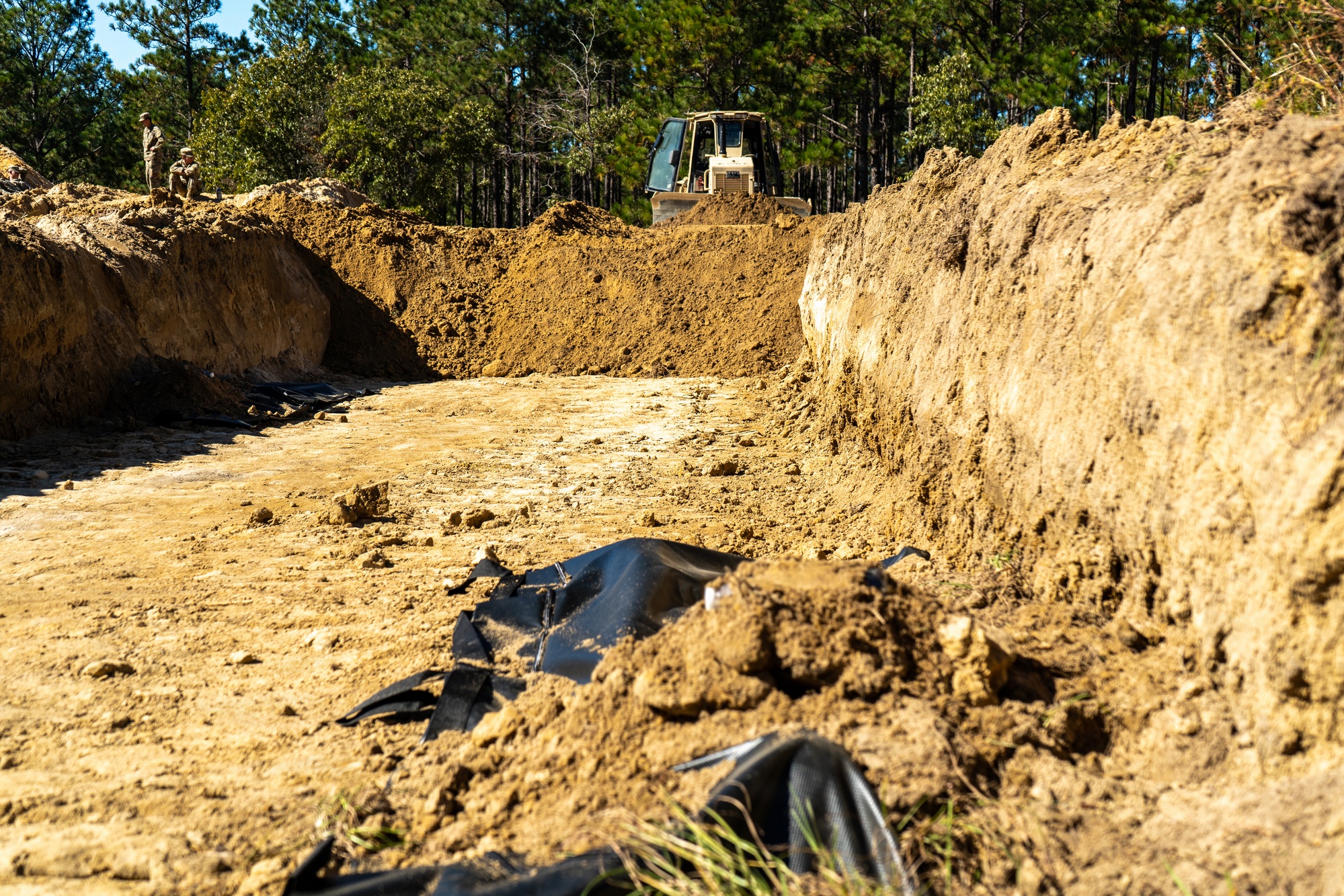
The United States Army has begun training to dig mass battlefield graves again. At Fort Bragg, North Carolina, soldiers spent October 20 and 21 rehearsing how to bury large numbers of fallen troops in temporary battlefield graves — excavating trenches with bulldozers, laying in simulated remains, and covering them at a pace the Army itself calculates at up to 2,400 burials in a single day. The Army mass graves training, run under the name Operation Dragon Covenant, is the first time the service has executed battlefield temporary interment at scale since the Korean War.
The exercise was announced in an official Army release on October 22 and reported by Army Times, Defense News and Newsweek. It has since travelled far beyond the defense press: a viral post on X, viewed tens of thousands of times within hours, presented the drill as preparation for a ground attack on Iran. That framing is not in the Army's release, which names no adversary and no specific war. What the Army actually described is in some ways more sobering — a military quietly rebuilding a capability it let lapse for two decades because it no longer believes the next big war will let it bring its dead home the way the last ones did.
What happened at Fort Bragg
Phase II of Operation Dragon Covenant was executed by the 3rd Corps Sustainment Command, working with the 20th Engineer Brigade and Unit Ministry Teams from across the XVIII Airborne Corps, near the St. Mere Eglise Drop Zone at Fort Bragg. Fatality management specialists, horizontal construction engineers, preventive medicine teams and chaplains trained together — roughly 130 religious support personnel alone took part, drawn from the 82nd Airborne Division, the 101st Airborne Division (Air Assault), the Fort Bragg Garrison and Special Forces elements.
The task was battlefield temporary interment: burying the dead on or near the battlefield, in marked and recorded graves, when they cannot be evacuated. No human remains were used. Soldiers placed simulated skeletal models and sealed water containers inside burial bags, then tested whether heavy earthmoving equipment could cover them without destroying them — because the entire point of a temporary grave is that it is temporary. Every plot is documented so that forensic and anthropological teams can return after the fighting, disinter the remains, identify them and repatriate every fallen soldier.
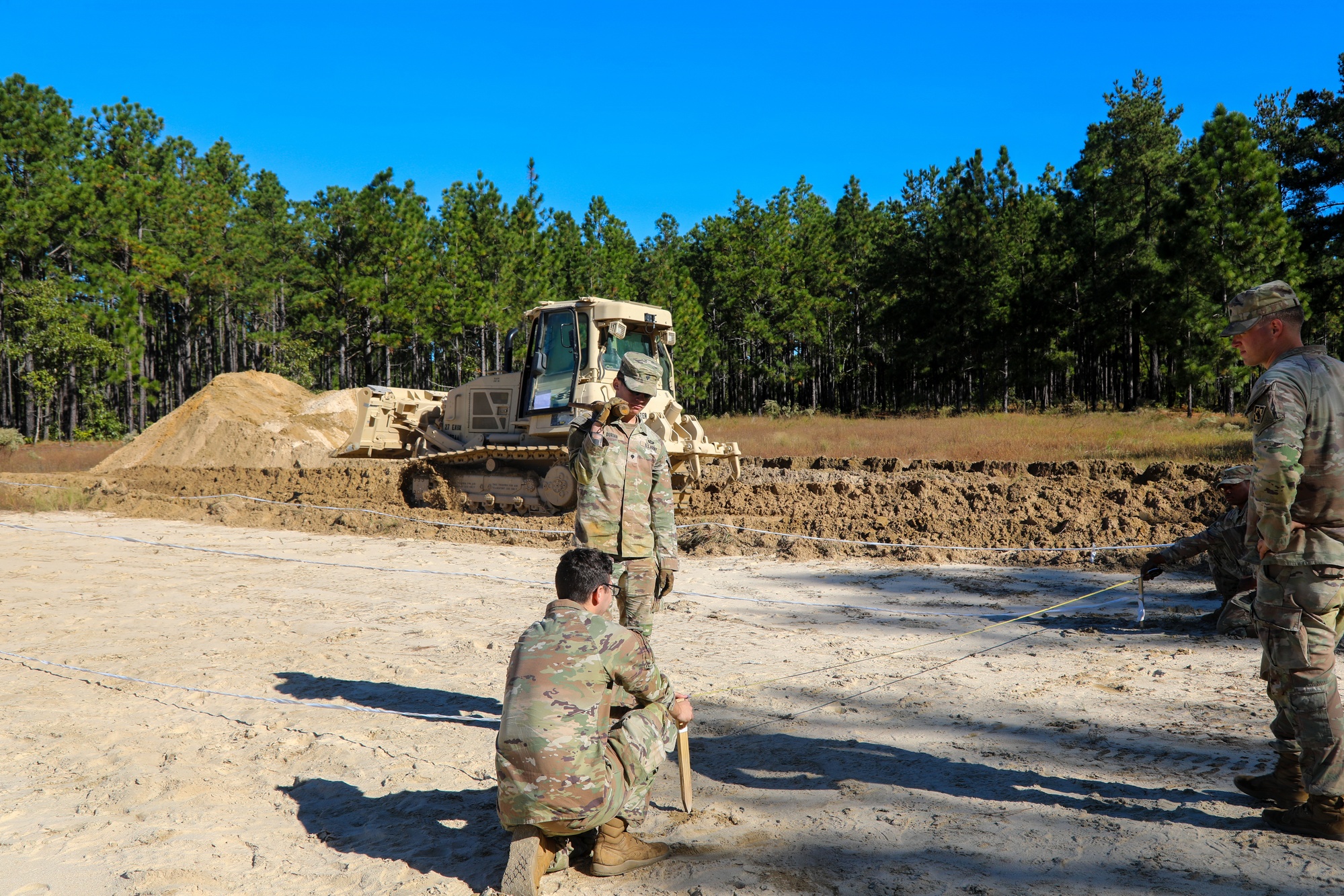
Army doctrine describes a standard temporary interment plot as five parallel trenches holding 100 casualties, ten laid on each side of each trench. In earlier exploratory trials, units using standard backhoes averaged three hours to dig a single trench for ten remains. At Fort Bragg, operators from the 27th Engineer Battalion used D6 bulldozers to complete a full trench for twenty remains in an average of one hour and fifteen minutes. Based on that pace, planners estimated that one engineer company equipped with eight bulldozers and four High Mobility Engineer Excavators could prepare and close trenches for up to 2,400 remains every 24 hours of continuous operations.
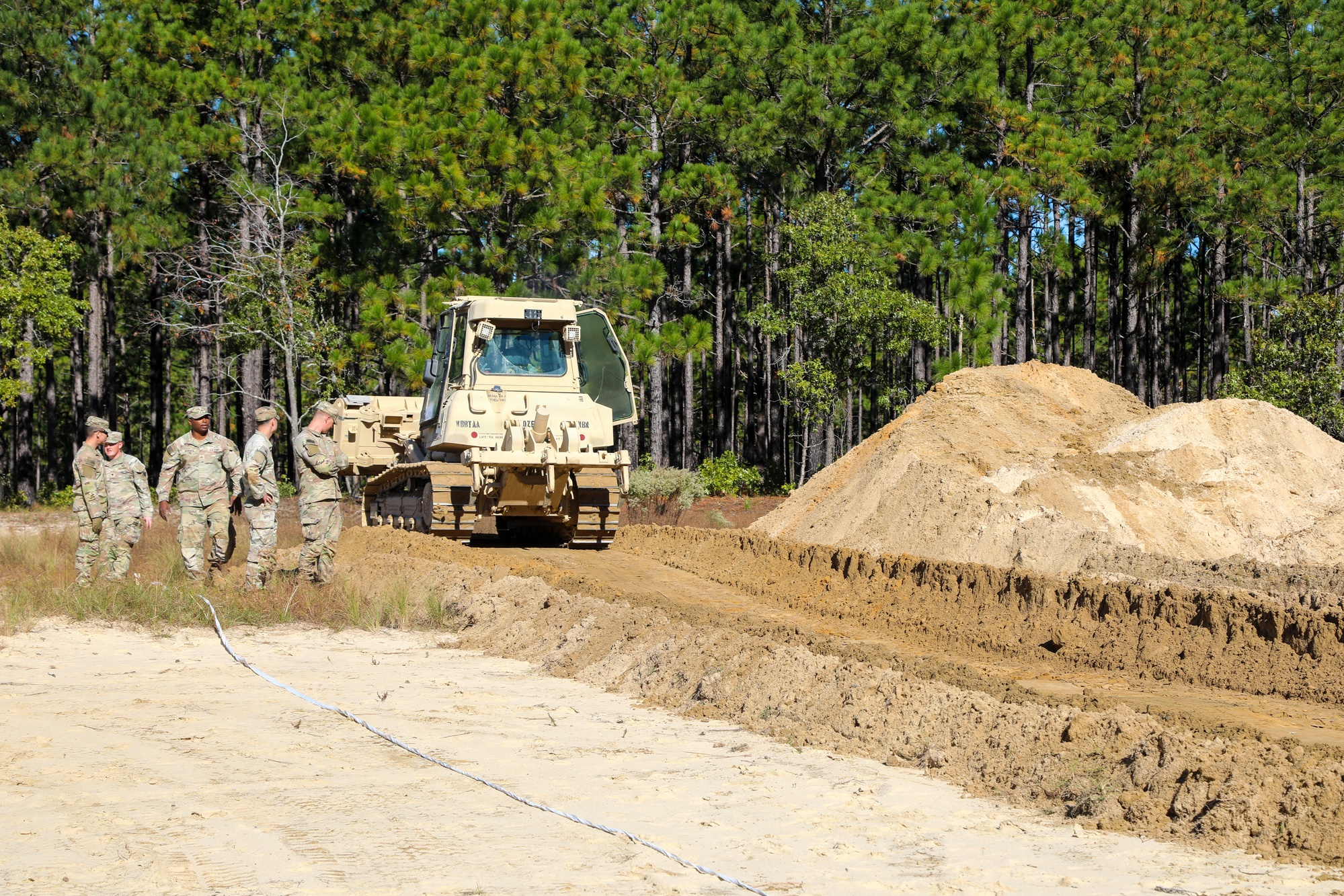
The drill also broke the manual. Doctrine called for a seven-foot corridor between rows; the soldiers found it about two feet too narrow for a bulldozer to pass without disturbing the graves beside it. The trenches were widened to fifteen feet, separated by a nine-foot pillar of undisturbed soil, and operators learned to hold the blade eighteen inches off the ground and let the soil fall inward by gravity rather than pushing it down onto the remains. When the test graves were exhumed, the simulated remains had survived intact.
"We realized quickly that the existing measurements in the book didn't accommodate the physical reality of the equipment," said Sgt. 1st Class Delbert Ruede, the senior fatality management non-commissioned officer for the 3rd Corps Sustainment Command. "This exercise allowed us to take a critical look at how we respect, honor, and systematically manage our fallen in a high-intensity conflict," Ruede said. "If we went to war tomorrow, we would be making this up as we went along. What we are doing here is taking a scientific, field-tested approach so that we can maintain positive control and respectfully care for our fallen."
"Backfilling without desecrating the remains is where the real skill lies," said 1st Lt. Connor Thompson, an engineer officer with the 27th Engineer Battalion. "Every operator has a different skill set, and soil conditions play a huge factor. Doing this in dry sand is completely different from frozen ground, clay, or mud. Getting our operators actual stick time on this specific task gives us data rather than assumptions."
The chaplains' war
Half of Dragon Covenant was not about bulldozers at all. It was the first time in more than twenty years that Army chaplains and religious affairs specialists had trained on religious support for temporary battlefield interment — because for two decades of counterinsurgency war, they never needed to. In Iraq and Afghanistan, American air superiority meant the fallen were evacuated rapidly through mortuary affairs channels to the United States, and every soldier came home to an individual, honoured process.
A large-scale war against a capable adversary breaks that system. The exercise worked through what replaces it. Before the first blade entered the earth, Chaplain (Maj.) Warwick Fuller of the 20th Engineer Brigade opened the interment site with an invocation, consecrating the ground. After the notional remains were placed, Chaplain (Maj.) Cornelius Muasa, the 3rd CSC's deputy command chaplain, and Chaplain (Capt.) David Chacko, the 330th Movement Control Battalion chaplain and Fort Bragg's Catholic priest, offered committal prayers as the engineers backfilled and closed the site.
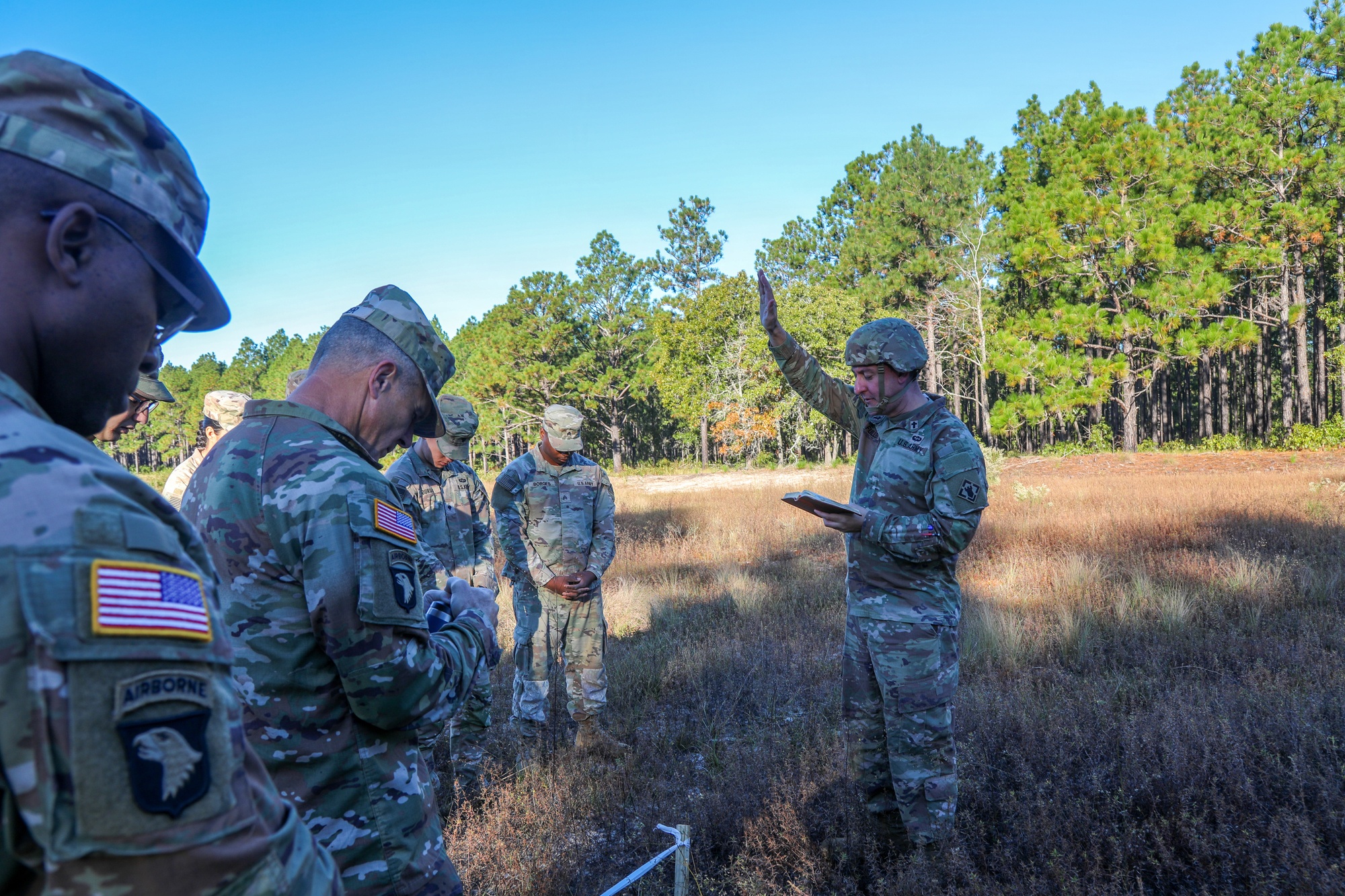
The harder questions were procedural. In a mass-casualty fight, the teams may not know a fallen soldier's identity, let alone their faith. "In a high-intensity, contested combat environment, fatality management teams cannot stop a 24-hour interment operation for individualized religious gravesite services," said Chaplain (Lt. Col.) Hans Ruska, the 3rd CSC chaplain. "We consulted with chaplains from various low density faith groups for advisement. The consensus was that by consecrating the site before remains are placed in the ground reassures families that their loved ones are treated with reverence, dignity and honor despite the inability to provide a memorial ceremony in a contested combat environment."
The exercise also measured the cost to the living. Planning data identified during Dragon Covenant indicates that unit ministry teams supporting high-casualty operations could reach physical, emotional and spiritual exhaustion within four to six hours — a finding the Army says will drive deliberate rotation plans for chaplain teams at brigade and division level. Religious affairs specialists, the enlisted soldiers of the Chaplain Corps (MOS 56M), were integrated directly into the interment workflow under Master Sgt. Amelia Alston of the 3rd CSC and Master Sgt. Lakesha Copeland of the 82nd Airborne Division, coordinating logistics and monitoring the welfare of the soldiers doing the burying.
The legal framework underneath all of this is old and strict. United States policy requires the evacuation of remains whenever operations permit; joint guidance authorizes temporary graves in mass-casualty situations where the dead cannot be moved safely, transport does not exist, or the deaths involve chemical, biological, radiological or nuclear weapons. The Geneva Conventions require that even enemy dead be recorded and their identifying information collected and preserved — and, as Defense News noted in its account of the exercise, the Army's planning extends the same identification and burial care to enemy remains, holding open the possibility of returning them to their own countries one day. Cremation is rarely authorized, and then only for hygiene or religious reasons.
What the viral post got right — and what it added
The post that carried this story to a mass audience on October 29 got the central fact right: the training is real, it is new, and the Army is not hiding it — the service published the photographs and the burial-rate figures itself. Commenters who dismissed the post as invented were wrong; the drill is documented in the Army's own release and across the defense press.
What the post added was a destination. Its flags and its closing line — "all this for a ground attack" — assigned the exercise to a specific, imminent war with Iran. No official source does that. The Army's release frames Dragon Covenant entirely in terms of large-scale combat operations against a peer adversary, the planning category the Pentagon uses for a major war in which control of the air, and therefore rapid evacuation, cannot be assumed. The doctrine being rebuilt is deliberately general: it is written for any battlefield where casualties arrive faster than aircraft can carry them home.
The reason the Iran reading spread so fast is timing, and the timing is genuinely striking. The Fort Bragg exercise became public in the same weeks that the Pentagon has been running its FORTRESS readiness initiative, that reporting has described Gulf allies being warned to prepare for a possible post-midterms campaign against Iran, and that CENTCOM's commander briefed the president in person on Iran military options. Readers connecting those dots are connecting real dots. But a dot is not a line: nothing in the Dragon Covenant release, the doctrine it feeds, or the Army's statements ties the burial training to Iran, to a ground invasion, or to any operation with a date on it. The honest summary is narrower and, in its own way, larger — the Army is preparing for the possibility of a war big enough to overwhelm the system that brought every fallen soldier home for twenty years, whoever that war is against.
Why this matters
Armies telegraph their expectations in their logistics long before they announce them in speeches. A military that expected small wars, fought under its own air umbrella, would have no reason to relearn mass burial: for twenty years the United States did not need the skill, and the institutional memory of it — last used at scale in Korea, where nearly 37,000 American troops were killed between 1950 and 1953 — had effectively died out. The manual's measurements no longer matched the machines. The chaplains had never trained for it. The fatality management NCO running the exercise said the quiet part aloud: if war came tomorrow, "we would be making this up as we went along."
The numbers in the release deserve a slow read, because they are planning factors, and planning factors are expectations written in arithmetic. A standard plot holds 100. A single engineer company, working nonstop, is expected to bury 2,400 in a day. Nobody writes that figure into doctrine for a skirmish. It is the arithmetic of a war in which a brigade could lose in an afternoon what a battalion lost in a year of Afghanistan — the kind of loss rates American planners associate with a peer fight, the wars in Ukraine and the Middle East having demonstrated what modern artillery, drones and missiles do to massed troops. Dragon Covenant is what it looks like when that arithmetic stops being a think-tank scenario and becomes a training schedule.
There is also a promise embedded in the procedure, and it is worth naming because it distinguishes this from the phrase that went viral. A "mass grave" in the public imagination is anonymous and final — a war-crime word. What the Army practiced at Fort Bragg is the opposite discipline: graves dug specifically so that each one can be found again, each set of remains identified, each family eventually given their soldier back. The blade held eighteen inches off the ground, the nine feet of undisturbed earth, the exhumation tests to prove the dead were not crushed — that is the bureaucracy of dignity, rebuilt under time pressure. The same week produced a second data point in the same direction: the Pentagon now counts the cost of its current Iran war posture at $47.1 billion, with roughly two-thirds of its Patriot interceptor stockpile expended — a reminder that the preparations run from missile magazines all the way down to burial plots. (See our reporting on the Pentagon's $47.1 billion Iran war cost and on Washington's warning to Gulf allies of a possible post-midterms Iran campaign.)
What happens next
The findings from Fort Bragg are being forwarded to the Joint Mortuary Affairs Center at Fort Lee, Virginia, and to the Chaplain Corps' Transformation Integration Directorate. They will feed the forthcoming revision of ATP 4-46, the Army's fatality management manual — the trench dimensions will be rewritten around the machines the Army actually owns — and a future revision of ATP 1-05.05, which governs religious support to casualty care.
Phase III of Dragon Covenant is scheduled for spring 2027, and it is designed to be harder: the full pipeline stress-tested in daylight and under blackout conditions with night-vision systems, with security teams, Role 2 medical facilities and a fully staffed Mortuary Affairs Collection Point added to the exercise. In other words, the Army is moving from "can we dig the graves" to "can the whole system — recovery, collection, identification, burial, ministry — run at war speed, in the dark, under threat."
Whether that system is ever used is a question no exercise can answer. But the direction of travel is now a matter of public record, published by the Army itself: the United States is rebuilding, piece by piece, the machinery of a large war — including the part of it that buries the dead where they fall, and promises to bring them home when the fighting stops.
Sources
- U.S. Army (official release, October 22, 2026) — "Army Tests Battlefield Temporary Interment to Validate Remains Preservation and Future Repatriation" — also published by DVIDS: https://www.dvidshub.net/news/577612/army-tests-battlefield-temporary-interment-validate-remains-preservation-and-future-repatriation
- Defense News (October 26, 2026) — "US Army practices digging temporary battlefield graves"
- Army Times (October 26, 2026), via Daily Caller (October 27, 2026) — "Army To Begin Practicing Digging Battlefield Graves"
- Photos: U.S. Army — Capt. Thomas McCarty and Sgt. 1st Class Ange Desinor (public domain, via DVIDS)