UNHCR funding crisis
GENEVA — The UNHCR funding crisis could leave nearly 8.3 million refugees, displaced people and stateless people without vital assistance in 2026, the UN refugee agency warned Tuesday, September 29. UNHCR had received only 32% of the $8.505 billion it said it needed by the end of July, leaving a $5.789 billion gap while the population under its mandate is projected to reach 131.2 million by year end.
The warning is not simply that fewer food parcels or cash grants will be distributed. UNHCR's 26-page report, Protection Eroded: The Human Cost of Underfunding, says core systems are approaching a point at which they cease to function. Registration backlogs can leave refugees without papers needed to obtain services. Fewer child-protection workers mean risks can go unseen. Closed safe spaces and prevention programmes can remove one of the few routes to help for women and girls facing gender-based violence.
“Below a certain threshold, the system doesn't shrink, it fails,” the report said. Dominique Hyde, UNHCR's director of external relations, sharpened that warning: “Protection cannot be reduced indefinitely without systems collapsing. Below a certain threshold, services do not simply reach fewer people; they can stop functioning altogether.”
Why this matters: protection is infrastructure, not an optional extra
Humanitarian funding is often discussed as a volume question: how many people receive a payment, a shelter kit or a meal. Protection work is different. It behaves more like infrastructure. A registration office needs trained staff, identity systems, secure records and links to national authorities. A safe house needs confidentiality, case workers and referral pathways. If one part disappears, the remaining parts may not produce a smaller version of the same service; they may produce no safe service at all.
That is the analytical meaning of the agency's collapse language. A 20% cut does not necessarily reduce protection by 20%. In a remote camp with one functioning registration team, removing that team can turn a partial service into a total absence. Delays then compound: people cannot prove status, children miss school enrollment, families struggle to access health care, and undocumented refugees face greater exposure to detention, exploitation or forced onward movement.
The scale also changes the global risk. The projected mandate population of 131.2 million is 1.8 million higher than the 129.4 million recorded at the end of 2025. Demand is therefore rising while resources are falling. Nearly 8.3 million people at risk of losing help represent about 6.3% of the projected mandate population — roughly one in sixteen. That ratio is not a forecast that every affected person will lose every service, but it shows why the agency calls this a system-level emergency rather than a temporary cash squeeze.
The numbers behind the refugee funding gap
UNHCR said $5.2 billion was available in 2024 and $3.9 billion in 2025, a decline the agency describes as 24%. By July 2026, it had received about $2.7 billion, or 32% of the $8.505 billion requirement. Arithmetic puts the remaining gap at $5.789 billion. Put another way, the agency had secured about $20.70 for each person in its projected 131.2 million mandate population, against an annual requirement equivalent to about $64.82 per person.
Those per-capita figures are an accounting lens, not a promise of equal cash for every displaced person. UNHCR funds legal registration, emergency shelter, staff, transport, community programmes and coordination as well as direct assistance. Needs also differ sharply by country. But the comparison exposes the compression: the budget request itself averages less than $65 per person for an entire year, and available funding by July covered less than one-third of that benchmark.
The problem is not only the amount. Reuters reported that tightly earmarked contributions rose to 51% of donor funding in 2026 from 19% five years earlier. Earmarks can assure taxpayers that money reaches a named crisis, but they also leave UNHCR less able to move funds when a neglected emergency worsens. A dollar committed to one operation cannot automatically clear a registration backlog in another.
UNHCR has already absorbed major internal cuts. The agency reduced its workforce by 33% in 2025, closed offices in 140 locations and ended operations in 15 countries compared with 2024. That history matters because it narrows the argument that another round can be covered by efficiency alone. Administrative savings may preserve front-line work for a time; once offices and posts have disappeared, the next reduction lands more directly on services.
How the cuts happened: the 2024 funding arrangement was not a guarantee
The fall from $5.2 billion in 2024 to $3.9 billion in 2025 followed aid reductions by the United States and other donor countries, according to Reuters and UNHCR. The 2024 funding level rested on annual voluntary commitments rather than a binding multiyear guarantee. When governments revised budgets and priorities, the agency could not treat the prior year's support as money already secured for the next one.
That structure creates a recurring mismatch. Displacement usually lasts years, while contributions are negotiated on political and fiscal calendars. A family registered in Chad in 2024 may still need legal status, schooling and protection in 2026, but the programme serving that family may have to reopen its budget every year. The gap becomes especially dangerous when several large donors cut at once and when more than half of the remaining money is earmarked.
Donor governments commonly frame foreign-aid reductions as choices about domestic spending, strategic priorities, burden sharing and proof that agencies are efficient. The Reuters and AFP reports on Tuesday did not include a detailed new response from the United States or the other governments whose reductions UNHCR cited. That absence leaves an important accountability question unanswered: whether donors intend their cuts to reduce particular programmes or expect the agency to spread less money across the same mandate.
Critics of broad humanitarian cuts argue that the bill does not disappear; it migrates. Host governments absorb pressure on schools, clinics and local administration. Families take on debt or pull children from school. Some displaced people move again, sometimes onto more dangerous routes. UNHCR's case is therefore partly fiscal: an early registration or protection intervention may cost less than responding later to trafficking, exploitation, detention or renewed displacement.
Chad: 319,000 people waiting for registration
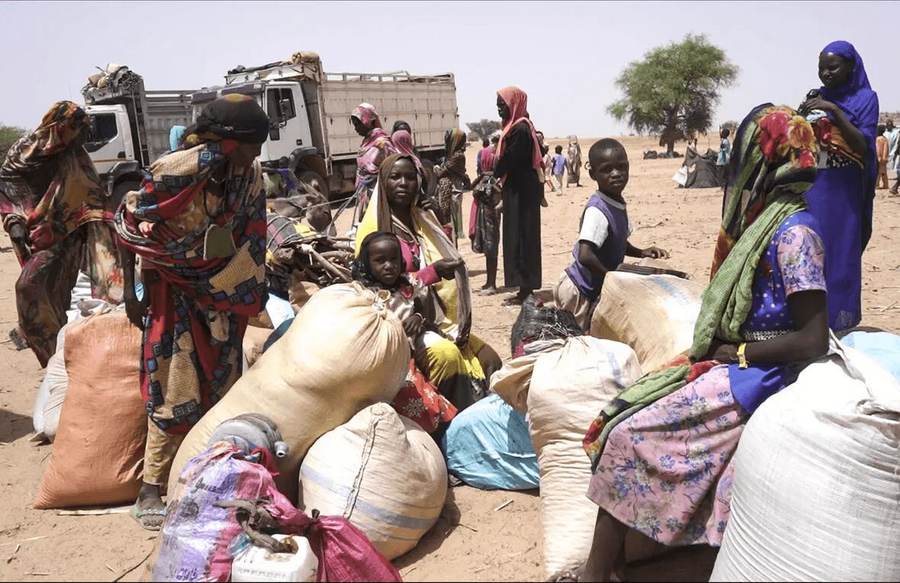
The clearest example of the Sudan refugees Chad registration delays is at the border of the world's worst displacement crisis. UNHCR says 319,000 people in Chad face delays in registration. Registration is the gateway to recognized status and often to food, health care, schooling and family reunification. A backlog of that size is not just paperwork; it is a population living longer in legal and administrative uncertainty.
The agency also says 200,000 women and girls in Chad could lose safe spaces and programmes intended to prevent gender-based violence. AFP separately reported that about 233,000 children could lose child-protection support. These services are difficult to restart after staff disperse and trust networks break. A closed centre can be rebuilt physically, but relationships with communities, confidential case files and referral links take time to restore.
Chad is already carrying the spillover from Sudan's war. That shifts a global funding decision onto one of the countries least able to replace international programmes at national scale. Host communities also bear the consequences: when services are restricted to a camp or collapse entirely, competition can intensify over water, clinics, transport and jobs. The political risk is that refugees are blamed for shortages caused by a financing failure far beyond the border region.
Sudan: a registration suspension leaves 140,000 people outside the system
Inside Sudan, about 140,000 refugees and asylum-seekers remained unregistered by midyear after registration activities were suspended for the first five months of 2026. The civil war entered its fourth year in April, and the United Nations calls Sudan the world's worst displacement crisis. That makes the suspension especially consequential: the need for a functioning protection registry grew while the system was offline.
Unregistered people can become invisible in planning data as well as in daily life. If an agency cannot establish who is present, where they are and which risks they face, it cannot allocate scarce protection officers rationally. The resulting information gap can then be cited as uncertainty when donors decide where to send money, creating a feedback loop in which underfunding produces weaker data and weaker data make funding harder to defend.
There is also a regional effect. Sudanese people who cannot find safety or documentation inside the country may cross into Chad and other neighbors, adding pressure to the very systems already reporting delays. That is why the global displacement crisis 2026 cannot be managed country by country. Registration failure in one operation creates needs in another.
Afghanistan returnee grants cut from $375 to $170
In Afghanistan, the Afghanistan returnee grants cut is stark: support per person has fallen from $375 to $170, a reduction of $205, or about 55%. More than one million people have returned this year, voluntarily or under pressure, from Iran and Pakistan. At the old rate, a grant for one million people would imply $375 million; at the reduced rate, $170 million. The $205 million difference illustrates the scale of resources no longer reaching households, although eligibility and actual recipient totals may differ.
For a returning family, $170 has to stretch across transport, food, temporary shelter, documents and the first steps toward work. The grant is not designed to rebuild a life by itself. Cutting it by more than half increases the chance that a family spends the entire amount on immediate survival and has nothing left for rent, tools or school costs. A return recorded as completed can therefore become a new episode of internal displacement.
The policy tension is sharp. Governments conducting or encouraging returns may count the border crossing as the end of a migration case. UNHCR must plan for what happens after arrival. If reintegration support is too small, the movement has been transferred geographically rather than resolved.
Historical parallels: aid shocks turn temporary cuts into lasting losses
Past humanitarian funding shocks have usually produced a familiar sequence: agencies narrow eligibility, reduce cash or food, freeze hiring, close field offices and postpone programmes judged less immediately life-saving. The current crisis follows that pattern but at a more dangerous scale because staffing and locations were already cut in 2025 and because the mandate population remains near a record.
The historical lesson is that restoring money does not instantly restore capacity. Experienced protection staff take time to recruit and train. Local partners may close. Landlords and suppliers move on. Communities lose confidence in referral systems that stopped answering. A one-year budget shock can therefore leave a multiyear operational scar even if donor funding later recovers.
The comparison with previous shortfalls also exposes the limits of emergency appeals. Appeals work best when a sudden event briefly mobilizes attention. The crises in Sudan and Afghanistan are protracted, and they compete with wars, disasters and domestic political priorities elsewhere. Repeated emergency language can raise awareness without creating durable financing.
What happens next: three year-end scenarios
A late donor rescue. Governments could provide flexible, unearmarked contributions before year end. That would not erase months of delays, but it could keep registration teams, safe spaces and child-protection networks operating. Flexible money matters more than the headline total because it allows UNHCR to direct funds to services closest to failure.
A managed contraction. If some new money arrives but the $5.789 billion gap remains large, the agency will keep prioritizing the most acute cases. More people will wait longer, grants will remain smaller and country operations will triage rather than cover full needs. This is the scenario in which the system formally survives while its reach and reliability deteriorate.
Protection systems collapse locally. If funding stays near July's 32% level and earmarks prevent redistribution, some programmes may stop altogether. Registration suspensions could lengthen, safe spaces could close and trained staff could leave. The effect would not be uniform; specific districts and border regions would cross the failure threshold first.
Changing that trajectory requires more than one emergency cheque. UNHCR needs donors to close part of the immediate gap, reduce tight earmarking, give multiyear commitments and coordinate so that several governments do not retreat from the same operation at once. Host countries also need development financing for schools, clinics, water and jobs, so refugee services are not isolated from the communities around them.
The agency's warning is ultimately about the difference between scarcity and failure. Scarcity forces painful choices. Failure removes the machinery that makes any choice possible. By September 29, with 8.3 million people at risk and only 32% of the annual requirement received by July, the question is no longer whether UNHCR can make its budget go further. It is which protection systems donors are prepared to let stop.
Sources
- Reuters: UN agency warns funding crisis could leave 8.3 million people without aid
- AFP via Times of Bangladesh: 8.3 million refugees at risk as UNHCR faces severe funding cuts
- UNHCR: Protection Eroded report summary and agency statement
- UNHCR Canada: source and context for the Chad feature photograph
Reporting basis: Fixed September 29, 2026 snapshot based on Reuters, AFP and UNHCR reporting. Calculations are Signal Post News analysis derived from the cited agency figures; per-capita comparisons are analytical ratios, not individual entitlements.