Two findings, one crisis
On September 17, the UN Independent International Fact-Finding Mission on Iran said it had reasonable grounds to believe that the United States was behind February strikes on a clearly identifiable school in Minab and a sports complex and residential area in Lamard, and that the attacks amounted to war crimes. The same mission said Iranian authorities committed crimes against humanity during their crackdown on anti-government protests. Each allegation must be evaluated on its own evidence and legal standard; an allegation against one government does not resolve the separate case against the other. The report now moves into the Human Rights Council process in Geneva, where governments will debate accountability, evidence and political selectivity.
Why this matters
A formal allegation against a sitting U.S. administration changes the legal and diplomatic debate around the war even if it does not produce a prosecution. Washington has framed its actions in the language of security and deterrence; Iran can now cite a UN-mandated inquiry to challenge that framing. The mission’s parallel findings against Iranian authorities mean the report cannot reasonably be presented as exonerating Tehran. Both sets of allegations remain subject to further evidentiary and legal review.
The veto creates a second accountability gap
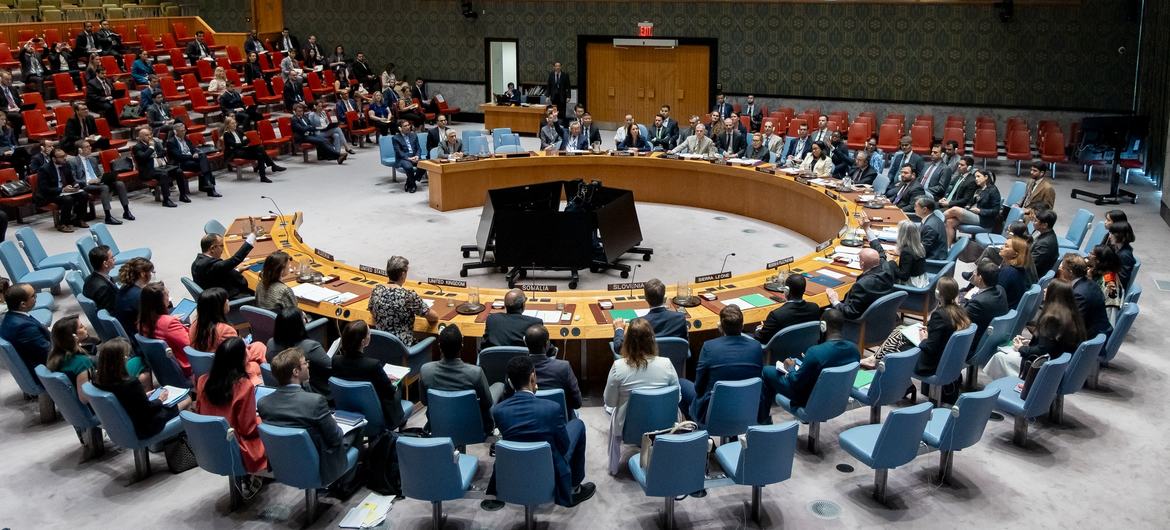
On the same day, Russia and China vetoed a U.S.-drafted resolution that would have extended the independent panel monitoring UN sanctions on Iran. Eleven members voted yes; Pakistan and Somalia abstained. Because Beijing and Moscow are permanent members, two negative votes outweighed the council’s large majority. The panel’s mandate was due to expire September 26, just as leaders gather for the General Assembly. Deputy U.S. Ambassador Jennifer Locetta argued that the resulting monitoring gap benefits Iran. That is directionally right: restrictions that are not independently tracked become easier to dispute, evade or selectively enforce.
How we got here
The sanctions dispute reaches back to the 2015 nuclear agreement. France, Britain and Germany accused Iran of violating the pact and triggered the “snapback” mechanism that restored UN sanctions on September 27, 2025. Russia and China reject the Western legal interpretation. The February 2026 opening of the U.S.-Israeli war with Iran then transformed a technical compliance argument into a wider conflict about military conduct, civilian protection and the credibility of institutions designed to restrain all sides.
Who wins, who loses, and what critics will say
Iran gains room to cite the war-crimes finding in diplomacy and faces less centralized monitoring after the veto. Russia and China demonstrate that a Security Council majority cannot override permanent-member opposition. Washington faces additional scrutiny but can still challenge the mission’s evidence and legal analysis. Sanctions skeptics argue that expert panels can become extensions of geopolitical pressure; supporters answer that without a shared evidentiary mechanism, competing claims become harder to test. For civilians, weaker accountability can make investigation and remedy slower.
What the numbers imply
The 11–2–2 vote reveals broad support without enforceable consensus. The school strike reportedly killed more than 150 people, including about 120 children; the Lamard strike killed 22 civilians. Those figures make proportionality and distinction more than abstract doctrines. The enforcement history is equally stark: UN fact-finding missions can preserve records, clarify responsibility and raise diplomatic cost, but they cannot arrest officials or compel reparations on their own. Their influence depends on states, courts and future political openings.
What happens at UNGA
The General Assembly week will turn the dueling findings into diplomatic ammunition. Expect Iran to foreground the U.S. allegation, Western governments to emphasize the mission’s crimes-against-humanity findings against Tehran, and Russia and China to defend the veto as resistance to an expired framework. The practical questions are whether states build an alternative monitoring coalition, whether the Human Rights Council renews investigative capacity and whether Washington provides a detailed response. The base case is louder argument and weaker common verification; the better case is a narrower monitoring mechanism that survives great-power disagreement.
The legal standard and its limits
The mission’s phrase “reasonable grounds to believe” is an investigative threshold, not a criminal conviction. It says the available material supports a conclusion strongly enough to report, while leaving questions of individual responsibility, command decisions and defenses for a competent judicial process. Political actors may treat the finding as a final verdict or dismiss it as merely advisory, but neither characterization matches the stated threshold. The public record should be tested against targeting files, battle-damage analysis, communications and the identities of those who selected and approved the targets. The same discipline applies to the mission’s allegations against Iranian authorities. International humanitarian law requires parties to distinguish civilians and civilian objects, take feasible precautions and avoid attacks expected to cause excessive civilian harm relative to the anticipated military advantage. The presence of an alleged military purpose does not remove those duties; a high civilian toll alone also does not resolve every legal element. The report identifies incidents and legal questions for further investigation.
A credible next step
An accountability strategy that relies solely on the Security Council will fail whenever a permanent member sees its interests at risk. States therefore have three narrower options: preserve evidence through the Human Rights Council and national prosecutors; build a voluntary sanctions-monitoring group that publishes methods and findings; and use domestic export-control and financial authorities with clearer due-process safeguards. None has the council panel’s universal legitimacy. Together, however, they can reduce the information vacuum created by the veto. Washington’s strongest response would be specific rather than rhetorical: publish its legal basis, explain the target-identification process and disclose what review followed the civilian deaths. Tehran should face the same evidentiary demand for protest repression. The test of a rules-based order is not whether institutions always reach a preferred result. It is whether governments accept scrutiny when the rules point at them.
Sources: Reuters: UN mission findings; Reuters: Russia–China veto; United Nations: mission summary. Facts and figures are a fixed September 18, 2026 reporting snapshot and do not update live.