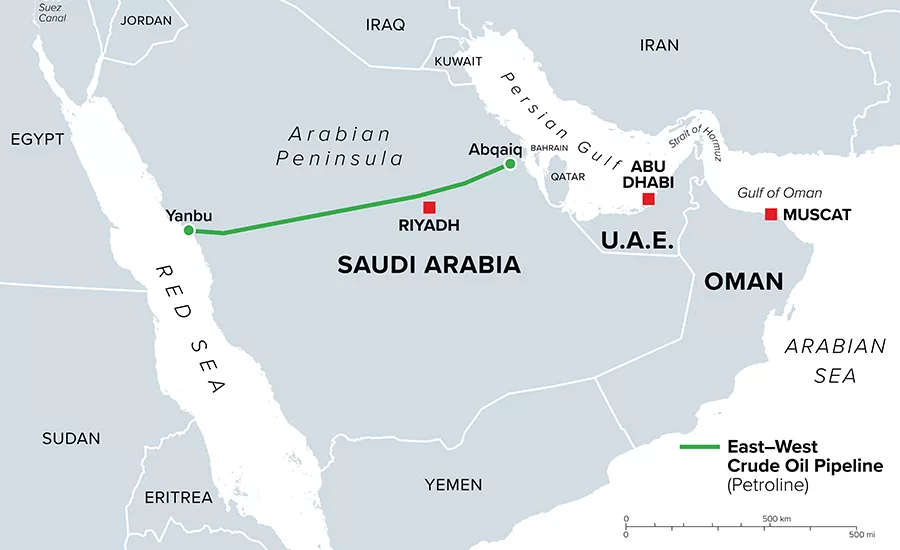

Oil prices eased by about 1% early Friday but remained above $100 a barrel: Brent was reported at $103.77 and West Texas Intermediate at $100.88. The decline offered little comfort because three pumping stations on Saudi Arabia’s East–West pipeline were reportedly damaged, adding uncertainty to a route built to move crude toward the Red Sea port of Yanbu.
A prolonged interruption at Yanbu could affect capacity equivalent to as much as 4% of global oil supply, according to the reporting snapshot. Saudi Arabia was arranging alternative shipments for Asian customers near Oman, a sign that the response is already logistical as well as military and diplomatic.
Why this pipeline is more than infrastructure
The East–West route gives Saudi exports an alternative to the Gulf and the Strait of Hormuz. That redundancy is strategic: when one maritime corridor becomes dangerous, the ability to shift barrels to another coast limits the shock. Damage to the alternative route removes some of the insurance precisely when it is most valuable.
The 4% figure should not be read as an automatic loss of 4% of supply. It describes potential exposure if disruption is prolonged and replacement routes cannot compensate. Markets price that uncertainty before the full physical effect is known.
The risk premium is the price of not knowing whether redundancy will still work when it is needed.
What prices above $100 mean
Brent at $103.77 and WTI at $100.88 are snapshots, not live quotes. Their importance is the threshold: sustained triple-digit oil can raise fuel, freight and production costs across economies, complicating the inflation fight and household budgets far from the Red Sea.
Importing countries with weaker currencies feel the pressure most quickly because they pay both the world price and the exchange-rate cost. Exporters can receive more revenue, but damage, security spending and uncertain shipping may absorb part of the gain.
Alternative shipments buy time, not certainty
Routing cargoes near Oman can help meet Asian commitments, but every change brings vessel availability, loading schedules, insurance and travel time into the calculation. The market will watch not only whether Saudi Arabia can replace volumes, but how quickly and at what cost.
Consumers should resist translating one morning’s crude quote directly into one day’s pump price. Retail fuel includes refining, taxes, distribution and local inventories. The direction matters, but the pass-through differs by country and product.
Why this matters
The incident targets resilience rather than only production. Global supply chains rely on alternate routes; when the bypass is damaged, a regional conflict acquires wider economic reach.
How we got here
Saudi Arabia developed east-west capacity to reduce dependence on Gulf chokepoints. Escalation around Iran and the Red Sea has now raised the value—and vulnerability—of that hedge.
Winners, losers and critics
Other exporters may gain from higher prices, while importers, airlines, logistics firms and households lose. Traders can benefit from volatility, but physical consumers bear the cost. Critics of alarmist supply estimates are right to distinguish capacity at risk from barrels actually lost.
What the numbers imply
A 1% daily price decline does not signal resolution when both benchmarks remain above $100. The larger number—up to 4% of global supply potentially affected—defines the severe scenario, not the confirmed outcome. Duration and substitution determine which number matters.
What happens next
Watch repair timelines, Yanbu loadings, alternate cargo arrangements, insurance costs and any further attacks. A quick repair would reduce the premium; repeated damage or delayed exports would pull the issue into inflation forecasts and central-bank decisions.
Source: Price snapshot, reported pumping-station damage, potential supply exposure and alternative shipments from Reuters, September 18, 2026. Values are fixed to that report and do not update.