War · Sudan · Africa
Sudan’s war is no longer only Sudan’s. UN-appointed investigators told the world on Wednesday that weapons, military technology and foreign fighters are still flowing in through a transnational network — in the same month that drone attacks on civilians reached their highest level since the war began — while in El Obeid, the city at the centre of their new report, some 600,000 people are caught between RSF drones overhead and SAF detention cells on the ground.
Track it live: Africa wars tracker
The Independent International Fact-Finding Mission for the Sudan released its El Obeid report in New York on October 28, after presenting its September findings on external support to the General Assembly’s Third Committee. Its chair, Mohamed Chande Othman, summarised the external finding in one sentence: there are reasonable grounds to believe that transfers of weapons, technology, logistics and foreign personnel “continue to sustain and intensify the conflict.” A network operating across several countries, the Mission found, enabled and reinforced operations by the Rapid Support Forces — and external actors supplied both sides.
The Mission was established by the UN Human Rights Council in October 2023 (resolution A/HRC/RES/54/2), its mandate has been extended to October 2027, and on 6 July 2026 the Council (resolution A/HRC/62/1) asked it to inquire into El Obeid after the city’s encirclement by the RSF. The war it is investigating began on 15 April 2023 between the Sudanese Armed Forces (SAF) and the RSF.
What the investigators say is flowing in — and the line they would not cross
Asked directly who was supplying the weapons, Othman named a geography, not a government: individuals and entities in Chad, in Puntland in Somalia, in southeastern Libya and in the United Arab Emirates were involved, he said, in a transnational network supporting the RSF. He was equally direct about what the evidence does not show: the investigators have not linked any neighbouring state, as a state. That distinction matters, and it is where the denials sit. Chad denies its territory is used to supply the warring parties, and the UAE has repeatedly denied arming the RSF; neither government is accused by this Mission of directing the transfers. What the Mission is saying is narrower and, in its way, harder to answer: that private and semi-private chains — brokers, logistics intermediaries, recruiters and transit points — are moving war material and people into Sudan at a scale that is changing the war, and that the states on whose territory those chains operate cannot plausibly claim not to know. “All States must take reasonable action to prevent individuals and entities operating under their jurisdiction from contributing to violations and international crimes in Sudan,” Othman said.
El Obeid: drones from one side, detention from the other
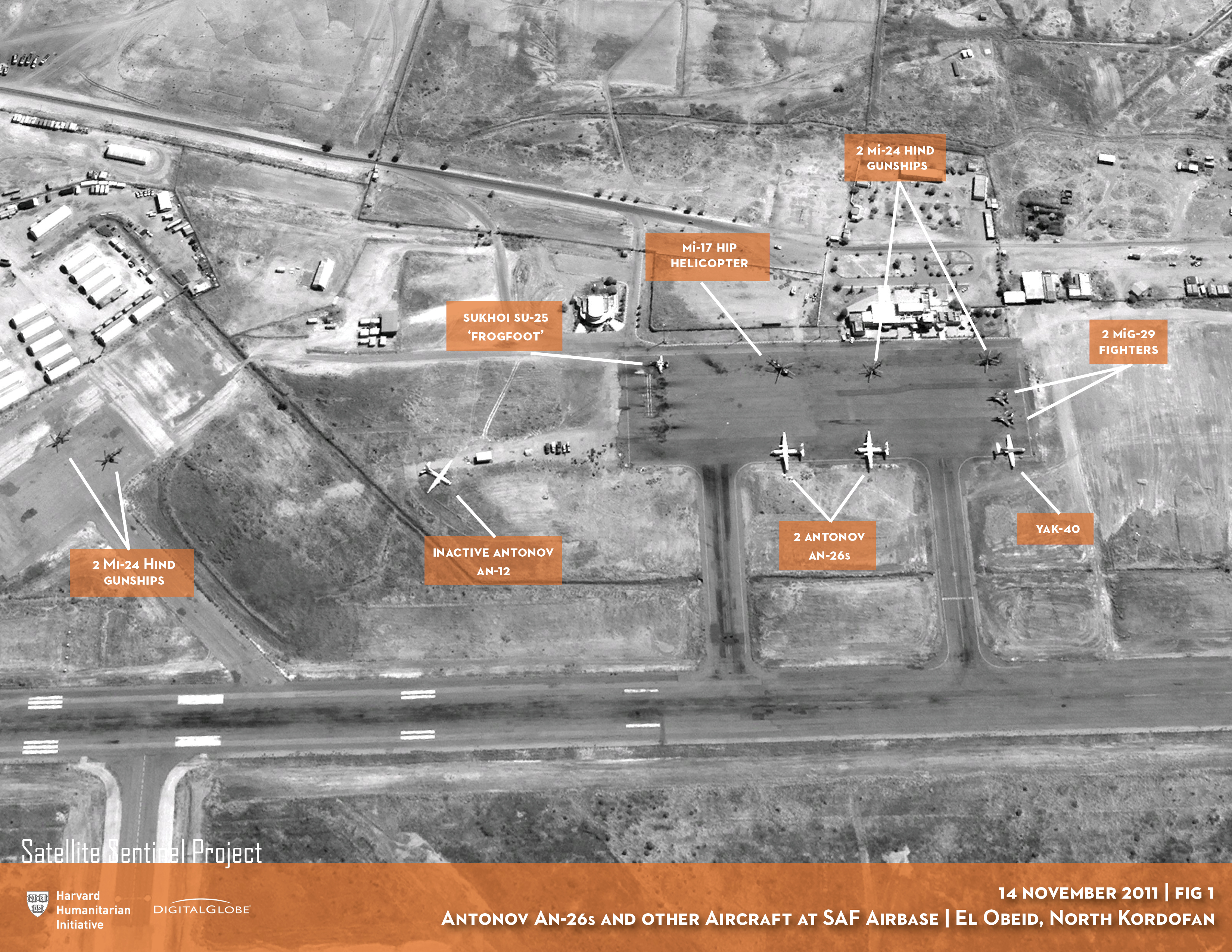
The report’s ground-level subject is El Obeid, capital of North Kordofan, a city of about 600,000 that remains partially encircled by the RSF. From the air, the threat is the RSF’s drones: strikes that continue to kill and injure civilians and have damaged homes, schools, displacement sites and the electricity and water systems the city runs on — conduct the Mission says may amount to war crimes. One expert told investigators that only around 30 percent of the city’s hospitals remained operational after the attacks. On the ground, the threat the report documents comes from the other army. SAF-affiliated security forces have intensified surveillance and arrests, targeting people engaged in humanitarian, human-rights and peace work. “Thousands have been arrested by SAF security cells, detained and tortured in unofficial locations and in El Obeid Central Prison, kept under appalling conditions,” said Mission member Mona Rishmawi. “These practices must stop immediately.” The prison reportedly holds some 2,000 people against a capacity of about 450 — up to forty people, one former detainee described, in a cell of roughly two and a half by two metres. The Mission says it has credible accounts of incommunicado detention, torture, deaths in custody and allegations of sexual violence against female detainees, and notes that the SAF’s own deployment inside residential neighbourhoods has heightened the foreseeable risk to the civilians living around its positions.
October was the worst month for drone attacks on civilians
The El Obeid findings land on a national pattern. October, Othman said, had seen the highest number of drone attacks on civilians since the war began in April 2023 — and the Mission is already investigating the month’s largest reported incidents: a drone attack on a market in Abyei on October 19, reportedly by forces of the military government, said to have killed at least 80 people, and reported Egyptian airstrikes on gold-mining sites near the Sudan-Egypt border said to have killed at least 72 miners. Both are investigations, not findings, and this article reports them as such. The direction of travel, though, is the Mission’s central warning: a war that began as a fight between two generals’ forces in Khartoum now reaches, by drone, communities far from any front line. “The conflict is becoming more geographically extensive, more technologically sophisticated and increasingly dangerous for civilians,” Othman said.
Why this matters
Three things make Wednesday’s presentation more than another grim report. First, it reframes responsibility. For three years the diplomatic argument over Sudan has been stuck on a Darfur-only arms embargo written in a different era; the Mission’s September findings, now put to the General Assembly, describe supply chains that feed a nationwide drone war — and its members repeated the obvious remedy, expanding the embargo to all of Sudan. “Sovereignty should not shield mass atrocity crimes, period,” said Joy Ngozi Ezeilo. The Security Council declined to widen the embargo in September and again this month, so the gap between what investigators document and what the Council will authorise is now the story in itself. Second, El Obeid is a warning address, not just a case study. The report arrives one year after the RSF’s takeover of El Fasher, where the Mission previously found violations bearing the hallmarks of genocide — and where, Ezeilo noted, accountability remains entirely absent. A partially encircled city, a collapsing hospital system, mass detention by the force holding the city and drone attrition by the force surrounding it: the Mission is describing the conditions that precede an atrocity, in public, before it happens. Third, the numbers expose the aid paradox. UN officials said the same day that humanitarian groups reached more than 17 million people in Sudan in the first nine months of this year — yet only 3 million of them, 18 percent, received help across multiple sectors. Access, funding and the militarisation of aid by both sides, the Mission found, are strangling the rest. The drone war’s toll is already documented in Darfur, where a drone strike on a market in Nyala killed 21 people this week — and the accountability gap has begun to draw consequences of its own, including UK sanctions on 15 Sudan commanders from both sides over the El Fasher rape and starvation campaign.
What is established, what is alleged, and what happens next
Hold the layers apart. Established: the Mission exists, its mandate runs to October 2027, its El Obeid report is published, and its members said what is quoted here, on the record, in New York. Found, on the Mission’s “reasonable grounds” standard: that external supply networks sustain both parties and reinforced RSF operations, and that the patterns in El Obeid may amount to war crimes — a legal characterisation, not a court verdict; neither the SAF nor the RSF has been tried on these findings, and both have denied wrongdoing in this war as a matter of course. Under investigation, and not yet found: the Abyei market toll and the reported strikes near the Egyptian border. What happens next is measurable. Watch whether the Security Council returns to the embargo question with the Mission’s evidence now formally before the General Assembly; whether any state named as hosting network nodes announces enforcement action against the individuals and entities on its territory; and whether detention monitors are granted the access to El Obeid Central Prison that Rishmawi demanded. A year after El Fasher, the investigators’ bleakest point was also their simplest: the passage of time, Ezeilo said, should not diminish attention to what happened there — it should remind the world of the cost of impunity. El Obeid is where that cost is now being tallied, in advance. The UN noon briefing on October 28 echoed the report and noted that Monday’s drone strikes on Nyala killed dozens and injured more than 150. On the ground in North Kordofan, meanwhile, the conventional war is also moving: the Sudan army’s capture of Al-Mazroub, the RSF’s largest North Kordofan stronghold, underlines that El Obeid’s fate will be decided by both wars at once — the one fought with drones and supply chains, and the one fought town by town.
Sources: UN Human Rights Office (OHCHR), press release (October 28, 2026), “Sudan: Expanding drone warfare and severe repression in El Obeid put civilians at grave risk”; UN News (October 28, 2026), reporting the Fact-Finding Mission’s presentation to the General Assembly’s Third Committee; UNifeed (October 28, 2026), video coverage of the Mission’s New York briefing; and AnewZ (October 29, 2026), reporting the UN findings on foreign weapons and fighters sustaining Sudan’s civil war.