War / Ukraine
Two more glide-bomb jets gone: Ukraine says a Neptune missile reached some 400 kilometres into Russia to destroy two Su-34 fighter-bombers on the ground at Marinovka in the Volgograd region — the Ukrainian Navy's second claimed airfield strike of October. Moscow has not confirmed any loss, and no imagery of wrecked aircraft has been released, so the claim stands on a satellite-detected fire and Kyiv's word.
Track it live: Ukraine war map — live tracker
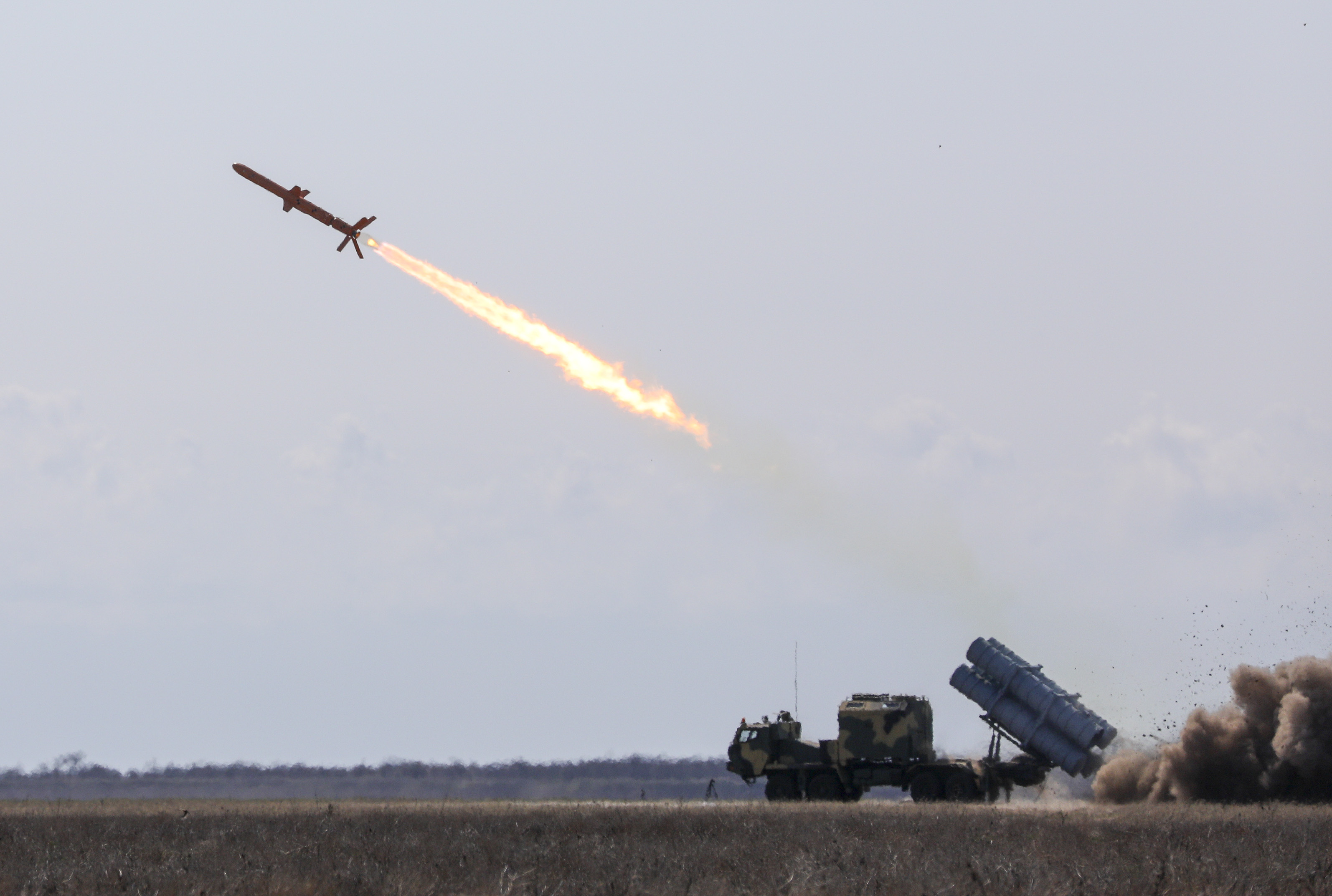
KYIV, October 30, 2026 — Ukraine's Navy said on Thursday, October 29, that units using the Neptune coastal-defence missile system struck Marinovka airfield in Russia's Volgograd region and destroyed two Su-34 frontline fighter-bombers on the ground. President Volodymyr Zelenskyy put the claim at the top of his evening address the same day: "We carried out two missile strikes, destroying two Russian Su-34s, and also hitting an Iskander launcher." The second strike, against an Iskander ballistic-missile launcher, hit a separate site that Kyiv did not locate in the address. Russia has not confirmed the Marinovka losses, Russian officials had not acknowledged any damage at the airfield by Friday, and the Ukrainian Navy released no imagery of wrecked aircraft — which is why every loss figure in this report is attributed to the side that announced it.
What was hit at Marinovka
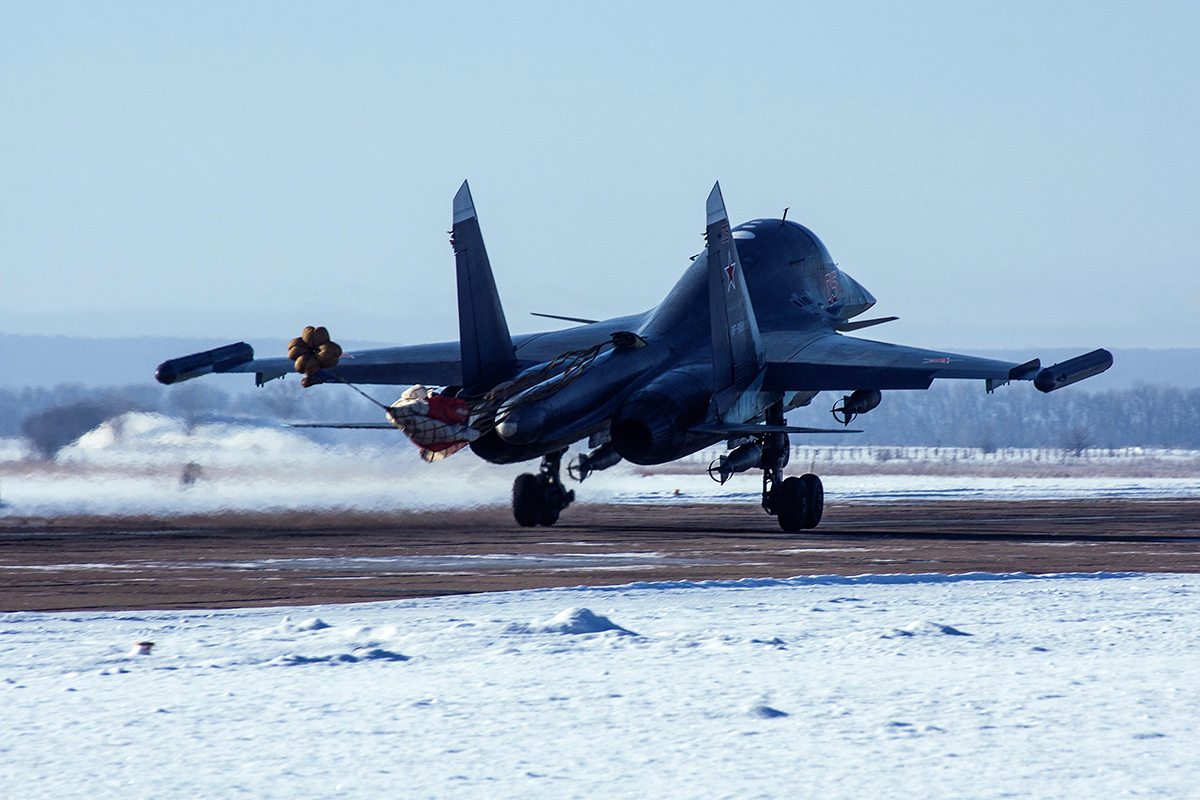
Marinovka is a frontline-aviation base near the settlement of Oktyabrsky in Volgograd region, roughly 400 kilometres from Ukrainian territory. It hosts the 11th Mixed Aviation Regiment, part of the 4th Mixed Aviation Division of Russia's 4th Air and Air Defence Army, and its Su-34s are among the aircraft that fly the glide-bomb campaign against Ukrainian cities, front-line areas and military positions. The Su-34 — NATO reporting name Fullback — is a two-seat strike derivative of the Su-27 that entered service in 2014 and can carry up to eight tonnes of munitions. Fitted with UMPK wing-and-guidance kits, ordinary bombs become guided glide bombs — the KABs that Russian aircraft release from behind their own lines and that Ukrainian air defences struggle to intercept once they are gliding. That role is precisely why Kyiv hunts the type on the ground: a Su-34 caught on its apron cannot be shot down on the way home, and it cannot be replaced quickly, as the production figures below show.
What is verified — and what is not
The claim is not wholly unsupported, and it is not yet proven. Three strands of evidence sit between Kyiv's statement and independent confirmation. First, satellite monitoring: NASA's FIRMS fire-detection system recorded a fire — an abnormally high temperature — at 02:28 in the aircraft parking area near newly built hangars at Marinovka, as reported by the Ukrainian military outlet Militarnyi. A fire in the parking area at that hour is consistent with a strike; it is not, by itself, a count of destroyed aircraft. Second, Russian Telegram channels also reported two Su-34s destroyed at the base, and said two servicemen were killed and two injured. The aircraft report aligns with Kyiv's; the personnel claim is unverified and is recorded here only as a Russian-channel report. Third, the absences: the Ukrainian Navy published no photographs or video of wrecked jets, and Russian officials had not acknowledged any damage by October 30. The honest summary is that something burned at Marinovka in the early hours, two independent-leaning channels of reporting describe destroyed aircraft, and the aircraft-loss tally — two Su-34s destroyed — remains a Ukrainian claim pending independent confirmation.
Why this matters
The attrition maths
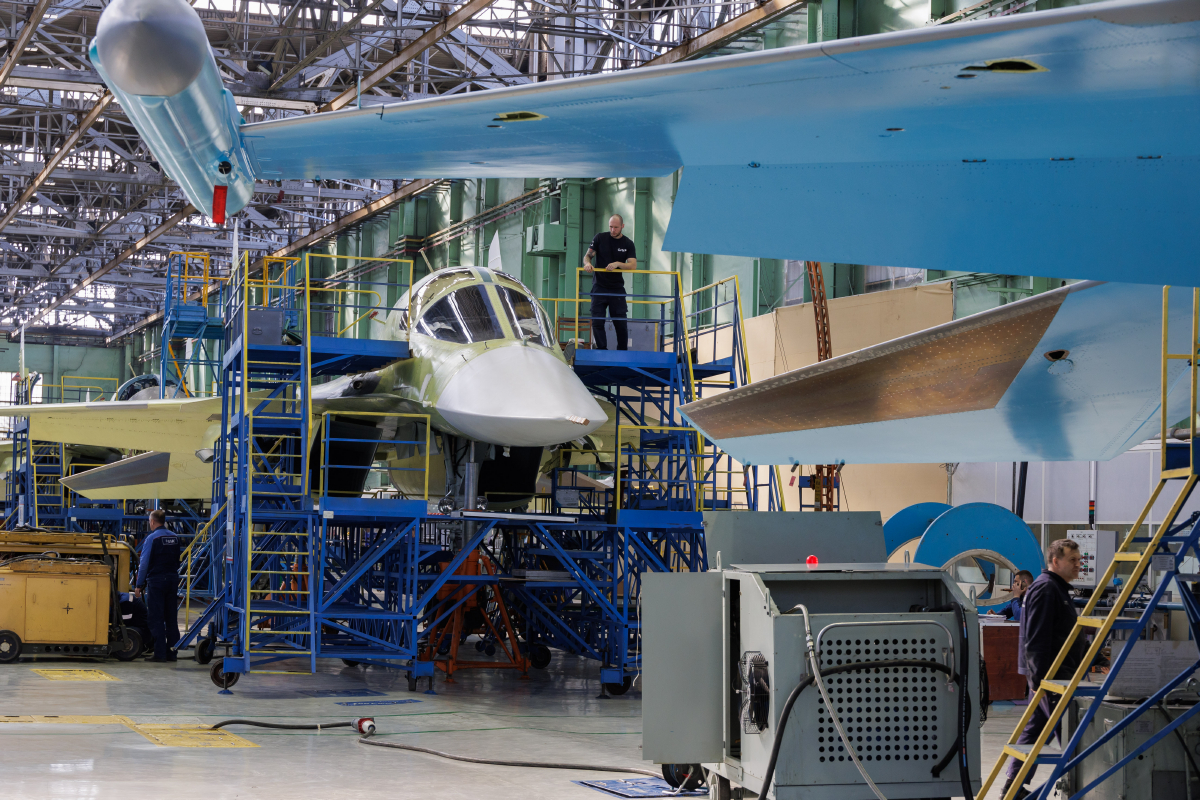
Ukraine's military intelligence directorate, the GUR, set out the ledger on October 29. Russia had about 140 Su-34s of all versions, including the modernised Su-34M, in service as of October 22, Kyiv says. Against that fleet, Ukraine says Russia has lost 43 Su-34s destroyed and 7 damaged since the full-scale invasion began in 2022. Set those claimed losses against production, estimated at only 14 to 18 aircraft a year, and the arithmetic is stark: 43 destroyed airframes equal roughly two and a half to three years of the Novosibirsk plant's entire output. Even discounting Kyiv's tally for the fog that hangs over every wartime claim, the direction of travel is what matters. A fleet of about 140 cannot absorb losses in the forties — destroyed or merely damaged-and-grounded — while a production line replaces fewer than twenty a year, without the shortfall eventually showing up in sortie rates. Two more airframes at Marinovka, if confirmed, are not a rounding error in that equation; they are about six weeks of production burned in one night.
The glide-bomb connection
The second reason Marinovka matters is what the Su-34 does. Russia's glide-bomb campaign — thousands of UMPK-fitted bombs a month by Ukrainian estimates — depends on a small number of launch platforms, and the Su-34 is the principal one. Every airframe lost on the ground subtracts not one aircraft but the stream of sorties that aircraft would have flown for the rest of the war. That is the logic of Kyiv's airfield campaign: missiles are comparatively cheap and domestically built, modern strike aircraft are neither, and an aircraft destroyed on its apron costs Moscow the same airframe as one shot down over the front — without Ukraine having to defeat its crew, its escorts or its electronic warfare on the way in. Moscow's counter-argument, made after earlier strikes, is that the fleet is large, losses are exaggerated, and the glide-bomb campaign has continued through every previous claim. On the evidence of continued glide-bomb attacks, that is true so far; the question the Marinovka claim poses is cumulative, not immediate.
From ship-killer to 1,000-kilometre land-attack weapon
The weapon doing this work was never designed for it. The R-360 Neptune was developed by Kyiv's Luch Design Bureau from the Kh-35 as an anti-ship missile for coastal defence, and it became famous in April 2022 as the missile credited with sinking the Moskva, the flagship of Russia's Black Sea Fleet. A land-attack variant followed in 2023, turning a sea-denial weapon against ports, depots and airfields. Then came the lengthened version Zelenskyy calls the "Long Neptune," reported to reach up to 1,000 kilometres and first used in 2025, according to the president. Marinovka, at roughly 400 kilometres, sits comfortably inside even the older missile's practical envelope — which is part of the story. Ukraine no longer needs its longest-legged weapons to hold Volgograd-region airfields at risk; it needs them for the bases Russia might retreat to next. And because Neptune is Ukrainian-designed and Ukrainian-built, strikes like this one do not depend on foreign targeting permissions — a point Kyiv has made repeatedly this autumn as its dependence on American support has become a political argument in two capitals.
October's pattern: airfields in the Navy's sights
Marinovka is the second Neptune airfield strike Kyiv has announced in a fortnight. On the night of October 14–15, a Neptune strike on Borisoglebsk airfield in Voronezh region hit six Su-34Ms — Zelenskyy said four were destroyed and two damaged, and Reuters verified satellite imagery showing destruction at that base, a level of corroboration the Marinovka claim does not yet have. That strike is covered in full in our report on the Neptune strike that hit six Su-34M jets at Borisoglebsk. Earlier in the month, on October 4, Ukraine's Security Service (SBU) claimed a Su-35 and a Su-34 destroyed at Khanskaya air base in Adygea. Nor is Marinovka itself a new target: on June 27, 2025, the SBU claimed two Su-34s destroyed and two damaged there, an attack British defence intelligence assessed had almost certainly destroyed at least two aircraft, and the base was struck by drones in August 2024. A base that has been hit in 2024, again in 2025 and now, Kyiv says, in 2026 is a base whose defences, shelters and dispersal plans have had every chance to adapt — which cuts both ways in assessing the new claim: either the adaptations failed again, or the damage this time is smaller than announced. Only imagery will settle it.
What Kyiv gains, what Moscow can do
For Kyiv, a confirmed Marinovka extends a campaign that is working on several levels at once: it attrits the glide-bomb fleet, it demonstrates that a wholly domestic missile can hold rear bases at risk without foreign permission, and it answers — on the same news cycle — Russian strikes on Ukrainian cities with visible damage of Ukraine's own. For Moscow, the options are familiar and each carries a cost. Dispersal spreads aircraft across more airfields and slows the maintenance and arming cycle that generates sorties. Hardened shelters protect parked jets but take time and concrete to build across dozens of bases. More air defence around rear airfields means less of it somewhere else. Pulling Su-34s further back shortens the reach of their glide bombs against front-line targets, because a glide bomb's range is bounded by the altitude and position of its release. Sceptics of Kyiv's claims add a caution that applies to Marinovka directly: wartime loss tallies from any capital run ahead of the wreckage, Ukraine has an interest in the largest defensible number, and a FIRMS heat signature proves a fire, not two destroyed bombers. That caution is fair — and it is why this report treats the two Su-34s as claimed, not counted.
The same day, the other direction
The Marinovka claim was reported on the same day that Russian strikes killed at least 19 people across Dnipro, Chernihiv and Kremenchuk — a daylight wave of drone and missile attacks on Ukrainian cities and railway infrastructure that Signal Post News covered in its report on the Russian daylight strikes that killed at least 19 people across Ukraine. Read together, the two stories are the war's long-range exchange in miniature: Russia strikes Ukrainian cities and infrastructure; Ukraine strikes the airfields and factories that generate Russia's striking power. Each side presents its own strikes as military necessity and the other's as the escalation. The facts recorded here — 19 dead in Ukrainian cities, a fire on a Volgograd apron, two bombers claimed destroyed — are stated without adopting either government's framing of them.
What happens next
Four developments will confirm, shrink or extend this story. First, battle-damage assessment: high-resolution satellite imagery of the Marinovka parking area, of the kind that settled the Borisoglebsk argument within a day, will show whether two Su-34 airframes burned where the FIRMS fire was recorded. Second, Russia's basing: if Su-34s begin appearing at airfields still further from Ukraine, or under new shelters at Marinovka itself, Moscow will have priced in more Neptunes — and every kilometre of retreat trims the glide-bomb threat to front-line cities. Third, tempo: whether glide-bomb activity in the sectors Marinovka supports measurably dips will show if the strike, real or exaggerated, had operational effect. Fourth, the next target: October has now produced claimed Navy strikes at Khanskaya, Borisoglebsk and Marinovka, and the pattern suggests the campaign is systematic rather than opportunistic. For now, the verified core is narrow and worth stating plainly: a fire burned in Marinovka's aircraft parking area in the early hours of October 29, Ukraine's Navy and president say two Su-34s were destroyed there, Russian channels reported the same losses, and Moscow has said nothing at all.
Related coverage: Ukraine Neptune strike damages six Su-34M jets at Borisoglebsk · Dnipro train station attack toll rises to 14 as daylight strikes kill at least 19 across Ukraine
Sources
- Ukrainian Navy statement (October 29, 2026) — Neptune coastal-defence missile units struck Marinovka airfield in Volgograd region and destroyed two Su-34 fighter-bombers of the 11th Mixed Aviation Regiment near Oktyabrsky.
- President Volodymyr Zelenskyy, evening address (October 29, 2026) — "We carried out two missile strikes, destroying two Russian Su-34s, and also hitting an Iskander launcher"; the second strike hit an Iskander launcher at a separate site.
- 112.ua (October 29, 2026) — the Navy's Marinovka statement and the GUR fleet figures: about 140 Su-34s in service as of October 22, 43 destroyed and 7 damaged since 2022, production estimated at 14–18 a year; also carried by Espreso.
- Aeronaut (October 29–30, 2026) — strike against the Marinovka military airfield: the regiment and division at the base, and the claim as reported.
- Militarnyi (October 29, 2026) — NASA FIRMS satellite monitoring recorded a fire and abnormally high temperature at 02:28 in the aircraft parking area near newly built hangars at Marinovka; Russian Telegram channels reported two Su-34s destroyed and two servicemen killed and two injured (personnel claim unverified).
- Kyiv Post, Ukrainska Pravda and Suspilne (October 29–30, 2026) — Ukrainian reporting of the Navy statement and the president's address; Marinovka's strike history (June 27, 2025 SBU claim and British defence intelligence assessment; August 2024 drone strike); the October 4 SBU claim at Khanskaya; and the October 14–15 Borisoglebsk strike, where Reuters verified satellite imagery of destruction.