What is confirmed — and what remains a claim
Ukraine launched an exceptionally large long-range attack against Russia as voting ended in the country’s first parliamentary election held entirely during the full-scale war. The Associated Press reported that more than 1,000 Ukrainian drones were launched across Russia, including hundreds toward Moscow. Moscow Mayor Sergei Sobyanin described the operation as the largest drone attack yet directed at the capital and said 450 aircraft had been destroyed on approach. Russia’s Defense Ministry put the nationwide interception total above 1,100. Those military figures come from Russian authorities and have not been independently verified.
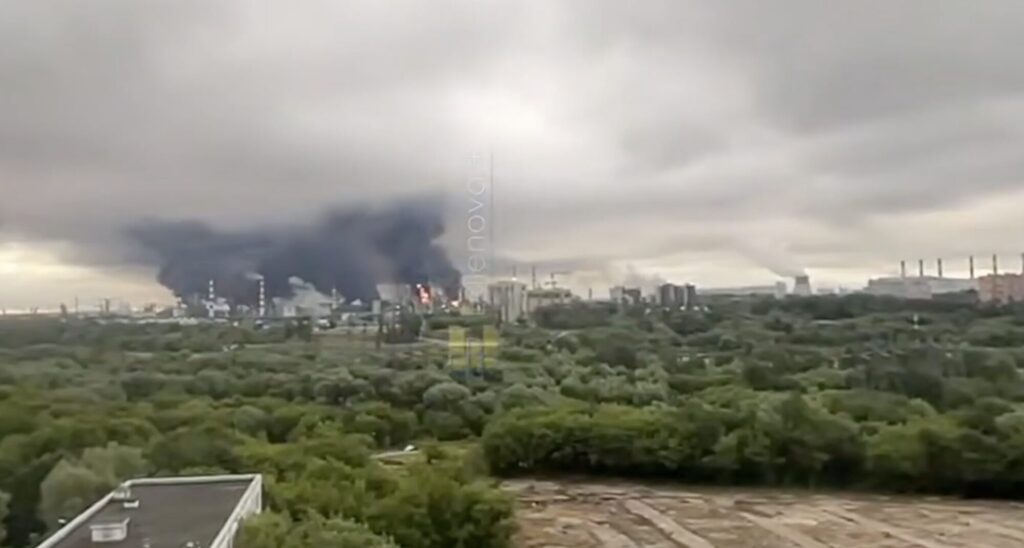
What is clearer is that some weapons penetrated the defense screen. Regional officials said two people were killed and 20 wounded in the Moscow region; a residential building was struck, and the Moscow Oil Refinery was damaged. Volodymyr Zelenskyy acknowledged a Ukrainian operation against oil and logistics infrastructure and said domestically produced Flamingo and Pelican missiles were among the weapons used. Russia simultaneously attacked the Kyiv region, where local authorities said four civilians, including three children, were killed. The symmetry is grim: both governments presented military logic while families on both sides absorbed the consequences.
Why this matters
The timing gave the military operation a political dimension. By directing a large wave toward Moscow during the final day of voting, Kyiv demonstrated that the capital remained within reach despite Russian air defenses. Ukrainian officials have said that exposing the domestic costs of the war is intended to increase pressure on Russia, but available reporting does not establish how the operation affected voter attitudes or political support.
The attack may also reflect a change in the economics of long-range operations. Ukraine once depended heavily on scarce Western missiles whose use came with donor restrictions. A force built around locally produced drones can be launched in larger numbers and may require Russia to spend more on interception and disperse defenses across more sites. The overall cost exchange and operational effect cannot be established without verified data on launches, interceptions, damage and replacement rates.
The history behind the target set
Ukraine’s long-range campaign evolved from symbolic strikes into a systematic effort against the infrastructure that finances and supplies Russia’s war. Refineries, depots and logistics hubs have become recurring targets because they sit at the junction of export income, military fuel and civilian confidence. By mid-September, Reuters calculated that half of Russia’s six largest diesel-producing refineries had cut or halted output after attacks. Russia restricted fuel exports, while regional shortages and rising prices made disruption visible far from the front.
Moscow is different from a refinery hundreds of kilometers away. The city is Russia’s administrative center, its largest media stage and the place where political elites experience risk most directly. Earlier Ukrainian raids showed that the capital could be reached, but this wave tested whether defenses could cope with industrial volume. It also forced authorities to explain the war during an election designed to communicate continuity rather than vulnerability.
Election timing and competing interpretations
Russian officials characterized the attack as an unsuccessful attempt to disrupt voting. That interpretation serves the Kremlin by turning air-defense activity into evidence of state competence: the enemy tried, the system held, the election continued. Kyiv’s interpretation is almost the reverse. In its telling, the strike showed that a managed vote cannot insulate Russia from the costs of the invasion and that domestic weapons can reach assets previously treated as secure.
Both accounts require independent testing. The Russian presentation emphasizes interceptions and continuity while giving less attention to penetrations and refinery damage. The Ukrainian presentation emphasizes military and economic targets, while the reported deaths and injuries require separate scrutiny of civilian harm. Outside governments also face competing considerations: maintaining Ukraine's leverage, limiting Russian energy revenue, containing fuel-price effects and reducing escalation risk.
Reading the numbers carefully
The headline figure is enormous, but reported launch and interception totals are not the same thing as independently counted aircraft. Wartime ministries have incentives to magnify both the threat they defeated and the success of their own defenses. The most responsible conclusion is therefore comparative rather than exact: multiple accounts agree this was the largest operation of its kind against Moscow, while the precise number of launched, diverted and destroyed weapons remains uncertain.
Scale still changes the arithmetic. If a defender stopped 90 percent of a 100-drone raid, 10 could remain; the same rate against 1,000 would leave 100. Large waves can also require expensive interceptors and wider defensive coverage. Yet volume alone does not establish military success. The more meaningful measures are refinery downtime, repair costs, fuel availability, diverted air-defense units and whether subsequent waves can be sustained.
Who wins and who loses
Ukraine gains proof that its domestic weapons industry can produce strategic reach without waiting for foreign permission. Its negotiators also gain a form of leverage: the capacity to impose costs deep inside Russia is an asset at any future table. Drone manufacturers and electronic-warfare specialists on both sides gain urgency, funding and battlefield data.
Russia’s air-defense command loses the presumption that mass alone can be reliably absorbed, even if most aircraft were intercepted. Refiners, transport operators and consumers lose when disrupted production feeds into diesel scarcity. Civilians lose most directly, whether in the Moscow region or around Kyiv, because increasingly automated campaigns still end in homes and hospitals. Energy-importing countries can lose too if damage to Russian refining tightens global product markets even while crude continues to flow.
The political winner is less obvious. The Kremlin can use the attack to justify tighter controls and rally voters around external threat. Kyiv can use the same images to show Russians that the invasion has consequences at home. Which message prevails depends less on one night than on what residents experience afterward: normal commutes and full fuel stations, or recurring alerts and shortages.
Three paths from here
Retaliation and escalation. Russia could answer with larger attacks on Ukrainian cities and power infrastructure, seeking to restore deterrence through punishment. This is the most immediate danger. Each side may believe the other will concede first, even as both expand the definition of a legitimate target.
A campaign of economic attrition. Ukraine could keep Moscow raids occasional while repeatedly hitting refineries and logistics nodes. In this scenario, the election-day strike becomes a demonstration attached to a longer effort: compel Russia to spread air defenses, reduce product output and convert war costs into political pressure. Success would be measured over months, not by a single explosion.
Leverage for diplomacy. Deep-strike capacity could become part of bargaining rather than an end in itself. Ukraine might offer limits on refinery attacks in exchange for verified Russian steps, while mediators seek reciprocal protections for energy and civilian infrastructure. That outcome would require monitoring, sequencing and trust that do not yet exist, but it is the only scenario in which demonstrated reach reduces rather than expands the next round of violence.
What to watch next
The first indicator is physical: whether the Moscow refinery returns to normal operations quickly or reports meaningful outages. The second is operational: whether Ukraine can repeat attacks at similar scale without a long pause. The third is political: whether Russian authorities emphasize successful interception, punish security officials, tighten information controls or announce new protective measures around the capital.
Finally, watch the language of diplomacy. Calls to halt refinery attacks without a reciprocal Russian commitment would constrain Kyiv while leaving Moscow’s strike campaign intact. A credible de-escalation proposal would name both sides, specify protected categories and create verification. Until then, the election-day offensive should be read neither as a decisive breakthrough nor as mere spectacle. It is evidence that the war’s geography, production base and political theater have all changed.
Sources
Associated Press (via WAMC/NPR), “Ukraine fires over 1,000 drones at Russia, including hundreds launched at Moscow,” September 20, 2026: Read the report
CNN, “Moscow targeted by ‘largest ever’ drone attack on final day of Russia’s parliamentary election,” September 20, 2026: Read the report
Reuters, “Russian drone attack kills three children and a woman in Kyiv region,” September 20, 2026: Read the report
Bloomberg via Rigzone, “Trump Demands Russian Refineries Be Spared as Diesel Surges,” September 14, 2026: Read the report
Reuters via The Hindu BusinessLine, “Drone attacks disrupt Russia’s major diesel refineries and fuel supply,” September 15, 2026: Read the report