War · Ukraine · Russia
The Komyshuvakha aid point bombing is now one of the deadliest single strikes on Ukrainian civilians this year. On Friday, the acting head of the Zaporizhzhia regional administration, Mykhailo Semikin, said the confirmed death toll had risen to 53 — the latest in a week of upward revisions — as search and rescue crews entered a fifth day of work in the rubble of a school that had been handing out humanitarian aid, and of the underground shelter hit after it.
Track it live: Ukraine War Map — Live Global Trackers
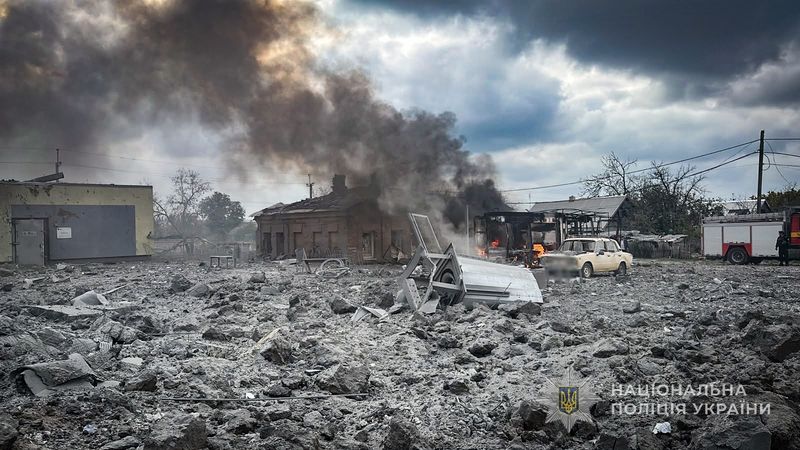
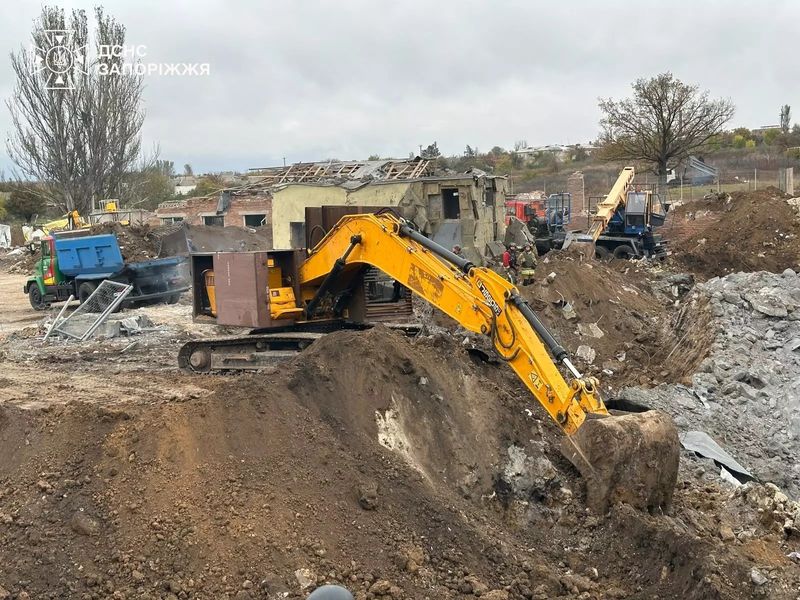
Komyshuvakha, Ukraine — The death toll from Russia’s bombing on Monday of an aid distribution point in Komyshuvakha, in Ukraine’s south-eastern Zaporizhzhia region, has risen to 53, the acting regional governor, Mykhailo Semikin, said on Friday via Telegram, Reuters reported — making the strike one of the deadliest on civilians this year. Ukraine’s State Emergency Service had earlier put the toll at 50. Search and rescue work at the site entered its fifth day on Friday, officials said, as crews continued to clear the ruins of the school building where residents had gathered to receive humanitarian aid.
Every figure in this story comes from one side of the war’s reporting chain, and that matters for how it should be read. The tolls, the sequence of the strikes and the identities of the dead have been reported by Ukrainian officials — the regional administration, the Emergency Service, the police and President Volodymyr Zelenskyy — and assessed by the United Nations human rights monitoring mission in Ukraine. Russia had not publicly commented on the strike in the reporting cited here. What follows attributes each claim to the official or body that made it.
What happened on Monday
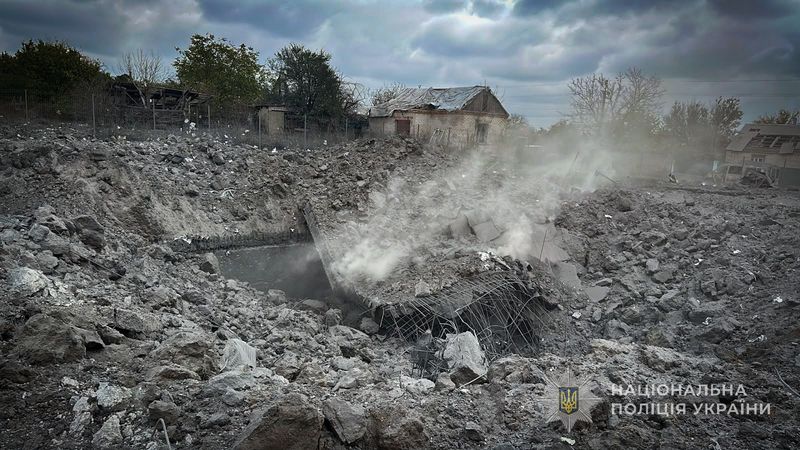
According to Ukrainian officials, several bombs hit a school building in Komyshuvakha that was being used to distribute humanitarian aid, at a moment when residents had gathered there to collect it. A follow-up strike then hit an underground shelter, Ukrainian officials said — the sequence Kyiv describes as a second blow aimed at the place people had fled to, and at those responding to the first. The settlement sits close to the front line in the Zaporizhzhia region, where aid distribution points in school buildings and other public premises have become part of the weekly routine of civilian life under bombardment.
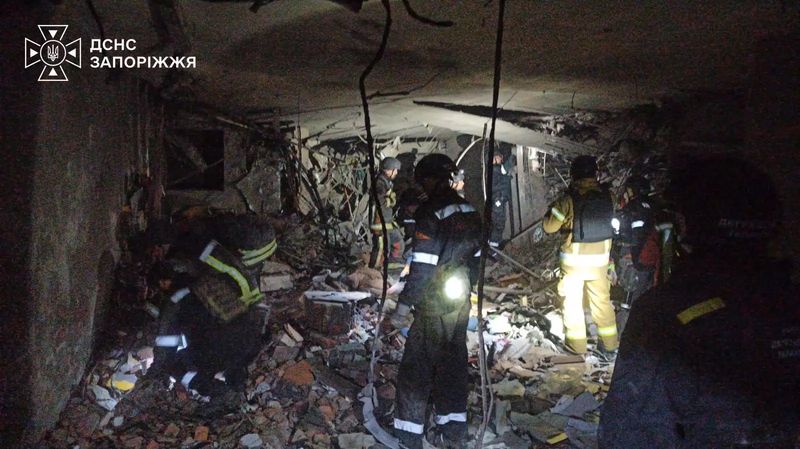
Among the dead, officials said, were four police officers and two members of a rescue crew — people who, on the Ukrainian account, were at the site because of the first strike when the follow-up came. The United Nations human rights monitoring mission in Ukraine said the bombing likely violated international law, a finding that rests on the character of the target as reported: a known aid distribution point and a civilian shelter. The mission’s assessment is the closest thing to an outside judgement the incident has so far produced, and it is an assessment of the bombing’s legality, not an independent count of its victims.
The toll, counted day by day
The number 53 is the fifth resting place of a count that has climbed all week, and the progression is itself part of the record. Early counts on Monday and Tuesday put the dead between 24 and 31, as the first bodies were recovered and officials warned that people remained under the rubble. The confirmed figure then rose to 37. On Wednesday, President Zelenskyy put the toll at 40, Al Jazeera reported, noting that some bodies had not yet been identified. Ukraine’s Emergency Service subsequently raised the count to 50. On Friday, Semikin’s Telegram statement took it to 53.
That pattern — a toll revised upward in steps over five days — is grimly familiar from this war’s largest strikes, and it follows the mechanics of the rescue rather than any dispute about the event. A collapsed school and a struck underground shelter do not give up their dead at once: each revision has followed another day of digging, another section of rubble cleared, another identification confirmed. It is why officials have paired every new figure with the same caution, and why Friday’s 53 should be read as the confirmed toll on the fifth day of the search, not necessarily the final one.
Why this matters
The first reason is what was hit. An aid distribution point is not a place civilians happen to be; it is a place they are told to be, at a known time, in a queue. In front-line settlements like Komyshuvakha, the weekly distribution of food and supplies is one of the last functioning services of civilian life, and the school building that hosts it doubles as the community’s shelter. A strike on that building, followed by a strike on the shelter itself, therefore lands on the exact infrastructure that is supposed to keep people alive — which is why the UN mission’s language about a likely violation of international law attaches to this incident with unusual speed and directness.
The second reason is who else died. Four police officers and two rescue workers are, on the Ukrainian account, among the 53. If the follow-up strike hit the shelter and the responders together, Komyshuvakha becomes the latest and deadliest entry in a long documented argument about follow-up strikes — the tactic, alleged against Russian forces throughout the war, of striking a site a second time as rescuers work in it. Ukrainian officials make that allegation explicitly here; the UN mission’s statement gives the underlying facts an outside legal frame; and the absence, in the reporting cited, of any public Russian comment leaves that frame standing unanswered for now.
The third reason is timing. The toll reached 53 on the Friday before the United States brings Ukrainian and Russian delegations together in Abu Dhabi on November 10–11 for talks on ending the war, with US envoy Steve Witkoff central to the American effort. Civilian tolls do not set negotiating agendas, but they set the weather in which negotiations happen. A strike that the UN says likely broke international law, still being dug out of as the delegations prepare to travel, is the background against which words like ceasefire, guarantees and accountability will be traded next week.
Who gains, who loses — and what critics say
The losses are not ambiguous. Komyshuvakha loses 53 of its people, including the police officers and rescuers its surviving residents will depend on next time. Ukraine’s emergency services lose trained crew in a war that consumes them steadily. And the aid system itself loses something harder to count: every distribution point in every front-line settlement is now a place residents must weigh against the risk of being gathered, in the open, at a published place and time.
For Kyiv, the incident supplies the strongest kind of evidence it brings to partners and to international bodies: a high civilian toll, at a civilian site, with a UN mission statement attached. Ukrainian officials have used such tolls to press the accountability argument and to argue against any settlement that treats strikes on civilians as a closed account. Critics of that framing note, correctly, that every figure in this story originates with Ukrainian officials and has not been independently verified body by body — the UN mission assessed the bombing’s legality, not its arithmetic. Critics of Russia’s conduct answer that the pattern is documented well beyond this one settlement, and that the demand for independent verification cannot be met while access to such sites is controlled by the war itself. Both cautions can be held at once, and both are reasons the toll progression above is attributed, step by step, rather than simply asserted.
The numbers in context
Reuters’ framing of Friday’s revision is the measured one: one of the deadliest strikes on civilians this year. That ranking is worth pausing on. This is a war in its fifth year, in which large tolls have become routine enough to pass in a day’s reporting — the same week brought reports of seven killed in attacks on buses in occupied Luhansk, on the word of the Moscow-installed governor there, and nightly drone barrages counted in the hundreds. Against that background, a single incident with a confirmed toll of 53, at an aid point, with a UN legal assessment attached, stands out not only for its size but for its kind. It is the combination — the number, the target and the follow-up strike on the shelter — that has carried Komyshuvakha from the daily toll lists into the diplomatic record.
What happens next
The first thing that happens next is more of the same work: the search entered its fifth day on Friday with the toll still rising, and until the Emergency Service declares the site cleared, each day carries the possibility of another revision. Identification of the dead — already flagged by Zelenskyy on Wednesday as incomplete — will run behind recovery, which means some families in Komyshuvakha will wait longer for certainty than the headlines do.
The second track is legal and diplomatic. The UN mission’s finding that the bombing likely violated international law now sits in the record that Ukrainian prosecutors and international investigators draw on, and Kyiv can be expected to put Komyshuvakha in front of every partner it meets. The third track is Abu Dhabi: the US-brokered talks on November 10–11, prepared by Witkoff and the American team, are where the war’s end is supposed to be discussed — and whether civilian protection, or accountability for strikes like this one, appears anywhere in that discussion will say a great deal about what kind of end is being negotiated. Germany’s proposal this week of an extra €100 million to keep Ukraine’s infrastructure running is the reconstruction side of the same ledger. Komyshuvakha is the other side.
Read next: Seven killed in attacks on buses in occupied Luhansk, Russian-installed governor says · Russia fires 433 drones in one night, cutting power across Ukraine · Germany proposes an extra €100 million for Ukraine’s infrastructure
Reporting based on Reuters’ November 6, 2026 report that the death toll had risen to 53, citing acting regional governor Mykhailo Semikin’s Telegram statement, and its November 4, 2026 report on the strike, together with Al Jazeera’s November 4–6, 2026 coverage of the Komyshuvakha bombing, including President Zelenskyy’s Wednesday toll of 40. All casualty and strike-sequence claims are attributed to Ukrainian officials and the UN human rights monitoring mission in Ukraine; Russia had not publicly commented in the sources cited. Sources: Reuters, November 6, 2026, Reuters, November 4, 2026; Al Jazeera, Komyshuvakha coverage, November 4–6, 2026.