Trump Nobel Peace Prize 2026
Trump Nobel Peace Prize 2026Nobel Peace Prize 2026 announcement dateTrump settled eight wars claimMaria Corina Machado Nobel medal Trumpwho will win Nobel Peace Prize 2026Trump Obama Nobel 2009Nobel Peace Prize frontrunners 2026Trump Iran nuclear obliteration claimVenezuela Iran wars Trump Nobel
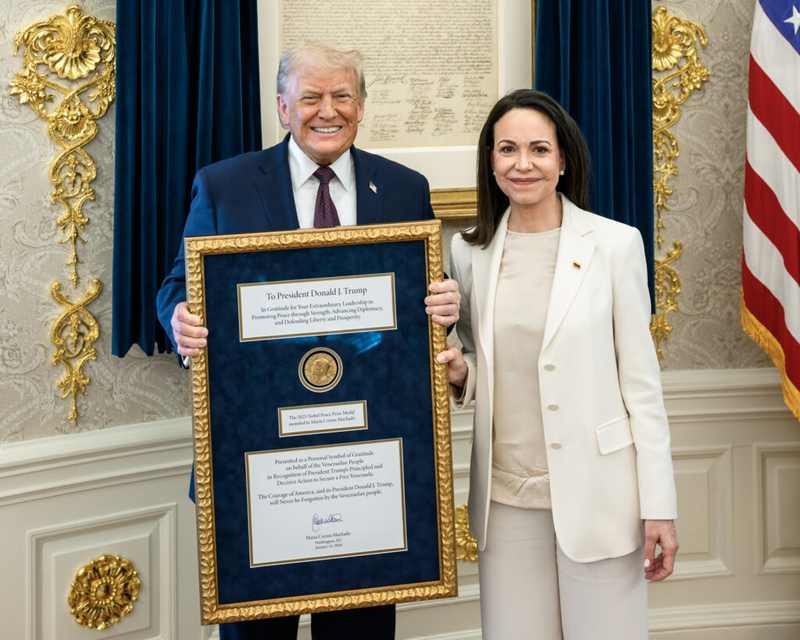
WASHINGTON — President Donald Trump made a last-minute public push for the Nobel Peace Prize on Wednesday, October 7, using Oval Office remarks to argue that no president in history has done more for peace — two days before the Norwegian Nobel Committee announces the 2026 laureate in Oslo on Friday. "I'm not bragging. I'm just telling you the facts," Trump told journalists. "I settled eight wars, and big ones." He pointed to the return of Israeli hostages from Hamas, said his pressure campaign had kept Iran from developing a nuclear weapon, revived his long-running grievance that Barack Obama won the prize in his first year in office, and warned the committee it would be "a great discredit to them" not to choose him. The remarks were reported Wednesday by USA Today and the New York Post, with Reuters carrying a matching account.
The timing is the tell. With roughly 48 hours left before the announcement, the White House chose a public, on-the-record closing argument rather than quiet diplomacy — a fitting end to the most openly lobbied Nobel campaign in the prize's modern history. Whether Oslo listens is a separate question. The White House itself is bracing for a snub, the Post reports — which means Wednesday's remarks were as much about shaping the story of a loss as about preventing one.
Why this matters: a 48-hour window and a White House braced for a snub
The announcement is scheduled for Friday, October 9, at 11:00 a.m. Oslo local time (9:00 GMT), at the Norwegian Nobel Institute. In prize politics, the final days are when campaigns peak — and Trump's team chose to peak in public, in the Oval Office, on camera. That choice reveals the campaign's real audience: not the five committee members in Oslo, who decide by majority vote and do not respond to lobbying, but the American public watching at home five weeks before the November 3 midterm elections.
The posture is the story. The White House is simultaneously arguing that Trump deserves the prize and preparing for him not to get it. That duality is deliberate: it banks the domestic political credit for a vigorous campaign while pre-loading the grievance narrative if Oslo says no. Trump's line that the committee has "a reputation for maybe not giving it to people like me" converts a probable loss into advance evidence of bias — the same maneuver he used after the 2025 prize went to Machado, when the campaign pivoted to celebrating her January 2026 medal handover as a moral victory.
Analysis: the stakes extend beyond one man's trophy shelf. The 2026 announcement lands in the middle of two active American wars and a stalled Russia-Ukraine peace effort. Whoever Oslo names will be read as the committee's verdict on what "peace work" means in 2026 — and Trump's campaign is the loudest, most aggressive attempt to define that term on his own behalf. A win would validate the transactional, tariff-leveraged model of peacemaking he claims. A snub would reaffirm the committee's institutional resistance to exactly that model.
Background: a decade of wanting the prize
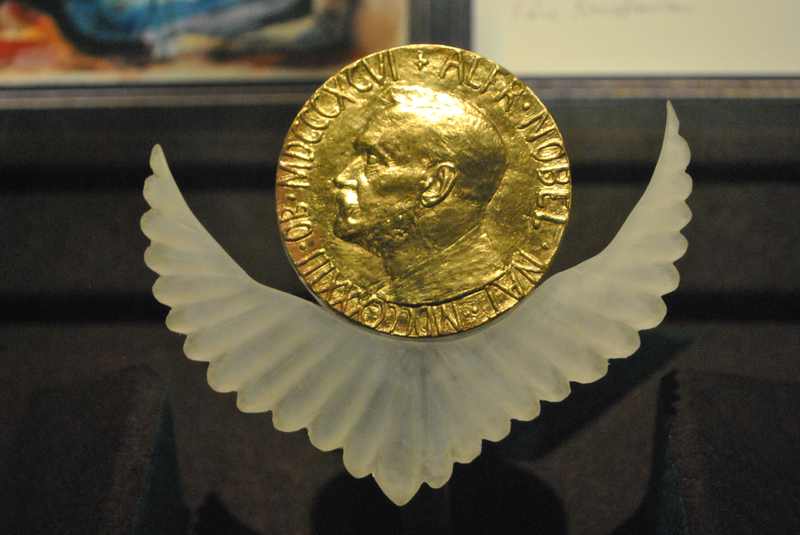
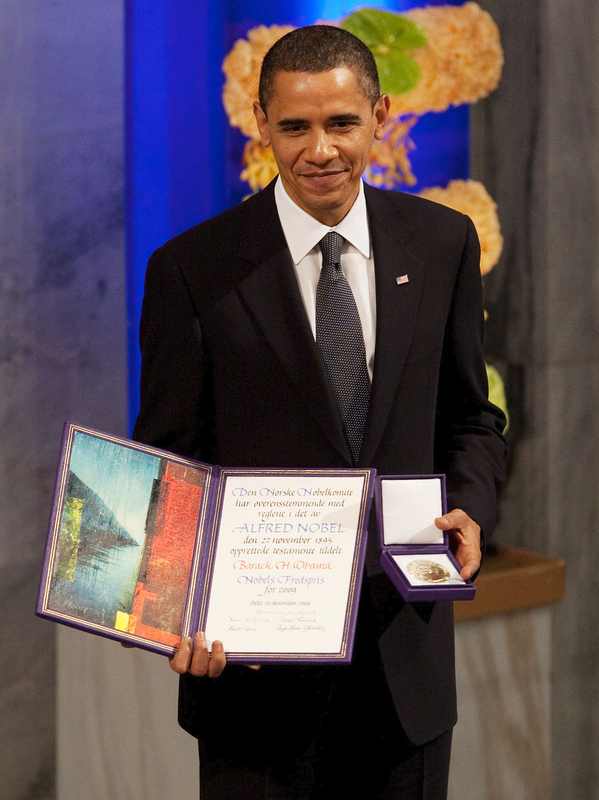
Trump's Nobel ambitions date to his first term, when he repeatedly suggested that his summits with North Korea's Kim Jong Un and his Middle East diplomacy merited the award. The grievance then hardened into doctrine around a single data point: Barack Obama received the 2009 prize in his first year in office. Trump has cited that fact for years as proof the system is rigged — a theme he revived on Wednesday, arguing Obama was honored before he had done anything to earn it.
In 2025 he campaigned openly and heavily — and lost. The prize went to Venezuelan opposition leader María Corina Machado, honored for her resistance to authoritarian rule. In January 2026, during an Oval Office visit, Machado presented Trump with her Nobel medal, telling him he deserved it more. Trump has brandished that moment ever since, describing it in the Oval Office on Wednesday as an extraordinary honor. The Norwegian Nobel Committee responded to the episode by reiterating that the prize cannot be transferred, shared or withdrawn — a guardrail that exists precisely so the award cannot become a tradable political token.
How the prize actually works matters here. It is decided by the five-member Norwegian Nobel Committee, appointed by Norway's parliament, voting by majority and announcing each October. Nominations for the 2026 prize closed in February 2026 — a structural fact that limits how much late-breaking diplomacy can move the needle. The committee's 2026 judgment is anchored mainly in work completed before this spring's crises, which means the October push itself arrives after the evidentiary window has effectively closed.
The supporters' case
The headline number is eight: eight conflicts settled, with Trump telling reporters "another one is coming." Supporters present this as an unprecedented volume of deal-making in under two years — more peacemaking, they argue, than any modern president has packed into a single term, let alone twenty months.
The hostages are the emotional core of the case. Trump says he secured the return of Israeli hostages held by Hamas — a concrete, human outcome his allies rank above abstract diplomacy. Where critics see process, supporters see people coming home.
Then there is the leverage doctrine, the most original element of the Trump theory of peace: that tariffs and the threat of tariffs stopped wars before they started. On Wednesday he argued he had used tariff threats to keep countries from what he called partaking in killing people. Supporters frame this as 21st-century deterrence — economic coercion achieving what decades of communiqués could not.
The Iran argument completes the case. Trump said he "stopped maybe the total obliteration of the world" by ensuring Iran never obtains a nuclear weapon — framing the Iran war, which began in February, as preventive peacemaking rather than aggression. And the nominations: the leaders of Cambodia, Israel and Pakistan have said they nominated him, Reuters reports — though nominations are secret and unverifiable, which makes those announcements function as much as endorsements as evidence.
The critics' case
The central objection is chronological, and it is formidable: since the 2025 prize was awarded, the United States under Trump has launched two new wars. In January, American forces invaded Venezuela and arrested the country's leader on drug charges, after which Delcy Rodríguez claimed power. In February, the US went to war with Iran over Tehran's nuclear program — a conflict still underway. Awarding a peace prize to a president actively waging two wars would, critics argue, redefine the award out of recognition.
The "eight wars" ledger is contested on its own terms. Reuters reports that parties to some of the conflicts Trump claims to have resolved dispute the extent of Washington's diplomatic role, and fighting has flared again in several of those regions, including the Democratic Republic of Congo and along the Cambodia–Thailand border. Several episodes on the list were brief flare-ups or multilateral efforts rather than American-brokered settlements — the difference between showing up at a ceasefire and causing one.
The unsolved war is the hole in the middle of the campaign. Trump himself alluded on Wednesday to the Russia-Ukraine war his administration has been trying to stop — the conflict he once promised to end on his first day back in office, and which instead ground on through another day of strikes on October 7. A peace-prize campaign with Europe's largest land war still raging is, critics say, a campaign built on a missing centerpiece.
The Obama comparison cuts both ways. Obama won in 2009 for early diplomatic outreach and a stated commitment to multilateral engagement. Trump's camp treats that as proof of a low bar applied selectively. His critics treat it as proof the committee rewards the direction of travel, not just the destination — and argue Trump's direction of travel includes two wars of choice.
Fact-check: what is claimed vs. what is established
"Settled eight wars" — unsubstantiated as a tally. This is a White House talking point, not an independently validated count. No neutral arbiter has confirmed an eight-item ledger, and several items are disputed by the other parties involved or have seen fighting resume.
"Got all the hostages back" — partially established, contested in attribution. Hostage releases connected to the Gaza file are real events, but characterizing every release as Trump's personal achievement is disputed by other governments and mediators involved in the negotiations.
"Stopped the total obliteration of the world" — unverifiable. The claim rests on intelligence assessments about how close Iran was to a nuclear weapon — assessments that are classified and not publicly checkable. The scale of the phrasing is rhetorical, not measurable.
The Machado medal — genuine event, symbolic meaning only. The January 2026 Oval Office handover happened, but the Nobel Committee's position is that prizes cannot be transferred. Trump holds a medal, not a share of the 2025 prize.
What the numbers and history say
The 2025 result is the cautionary data point. Trump campaigned harder and more publicly than any previous aspirant — and did not win. The committee has a long record of ignoring public lobbying; there is no documented case of a pressure campaign moving the needle, and the committee's secrecy rules are designed to make lobbying unworkable.
History sets a narrow precedent for sitting presidents. Three have won while in office: Theodore Roosevelt (1906), Woodrow Wilson (1919) and Barack Obama (2009). Each won without waging an acknowledged new war at the time — a pattern the current campaign must overcome, given Venezuela and Iran. The committee has also repeatedly honored non-state actors — the EU in 2012, Nihon Hidankyo in 2024, the imprisoned Narges Mohammadi in 2023 — which is why analysts list humanitarian organizations among the 2026 favorites. The prize is often used to protect civic space rather than to crown statecraft.
Analysis: the calendar math may be the campaign's quietest enemy. With nominations closed in February 2026, the committee's file on Trump is largely the pre-spring record — before the year's headline crises and before most of the diplomacy cited on Wednesday. Late developments arrive after the evidentiary window, which structurally favors candidates whose case was complete early. The October push is superb politics; as prize strategy, it is aimed at a jury that has mostly finished deliberating.
What happens next: Friday in Oslo
The announcement comes Friday, October 9, at 11:00 a.m. Oslo local time (9:00 GMT). Two scenarios, both consequential:
If he wins: instant vindication of the most public Nobel campaign ever run — a fourth sitting-president win, a historic first for a president who campaigned for the prize as openly as for office, and a powerful asset five weeks before the midterms. It would also ratify the tariff-leverage theory of peacemaking as prize-worthy statecraft.
If he is snubbed — the outcome the White House is reportedly braced for — expect the grievance machinery to engage within hours. The "great discredit to them" framing becomes the story, the 2027 campaign effectively begins, and the Machado medal gets another outing as the people's prize versus the committee's. The political utility of losing may, paradoxically, approach the utility of winning.
The analysts' path to a future prize is specific, per the New York Post: end the Russia-Ukraine war and secure a durable Middle East peace. In other words, the committee's price is the very outcome Wednesday's remarks conceded is unfinished — an admission that doubles as a roadmap.
The names circulating among analysts — speculation only, since the committee never comments on favorites — include humanitarian organizations, Pope Leo XIV, Canadian Prime Minister Mark Carney, and Yulia Navalnaya, the widow of Russian opposition leader Alexei Navalny. Melania Trump has even been mentioned as a longshot for her work reuniting Ukrainian and Russian children, per the Post. None of this is a shortlist; it is the chatter of a city that keeps its secrets for 50 years.
Sources
- USA Today — "'I'm not bragging': Trump makes last-minute play for Nobel Peace Prize" (Oct 7, 2026): Oval Office remarks, the eight-wars claim, the Obama complaint, the Iran nuclear argument.
- New York Post — "White House braces for another Nobel Peace Prize snub" (Oct 7, 2026): White House posture, the two-action path analysts see, names circulating as possible laureates.
- Reuters — "Trump says he deserves Nobel Peace Prize but has doubts he will get it" (Oct 7, 2026): second verification; notes parties to claimed conflicts dispute Trump's role and fighting has resumed in some regions.
- The Nobel Prize — official rules, history and laureates of the Peace Prize.