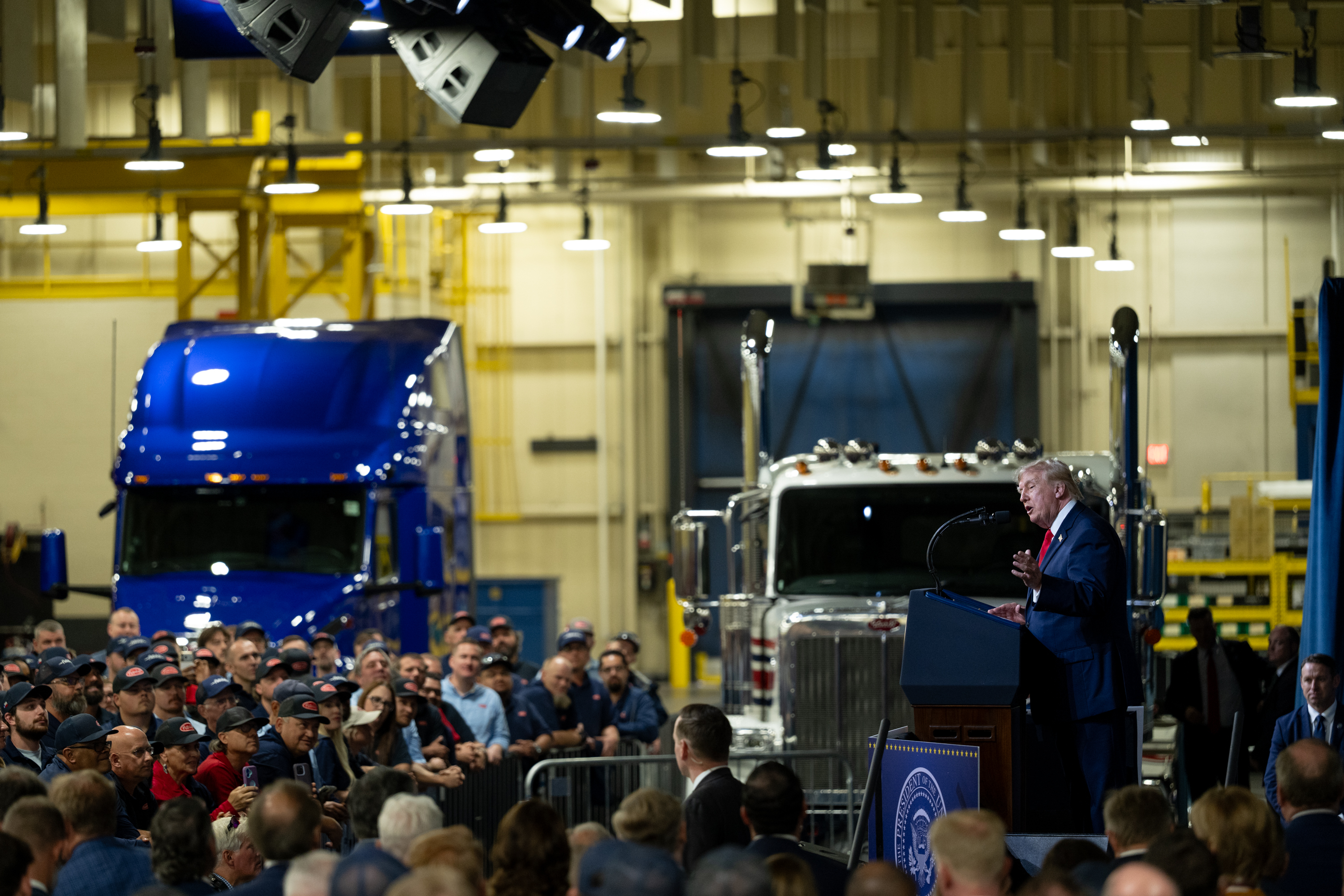
Trump Mohammad joke Georgia rally: President Donald Trump, campaigning in a hangar at Dalton Municipal Airport on Friday for Senate candidate Mike Collins, turned a passage about Iran into a joke about the name Mohammad — and drew a muted response from his own crowd, according to Reuters.
Dalton, Georgia / 'Hello, Mohammad,' a muted hangar — and a Senate race 18 days from decision
The joke
Trump came to Dalton, in Georgia's northwest corner, to campaign for two Republicans: Representative Mike Collins, who is challenging Democratic Senator Jon Ossoff, and health care executive Rick Jackson, the Republican nominee for governor against former Atlanta Mayor Keisha Lance Bottoms. The election is November 3, early voting in Georgia is already under way, and both races are the kind that presidents fly in to move. The speech ranged across his standard rally material, but it was a foreign-policy passage — a discussion of Iran and its leadership — that produced the line of the night.
If you are unsure of a man's name and he is from the Middle East, Trump told the crowd, just say "Mohammad": the odds, he said, run to roughly a 65 percent chance of being right. "Hello, Mohammad. I've done it for years now. I've never been wrong," he said. Mohammad — also transliterated Muhammad and in several other forms — is among the most common male given names in the world, borne in honour of the Prophet Mohammad, and is especially widespread across the Middle East and the wider Muslim world. Trump then extended the riff to Iran's presidency, remarking that "Iran is the only country where nobody wants to be president," and acted out a small scene in which he asks a succession of men named Mohammad whether any of them would like the job, each declining. Iran does have a president — Masoud Pezeshkian, in office since 2024 — a fact that sat quietly beneath the routine.
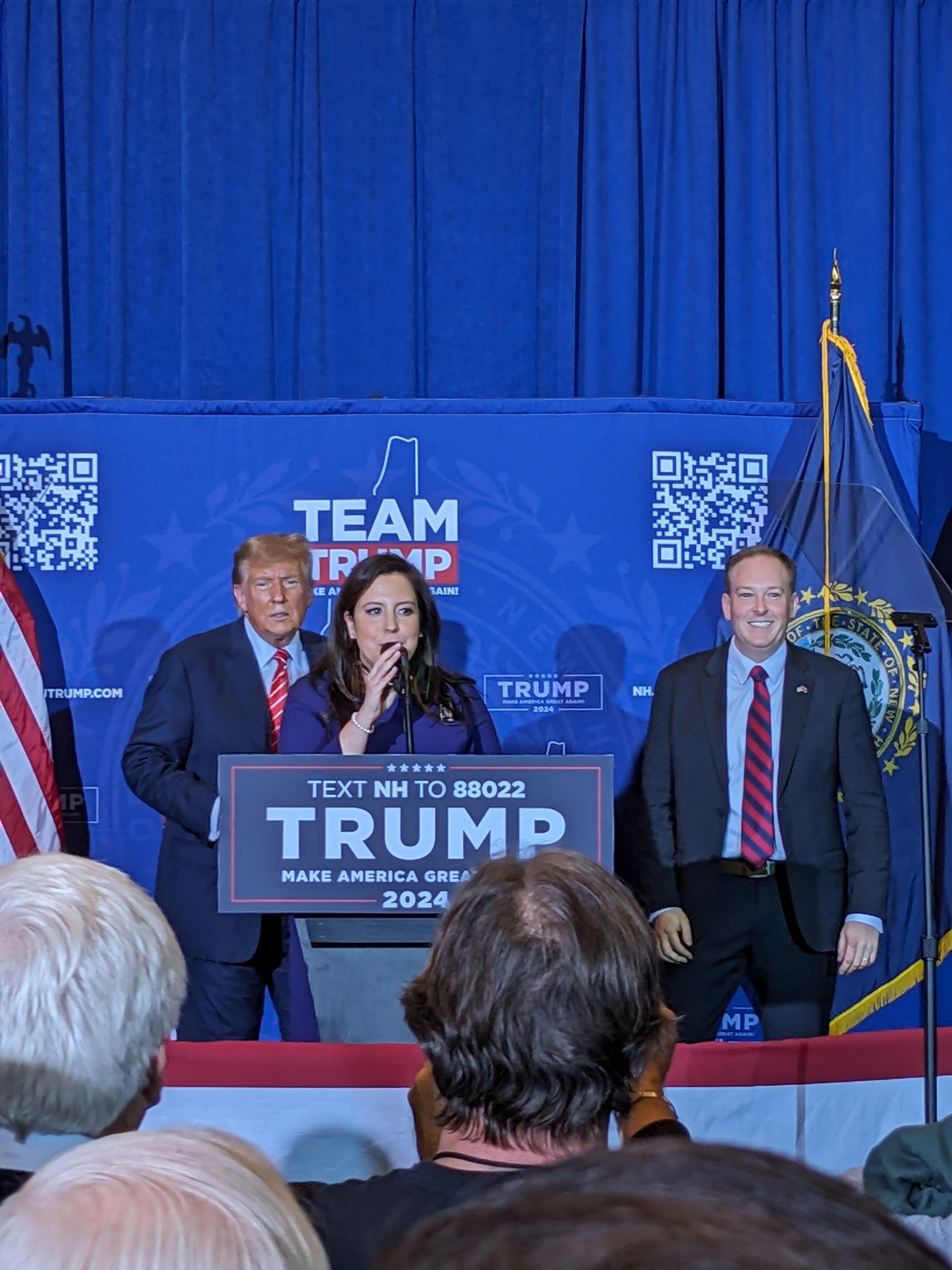
That muted response is itself part of the story. Trump's rallies run on call and response: his best-known lines are delivered to be cheered, and the cheering usually comes. Reuters' reporters in the hangar recorded something quieter for this one — not hostility, not a walkout, but a joke landing at a lower volume than the room gives his usual material. He moved on, and repeated the pledge that anchors his Iran policy and drew a fuller reaction: that Iran will never be permitted to obtain a nuclear weapon. The vow came seven months after the United States and Israel's war on Tehran, and it is the part of the Iran passage his campaign would presumably prefer to have quoted.
The reaction
The criticism arrived in a form that has become familiar, because the underlying dispute is years old. Rights advocates and Muslim advocacy organizations have repeatedly accused Trump of rhetoric that demonizes Muslims, immigrants and minority groups, and of treating Muslim identity itself as a punchline. Reuters noted that the Council on American-Islamic Relations, in its annual report released earlier this year, attributed rising Islamophobia in the United States in part to the administration's second-term crackdowns — on immigration enforcement and on pro-Palestinian protest. Against that backdrop, critics read the Dalton line not as an isolated gag but as another instance of a sitting president inviting a crowd to laugh at a religious name — and, by extension, at the people who carry it.
Context reported by Reuters adds a harder edge to that reading. The news agency reported that Trump has escalated this strain of rhetoric during the midterm season, particularly toward Somali and Muslim Americans — including pointing it at Abdul El-Sayed, the Muslim Democratic Senate candidate in Michigan, whom he has taken to calling "Mohammed," and at Representative Ilhan Omar of Minnesota. In that light, Friday's joke was heard by critics not as vaudeville but as a campaign theme with a laugh track. As of Friday night, however, no major Muslim advocacy organization had issued a statement singling out the Dalton remark itself in the coverage of the rally; the condemnation, so far, is the standing one, applied to a new example.
The other side of the argument was on display in the hangar and in friendly coverage afterward. Trump delivered the line as a joke, in a stretch of the speech built for laughs, and his supporters have long treated his rally comedy as entertainment rather than doctrine — the improvisational showmanship that distinguishes his events from ordinary campaign speeches. Conservative coverage of the Dalton stop led not with the Mohammad passage but with the rally's economic announcements and endorsements, treating the evening as a conventional and successful campaign event. No Republican on the stage or in the Georgia delegation publicly objected to the remark on Friday. The two readings — a president mocking a faith's most honoured name, or a performer doing a bit his audience mostly let pass — are now the fixed positions into which the clip will be filed by each side's media.
The rest of the rally
The Mohammad moment shared the stage with a full card of Georgia attacks. Trump went at Ossoff personally, reviving a nickname — "Pee-wee Herman" — and mocking the senator's grooming, telling the crowd that Ossoff "goes full bore" on makeup. The New York Post reported that Ossoff's campaign has spent nearly $3,000 on makeup services this cycle, a figure drawn from Washington Free Beacon reporting and naming makeup artist Stephanie Ponder; Ossoff's campaign had not commented on it to the Post. Trump also repeated his claim that Ossoff's election was not legitimate — a claim he has made for years; it is presented without evidence, and the record is that Ossoff won his seat in Georgia's January 2021 runoff.
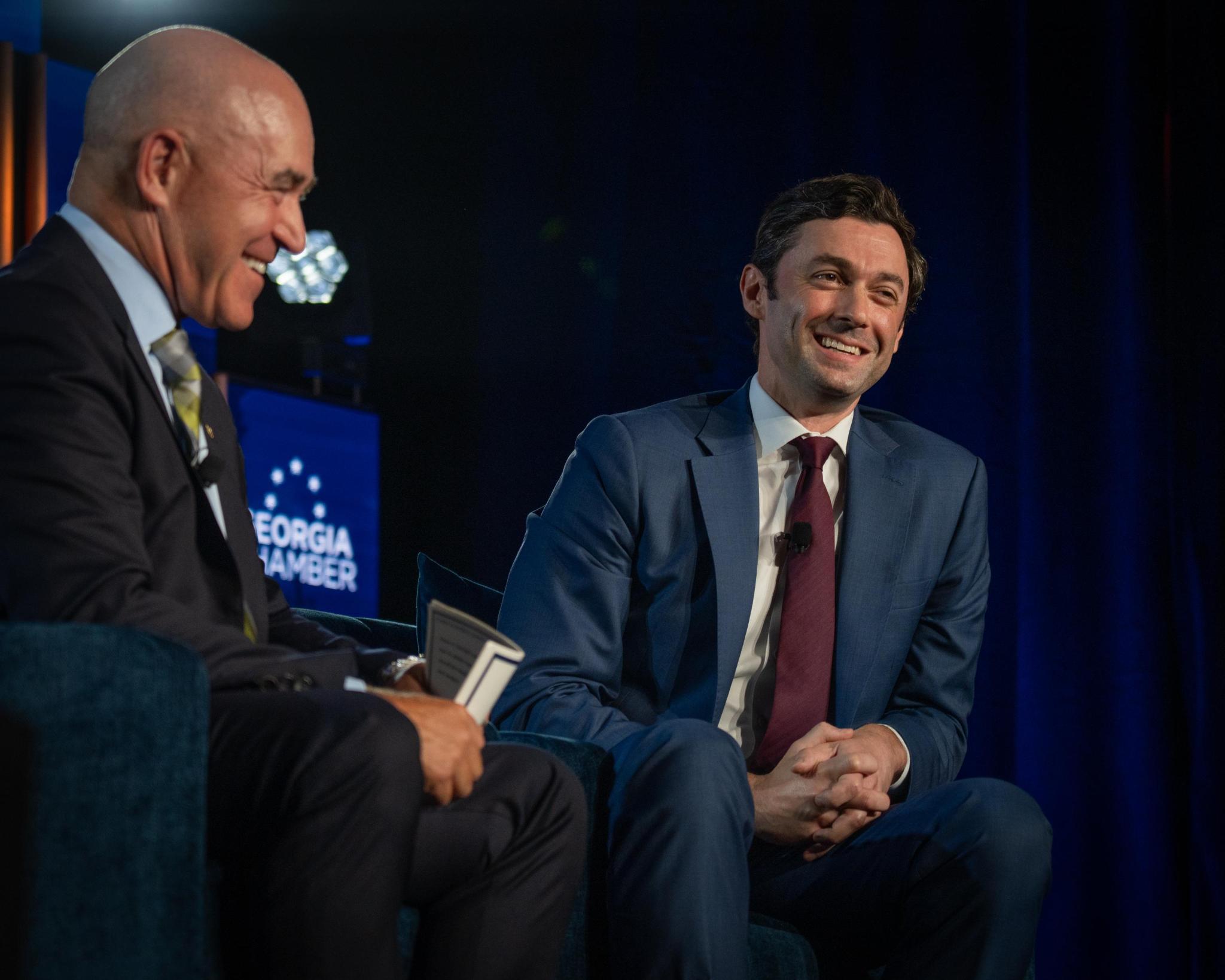
Herschel Walker, the football great whose 2022 Senate campaign Trump backed, got a warmer but barbed treatment: Trump praised him, noted his endorsement, and joked that "he was a better football player than candidate," before calling the 2022 Georgia race rigged. There is no evidence for that either; Walker conceded his runoff defeat to Senator Raphael Warnock in December 2022, saying there were no excuses in life, and now serves as U.S. ambassador to the Bahamas. On economics, Trump touted an announcement Georgia voters had heard days earlier from Governor Brian Kemp's office: Hyundai Transys, the Hyundai Motor Group parts affiliate, will spend $560 million modernizing two Georgia plants and building a third near West Point, creating 320 jobs around hybrid powertrains. Kemp himself was absent from Dalton, citing a family obligation; Vice President JD Vance had campaigned in Atlanta earlier in the week, and protesters who interrupted the Dalton speech were waved off by Trump with a suggestion that Ossoff had paid them.
What it means, 18 days out
Georgia explains the trip. Trump carried the state by about two points in 2024, and both of its 2026 prizes are live: the governor's race is a statistical tie in recent surveys — a Rasmussen Reports poll in September put Jackson ahead of Bottoms 48 to 45, inside the margin of error — while the Senate race is the harder lift. Polling averages compiled by RealClearPolitics from surveys taken between mid-September and October 9 put Ossoff ahead of Collins by roughly eight points, 51 to 43, and most forecasters rate the seat as leaning or likely Democratic. Collins beat a Kemp-backed rival for the nomination despite Ossoff's overwhelming fundraising advantage — the senator had raised more than $124 million by the end of September, against roughly $10 million for Collins — which is precisely why the president's own drawing power is being spent in hangars like Dalton's: the theory is that Trump's base, turned out at presidential levels in a midterm, is the only arithmetic that closes an eight-point gap in 18 days.
Friday's speech was built for that arithmetic — red-meat attacks on Ossoff, a jobs announcement, a loyalty roll call — and the Mohammad joke was, in campaign terms, an improvisation inside it. The open question is what travels further: the rally as his Georgia audience experienced it, or the 20 seconds of tape now circulating without the hangar around it. Democrats have shown all cycle that they intend to run on Trump's words verbatim; Republicans have shown they intend to run on turnout. Both strategies got material in Dalton. Early voting runs through October 30, Election Day is November 3, and if no Senate candidate clears 50 percent, Georgia does this all again in a December 1 runoff — a reminder, in the state that made late-night runoffs a national ritual, that the last word on Friday night is unlikely to be Friday night's.
Related coverage: Trump's Nobel Peace Prize Snub Explodes at Syracuse Rally: 'Eight' Medals, 'Indelible Stain' on Norway · Georgia Board Asks DOJ to Declare Voting Machines Unlawful Before Midterms · Trump Administration Investigates Ilhan Omar in Bid to Strip Her Citizenship and Deport Her, Officials Tell the Wall Street Journal
Sources
Reuters — October 16, 2026, Steve Holland and Kanishka Singh (the Dalton rally; the Mohammad joke and the crowd's muted response; the Iran presidency riff; the pattern of criticism from rights advocates and Muslim groups, including CAIR's annual report; the El-Sayed and Omar context; the renewed nuclear vow). New York Post — October 16, 2026 (the makeup attack; nearly $3,000 in campaign makeup spending this cycle per Washington Free Beacon reporting; Ossoff's campaign had not commented). Aju Press — October 16, 2026 (rally report, including the "Pee-wee Herman" nickname and the Hyundai Transys announcement). The Guardian — rally coverage syndicated October 16, 2026 (the election-legitimacy claim, stated without evidence). The Comeback — October 2026 (the Walker remarks; the December 2022 concession). Office of Governor Brian Kemp — October 8, 2026 (Hyundai Transys: $560 million, West Point-area facilities, 320 jobs). RealClearPolitics polling average — surveys September 14 to October 9, 2026 (Ossoff 51.3%, Collins 43.2%). Rasmussen Reports — survey September 14, 2026 (Jackson 48%, Bottoms 45%). Federal Election Commission filings through September 30, 2026 (fundraising totals). FOX 5 Atlanta — candidate profiles, October 2026.