Politics / Media — The Trump Bill Maher Truth Social post that landed on Sunday night ran 1,323 words — the longest of the more than 97,000 social media posts of Donald Trump’s life, nearly double his previous record — and it ended, in public, one of the strangest courtships in American politics: two White House dinners, a comedian who kept mocking him anyway, and, buried in the middle of the essay, a president confirming he is thinking about moving the press corps out of the White House.
WASHINGTON — It began, as these things now do, with a dinner that was supposed to change the tone. It ended on Sunday night with the president of the United States typing 1,323 words about a comedian. President Donald Trump’s Truth Social essay on Bill Maher — posted Sunday evening, eleven days after Maher dined at the White House for the second time and two days after Maher’s first television show since that dinner — is, according to CNN’s analysis and the Factbase database that archives his output, the longest post Trump has ever written: the longest of 97,455 cumulative social media posts since 2011, and nearly twice the length of his previous record, a 723-word post in May that began with complaints about the Kennedy Center’s plumbing and air conditioning before veering into attacks on a federal judge, the Supreme Court’s tariff ruling and birthright citizenship. “Let’s talk about this COMPLETE AND TOTAL LOSER, Bill Maher,” Sunday’s post begins. It ends, 1,323 words later: “Bill: Don’t call anymore. It’s useless.”
Between those two lines, the post does several things at once, and it is worth separating them, because only one of them is about a comedian. It is a breakup letter, recounting two White House dinners in operatic detail and disputing everything from the length of the second dinner to the state of Maher’s health. It is a fact dispute, in which Trump cites polling numbers that CNN — the network he credits for them — says do not say what he claims they say. It is a threat of a boycott: “I’m going to have the Republicans not cover you anymore.” And in the middle, almost as an aside, it is a genuine piece of news about the presidency itself. “I am not a building a swimming pool in the White House Briefing Room, and never had any intention of doing so,” Trump wrote. “I am thinking about moving the Press, and putting them in a different location, but I will use that location for very badly needed space.” The president of the United States confirmed, inside a 1,323-word essay about a late-night host, that he is considering evicting the White House press corps from the workspace it has used for more than five decades — while his administration is in court fighting to keep three news organizations out of the building altogether.
Two dinners, one rupture
The relationship, such as it was, had a long fuse. By the post’s own telling, the go-between was Chuck LaBella, Maher’s friend and business associate, whom Trump describes as a “gofer” on The Apprentice who rode that show’s success up through the ranks of NBC. For years, Trump writes, LaBella called “nonstop,” insisting that Maher “loves” and respects him and asking for a meeting and a show appearance. Trump says he agreed to meet — twice, eventually — but “never agreed to do his show, which he wants me to do, DESPERATELY. It won’t happen!” The first dinner came in 2025 — March, by CNN’s account — and it produced one of the year’s most dissected detentes: Maher, a liberal critic of long standing, described Trump on air as gracious and unlike his public persona, and took heavy criticism from his own audience for it. Trump’s version, written Sunday, is less fond. “He invited himself to the White House!” the post says. “Bill was very nervous. He asked for a drink. He was very insecure, and he had a seriously bruised eye and nose area, as though somebody had just beaten him up — But it wasn’t me!” Those are the president’s characterizations, offered without evidence, and they are best read as what they are: one side of a dinner, published by the host, eleven days after the second one went wrong.
The second dinner, on October 15, brought Maher back to the White House alongside ESPN host Stephen A. Smith and the musician Kid Rock. By every account available the night itself went well. Smith said on his podcast the next day that “we were there for over four hours in the White House, and Donald Trump did not run from any questions.” Trump, the day after, called it a “great dinner” and said Maher “likes me a lot more than people understand, and I actually like him.” On Sunday he rewrote all of it. The meeting, he now says, “didn’t last four hours, it lasted two hours, maybe less, and everybody was happy. We have the timestamps. I learned nothing, and felt it was a waste of time.” He says LaBella called ten times to arrange it. He says Maher “looked like hell this time,” that “Bill was drunk and had alcohol in his hand as he walked through the White House,” and that he had wanted to tell him “he’s a major POTHEAD. He’s got to stop, it’s very bad for his health.” None of that is corroborated by the other named guests in the coverage available Sunday night, and Maher had not publicly responded to any of it in that coverage. What changed between October 16 and October 25 was not the dinner. It was the television show that followed it.
What Maher actually said on Friday
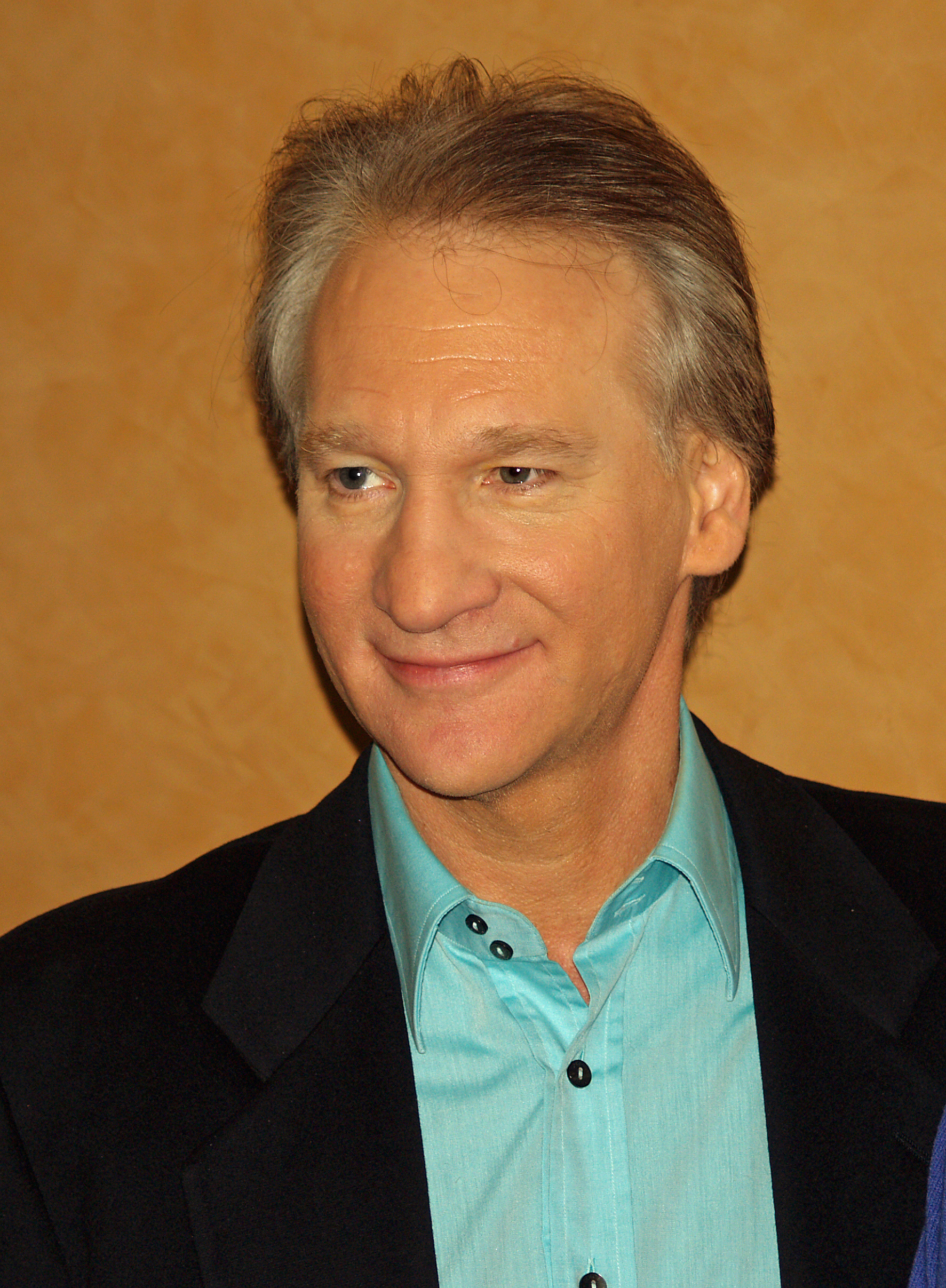
Friday’s edition of HBO’s Real Time was Maher’s first since the dinner, and its panel alone told a story about the show’s place in the year’s politics: former White House press secretary Karoline Leavitt, the Republican candidate for governor of California, Steve Hilton, and Kentucky’s Democratic governor, Andy Beshear. Maher’s monologue, as quoted in coverage of the post, went directly at the president’s standing ten days before the midterms. “Trump has the lowest approval rating of any midterm candidate ever,” Maher said — his claim, delivered as a monologue line, not a verified statistic. “Only 1 percent of the Republicans are mentioning him in their ads. It’s gotten really bad. I mean, the billboards outside of his rallies now just say ‘Lee Greenwood and Friends.’” He joked about Trump’s remarks on Senator Jon Husted’s physique, and about the president “gushing about men’s bodies”: “I was there for dinner for four hours last week, and not a peep. Nothing.” Leavitt, for her part, was praised even by Trump — “Karoline Leavitt was GREAT on the show,” the post says, before calling her interviewer “a biased, dumb SLEAZEBAG, asking questions” and saying she “couldn’t be comfortable going against Lie after Lie.”
What makes Friday’s show a genuinely complicated text for both men is that Maher did not only attack. In the same episode, he raised the week’s strangest White House story — a New York Times report that Trump had discussed turning the James S. Brady Press Briefing Room back into a swimming pool — and Leavitt, who knows the building, confirmed the history and added a detail: the pool’s tile is still visible on the stairs beneath the briefing room, and the president, she said, had been “flirting” with the relocation idea. Maher then turned around and defended Trump’s White House ballroom project against its critics, in terms his own audience did not expect. That is the pattern that has defined the Maher experiment from the start, and it cuts both ways politically. To his defenders, Maher is the rare critic who praises the president when he thinks the president is right and criticizes him when he thinks he is wrong, and who treated the dinners as reporting rather than surrender. To his critics on the left, the dinners were access that purchased nothing but photographs. To Trump, by Sunday night, the ballroom defense counted for nothing against the approval-rating jokes: “After the second dinner, Bill’s ‘show’ was far worse than the first. He went crazy! He’s gutless, because he enjoyed every minute.”
The news buried in the middle: the press corps
Strip the feud away and Sunday’s post still contains a hard news development, because the swimming-pool passage was the second time in two days that the president had addressed the future of the press corps’ workspace — and the two statements, read together, are the clearest account yet of what he is actually considering. The New York Times reported on October 20 that Trump had urged Leavitt in August, before her departure as press secretary, to move news conferences out of the Brady Briefing Room, that the idea was never carried out, and that he had told aides he would rather restore the indoor therapy pool Franklin D. Roosevelt installed on the site — the pool the Nixon administration replaced with the briefing room that has housed the press corps for more than five decades. On Saturday, Trump responded to that report in a separate post: he denied the pool plan in the strongest terms (“I NEVER even thought to do such a stupid thing!”), said “the old swimming pool will never be brought back,” but confirmed, in Reuters’ account, that he could relocate the corps itself: “Although I may move the Fake News to a less obnoxious location.” White House communications director Steven Cheung, asked about the report, did not rule anything out: “All options remain on the table, and we will make an announcement when appropriate.”
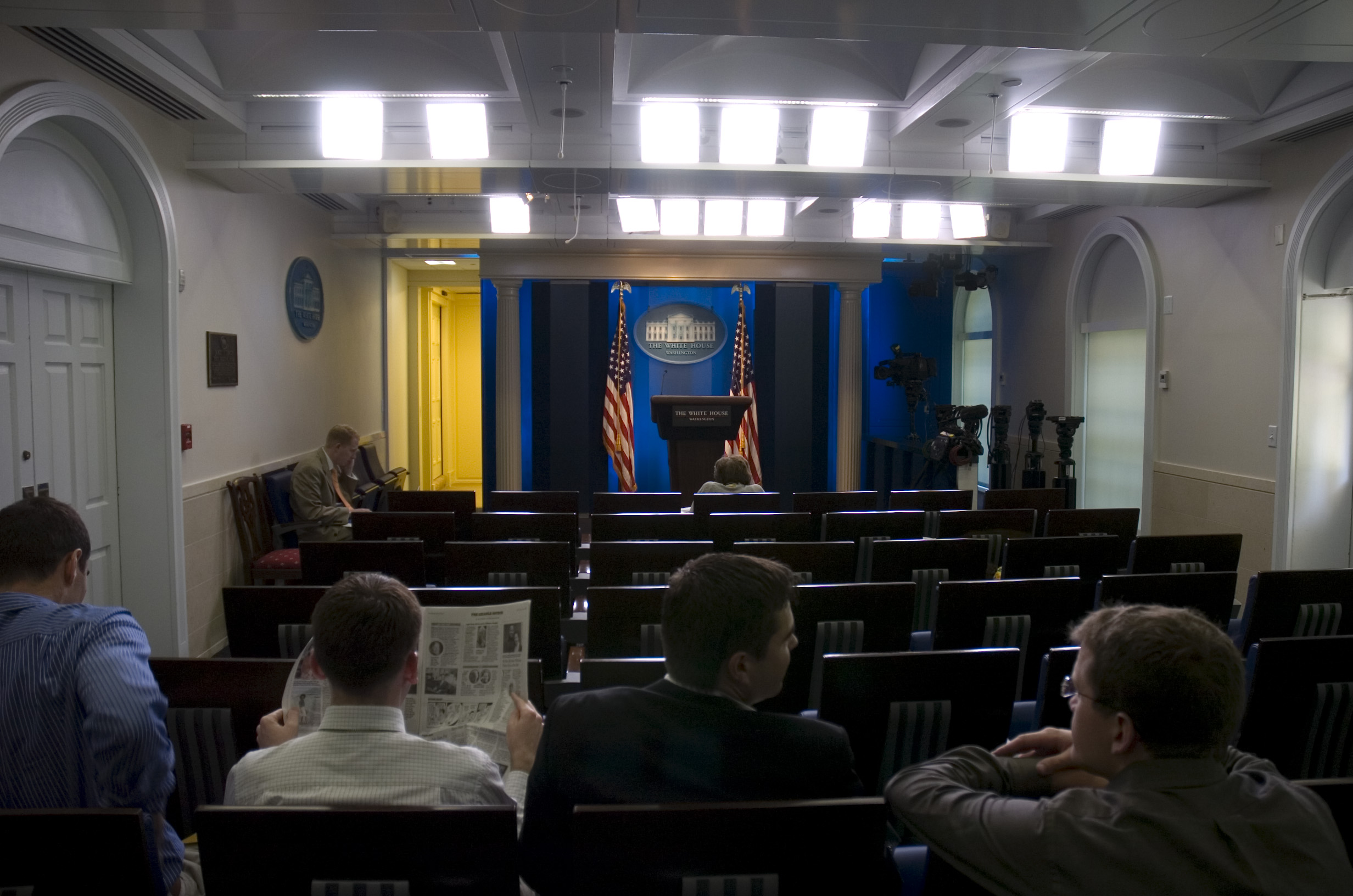
Sunday’s version, inside the Maher post, denies the pool again — “never had any intention of doing so” — and states the relocation idea in his own words rather than a wire summary: “I am thinking about moving the Press, and putting them in a different location, but I will use that location for very badly needed space.” The context that gives that sentence its weight is litigation. In September, the administration banned reporters from CNN, MS NOW and Politico from the White House; a federal judge ordered their access restored and deemed the ban likely unconstitutional, and the administration is still contesting the case — the fight covered in our reporting on the press-ban hearing and on the judge’s order blocking the ban. A relocation is not a ban: every modern administration rearranges workspace, and the White House is entitled to argue that the West Wing’s square footage is scarce and that where reporters sit is an administrative choice, not a speech restriction. Press advocates answer that proximity is the substance of access — the briefing room and the workspaces around it are where unscripted questions happen — and that a president who has spent two months in court over who may enter the building should expect a move of the entire corps to be read as part of the same campaign. Both readings are available in the president’s own two posts; what is not in dispute, after Sunday, is that the idea is his, stated twice, in writing.
Why this matters
It is tempting to file a 1,323-word presidential essay about a comedian under entertainment, and much of it belongs there. But the post matters for three reasons that outlast the feud. The first is the document itself. Trump’s social media posts are not commentary on his presidency; increasingly, they are instruments of it — endorsements, personnel verdicts, policy signals and, as here, on-the-record confirmations of plans his own communications staff had left at “all options remain on the table.” When the longest post of his life spends a paragraph on the disposition of the press corps, that paragraph will be quoted in the litigation and the coverage of the litigation, whatever the surrounding 1,300 words are about. The second reason is what the rupture demonstrates about the dinner strategy, from both directions. Twice now, a White House dinner with Maher has been followed, in short order, by a public presidential denunciation — in February, after Maher mocked his Canada remarks, Trump called hosting him “a total waste of time,” the identical phrase he used on Sunday. Access did not moderate the comedian’s coverage, and coverage did not, in the end, preserve the president’s goodwill. Whether that makes the dinners a failure depends on what they were for: if the point was a working relationship with a heterodox critic, Sunday night is the obituary; if the point, for both men, was the spectacle of the attempt, then the cycle of dinner, monologue and denunciation may simply be the format, and it may run again.
The third reason is the information fight folded inside the insult fight, because it previews the argument of the next ten days. Maher’s monologue was, at bottom, an electability argument: a president whose party’s candidates barely mention him, with approval ratings he called the lowest of any midterm figure ever. Trump’s reply was an electability counter-argument: record Republican support, a record endorsement slate, a party unified behind him. Those are the two stories the two parties will tell about the midterms between now and November 3, and Sunday’s post is a unusually complete specimen of the collision — each side’s strongest talking points, each side’s shakiest numbers, in a single document. Which brings us to the numbers themselves.
What the numbers actually say
Start with the post’s own dimensions, because they are the one set of figures nobody disputes. 1,323 words; 97,455 posts in the Factbase archive since 2011; a previous record of 723 words, set in May. The escalation has a shape: February’s anti-Maher post ran to roughly 490 words by contemporary coverage’s count; May’s record was 723; October’s is 1,323. The president’s posts are getting longer as the midterm stakes rise, and the subjects are getting smaller — from tariffs and judges in May to a comedian’s laugh track in October (“what Laughter Machine does he use? People can’t think he’s funny,” he wrote, of a show whose studio audience is visible and audible on camera). The polling claims need more care. Trump wrote that “CNN just came out with a Poll showing that I’m at 98 and 99% support within the Republican Party, an All Time Record High,” and cited CNN figures putting him at 53 percent as the most popular figure in Republican history, against Ronald Reagan at 18 percent and Abraham Lincoln at 8. CNN’s own account, published alongside its report of the post, separates the strands: its most recent poll, released last week, measured Trump’s approval among Republicans at 74 percent — which it called a new numeric low for him — while the 98 and 99 percent figures track a weeks-old segment by its chief data analyst, Harry Enten, describing another network’s poll of voters who identify as MAGA Republicans, a loyal subset of the party rather than the whole of it. Trump has been screening that Enten clip at midterm rallies, and the distinction matters precisely because both numbers are real measurements of different things: near-unanimity among his movement’s identifiers, and a notably softer 74 percent among Republicans as a whole, with the general electorate a third question entirely. Maher’s counter-claims deserve the same treatment: “lowest approval rating of any midterm candidate ever” and “only 1 percent” of Republican ads mentioning Trump are monologue lines attributed here to Maher, not figures this article can verify, and readers should hold them at the same arm’s length.
Two more of the post’s numbers should be labeled plainly. Trump’s endorsement record — “98% in the House, and 100% in the Senate” — is his figure, offered in the post without a source, and it is printed here as his claim. His California passage — that officials “found 20,000” illegal voters “in the last few days alone, and the number could easily go to over 1,000,000” — is likewise his claim, made without cited evidence in the post; CNN characterized the essay overall as “riddled with inaccuracies,” and no election authority in the coverage available Sunday night had announced any such finding. And his vow to “have the Republicans not cover you anymore” is ambiguous in a way CNN flagged: it could mean Republican guests declining to appear on Real Time — Leavitt, Hilton and, in his way, Beshear all just did — or the right-leaning channels that amplify Maher’s monologues when they target the left. The first would be a booking boycott a president can plausibly organize; the second would require the cooperation of networks that profit from the clips. Either way, it is a testable promise, and the guest list of next Friday’s show is the first place to check it.
What happens next
Three clocks are now running. The first is Maher’s: Real Time returns Friday, and the host who built a second career chapter out of answering presidents in monologue has been handed 1,323 words of material, including personal claims about his health and his drinking that he will either rebut, joke about or ignore — each a different story. He had not responded in any coverage available late Sunday. The second clock is the building’s: Cheung’s “announcement when appropriate” hangs over the briefing room, and any actual relocation plan will land in the middle of the press-ban litigation, where the administration is already arguing that access decisions are its prerogative. The third clock is the election’s. Israel votes on Tuesday, the midterms follow on November 3, and the argument inside this post — is the president an asset his party is hiding from, or the most popular Republican who ever lived? — will be answered by turnout rather than by either man’s monologue. Trump closed with the sign-off he uses for personnel firings and peace deals alike: “Thank you for your attention to this matter.” For once, the matter genuinely had his attention — all 1,323 words of it.
Sources
CNN, “Trump rails against Bill Maher in his longest Truth Social post ever,” October 25, 2026 (word count and Factbase record; dinner history; Friday panel; polling fact-checks). Showbiz411, “Trump Savages Bill Maher After Having Dinner with Him Again, at The White House,” October 25, 2026 (full text of the post; Maher’s Friday monologue lines). Reuters, “Trump says he may move White House press corps,” October 24, 2026 (Saturday post; New York Times October 20 report; press-ban litigation background). USA TODAY, “Trump suggests he might move press corps out of the White House,” October 24, 2026. Washington Examiner, “Trump hints at White House press corps relocation,” October 24–25, 2026 (Leavitt’s Real Time remarks). The Hill, via syndication, “Trump considering moving White House press corps,” October 25–26, 2026. Daily Mail, “Trump eviscerates ‘total loser’ Bill Maher in 1,300-word Truth Social post,” October 26, 2026. Fox News, February 2026 (the earlier Trump–Maher post and “total waste of time” precedent).