World / Iran War — Standing on the South Lawn on his way to a Florida rally on Friday, President Donald Trump framed the choice in the Iran war as a question he put to himself out loud: end it fast, or let it fade. Markets heard the first option. His own UN ambassador, hours earlier, had refused to rule out another year of it.
Track it live: Iran war, live — Signal Post News tracker · Oil prices, live
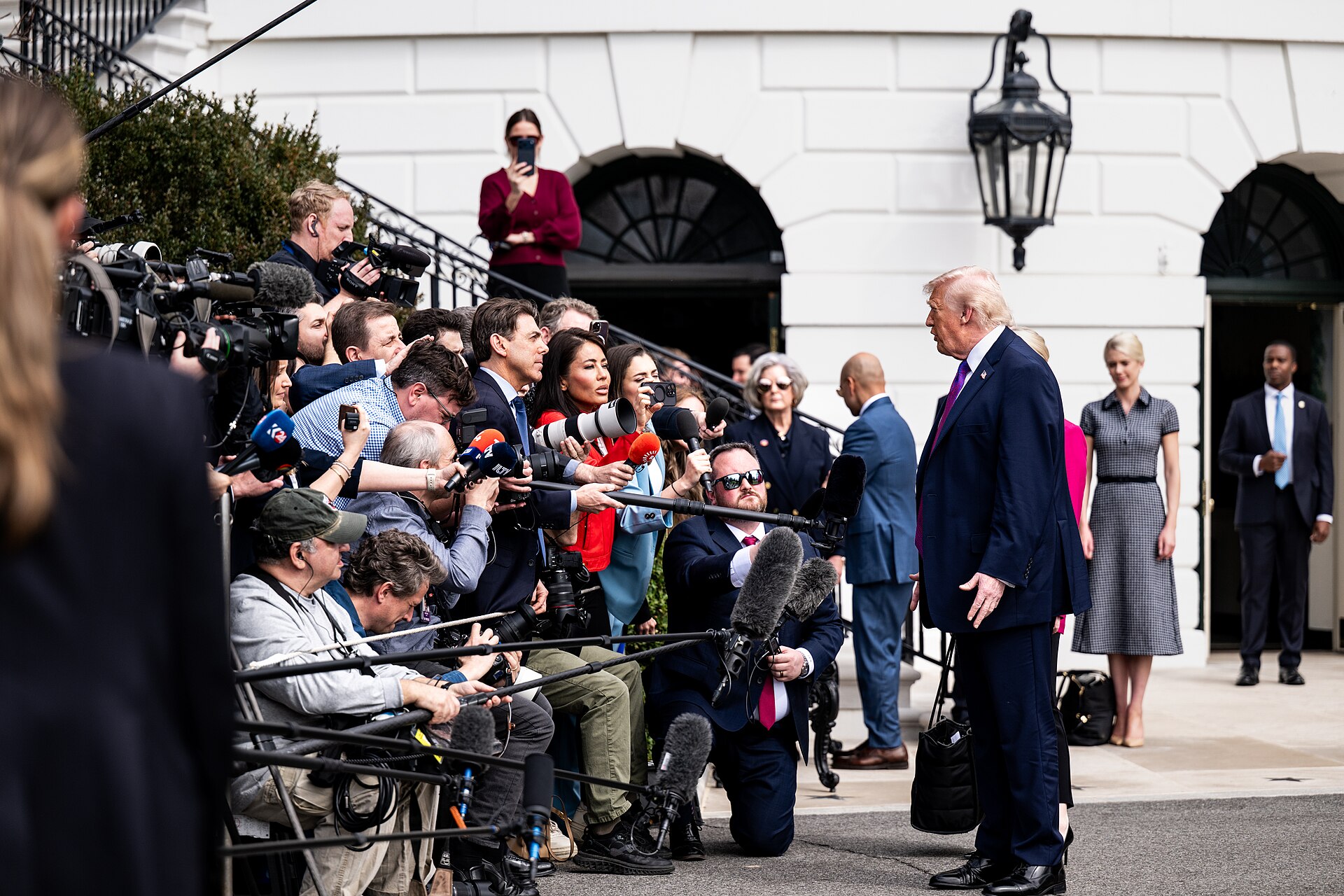
WASHINGTON — The Trump Iran war end question was posed on Friday by the president himself, in the form of a choice. Speaking to reporters on the White House South Lawn as he left for a trip to Florida, President Donald Trump said the United States could end the war with Iran quickly, but questioned whether Washington should seek a swift conclusion or allow the conflict to gradually wind down. “We could end it very quickly,” Trump said, according to Reuters, whose reporters Steve Holland and Jarrett Renshaw covered the gaggle. “Do we want to finish it off or just want to let it wither?”
Trump added that oil is getting out through the Strait of Hormuz. “We are getting everything we want,” he said, per Reuters. A second, independent contemporaneous account of the same gaggle — the live market blog at investingLive, which transcribed the remarks as traders reacted — recorded a harder-edged version of the same point: “We could take all of the oil in Iran,” and “We could end Iran war very quickly.” investingLive noted West Texas Intermediate crude up $2.82 at $102.27 a barrel, about 40 cents from the day’s highs, and observed that markets were watching the comments closely for any sign of a weekend escalation.
Two timelines, one morning
The reason the South Lawn remarks landed so hard is that they collided, within hours, with the opposite timeline from inside Trump’s own administration. On Friday morning, his ambassador to the United Nations, Mike Waltz, told the Financial Times he would not rule out the United States still fighting Iran in twelve months’ time — against Trump’s own initial estimate, at the war’s start in late February, of four to five weeks. Waltz said the president and the U.S. Navy could maintain the blockade of Iranian ports “for the foreseeable future,” and set the end-conditions as the disposal of Iran’s highly enriched uranium and a meaningful agreement on its domestic enrichment. Our separate report on Waltz’s refusal to rule out another year of war sets out that interview in full.
Read together, Friday produced both of the administration’s clocks at once. The ambassador’s clock runs in years and is built for leverage: a blockade that can be held indefinitely, conditions Tehran has not met, and no hypotheticals. The president’s clock, offered on the lawn a few hours later, runs in days — but only if he chooses the fast option, and the whole point of his question was that he has not publicly chosen. “Finish it off” and “let it wither” are not two descriptions of one policy. They are two different wars: a short, intense conclusion, or a slow strangulation in which the blockade, the oil price and the calendar do the work.
Why this matters
The framing matters because the calendar underneath it is unforgiving. The midterm elections fall on November 3, eleven days after the gaggle. Brent crude traded above $114 a barrel on Friday — the Financial Times put the day’s high at $115, the first time since May — and AAA said this week that gasoline is on pace for the most expensive October on record, at a $4.27 national average. Trump himself argued on Truth Social on Thursday night that Iran is “doing everything they can to drive up the price of Oil prior to the U.S. Midterm Election” and is “even making up fake hits, mines, and everything else” — a reference to the Revolutionary Guard’s claim to have put seven tankers out of action near Hormuz, which no party outside Iran has independently confirmed. In other words, the president says Tehran is timing the oil price against his election; his Friday question was about whether he should time the war’s ending against it too.
There is also a harder plan sitting behind the rhetoric. Reporting this week, including CNN’s account from Iowa on Thursday, describes advisers having drawn up plans for renewed strikes on Iran in coordination with Israel, to be executed as soon as Trump gives the go-ahead — with targets including nuclear sites, energy facilities and Iran’s remaining missile and drone arsenal, and one option under active consideration involving the largest non-nuclear bomb in the U.S. arsenal against Iranian energy and nuclear infrastructure. Trump has said he does not intend to resume strikes before Election Day. “Finish it off,” heard against that backdrop, is not an abstraction: a version of it exists on paper, dated for after the vote. “Let it wither” is the alternative the same reporting implies he keeps returning to in public — declare the objectives met, keep the blockade, and let Iran’s economy, which by Tehran’s own statistics contracted sharply this year, carry the cost.
The Starlink aside that cut the other way
The gaggle ranged well beyond Iran, and one aside deserves recording precisely because it sits awkwardly with Thursday’s story. On Ukraine’s Starlink and Starshield access, investingLive’s transcription records Trump saying that if the service is not fixed for Ukraine, he will talk to Elon Musk — and that he has not spoken to Musk. On Thursday, Trump had said of the reported restoration, “Whether I called or whether somebody else called, doesn’t make any difference, I guess. The bottom line — he put it back,” while CNN reported, via a person familiar with the matter, that Trump had asked Musk in a phone call in recent days to restore full access. Kyiv, for its part, said on Friday that the speed restrictions are still in place and still disrupting high-speed military drones — the dispute our Starlink restoration report covers from both sides. Friday’s version — no call, but a willingness to make one if the fix does not hold — is now the president’s latest word on the subject, and it leaves the earlier accounts unreconciled. All three versions are reported here as their sources stated them; none has been independently resolved.
The same gaggle, per investingLive, touched the rest of a crowded Friday: Trump said the United States is close to a trade deal with Mexico, that Canada is working hard to make a deal, that he discussed opening up North Sea drilling with the United Kingdom, and that a UK call on Friday included discussion of both Ukraine and Iran. He then flew to Fort Myers, where he was scheduled to address supporters at Florida Gulf Coast University’s Alico Arena at 2 p.m. Eastern, campaigning for Republican candidates including gubernatorial nominee Byron Donalds.
What happens next
Three dates will test which of Friday’s two clocks is real. The first is the weekend itself: investingLive’s traders were watching for escalation within days, and crude holding above $102 for WTI and $114 for Brent says the market is pricing the “finish it” branch, not the withering one. The second is November 3: Trump has tied Iran’s tactics to the midterms, has said strikes would not resume before them, and has promised voters prices fall after them — a promise that requires either a deal, a conclusion, or a collapse in Tehran’s position, none of which the blockade alone has yet produced. The third is the one Waltz named by refusing to name it: if the war is still being fought in October 2027, Friday’s question will read, in retrospect, as the moment the long war was chosen by default — not finished, and not quite allowed to wither either, but held, at $100-plus oil, because ending it quickly carried a price the president was still publicly weighing on his own front lawn.
Sources: Reuters, October 23, 2026 (Trump South Lawn gaggle, reporting by Steve Holland and Jarrett Renshaw); investingLive, October 23, 2026 (live transcription of the same gaggle; WTI at $102.27); Financial Times via Signal Post News reporting, October 23, 2026 (Waltz interview; Brent high of $115); CNN, October 22–23, 2026 (post-midterm strike planning; Starlink call reporting; Kyiv’s Friday denial); AAA Newsroom, October 22, 2026 (gasoline at $4.27, on pace for a record October).