Published October 1, 2026 at 11:30 a.m. PDT
Trump approval rating career low
WASHINGTON — President Donald Trump's approval rating has fallen to 31% in a new Associated Press-NORC Center for Public Affairs Research poll released Thursday — a new career low for the president in AP-NORC polling, and the latest sign that the cost of living is threatening his party's grip on Congress 33 days before the midterm elections.
The survey, conducted September 24–28 among 2,140 adults with a margin of error of ±2.9 percentage points, found 69% of Americans disapprove of the job Trump is doing as president — a two-point drop from the 33% he registered in the July AP-NORC poll. It breaks a floor Trump had held for nearly a decade: his previous career low of 32% was recorded in two AP-NORC polls between late September and early December 2017, during his first term.
The headline number is grim for the White House, but the internals are grimmer. Just 26% of Americans approve of Trump's handling of the economy — a new low, down 14 points from 40% in March 2025, and below the 28% former President Joe Biden managed in June 2022 amid record inflation. Only 17% approve of his handling of the cost of living. And 65% of Americans blame Trump's policies for the country's cost-of-living problems — a share that makes Biden's position look enviable by comparison. In October 2022, only 44% blamed the then-president's policies for the same kind of pain.
Why this matters: the midterms are turning into a referendum
Thirty-three days is a long time in politics, where one event can reorder a race overnight. It is a short time in household economics. The prices voters see at the grocery store, the gas station and on monthly bills do not usually fall fast enough to rescue an incumbent party between one poll and Election Day. That makes the Trump midterm elections approval rating less a mood reading than a measure of the terrain Republicans must cross.
The most dangerous figure for the White House is not simply 31% approval or 69% disapproval. It is attribution: 65% say Trump's policies are responsible for cost-of-living problems. The affordability issue Trump promised to fix on day one is now attached to him personally. An administration can argue that inflation has many causes; a campaign must deal with the simpler fact that voters have decided who owns the result.
That ownership cuts across the usual partisan boundary. Sixty-nine percent say Trump's handling of the cost of living has been worse than expected, including 52% of Republicans. “Worse than expected” is the tell. It captures disappointed expectations inside his coalition rather than routine opposition from outside it.
Democrats do not need an elaborate persuasion machine to turn those findings into a campaign message. The poll is the advertisement: prices remain high, most voters blame the president, and even many Republicans expected better. Quinnipiac's registered-voter survey reinforces the electoral risk, finding 51% want Democrats to win control of the House and 39% want Republicans, with independents breaking 54% to 30% for Democrats.
How we got here: a 16-point slide in nine months
Trump began this term at 47% approval in AP-NORC polling. The fall to 31% is a 16-point slide in nine months. His economic rating moved in the same direction: from 40% in March 2025 to 26% now. The political story is therefore not a detached debate over presidential style. It is the collapse of confidence in the issue on which Trump asked to be judged.
The historical markers sharpen the warning. Biden's economy approval was 28% in June 2022, amid record inflation, and Democrats lost the House that November. Trump is now below that level. A Wall Street Journal poll conducted September 16–21 put him at 37% approval and 61% disapproval, the lowest rating for an incumbent heading into midterms since the Journal began polling in 1990 and worse than George W. Bush's position before the 2006 Democratic wave.
The first-term parallel is also revealing. Trump's previous AP-NORC floor of 32% came during the political turbulence of 2017. The new low comes amid prices. Chaos can be reframed as combativeness; a grocery receipt is harder to message away. The cost of living approval Trump registers at 17% suggests voters are judging outcomes, not explanations.
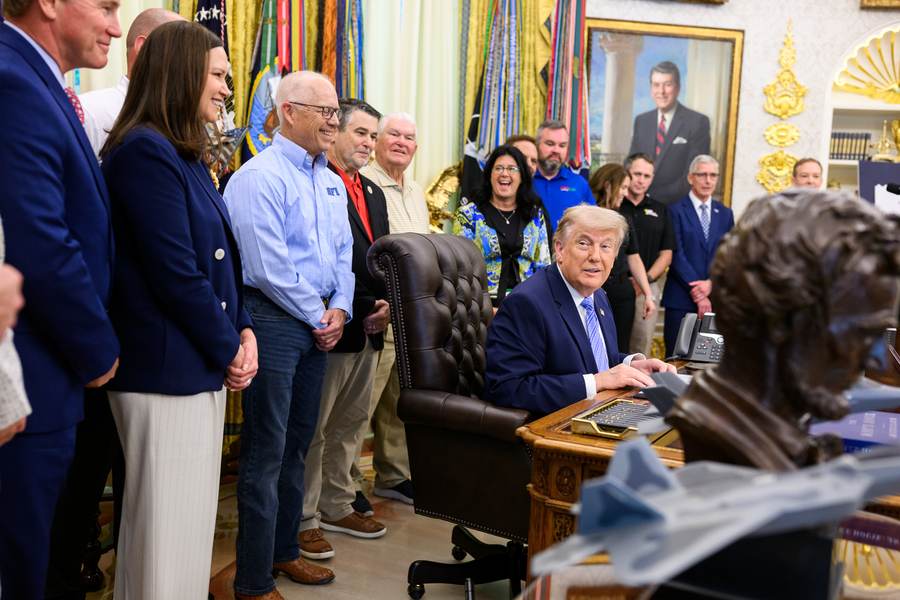
Part of the pressure comes from energy. The Iran war has pushed up oil and gasoline costs, and Trump has predicted prices will ease when the war ends. In the Oval Office on August 31, he offered an inheritance argument: “Affordability ... I inherited that from the Biden administration. We had very high prices; we had eggs that were selling at four times what they are now.” The AP-NORC blame result shows the limits of that defense. After months in office, voters increasingly assign the economy to the person holding power.
What the numbers say: the blame is sticking to the president
The comparison with Biden may be the poll's most politically lethal statistic. In October 2022, 44% said Biden's policies were responsible for cost-of-living problems. Now, 65% blame Trump. That 21-point gap does not prove identical economic conditions, but it does reveal a much broader willingness to connect today's pain directly to presidential choices.
A partisan shield remains. Sixty-seven percent of Republicans say prices reflect factors outside Trump's control. Yet that defense sits beside the finding that 52% of Republicans say his handling of the cost of living was worse than expected. Those answers are not mutually exclusive: a voter can blame global forces and still judge the response inadequate. Politically, though, the tension shows the shield cracking at its edges.
The dissatisfaction is also personal and local. More than half say the national economy, the country as a whole and their local economy are worse than when Trump took office. Forty-six percent say their own family is worse off. That gradient matters. Voters often distinguish between gloomy national headlines and their own household experience; here, both point in the same direction.
No single survey defines public opinion, but the Trump approval rating average polls tell a consistent story. The Journal measured 37% approval and 61% disapproval. Quinnipiac, surveying 1,032 registered voters September 24–27 with a ±3.8-point margin of error, found 34% approve and 61% disapprove. The disapproval figure tied Quinnipiac's all-time high, last seen January 18, 2021, days after January 6; its 31% rating for Trump's economy was also a record low in that series. Analyst Tim Malloy called the result a “warning light flashing red” for Republicans.
Other Trump approval polls in October 2026 place him above AP-NORC's low point but still underwater: Emerson, fielded September 21–22, reported 39% approve and 58% disapprove; YouGov/Economist, September 25–28, found 36% and 62%; Harvard-Harris found 42% and 55%; Rasmussen 44% and 55%; and Morning Consult 43% and 54%. Marquette Law put him below 30% on the economy, tariffs, the Iran war, gas prices and inflation or cost of living.
Aggregates as of October 1 narrow the range without improving the direction: RealClearPolitics stood at 38.8% approve and 59.6% disapprove, the New York Times at 37% and 61%, and Silver Bulletin at 37.7% and 59.9%. The AP-NORC 31% is the low end, not the whole market. But every series is describing second-term weakness. The exact depth varies; the direction does not.
Who wins, who loses — and the polling caveats
Democrats are the immediate winners. A double-digit House preference gives candidates a recruiting argument, donors a reason to spend and organizers a turnout message built around prices. There is no obvious second winner. Even Trump's defenders are forced into a defensive crouch, explaining why economic frustration should be attributed elsewhere rather than selling a felt improvement.
The losers are Republican candidates in competitive districts, the White House's economic narrative and the “affordability president” brand. Trump is answering with a campaign blitz across 35 competitive House and Senate races, starting in Texas and Oklahoma. Thursday's Durant rally is part of that effort. It may energize the base, but every candidate sharing the stage also inherits questions about 31%, 26% and 17%.
There are important caveats. AP-NORC's ±2.9-point margin of error means the two-point change from July's 33% is within sampling noise. The durable story is the trend and the fact that 31% marks a new low in this series, not a claim that precisely two points of support vanished. AP-NORC surveyed adults through an online panel, while Quinnipiac surveyed registered voters; likely-voter screens would describe a different electorate again.
One poll remains a snapshot. The corroboration across pollsters is what gives this one weight. Signal Post News's September 22 analysis of a Reuters/Ipsos 32% result found the same collision between economic anxiety and Republican midterm exposure. Different samples and methods should not be blended as if they were one survey, but their shared direction is difficult to dismiss.
What happens next: 33 days, three scenarios
Scenario one: continued erosion or a flatline. This is the most plausible path because prices rarely reset in 33 days. The 35-race campaign blitz, including the Oklahoma rally in Durant, is the counter-strategy: shift attention from household frustration to partisan stakes, candidate loyalty and turnout.
Scenario two: a partial rebound. Talk of de-escalation in the Iran war could lower oil and gasoline prices, while a surprisingly favorable October economic report could soften the mood. But the AP-NORC findings suggest attribution is sticky. A modest change in a national indicator may not quickly reverse a household judgment already assigned to the president.
Scenario three: the floor drops further. A shutdown overhang, a poor inflation reading or a damaging debate moment could cement the “worse than expected” verdict. Once an electorate moves from temporary frustration to a judgment about competence, recovery becomes harder because every new data point is interpreted through the established frame.
Watch the next AP-NORC, CNN and Quinnipiac releases; October inflation data; gasoline prices; the House generic ballot; and whether the White House moves beyond “inherited” to a new affordability message. Its proposed $500 ACA refund checks are tangible counter-programming, but voters will decide whether a discrete payment changes their broader view of prices and management.
Thirty-one percent is a number, not a verdict. Margins move, electorates differ and campaigns can still change the choice. But it is now the number every Republican candidate will be asked about for the next 33 days — and the number the White House must answer with something voters can feel.
Sources
- USA TODAY: “Trump approval rating hits new career low in latest AP-NORC poll” (Kinsey Crowley, October 1, 2026)
- USA TODAY: “65% of Americans blame Trump for high cost of living, new poll shows” (Kinsey Crowley, October 1, 2026)
- El Paso Times: “Trump approval rating hits new low ahead of midterm elections” (October 1, 2026; Wall Street Journal poll details)
- USA TODAY: “Donald Trump's disapproval rating matches Jan. 6 peak in new poll” (September 30, 2026; Quinnipiac details)
- The Associated Press-NORC Center for Public Affairs Research — AP wire: “Most Americans blame Trump for high prices as his economic approval hits new low” (October 1, 2026)
Reporting note: Reporting basis: the Associated Press-NORC Center for Public Affairs Research poll released October 1, 2026 (2,140 adults, Sept. 24–28, ±2.9 pts), as reported by USA TODAY and the Associated Press; Wall Street Journal, Quinnipiac University, Emerson, YouGov/Economist, Harvard-Harris, Rasmussen, Morning Consult and Marquette Law figures as reported; RealClearPolitics, New York Times and Silver Bulletin aggregates as of Oct. 1. Trump's Aug. 31 remarks are his own words as reported from the Oval Office. Analysis is Signal Post News's.