Tallahassee underground electrical fire
Breaking / Florida / Infrastructure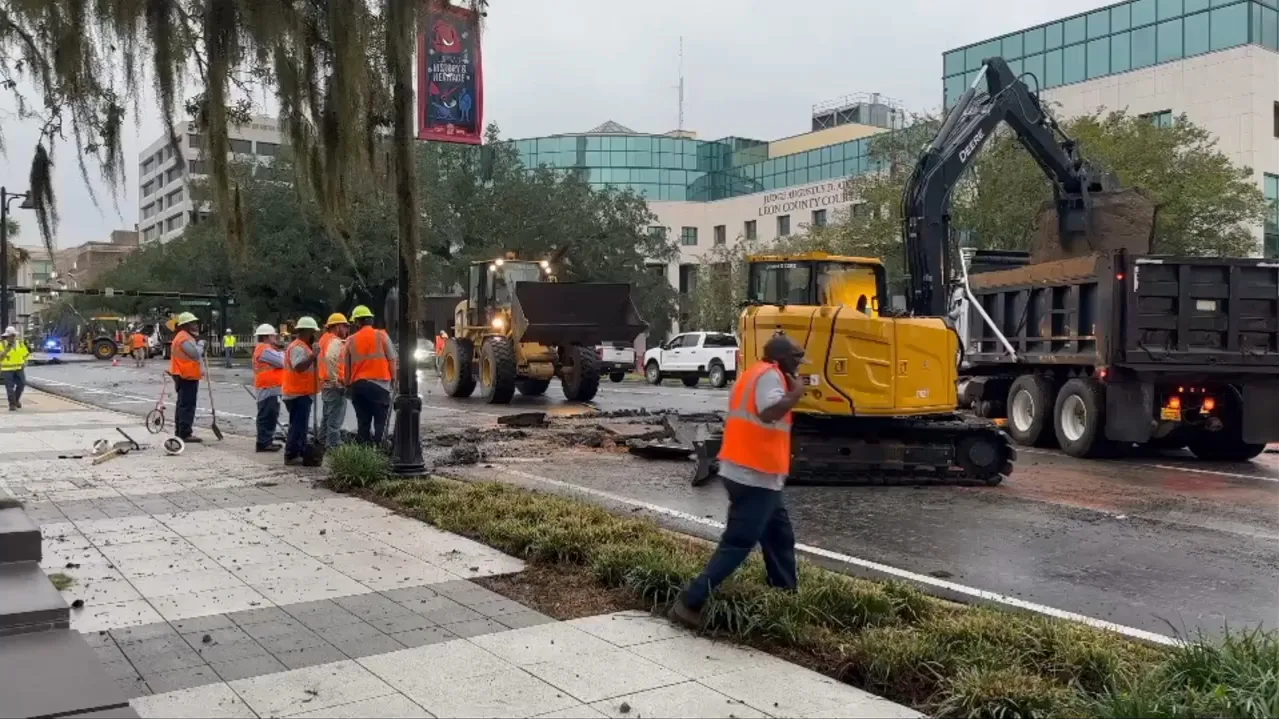
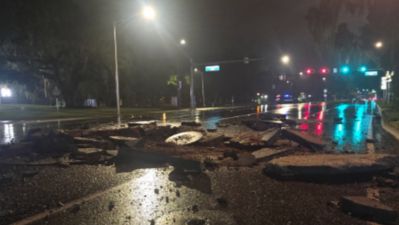
A Tallahassee underground electrical fire ruptured manholes and damaged streets around the Leon County Courthouse early Tuesday, forcing officials to close part of downtown, shut off power for crew safety and suspend court and county services. The Tallahassee Fire Department said it responded to a fire alarm at the courthouse, 301 S. Monroe St., at about 5:15 a.m. and found several roadway fires with visible damage near Monroe Street, Apalachee Parkway and Calhoun Street.
By daylight, the fires were out and no injuries had been reported, according to city communications director Alison Faris. The physical emergency had already become a systems emergency: signals were dark, Monroe Street was torn open, the courthouse and county annex were closed, and a damaged fiber-optic network disrupted county phones, the website and text-to-911.
Why this matters
This was not simply a hole in a street or a localized electrical fault. It struck the compact district where transportation, courts, public safety communications and local government depend on the same few blocks. A failure below Monroe Street quickly reached above-ground traffic and government operations, exposing how shared infrastructure can produce cascading disruption even when no one is hurt.
The episode also separates two kinds of risk. The immediate risk came from fire, energized equipment, airborne manhole covers and unstable pavement. The longer-term risk is operational: how quickly public agencies can restore redundant communications, verify the street is structurally safe and explain what failed. Those answers matter in any city; they matter especially in Florida's capital, where the same downtown grid serves residents, state workers, courts, businesses and emergency responders.
Timeline: from courthouse alarm to a downtown perimeter
About 5:15 a.m.: Firefighters were sent to the courthouse alarm and encountered fires burning in roadways. The early hour limited commuter exposure, but it also meant first responders were entering a dark scene before the cause or underground conditions were clear.
Early morning: Reports raised the possibility of a gas leak. TFD quickly ruled that out, and investigators determined natural gas was not involved in either the fire or the manhole ruptures. Natural-gas caps were found lying in the road at Park Avenue and Franklin Boulevard, an unusual detail that officials documented without treating it as proof that gas caused the event.
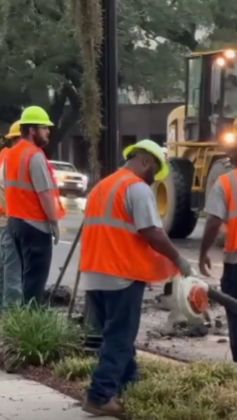
Morning response: City electrical and underground-utility crews planned a service outage so workers could enter the affected area safely. Generators were deployed at several intersections after traffic signals went dark. Police and deputies expanded road controls while crews assessed damage and began filling two craters around manholes in Monroe Street—one near Jefferson Street and another closer to Apalachee Parkway.
Daytime operations: The city expected delays through the day and said northbound Monroe Street lanes could reopen by early afternoon. That was an expectation, not a guaranteed full repair time. The exact cause remained under investigation.
Tallahassee manhole explosions: what officials know
Witnesses and photographs documented manhole covers blown into the air and fire emerging from below the street. Officials described an underground electrical fire, not a gas explosion. That distinction is important: the visible blast can look similar from street level, but the fuel source, repair work and continuing hazards differ.
The bulk of the damage was reported on Monroe Street between Jefferson Street and Apalachee Parkway, an area already within a Florida Department of Transportation paving project. The overlap is a legitimate subject for investigators to examine, but it is not evidence that the roadwork caused the fire. Until forensic inspections, utility records and construction logs are reviewed, any stronger claim would be speculation.
Although online searches may call it a “manhole cover explosion Florida” incident, the official description is more precise: an underground electrical fire that ruptured manholes. That language keeps the confirmed energy source separate from the force people saw at street level.
Underground electrical fire causes remain under investigation
Electrical-vault and manhole fires are a known hazard in older urban systems. Underground cables, connectors and transformers operate in confined spaces where insulation failure, degraded equipment, water intrusion, corrosion or an arc fault can generate extreme heat and pressure. In some cases, gases produced by overheated cable insulation can ignite and lift a heavy cover from its frame.
That background explains the mechanism cities investigate; it does not identify the cause in Tallahassee. Investigators will need to determine which component failed first, whether protective equipment operated as designed, what inspections showed before the incident and whether nearby road work affected the underground environment. The fact that such incidents can occur for several reasons is exactly why a definitive attribution must wait.
Monroe Street closed Tallahassee: the commuter picture
Leon County Sheriff's Office described a broad perimeter around the downtown core. Its southern boundary ran near South Monroe Street and FAMU Way; the west side reached Gaines Street and South Adams Street; the east side extended to Apalachee Parkway and Franklin Boulevard; and the northern edge included Calhoun Street and North Monroe Street near College Avenue.
Additional lane closures affected North Monroe from Apalachee Parkway north to Park Avenue and east toward Franklin Boulevard. That footprint matters because it captures more than the point of pavement damage: it keeps vehicles and pedestrians away from utility work, detours traffic around dark signals and gives crews room to inspect connected infrastructure.
Drivers were told to treat any intersection without a working signal as a four-way stop. For residents checking the downtown Tallahassee fire today, the practical instruction was simple: avoid the perimeter, expect delays and stop at dark signals as though each were a four-way stop.
For downtown businesses, the disruption was more diffuse. A closed block can delay staff, reduce morning foot traffic, interrupt deliveries and make customers assume an entire district is inaccessible even when particular storefronts remain open. Clear block-by-block reopening notices will therefore be as important as the physical repairs.
Tallahassee courthouse closed as county systems go offline
Leon County closed both the courthouse at 301 S. Monroe St. and the Leon County Annex at 315 S. Calhoun St. for the day. Second Judicial Circuit Chief Judge Frank Allman canceled court proceedings after case-management systems, email and network access were disrupted. Those cancellations move hearings and deadlines beyond the damaged block, creating follow-up work for court staff, attorneys and residents.
The underground fire also cut the county's fiber-optic network. County phone lines and the public website were disrupted, and in-person visitation at the Leon County Detention Facility was suspended. The voice 911 system remained available. TTY service was also available for deaf and hard-of-hearing callers, but text-to-911 was not functioning.
Leon County text-to-911 outage changes how residents seek help
The loss of text-to-911 is a narrower outage than a total 911 failure, but it is consequential. Text can be essential when speaking would reveal a caller's location, when cellular voice quality is poor or when a disability makes a voice call difficult. The county's notice that voice 911 and TTY remained available gave residents alternatives, but it also showed why emergency communications need multiple independent paths.
Leon County Commission Chairman Christian Caban said, “This morning's underground electrical fire has affected several County services.” County Administrator Vincent S. Long described a coordinated restoration effort involving the county, city, Sheriff's Office and Consolidated Dispatch Agency. Those statements establish the operational response; restoration times and the root cause still require technical confirmation.
A coordinated response across eight agencies
The response joined the Tallahassee Fire Department, Tallahassee Police Department, City of Tallahassee Electric & Gas Utility, City Underground Utilities & Public Infrastructure, Leon County Sheriff's Office, Capitol Police and FDOT, with county restoration work coordinated through the Consolidated Dispatch Agency. The mix reflects the incident's layers: fire suppression, electrical isolation, traffic control, road repair, state-property security and communications continuity.
Multi-agency response can look excessive when the visible flames are confined to a few openings. Here, the opposite is true. The surface damage was only the most visible part of a networked failure. Each agency controlled a different piece of the same recovery, and reopening one lane safely depended on evidence from several of them.
What happens next
1. Investigators identify the initiating failure
The first technical question is whether a cable, splice, transformer, conduit or another component failed and whether the pressure event followed an electrical arc. Officials also need to document why more than one roadway location burned and whether the damaged points were connected.
2. Crews prove the street and network are stable
Filling visible craters is only the beginning. Before normal traffic returns, inspectors must be confident that pavement, utility chambers and surrounding conduits are secure. Separately, county technicians must restore fiber links and test phones, web services and text-to-911 rather than assuming connectivity is reliable because power has returned.
3. The public gets a repair timeline and an after-action record
Officials should be expected to provide a sequence of findings: what failed, when it was last inspected, how long permanent repairs will take, and whether other downtown vaults or manholes require priority checks. The nearby FDOT paving work should be examined as one factual line of inquiry, neither dismissed nor blamed without evidence.
A single morning without injuries is the best immediate outcome. The larger test will be whether Tallahassee treats the incident as an isolated repair or as a prompt to examine how electric, transportation and communications systems overlap beneath the capital's most consequential streets.
Sources
- Tallahassee Democrat: City update on downtown fires, road damage and utility response
- Tallahassee Democrat: Early incident report and downtown road closures
- Tallahassee Democrat: Photographs and video of the downtown damage
- Tallahassee Democrat: County infrastructure and service disruptions
- Fox 49: Monroe Street damage, closures and response
Reporting note: Incident facts and official statements were cross-checked across the linked local reports. The initiating electrical failure and permanent-repair timeline had not been established at publication.