Syria bus attack
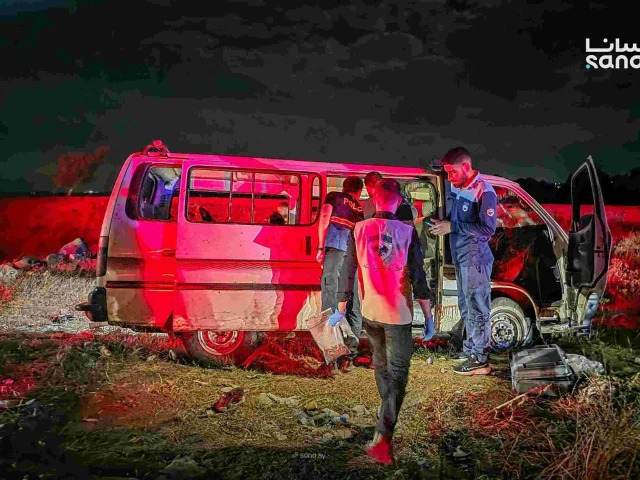
HOMS, Syria — The Syria bus attack on September 30, 2026, began as a journey home from work and ended as one of the deadliest assaults on civilians since Bashar al-Assad's government fell at the end of 2024. Unknown gunmen opened fire on a civilian bus as it crossed the Masyaf bridge in Homs province, killing seven people and wounding four, according to figures from the Homs health directorate carried by the Syrian state news agency SANA and reported by Reuters.
The bus was carrying engineers and other employees of a private company home from work, a security source told AFP. One employee of the Syrian Electricity Company was among the dead. AFP's first report put the toll at five before authorities revised it to seven killed and four wounded. No organization has claimed responsibility, and officials have not identified a suspect.
What happened in the Masyaf bridge attack
Homs internal security chief Brig. Gen. Bassem Muhammad Shaaban described the target as a civilian bus and said security forces would pursue those responsible, a statement relayed by SANA and reported by Reuters. A SANA handout photograph showed forensic investigators working around the damaged vehicle at night. That image establishes the aftermath, not the identity or motive of the shooters.
The distinction matters. Syria's armed landscape contains Islamic State remnants, local factions, former-regime networks and people pursuing sectarian revenge. Naming any one of them without evidence would turn uncertainty into propaganda. The government's first obligation is therefore not merely to promise arrests but to preserve the crime scene, publish what it can verify and keep collective blame from substituting for an investigation.
The Syrian Observatory for Human Rights said the victims belonged to the Alawite minority, a community previously targeted in the country, according to AFP's report. Syrian authorities have not confirmed the victims' identities or any sectarian motive. The Observatory's account should be treated as an attributed claim unless official records or independent evidence establish more.
The same-day Syria pipeline explosion widened the shock
Hours before the Homs bus shooting, an explosion struck a gas pipeline in eastern Ghouta near the Tishreen power plant outside Damascus. The blast knocked the Deir Ali, al-Nasiriyah and Tishreen plants offline and triggered a fire at Tishreen, according to The Insight International's report citing Syrian officials.
Energy Minister Mohammed al-Bashir said investigators had not determined whether the cause was “a technical malfunction, an attack or an act of sabotage,” according to The Insight International. It was the third pipeline incident in six weeks; officials had characterized the two earlier incidents as sabotage. The outages lengthened electricity-rationing periods in a country where reliable power is already scarce.
It is important not to fuse the two events into a single plot. There is no public evidence connecting the Masyaf Homs gunmen to the Tishreen power plant blast. But politically, the pairing is devastating even if the investigations remain separate: citizens saw a government unable to guarantee either safe passage home or dependable electricity on the same day.
Why this matters for post-Assad Syria security
Syria's transition is entering a more dangerous phase because the government now faces two forms of fragility at once. The first is a security vacuum: armed actors can exploit thin policing, fragmented command and communities that still fear one another. The second is energy fragility: a limited strike against a pipeline can remove three power plants from service and push the economic pain into homes, workshops and hospitals.
Two weeks earlier, protests over diesel and petrol prices had already exposed public anger over the cost of daily life, according to the wider energy context summarized by The Insight International. That means the pipeline explosion was not an isolated infrastructure story. It landed on an exhausted public for whom electricity, transport and food prices are part of the same crisis of state capacity.
A postwar government can survive sporadic attacks if it proves they are exceptional and contained. It can survive economic hardship if people believe reconstruction is moving. It struggles when violence and deprivation reinforce each other. Every blackout magnifies rumors; every attack makes repairs harder; every failure to explain what happened gives armed factions a larger stage.
How Syria reached this point
The Masyaf bridge attack follows a pattern of violence since Assad's fall. A bus bomb near Damascus on August 22 wounded members of the internal security forces. An explosion on a bus in Jaramana, a district associated with Christian and Druze communities, wounded 14 people in early August. In July, blasts near the hotel hosting French President Emmanuel Macron killed one person and wounded 36; authorities blamed Islamic State and later announced arrests. Those incidents and tolls were recounted in the chronology assembled by Reuters and AFP.
The common thread is not a proven common command. It is a state whose monopoly on force remains incomplete. Islamic State cells have an interest in demonstrating endurance. People bent on sectarian revenge can trigger fear disproportionate to their numbers. Armed factions outside a unified chain of command can preserve local leverage by making central authority look conditional.
That is why attribution must precede retaliation. A hurried roundup may produce the appearance of action while deepening resentment. A disciplined investigation is slower and less theatrical, but it is the only answer that distinguishes a government building lawful authority from another faction using state symbols.
Who loses, who benefits, and what critics will ask
The clearest losers are ordinary Syrians. Seven families lost relatives; four wounded people face recovery; coworkers will return to buses with a new calculation of risk. The electricity workforce also absorbs the damage on both fronts: one company employee was reported among the dead while crews confront a grid made more unstable by the pipeline failure, according to AFP and The Insight International.
The government's legitimacy narrative loses too. The promise after Assad was not simply a new leadership team; it was a safer and more functional state. Any faction seeking to prove that the government cannot protect workers or keep the lights on benefits from images of a bullet-damaged bus and a darkened capital, whether or not that faction carried out either incident.
Critics will ask whether leaders prioritized external conflict management and political consolidation over neighborhood policing, intelligence coordination and infrastructure protection. The government's line is Shaaban's vow to pursue the attackers—a statement of resolve, but not yet a result. The credibility test will be whether arrests rest on disclosed evidence and whether communities around Homs are protected without being collectively punished.
What the numbers imply
The casualty figures require proportion. The Jaramana bus explosion wounded 14; the July hotel-area blasts killed one and wounded 36; the Masyaf ambush killed seven and wounded four, according to the comparative tolls reported by Reuters. The latest incident had fewer total casualties than July but a much higher share of deaths. That does not establish a statistical trend from three events, yet it shows how quickly a direct civilian-targeted shooting can become more lethal than an indiscriminate blast.
The energy numbers are equally stark. One pipeline event removed three plants—Deir Ali, al-Nasiriyah and Tishreen—from service, according to The Insight International. In a system already rationing electricity, the consequence is not merely a lower national output figure. It is longer darkness, interrupted water pumping, spoiled medicine, idle machinery and another reason for businesses to price uncertainty into everything they sell.
Together, seven dead, four wounded and three plants offline describe the same governing problem: Syria has little margin for shock. A richer, more stable country can absorb a damaged line or reinforce a vulnerable route. Syria's depleted institutions must make hard tradeoffs while attackers need find only one exposed point.
What happens next: four possible paths
First, a security crackdown around Homs. Checkpoints, patrols and arrests are the most immediate response. They may deter another ambush, but they also risk sharpening sectarian tension if the Observatory's unconfirmed Alawite claim hardens into a public narrative before evidence identifies the attackers.
Second, copycat or retaliatory attacks on energy infrastructure. The eastern Ghouta blast demonstrated how concentrated the system's vulnerabilities are. If sabotage is established, other groups may see pipelines as a cheap way to produce nationwide pain. If the cause proves technical, the episode will still expose the maintenance deficit.
Third, greater pressure on international partners. Gulf states and Turkey may be asked to fund not only reconstruction but also grid protection, investigative capacity and local policing. Money can repair substations and train units. It cannot substitute for trusted institutions or an intelligence picture that communities are willing to support.
Fourth, a slow counter-insurgency grind. The likeliest danger is not a return to the old war in one dramatic step but a new normal of dispersed attacks, periodic arrests, infrastructure failures and contested narratives. That is harder to film and harder to end. It rewards a government that can work patiently, publish facts and avoid turning every unresolved crime into a sectarian verdict.
The open questions
Three questions remain unanswered: who attacked the bus, what caused the pipeline explosion, and who exactly were the victims? Reuters, AFP and The Insight International all reported important pieces of the developing picture, but none resolves those central uncertainties.
The correct conclusion is therefore narrower—and more serious—than a theory. Syria suffered two major failures in one day: civilians were attacked on a road and essential energy infrastructure went down outside the capital. The new authorities will be judged less by the speed of their accusations than by whether they can discover the truth, protect the next bus and keep the next pipeline working.
Sources and reporting notes
- Reuters: Seven killed and four injured after bus attacked in Syria's Homs
- AFP report: Attack on bus in Syria kills seven
- The Insight International: Pipeline explosion knocks Syrian power plants offline
Reporting note: SANA supplied the official Homs casualty figures, Shaaban's statement and the scene photograph, as carried by Reuters and AFP. The perpetrators, pipeline cause, victims' identities and any sectarian motive remained unconfirmed at publication. Analysis and scenario framing are by Signal Post News.
Signal Post News will update this report when investigators identify the bus attackers or determine the pipeline explosion's cause.
Back to all stories