Spain clears Ceuta migrant camp
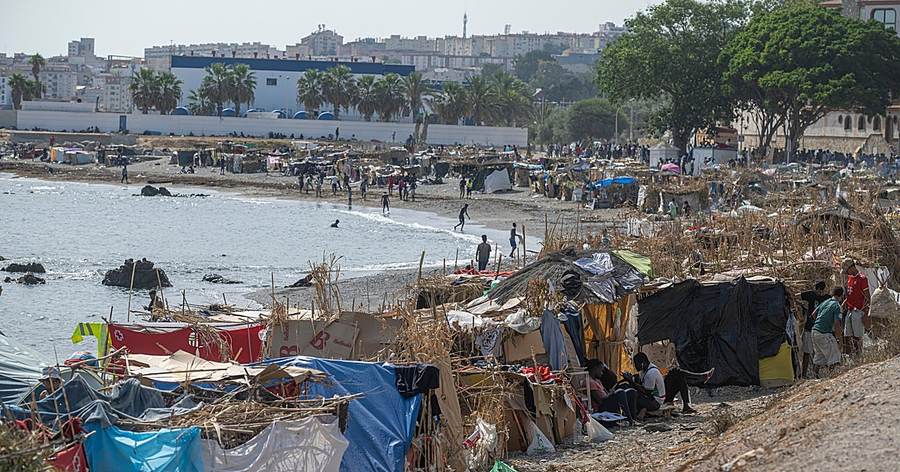
CEUTA, Spain — Spain clears Ceuta migrant camp: police on Sunday removed about 3,000 people from tents and improvised shelters on Trampolin beach, ending a two-month encampment in the Spanish enclave on Morocco's northern coast. A Spanish Interior Ministry spokesman told Reuters that those moved would be placed in temporary accommodation, processed or given the option of returning to Morocco. The operation came nine days before King Felipe VI and Queen Letizia are due to begin an October 13–14 visit — Felipe's first trip to Ceuta during his 12-year reign.
The timing makes the clearance impossible to read as a purely administrative act. Ceuta has been trying to restore public order since more than 72,000 people crossed from Morocco in late July, a movement nearly equal to the enclave's own population. Most later left, but Madrid estimates at least 10,000 remain. A demonstration on Saturday called for migrants to leave, while humanitarian groups continue to argue that the reception system has too few beds and too little certainty for those still sleeping rough.
Why this matters
The Sunday operation solves the most visible part of the problem: the tents are no longer on Trampolin beach. It does not answer the harder questions. Where will thousands of people stay after the first temporary placements? How quickly can Spain determine who may seek asylum, who is a minor, who can legally be returned and who must be transferred elsewhere? And can Madrid do that without allowing a royal visit to become the deadline that substitutes appearance for capacity?
For the Spanish government, the clearance offers a measure of control before a politically sensitive visit. For residents, it returns a beach and may reduce pressure on one neighborhood. For migrants, indoor accommodation can mean sanitation, food and a formal case file instead of another night exposed on the coast. But each gain has a limit. A cleared beach is not a completed migration process, and a temporary bed is not a durable legal outcome.
The operation also reaches beyond municipal management. Ceuta is Spanish and European Union territory on the African mainland, and Morocco claims sovereignty over it. Migration, policing and the monarchy therefore meet in one narrow space. Every Spanish decision can be interpreted in Rabat as a sovereignty signal; every failure of border control in Madrid becomes an argument about Morocco's cooperation; every image of force or destitution becomes evidence in Europe's wider debate over how its migration rules work at an external border.
The Ceuta migrant crisis 2026 began with a border rush larger than the city
The scale explains why normal administrative tools failed. More than 72,000 migrants crossed into Ceuta in July 2026, according to Spanish figures cited by Reuters, after crowds moved through or around the frontier with Morocco. Ceuta has roughly 80,000 residents and covers only 18.5 square kilometres. In the space of days, the number of arrivals was equivalent to about 90 percent of the resident population.
Most people returned to Morocco or were sent back, but even the government's estimate of at least 10,000 remaining equals roughly one person for every eight residents. That is a demographic ratio, not a claim that migrants are evenly spread through the city. It does show why beaches, pavements, reception centres, hospitals and police capacity came under simultaneous pressure.
The remaining figure is disputed. Madrid has used an estimate of at least 10,000; local and press estimates reported by The Times have ranged as high as 15,000. Neither number functions like a census. People move between informal camps, temporary facilities and return routes, and the count changes as cases are processed. The responsible conclusion is a range with uncertainty, not false precision. What is not disputed is that several thousand people remained outside formal accommodation well after the July surge.
The September operation, court clearance and a camp that filled too quickly
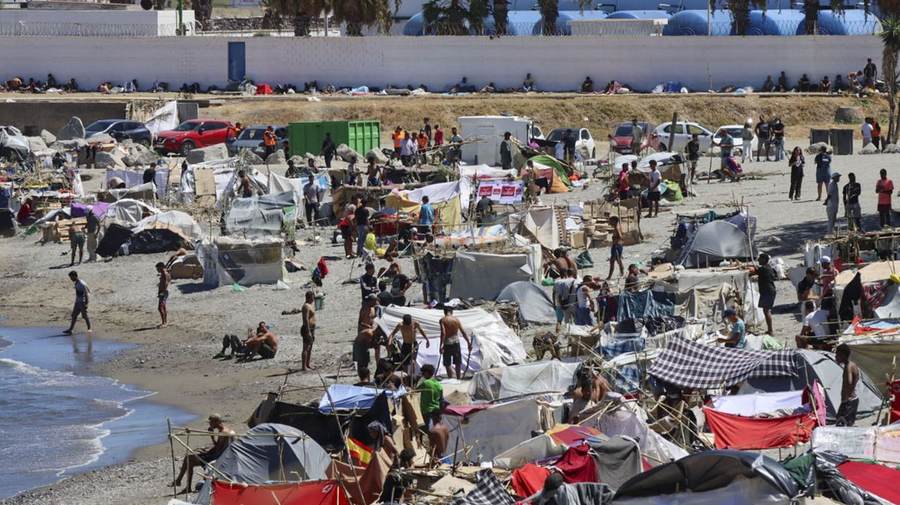
Sunday's move was not the first attempt to clear Trampolin beach Ceuta. On September 18, riot police and the Spanish military began moving migrants from beach encampments toward a newly built port facility. Reuters reported that police fired rubber bullets into the air and struck people with batons as crowds pressed for limited places. The immediate disorder subsided and the transfer resumed, but the images established the central contradiction: people were being forced from informal shelter while competing to enter formal shelter that could not hold everyone.
The port camp had capacity for 1,700 people. That is only 17 percent of a 10,000-person remaining population, or about 57 percent of the 3,000 people reported at Trampolin beach on Sunday. Even if every bed were empty — they were not — arithmetic alone shows why a single site could not finish the job. NGOs told Reuters in September that thousands were still sleeping outside and that reception centres did not meet the total need. One group estimated roughly 4,000 people remained on beaches and pavements after the earlier operation.
Legal rulings shaped both the border and the reception response. A Spanish court cleared temporary use of the port site before the September transfer. Separately, a Supreme Court ruling had found that Spain could not simply apply its immediate frontier-rejection procedure to people intercepted after entering by sea without an individual process. That did not erase Spain's power to return people. It raised the procedural threshold: identity, age, asylum claims, vulnerability and legal safeguards matter before removal.
The government called the September transfer a success. Opposition leader Alberto Núñez Feijóo of the Popular Party attacked Madrid's handling, while NGOs said insufficient capacity left the basic problem intact. Both judgments describe different tests. A police operation can meet its narrow objective — clear a route and move a group — while failing the broader policy test of providing enough lawful accommodation for everyone affected.
Who benefits, who loses and what critics say
Local residents: public space restored, pressure unresolved
The Saturday demonstration reflected anger among people who say national authorities allowed an emergency to become a two-month condition. Beaches are civic infrastructure in an enclave of 18.5 square kilometres, not spare land. Residents have a legitimate claim to safety, sanitation and functioning services. But a protest demand that migrants simply leave does not resolve whether each person can legally be returned or where vulnerable people should go meanwhile.
Migrants: shelter now, uncertainty next
A transfer from a tent to accommodation can improve health and security. It also begins or accelerates screening, possible asylum procedures and return decisions. The key measure is not whether buses moved on Sunday; it is whether each person can understand the process, access an interpreter and legal advice, and receive an individual decision rather than become part of a collective spectacle.
Madrid: better optics, a harder capacity test
The Spanish government can point to a restored beach and a controlled process. The political risk is equally clear: if people are merely shifted to another overcrowded site, the photographs will change while the capacity deficit remains. Feijóo and the Popular Party can argue that the government acted late and under ceremonial pressure. Government supporters can answer that a border event of this size could not be absorbed instantly and that cooperation with Morocco is unavoidable.
NGOs: capacity, not appearances, is the test
Rights groups have no reason yet to withdraw their criticism. Their September warning was concrete: 1,700 port places were not enough for thousands sleeping rough, and minimum reception conditions required by the European framework were not consistently available. Sunday's operation should be judged against those claims with bed counts, transfer records and processing times — not simply by whether tents disappeared.
Morocco: leverage with reputational costs
The Morocco Spain border migrants crisis revived accusations in Spain that Rabat failed to prevent the July surge or used migration pressure in a wider sovereignty dispute. Morocco rejects Spain's permanent sovereignty over Ceuta and Melilla. That history means border cooperation is never only technical. Rabat can help control departures and accept returns, but visible pressure on Ceuta also hardens Spanish opinion and makes compromise politically harder.
What the numbers say: 72,000 crossings, 10,000 remaining, 1,700 beds
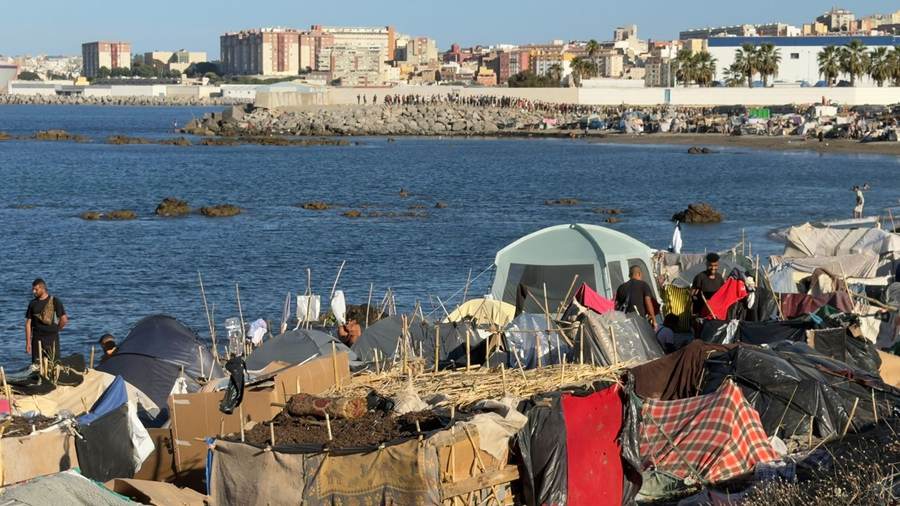
Five figures define the policy gap. More than 72,000 people crossed in late July. Ceuta has about 80,000 residents. Spain says at least 10,000 migrants remain. The September port camp has 1,700 places. The enclave covers 18.5 square kilometres.
Placed side by side, those numbers strip away rhetorical shortcuts. The July movement was nearly nine times the size of the population that Spain believes remains. That means returns did occur on a very large scale. Yet the residual 10,000 is still six times the port camp's capacity. The 3,000 people moved Sunday were almost twice that camp's total number of beds. Capacity therefore has to come from multiple sites, turnover through processing, transfers to mainland Spain, returns to Morocco or some combination of all four.
Density magnifies every delay. Dividing 10,000 people by 18.5 square kilometres produces a rough ratio of about 540 additional people per square kilometre, though real settlement is highly concentrated and the calculation is illustrative, not a map. The useful point is spatial: Ceuta cannot disperse a large emergency across a broad hinterland. A beach camp, port facility, hospital queue or protest can quickly become a citywide political event.
The comparison also exposes why competing claims can sound irreconcilable. Madrid can truthfully say that most of the 72,000 left. Local officials can truthfully say that the number remaining is still enormous relative to Ceuta's scale. NGOs can truthfully say that 1,700 beds do not cover the outdoor population. The argument is not mainly over arithmetic; it is over which denominator should define success.
Melilla, Ceuta and Morocco's sovereignty claim
The Melilla Ceuta Morocco claim gives the clearance a diplomatic charge absent from most municipal encampment operations. Spain considers both cities integral parts of its territory. Morocco regards them as occupied territory and has historically opposed Spanish royal visits. Felipe is a ceremonial head of state, but a monarch walking through Ceuta is also the most visible possible expression of Spanish sovereignty.
Reuters reported on October 1 that the October 13–14 journey would be Felipe's first visit to the enclaves in his 12-year reign. The trip follows the summer border crisis and comes after the king publicly called Ceuta's situation unacceptable while urging greater European solidarity. Morocco's government had not publicly welcomed the plan. The royal household can present the visit as support for Spanish citizens; Rabat can read the same itinerary as an assertion over contested ground.
That is why the camp's removal matters beyond sanitation. A royal visit framed by tents and unrest would tell one story: Madrid lacks control of a territory it calls fully Spanish. A visit after a clearance tells another: the state can restore order before its head of state arrives. Neither image settles sovereignty, and neither proves that the migration crisis has been solved.

What happens next: royal optics, processing, returns and the EU migration pact
First, watch where Sunday's 3,000 people actually sleep. Authorities should be able to show how many entered each facility, how many beds remain, how families and minors are handled, and whether anyone was left without shelter after the beach was cleared. The policy outcome begins after the operation, not when the final tent comes down.
Second, watch processing and voluntary returns. Spain says people can be processed or return to Morocco. “Voluntary” should mean an informed choice rather than the only alternative to homelessness or detention. Returns also depend on Morocco's cooperation and on case-by-case legal safeguards. If processing slows, temporary sites will fill; if it moves too quickly, legal challenges and claims of collective expulsion will follow.
Third, watch how the EU migration pact Spain obligations are applied. The September dispute already centred on whether reception conditions met minimum European standards. Screening, asylum access, identification of minors and vulnerable people, adequate shelter and lawful return procedures are not decorative requirements. They determine whether a visible show of control is also a defensible administrative process.
Fourth, watch the King Felipe Ceuta visit October 2026. The palace and government will want images of solidarity, normality and Spanish institutional presence. Protesters may use the visit to demand faster removals; rights groups may use it to show that people remain in precarious conditions elsewhere. The king's itinerary will be ceremonial, but the backdrop will be contested policy.
Finally, watch Madrid and Rabat after the cameras leave. Spain needs Moroccan cooperation on border control and returns. Morocco has its own leverage and its territorial claim. A public confrontation over the visit would deepen mistrust; quiet operational cooperation would show both governments still prefer management to escalation. The durable test is whether that cooperation reduces dangerous crossings without turning vulnerable people into bargaining instruments.
Conclusion
Sunday's clearance was consequential, but it was not a conclusion. It moved thousands of people out of a beach camp, returned a piece of Ceuta to public use and gave Madrid a more orderly stage for a historic royal visit. It also compressed the crisis into temporary facilities whose capacity has already been questioned.
The honest measure of success is what happens to the people after Trampolin beach: safe accommodation, credible counts, individual decisions, lawful returns where appropriate and enough transparency to distinguish resolution from relocation. Ceuta's geography ensures that every failure is visible. Its politics ensure that every image travels from a local beach to Madrid, Brussels and Rabat. The tents may be gone; the choices they exposed remain.
Sources and reporting notes
- Reuters, October 4, 2026 — Sunday clearance, 3,000 people at Trampolin beach, temporary accommodation and royal-visit timing
- Reuters, September 18, 2026 — earlier police operation, use of force, 1,700 port places and NGO capacity warnings
- The Times — estimates of 10,000–15,000 remaining, resident pressure and the Supreme Court context
- France 24 — shelter expansion after the July influx and the 72,000-crossing government figure
- Spanish Interior Ministry statement, October 4: a ministry spokesman told Reuters that those moved from Trampolin beach would be processed in temporary accommodation or could return to Morocco.
Verification note: The government's estimate of at least 10,000 people remaining is not a settled count; local and press estimates have been higher. The arithmetic in this article is analysis derived from the cited public figures. All four photographs are from the 2026 Ceuta crisis or, in King Felipe's case, a file portrait; the captions do not claim that any image depicts Sunday's police operation itself.