spain housing protests october 2026
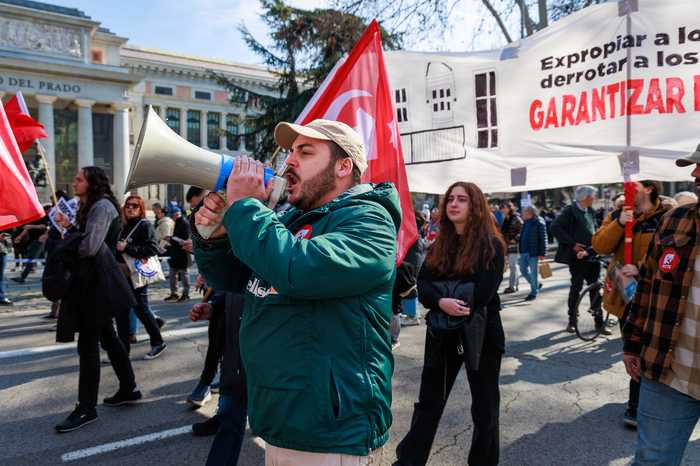
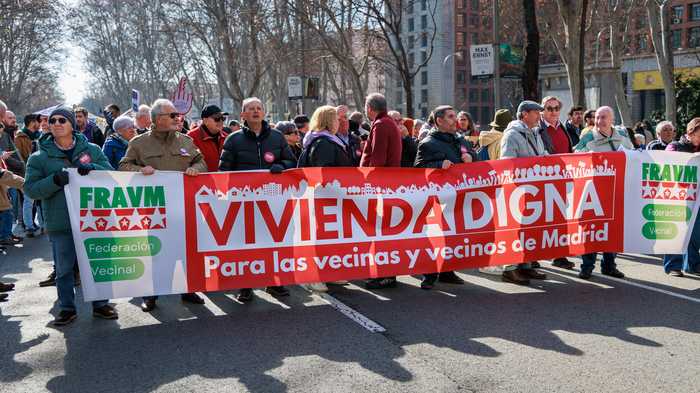
MADRID — Tens of thousands of people took to the streets of Madrid and more than 50 other Spanish cities on Saturday, in the largest day yet of the Spain housing protests October 2026 — one day after parliament struck down the government's emergency tenant-protection decrees. The Spanish government said about 70,000 people marched in the capital alone, setting off from several points around the city at noon and converging on Plaza de Cibeles in the center.
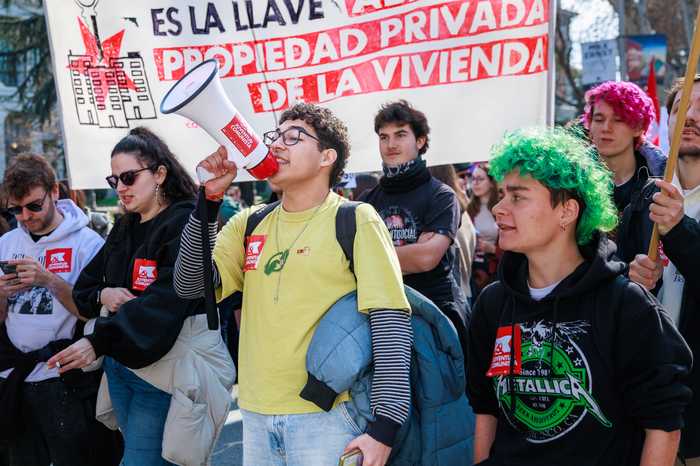
The demonstrations, coordinated by the Tenants' Union, were overwhelmingly peaceful — but in the southeastern city of Valencia, protesters clashed with police, who fired rubber bullets and tear gas to break up the crowds. About 30 demonstrators briefly got inside the City of Arts and Sciences, Valencia's landmark cultural complex, before being ousted by police.
Some marchers carried posters calling for a general strike, and the message from the streets was aimed squarely at the political class. "It's a shame," said Nando de Anguulo, 26, who joined the Madrid protest. "It only proves that it is us the people who have to adapt to the political parties, and not the politicians to what the people want, and this can't go on like that."
Why this matters: a housing crisis becomes a governing crisis
What began as anger over a single eviction has metastasized into the question that could end a government. Spanish media reported on Friday that Prime Minister Pedro Sanchez might call a snap election for November after the legislation failed — and that he would be watching the strength of Saturday's protests before deciding. His office refused to comment on the reports, which is itself a signal: when a prime minister's office won't deny an election rumor, the rumor is doing political work.
The deeper significance is structural. Spain's housing crisis is no longer a social issue to be managed; it is the issue around which the country's political arithmetic now turns. Sanchez's leftist minority government holds just 147 of the 350 seats in Congress and survives on a patchwork of smaller parties — a coalition so fragile that a Catalan separatist party with seven MPs, Junts, could single-handedly sink the government's flagship housing response. Saturday's marches were, in effect, a public audit of that arithmetic: 70,000 people in Madrid rendering a verdict the chamber could not.
There is a historical echo that Spanish politicians will not miss. For about a week, activists have been camped in tents in Puerta del Sol — the same square occupied for a month in 2011 by the indignados protesting austerity during the financial crisis. The 15-M movement reshaped Spanish politics for a decade, birthing new parties and breaking a two-party system. The tents are back, the square is full again, and the generation now sleeping in it is not protesting bank bailouts — it is protesting the fact that it cannot afford to move out of its parents' homes.
How we got here: from Maricarmen's stretcher to 50 cities
The anger was triggered by the eviction of 87-year-old Maricarmen Abascal, who was carried out on a stretcher from the Madrid flat where she had lived for more than seven decades. Police evicted her under an order secured by the investment fund that had bought her apartment and sought to raise her rent by 275 percent. Hundreds of people outside the building clashed with police; the leftist central government condemned the center-right Madrid regional administration of Isabel Diaz Ayuso for failing to prevent the eviction.
The image of an octogenarian removed on a stretcher did what years of statistics had not: it gave the housing crisis a face. By the following Monday, some 30,000 people had marched through Madrid shaking keys and carrying banners reading "Speculators go home" and "Housing is for living." Hundreds of tents filled Puerta del Sol, and the Tenants' Union — which has coordinated the protests — called for further demonstrations across the country.
The government's answer came on Tuesday, when the cabinet passed two decrees: one banning evictions of vulnerable tenants until 2030, extending a rent-freeze on existing leases by two years, and tightening rules on short-term rentals; and a second, stronger measure permitting automatic and indefinite renewal of rental contracts. But decrees in Spain's fragmented Congress must be ratified by the lower house — and the vote, held on Friday, was the moment everything broke.
The vote that lit the fuse: two decrees, one fragmented parliament
On Friday, Congress rejected the measures. The decisive blow came from Junts, the Catalan separatist center-right party, which raised last-minute objections on the eve of the vote and asked the government to devise a new proposal. Junts argued the measures would backfire — reducing the supply of rental housing, driving up prices, and making it even harder for people with limited means to find homes. "Many of the measures included will produce the opposite effect of what is intended," the party said in a statement.
Opposition parties had already signaled they would not support the decree, and the second, stronger decree on automatic lease renewal was expected to fail for lack of minimum support in the fractured chamber. Many activists, notably, said even the government's measures fell short. "It's not enough — it might be a starting point or a stopgap," 32-year-old pharmaceutical worker Julio Gomez told Reuters from the Puerta del Sol encampment, where he said he would stay "as long as it takes." Others accused the government of cynical staging: splitting the measures into two bills so the weaker one might squeak through while the stronger one was sacrificed. "They've done it so that one gets approved and the stronger one gets rejected, just to sneak one through by the skin of its teeth," said veterinarian Gonzalo Sanchez, 26.
That double rejection — by parliament and, in a sense, by the streets — is what detonated Saturday. The Tenants' Union put it bluntly: "There is an irreparable disconnect between what the people want and what the parties vote for."
Who benefits, who loses: the politics of a no vote
The winners from Friday's vote are, in the short term, the landlords and investment funds whose business models the decrees threatened, and the opposition parties — particularly the center-right Popular Party and Junts — who demonstrated, again, that nothing moves in Congress without them. Junts, with seven seats, extracted maximum leverage from minimum numbers: kingmaker math in its purest form.
The losers are the tenants the decrees were meant to protect, and the government itself, which now owns a high-profile failure on the issue voters care about most. The political damage compounds: Sanchez presented the decrees as his answer to the Maricarmen case, and their rejection makes the government look both weak and, to activists, half-hearted. Aidan, a 26-year-old wildfire firefighter at the Sol encampment, captured the mood: "I already thought the measures were insufficient and only temporary, but vetoing them is selfish and abandoning the people."
The most combustible element is generational. Blanca, a student at the protests, said young Spaniards were struggling to move out of their parents' homes: "Politicians not only do nothing but make it worse. We've decided to put our foot down." When the cohort that cannot afford rent is also the cohort that will decide the next decade of elections, a housing crisis stops being a policy file and becomes an existential threat to the parties that ignore it.
Valencia: the one city where the march turned violent
In more than 50 cities, Saturday's demonstrations were peaceful. Valencia was the exception. There, demonstrators clashed with police, who fired rubber bullets and tear gas to disperse the crowds, and about 30 protesters managed to get inside the City of Arts and Sciences — the landmark cultural building designed by Santiago Calatrava — before being removed by officers.
The Valencia clashes matter less for what happened than for what they signal. Peaceful mass protest is politically expensive to ignore but easy to police; violent confrontation gives the government a public-order narrative to hide behind. Expect both sides to weaponize Valencia in the coming days — the government pointing to disorder, the movement pointing to provocation. The honest reading is narrower: one city out of fifty, a few dozen people out of tens of thousands. The movement's discipline held almost everywhere.
What the numbers say: doubled rents, 147 seats, one 87-year-old
Put the figures in context and the story sharpens. Rents in Spain have on average doubled over the past decade, far outpacing salary growth — the structural fact beneath every slogan. Against that, the government's offer was a freeze and an eviction ban to 2030: real relief for vulnerable tenants, but nothing that builds a single new home or touches the supply shortage Junts cites. The activists' verdict — "not enough" — is arithmetically defensible.
Then the political numbers: 147 seats out of 350, a government that cannot pass emergency legislation without parties that openly oppose its approach. And the human number that started it all: one 87-year-old woman, seven decades in one flat, a 275 percent rent demand. After the backlash, the new owners agreed to let Abascal return at a low rent — the individual case resolved, the systemic one untouched. That asymmetry is precisely why the protests grew: a personal happy ending that changed nothing for everyone else.
Finally, the momentum number: 30,000 marched in Madrid on the first Saturday; 70,000, by the government's own count, on this one. A movement more than doubling its turnout in a week, with a permanent encampment in the country's most symbolic square, is not a protest cycle winding down. It is one winding up.
What happens next: three scenarios
Scenario one: the snap election. Sanchez watches Saturday's turnout and concludes the legislature is exhausted, calling a November vote that turns housing into the central campaign issue. This is the scenario Spanish media is already pricing in. It is high-risk for the Socialists — elections called from weakness rarely reward the caller — but it would at least convert parliamentary paralysis into a democratic verdict.
Scenario two: escalation. The general-strike posters on Saturday were not decoration. If the encampments hold and the Tenants' Union calls a national strike, Spain faces its first housing-driven general strike — a confrontation that would dwarf the current protests and force every party to take a binding position. The unions' involvement would also internationalize the story: Europe's housing crisis is not a Spanish monopoly.
Scenario three: the renegotiated decree. The government goes back to Junts and the other kingmakers with a reworked proposal — supply-side concessions in exchange for tenant protections — and tries to peel off enough votes for a narrower package. This is the lowest-drama path, but it satisfies nobody: activists already called the original measures a stopgap, and every concession to Junts dilutes them further.
Whichever path materializes, the underlying fact is unchanged: Spain's rents doubled in a decade, its parliament cannot pass housing law, and its young people are sleeping in tents in Puerta del Sol. Maricarmen Abascal got her flat back. Tens of thousands of Spaniards are still waiting for theirs.
Sources and reporting notes
- Reuters: Tens of thousands protest across Spain over housing crisis (October 3, 2026)
- Reuters: Protesters camped out across Spain demand passage of housing measures (September 30, 2026)
- Reuters: Spanish housing decree imperilled by opposition of Junts party (October 1, 2026)
- Reuters: Madrid housing protests enter third day after pensioner's eviction (September 28, 2026)
- Time Bulletin: Spain faces housing protests in more than 50 cities (October 3, 2026)
Reporting note: Turnout figures, the parliamentary timeline, decree contents, and protester quotations come from the cited reporting. The Madrid turnout figure (70,000) is the Spanish government's estimate; organizers' counts, where they differ, are not independently verified. Forward-looking scenarios and assessments of the numbers are Signal Post News analysis.