World · Europe
Six days, 3,261 rescues, one island of 11,400 people. The Canary Islands migrant surge has revived the Atlantic route at a pace its regional president calls unsustainable — and the numbers show both a genuine emergency at La Restinga and a year that, until October, had been moving the other way.
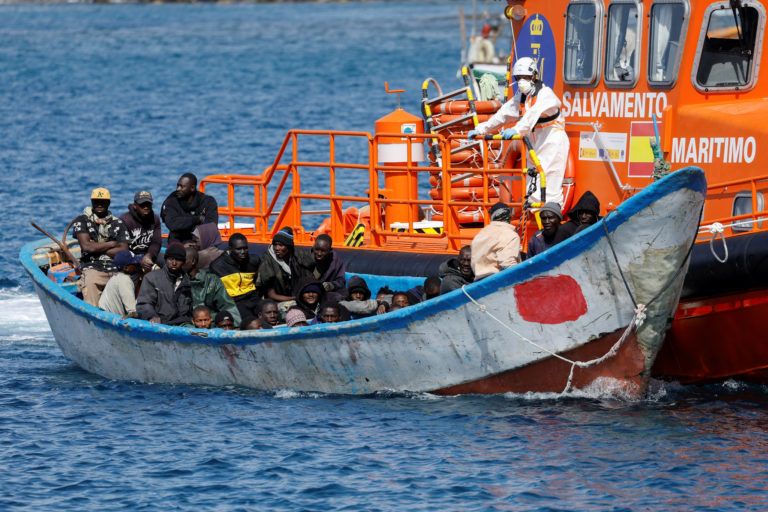
LA RESTINGA, El Hierro, November 6, 2026 — The Canary Islands migrant surge now under way in the Atlantic has brought 3,261 people to Spanish rescue boats in the first six days of November alone, overwhelming the tiny island of El Hierro and pushing its reception system, its health services and its 11,400 residents to a point the Canary Islands’ regional president, Fernando Clavijo, this week called “absolutely unsustainable.” Spain’s maritime rescue services have worked around the clock as boat after boat has been intercepted or escorted into port, and the arrivals have come with a human cost that is still being counted: at least nine migrants have died off the islands in recent weeks, one body was recovered on Thursday night alone, and a critically ill baby had to be airlifted to hospital on arrival.
Clavijo said the pace of arrivals is approaching the record-breaking levels of 2024 — on some days exceeding them — and warned that the smallest island in the archipelago cannot absorb a flow of this size on its own. His warning frames the central tension of the Spain migrant crisis November 2026 is now watching: a rescue operation that is, by the numbers, succeeding — thousands of people pulled alive from one of the world’s most dangerous crossings — arriving faster than the system built to receive them can process, house, treat and transfer them.
Thursday night at La Restinga: 500 people, two boats, one body
The surge’s intensity was visible in a single night. On Thursday night, November 5, rescue services brought about 500 people from two boats into the port of La Restinga, El Hierro’s southern fishing harbour and the island’s main arrival point. Reuters footage from the port showed hundreds of people gathered on the quay after disembarking — the rescued, rescue crews, police, medical teams and aid workers sharing a harbourside built for a village. Crews also recovered one body from the operation, a reminder that runs underneath every arrival statistic: for some of the people who set out, the crossing ends before land is sighted.
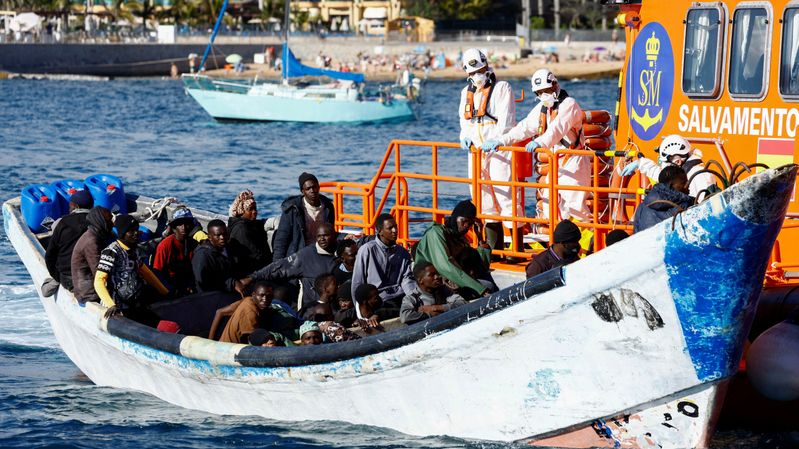
Friday brought no pause. Seven boats reached El Hierro on Friday, November 6, alone, according to EFE reporting, and rescues continued across the archipelago as the six-day total climbed to 3,261. Each arrival triggers the same sequence — medical triage on the quay, identification and registration, food, dry clothing and transfer to reception facilities — and each repetition draws on the same small pool of island staff, vehicles and beds. Buses normally used for island transport have been diverted to migration operations, and medical staff have been brought in from other islands to reinforce La Restinga, as healthcare on El Hierro comes under sustained pressure.
The numbers in context: a record October, a quieter year, a violent reversal
The November surge did not begin in November. According to EFE figures reported this week, 6,194 people arrived in the Canary Islands in October 2026 on 65 boats — more than arrived in the entire first half of the year, when 3,708 people reached the islands. The acceleration since then has been steep: October’s monthly total was surpassed in pace within days, with 3,261 rescues in November’s first six days working out at more than 540 people a day.
And yet the year-to-date picture points the other way. Arrivals in the first ten months of 2026 were still down nearly 61 percent compared with the same period of 2024, the archipelago’s record-breaking year. Both things are true at once, and holding them together is essential to understanding what is happening. This is not a year-long record being set; it is a sharp late-year reversal — a route that ran comparatively quietly for months suddenly running at, and on some days above, the tempo of the worst year on record. Systems sized for the quiet months, on the smallest island, are the ones meeting the loud ones.
The ratio that explains El Hierro’s emergency
Consider the arithmetic from El Hierro’s side of the quay. The island has about 11,400 residents. The 3,261 people rescued across the archipelago in six days amount to more than a quarter of El Hierro’s entire population — and a large share of those rescues have landed at La Restinga, a village within that small island. No community of 11,400 maintains spare hospital capacity, spare buses, spare interpreters, spare police shifts and spare beds for a population shock of that relative size. That is why island council president Alpidio Armas has appealed to the other islands to take people in, reporting that reception centres on Tenerife and Gran Canaria are already full, and why residents of La Restinga have protested at the strain on local services — a protest aimed less at the arrivals themselves than at a distribution of the burden that leaves the smallest island holding the largest share of it.
Why this matters
First, because El Hierro has become one of Europe’s key entry points for migrants arriving from West Africa, and what happens at La Restinga is therefore not a local story. The Atlantic route is a European border question that happens to be administered from a fishing port: decisions taken in Madrid and Brussels about funding, transfers and asylum processing land, physically, on this quay. Second, because the route is among the deadliest on earth. At least nine deaths in recent weeks, one body recovered on Thursday night and a baby airlifted in critical condition are the visible edge of a toll that is structurally undercounted — boats that vanish leave no manifest and no arrival statistic. Every surge in departures is, actuarially, also a surge in deaths, including deaths nobody records.
Third, because the surge tests a political argument running in both directions. The regional government argues that the Canary Islands are carrying a European responsibility with island-sized resources, and that solidarity — transfers to the mainland, shared reception, money — has not matched the rhetoric. Madrid’s position, in turn, has centred on processing, transfers and European coordination, and on the point that arrivals across the year remain far below 2024. Both claims can be documented; they answer different questions. The regional claim is about capacity per day on one small island. The national claim is about totals per year across a country. The people on the quay in La Restinga experience the first of those numbers, not the second.
The Atlantic route: why autumn, why now
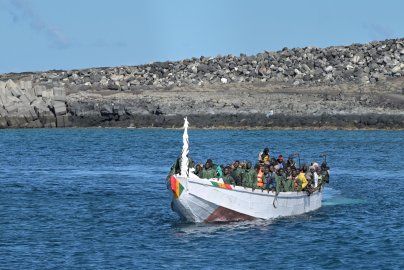
The crossing from the West African coast to the Canary Islands is one of the world’s deadliest migration routes. Boats — many of them cayucos, the long wooden fishing vessels built for coastal waters, not open ocean — travel hundreds of kilometres of Atlantic, exposed to currents that can push them past the islands entirely and into open sea. Departures typically pick up in autumn, when the seas are calmer, and Clavijo has pointed to exactly that: calm conditions are fuelling the current surge. Weather windows on this route function like a timetable. When the ocean flattens, boats leave; when boats leave together, they arrive together; and a reception system experiences not a flow but a pulse.
The 2024 comparison hanging over this week is not rhetorical. That year set the records Clavijo is measuring against, and it reshaped Spanish and European debate about the route — the same debate visible in our reporting on Madrid’s clearance of the migrant camp at Ceuta’s Trampolín beach ahead of a royal visit, where the politics of visibility and the politics of reception collided in Spain’s other African-border enclave. The comparison with other routes is equally sobering: the eastern route whose dangers we covered when a migrant boat capsized off Djibouti, killing 139 people, and the Atlantic route differ in geography but not in structure — unseaworthy boats, organised departures, and a death toll known mainly when a vessel is found.
What rescue and aid workers face
For the crews of Spain’s maritime rescue service, a surge week is a rotation of interceptions in open water, transfers alongside moving boats, and quayside triage repeated until the distinction between shifts blurs. The medical picture on arrival is its own discipline: dehydration, exposure, fuel burns and exhaustion are routine; the critically ill baby airlifted to hospital this week represents the severe end of a spectrum that medical teams flown in from other islands are now treating in a village health system. Aid workers and police describe the same bottleneck from different ends of it — people cannot move forward to reception centres that are full, so the port itself becomes the reception centre, and every hour of delay is an hour the next boat is already at sea.
What happens next
The immediate release valve is due within hours. A new CATE temporary reception centre at Granadilla, on Tenerife, built for more than 1,000 people, was due to open on Friday or Saturday, according to island officials — capacity that would let transfers off El Hierro resume at scale and test whether the bottleneck is beds or the logistics of moving people between islands. Armas’s appeal to the other islands, and the full centres on Tenerife and Gran Canaria, mean Granadilla’s opening will be watched as a measure of whether the archipelago can redistribute the surge internally before it becomes an argument only Madrid can settle.
The political clock runs alongside the operational one. Clavijo has sought coordination with Prime Minister Pedro Sánchez’s government in Madrid, and the meeting — its timing, its agenda and above all its outcome on transfers and funding — will signal whether the response stays administrative or becomes a formal state-level emergency posture. The domestic stakes are live ones: migration and reception capacity feed directly into the national argument Sánchez is already fighting on several fronts, as our coverage of Sánchez’s snap election and the housing decrees bound up with it has shown. Beyond Spain, the EU dimension is unavoidable: a route from West Africa to European territory, running at record daily pace, engages Frontex, the EU’s migration pact machinery and the union’s partnerships with departure countries, none of which move at the speed of a weather window.
And the weather window is the shortest clock of all. While the autumn calm holds, departures will continue, and each calm day is, on this week’s evidence, worth hundreds of rescues. Whether November 2026 is remembered as a six-day emergency or as the month the route’s 2024 records came back into reach depends on three things that have not yet happened: Granadilla opening and absorbing transfers, Madrid and the regional government agreeing a distribution that outlasts a news cycle, and the sea itself turning. Signal Post News will update this story as the rescue count, the Granadilla opening and the Madrid coordination talks are confirmed.
Sources: Reuters, “Migrant surge in Spain’s Canary Islands is unsustainable, authorities say,” November 6, 2026, reporting by Jesus Cabrera in La Restinga (3,261 rescues in six days; Clavijo statements; Thursday night La Restinga operation; nine deaths; year-to-date arrivals down nearly 61 percent versus 2024); EFE reporting via Teneriffa News, “More than 1,021 arrivals in the Canary Islands as rescues continue,” November 2026 (October arrivals of 6,194 on 65 boats; first-half total of 3,708; seven boats reaching El Hierro on Friday; La Restinga protests; Armas appeal and the Granadilla CATE centre); Al Jazeera summary of the Reuters reporting, November 6, 2026. Photos: Reuters and InfoMigrants, as credited in captions.