War · Ukraine · Poland
For the second time in four days, a Russian weapon crossed into NATO territory and Poland chose not to fire. The authorization to shoot was given; the order to use it was not. Warsaw’s explanation — the danger to people on the ground — is now the centre of a harder argument about deterrence, escalation and how a war next door keeps arriving, briefly and deniably, inside the alliance’s own sky.
Track it live: Ukraine war map — Live Global Trackers · Wars tracker — Live Global Trackers
WARSAW, November 23, 2026 — The Russian drone Polish airspace incident that Polish commanders managed overnight was brief, and it ended without a shot fired — but not for want of permission. A Russian unmanned aerial vehicle briefly violated Polish airspace during Russia’s nighttime attack on western Ukraine on the night of November 23–24, the Polish Armed Forces Operational Command said in a statement on X reported by Reuters. Polish forces gave authorization to shoot down the object, the command said; then, after the drone changed course to head east, they decided to refrain from using weapons, citing “the potential threat to civilians and the possible consequences of shooting down the object.” No casualties or damage in Poland were reported in connection with the incursion, and no Russian response to the Polish account had been reported as of publication.
What the Operational Command said
The Polish Armed Forces Operational Command drone statement, as reported by Reuters on November 24, describes a sequence that matters more than the incursion’s brevity. The object was detected during a large Russian attack on western Ukraine — the kind of strike package that regularly pushes Ukrainian air defences to their western edge, close to the Polish border. Authorization to engage was granted: the threshold question that has dominated Polish politics since earlier incursions — may our forces actually shoot? — was answered yes, in real time. What stopped the engagement was not authority but geometry and consequence. Once the object turned east, back toward Ukraine, commanders weighed a falling wreck, a missile or gun engagement over populated ground, and the risk that debris from a successful interception would kill the very people the air defence exists to protect. They held fire.
While the drone was being tracked, Poland’s Government Security Center (RCB) issued emergency alerts to residents across the Lublin region during the attack — the Polish air defence alert Lublin residents received on their phones as the overnight strike unfolded. Liveuamap, which reported the same Operational Command statement, also reported the RCB alert covering counties across the Lublin region. The alert is itself part of the story: it means the state treated the spillover risk to its own population as live and immediate, even as its commanders concluded that firing would raise, not lower, the danger to that population in this specific case.
Four days after missiles landed in Poland
The Kh-101 missiles landed in Poland on Friday
This incursion did not arrive in isolation. On Friday, November 20, three Russian Kh-101 cruise missiles landed in Poland, according to Polish prosecutors — an episode that moved the question of Russia war spillover NATO territory faces from the hypothetical to the forensic. Cruise missiles are not drones that drift off course in the same way; three of them coming down on allied territory in a single day is the gravest category of spillover short of a deliberate strike, and Warsaw’s public response ran through prosecutors and evidence rather than air-defence engagements, because by the time the missiles were found, there was nothing left to intercept.
The NATO AWACS Poland deployment
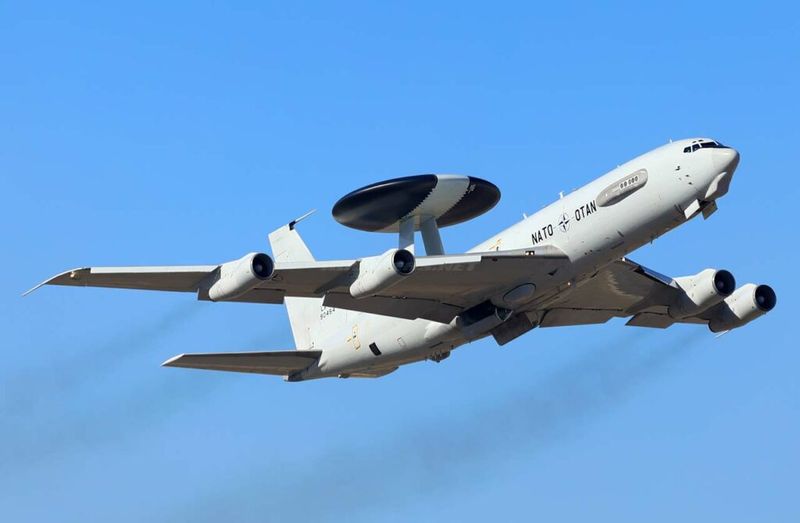
NATO’s answer to November 20 was eyes. The alliance decided to deploy an AWACS early-warning aircraft to Poland in response to the missile landings — a NATO AWACS Poland deployment that puts the alliance’s own airborne radar picture over the border region, shortening detection timelines and, just as importantly, making the monitoring of Polish airspace a visibly allied act rather than a national one. An AWACS does not shoot anything down. What it changes is attribution and warning: with an alliance radar in the sky, the next object’s track, origin and behaviour will be documented to a standard that is much harder for anyone to dispute.
Why this matters
Warsaw’s civilian-risk calculation
The case for holding fire is written in the Operational Command’s own sentence. Shooting down an aircraft — even an unmanned one — over populated territory converts a track on a radar screen into falling metal, fuel and possibly explosives, at a place and moment no one fully controls. The question “should Poland shoot down Russian drone intrusions on sight?” has a different answer over the forests of the border strip than over a Lublin-region town at night, with residents already alerted and awake. Commanders also knew the object was leaving: an eastbound drone is a departing threat, and engaging a departing threat buys little safety at a real price in risk. Restraint, on this account, was not hesitation. It was the system working as designed — authorization available, judgment applied.
Deterrence versus escalation
The case against restraint is about the next incursion, not this one. Every unengaged violation teaches the sender something: that objects can cross, be tracked, be authorized against — and still leave unharmed. Critics of restraint argue that a pattern of tolerated breaches normalizes them, lowering the perceived cost of the carelessness, or the probing, that produces them, and that deterrence in air defence is built precisely out of demonstrated willingness to fire. Critics of escalation answer that a shootdown is not a cost-free signal either: wreckage can kill civilians, a misidentified object can turn an incident into a crisis, and a state that fires reflexively hands the initiative to whoever chooses the time and place of the next crossing. Between those two arguments sits the alliance’s structural problem — NATO’s credibility rests on the border meaning something, while its safety rests on nobody treating a stray drone as the opening of a war.
A pattern, in numbers
Count only what is documented and the tempo is still striking. In the space of four days, Poland recorded three Kh-101 cruise missiles landing on its territory (November 20, per its prosecutors) and a Russian drone violating its airspace during a mass attack on western Ukraine (night of November 23–24, per its Operational Command), alongside an RCB emergency alert to a whole border region and a NATO decision to forward-deploy an AWACS. Earlier this autumn, Polish air-raid alarms were already sounding for Russian drones near the border — the subject of our October reporting on Poland’s border alarms — and Warsaw has spent the same period rewriting its engagement rules, as we reported in Poland’s shoot-down rules and the Swedish Gripens. The direction of travel is consistent: the incidents are recurring, the response machinery is getting faster and more allied, and the margin between an incident and an accident is being managed by judgment calls made in minutes, at night.
What happens next
Three scenarios now compete. In the first, the AWACS deployment and the demonstrated authorization regime stabilize the border: tracks are published, violations are documented to alliance standard, and Moscow’s strike planning routes around Polish airspace more carefully because the evidentiary cost of each crossing has risen. In the second, incursions continue at the current tempo and Polish politics forces the engagement question back open — with pressure to pre-delegate firing authority lower and earlier, accepting civilian-risk trade-offs that commanders refused this week. In the third, an accident decides the argument: debris from an interception, or a weapon that does not turn east, produces Polish casualties and converts a managed pattern into a NATO crisis. Which scenario arrives depends less on declarations than on the next few strike nights over western Ukraine — and on whether the drone that turned east on November 24 is remembered in Warsaw as proof the system works, or as the warning it declined to fire on.
Related reporting: Sparta II Drone Strike Baltic: Kremlin Accuses Ukraine of ‘Terrorist Activity’ After Cargo Ship Hit in Gulf of Finland.
Sources
Reuters, “Russian unmanned aerial vehicle briefly violated Polish airspace, Polish armed forces say” (November 24, 2026), reporting the Polish Armed Forces Operational Command statement on X: reuters.com. Liveuamap, reporting of the same Operational Command statement and of the Polish Government Security Center (RCB) emergency alert to residents across the Lublin region during the attack: liveuamap.com. Context on the November 20 Kh-101 landings is as reported by Polish prosecutors, and on the NATO AWACS deployment as announced in response; no Russian response to the November 23–24 incursion had been reported as of publication, and this article attributes each claim to its source accordingly.