War · Ukraine · Baltic
A sanctioned Russian military-logistics ship was burning in NATO-monitored waters on Saturday, its crew evacuated and three countries’ rescue services fighting the same fire. By Monday the argument was no longer about one ship: the Kremlin was accusing Ukraine of terrorism in the Baltic, and Moscow was spending $576 million to keep Kaliningrad supplied by sea.
Track it live: Ukraine war map — Live Global Trackers · Wars tracker — Live Global Trackers
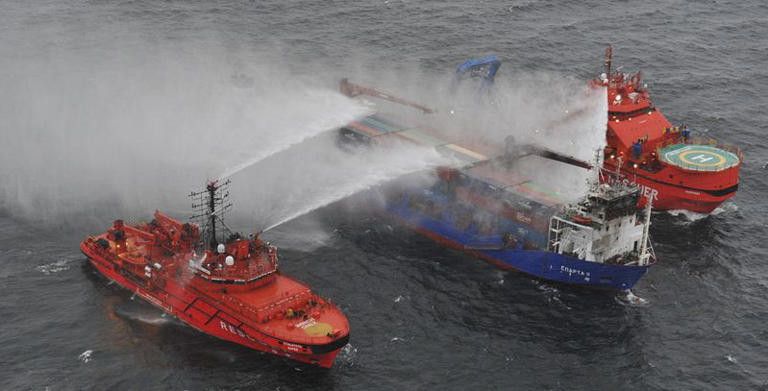
GULF OF FINLAND, November 23, 2026 — The Sparta II drone strike Baltic officials spent the weekend managing began on Saturday, November 21, when two drones hit the Russian-flagged cargo ship in international waters west of Gogland Island in the Gulf of Finland, according to Finnish authorities and reporting by Reuters, CNN and NPR. The strike started a fire and knocked out the ship’s steering as it sailed from St Petersburg to Kaliningrad. Powerless, the 121-metre vessel drifted into Finnish waters, coming to rest at anchor about 50 kilometres west of Suursaari — Gogland’s Finnish name — off the port of Loviisa. All 16 crew were evacuated to another Russian vessel, and one person suffered a minor injury. Finland’s Defence Forces said Ukraine was likely behind the attack; Kyiv has not commented. On Monday, the Kremlin accused Ukraine of “terrorist activity” in the Baltic and urged Baltic states to warn Kyiv — Moscow’s characterisation of the strike, stated here as its accusation, just as responsibility for the attack remains Finland’s assessment rather than an established finding.
Fire, drift and a three-nation rescue
What followed the strike was, by the standards of this war, an anomaly: a joint rescue. Finnish, Russian and Estonian responders fought the fire together through Saturday night and into Sunday, with Finnish Border Guard vessels and aircraft cooling the ship’s container stacks while the Russian rescue vessel Murman worked alongside them at Finland’s request, CNN reported. By Sunday, November 22, the Finnish Border Guard said the fire was no longer visible, though smoke and heat remained aboard; the Sparta II had taken on a slight list, and no fuel leak had been detected — a material fact in a shallow, enclosed sea where a spill would have become Finland’s and Estonia’s problem within hours. Later on Sunday, a Russian rescue vessel towed the ship out of Finnish waters toward St Petersburg.
The ship itself explains why it was worth hitting — and why its cargo drew questions nobody answered. The Sparta II is a 121-metre roll-on/roll-off cargo vessel operated by Oboronlogistika, the logistics company linked to Russia’s defence ministry. It was sanctioned by the United States in 2022 and by Ukraine in 2025. Finnish Border Guard commander Ilja Iljin said the vessel’s bridge and cargo area were damaged and warned that its unknown cargo presented a potential explosion risk; Finnish officials said it could not be ruled out that military materiel was aboard, while stressing that the cargo had not been confirmed. That distinction matters: a sanctioned defence-logistics ship on the St Petersburg–Kaliningrad run is a military-linked target in Moscow’s own logistics chain, but no authority has publicly established what this particular sailing carried.
The Kremlin’s answer — and a helicopter under investigation
On Monday, November 23, the Kremlin accused Ukraine of “terrorist activity” in the Baltic Sea and urged Baltic states to warn Kyiv against further attacks, Reuters reported. The wording is Moscow’s, and it does diplomatic work: it reframes a strike on a sanctioned military-logistics vessel as an attack on civilian shipping, and it addresses the warning not to Kyiv but to the NATO capitals around the gulf — Helsinki, Tallinn and, by extension, the alliance. Ukraine, for its part, has said nothing: no claim, no denial. That silence is consistent with Kyiv’s handling of the earlier Baltic strike it was reported to have claimed through its security service, and it leaves Finland’s “likely Ukraine” assessment as the most authoritative public attribution available.
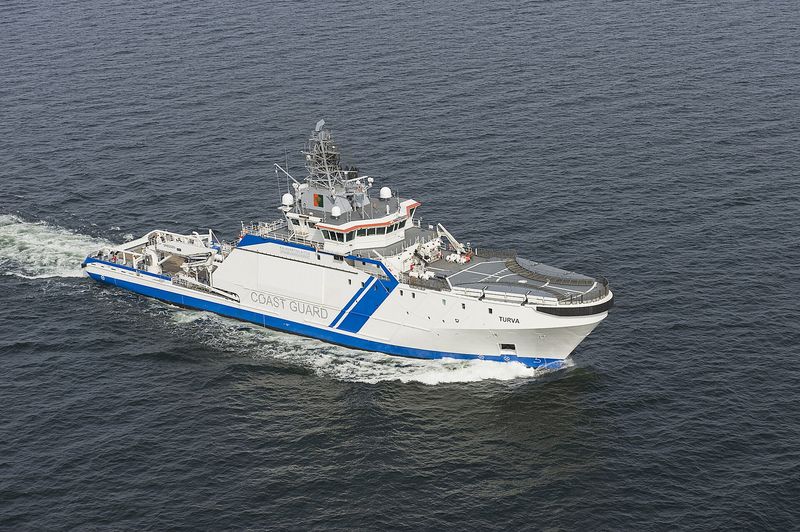
The weekend also produced a second, quieter incident that may matter as much as the first. Finland’s defence ministry said a Russian helicopter was suspected of briefly violating Finnish airspace during the rescue operation near Loviisa — reportedly penetrating several kilometres into Finnish territory — and that the suspected incursion is under investigation and NATO was informed. Finnish officials have not concluded whether the flight was connected to the rescue, to surveillance of the damaged ship, or to neither. In a gulf this narrow, an unexplained military helicopter crossing a NATO border during a live maritime emergency is exactly the kind of secondary incident through which crises escalate by accident rather than design.
Why this matters
The Baltic is becoming a front, not a flank
Until this month, Ukraine’s drone war at sea was a Black Sea and Mediterranean story. November has moved it into the Baltic twice in ten days: first the strike Ukraine’s SBU was reported to have claimed on the Baltic Fleet missile corvette Naro-Fominsk near the same island, now a strike on a cargo ship in the same waters. The geography is the message. The Gulf of Finland is a corridor roughly 400 kilometres long and, at its narrowest, less than 30 kilometres wide, bordered by two NATO members that joined or anchored the alliance’s northern flank — Finland and Estonia — and terminating at Russia’s second city. Every Russian hull moving between St Petersburg and Kaliningrad sails that corridor, in range of sensors, and now demonstrably of drones, for its entire passage.
Kaliningrad’s supply line is the real target
The Sparta II was not sailing anywhere exotic. It was running the exclave run: the sea bridge between mainland Russia and Kaliningrad, the Russian territory wedged between Poland and Lithuania with no land connection to the rest of Russia that does not cross NATO or Belarusian-controlled space. Since the full-scale invasion, that sea bridge has gone from a supplement to a lifeline. Maritime shipping now accounts for over half of Kaliningrad’s supplies, up from just 8% in 2021, before the invasion — a more than sixfold shift in the exclave’s logistics in under five years, driven by sanctions, rail-transit restrictions through Lithuania and the closure of land and air routes. A drone campaign that can reach that bridge does not need to sink many ships to impose costs: it needs only to make the run slower, escorted, insured at war rates, or intermittently impossible.
Escalation risk runs through the rescuers
The Sparta II incident shows the Baltic’s peculiar escalation geometry. The strike itself was aimed at Russia; its consequences landed in Finland — a burning, possibly ammunition-carrying ship drifting uncontrolled into Finnish waters, a suspected Russian airspace violation during the response, NATO informed, Estonian commanders warning publicly that further attacks in the gulf cannot be ruled out. None of that required anyone to intend an attack on a NATO state. It required only a disabled ship, a current, and a border drawn down the middle of a narrow sea. Critics of Kyiv’s Baltic campaign make precisely this argument: that the military value of one cargo ship is outweighed by the risk of an accident — a spill, a stray drone, a misread radar track — that pulls Finland or Estonia from rescuers into belligerents. Supporters answer that the corridor is a legitimate military logistics route, that the target was a sanctioned defence-ministry carrier, and that Russia chose to make Kaliningrad depend on it. Both arguments can be true at once, which is what makes the next incident more dangerous than this one.
War risk now prices Baltic shipping
For commercial shipping, the strike reprices the gulf. Insurers distinguish between a war zone and a sea where one sanctioned ship was hit; after two strikes in ten days in the same waters, underwriters, charterers and flag registries will treat the eastern Baltic as an area of elevated war risk, with premiums, crew-refusal clauses and routing decisions to match. The ships most exposed are not naval vessels but the ordinary ro-ro and container traffic of St Petersburg, Ust-Luga and Kaliningrad — and, on the other shore, Finnish and Estonian ports whose approaches share the same water. Russia has already begun escorting cargo traffic in the Baltic, according to regional reporting; escorts are themselves an admission that the sea is no longer treated as safe by the state that dominates its eastern end.
Moscow’s $576 million answer: two giant ferries for Kaliningrad
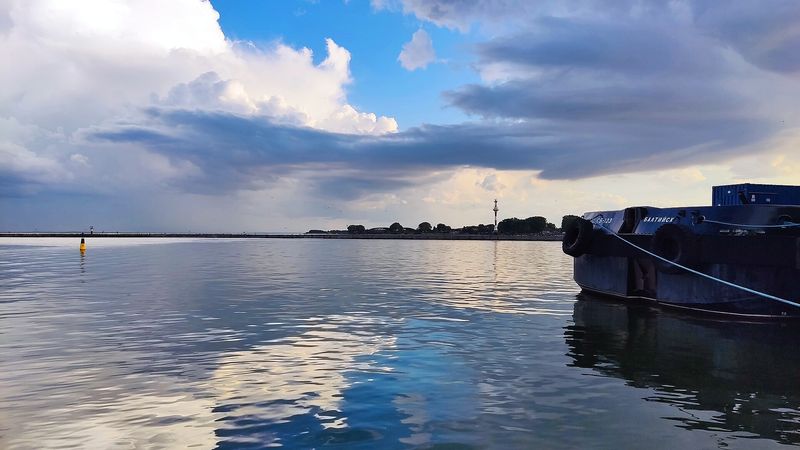
The Kremlin’s rhetorical answer came with a budget line attached. On Monday, Prime Minister Mikhail Mishustin announced that Russia will spend 47 billion roubles — about $576 million — building two giant rail ferries to secure supplies to Kaliningrad, Reuters reported. The ferries are expected to enter operation in 2030, running between Ust-Luga in the Leningrad region and Baltiysk, Kaliningrad’s port, and will be funded mostly from Russia’s rainy-day fund, the National Wealth Fund. Rail ferries matter for an exclave because they carry what trucks and containers cannot move as efficiently: entire trainloads of fuel, grain, vehicles and heavy cargo, loaded on rails at one port and rolled off onto rails at the other, without touching Lithuanian track.
Read the numbers as an admission and a timeline. The admission is the supply share: a state does not commit $576 million from its sovereign reserve fund to a ferry route unless the route has become strategic infrastructure, and Moscow’s own figures — maritime carriage rising from 8% of Kaliningrad’s supplies in 2021 to over half today — quantify how completely the exclave’s lifeline has moved to sea since 2022. The timeline is the vulnerability: the ferries arrive in 2030. Between now and then lie four winters of sailings by the existing fleet — ships like the Sparta II, ageing, sanctioned and now demonstrably reachable by drones — through a gulf where the other shore belongs to NATO. The ferry programme is therefore both a hardening measure and a measure of exposure: it tells you exactly how long Russia expects the vulnerability to last, and it cannot shorten that window by a single day.
Background: shadow fleets, military logistics and the Naro-Fominsk precedent
The Sparta II sits at the intersection of two fleets that sanctions have blurred together. One is the “shadow fleet” of tankers moving Russian oil outside Western insurance and price-cap rules. The other, less discussed, is the state logistics fleet: civilian-flagged, commercially crewed ships operated by defence-ministry-linked companies such as Oboronlogistika, moving military and dual-use cargo on routes the armed forces depend on. The Sparta II belongs to the second category, and its sanctioning history — Washington in 2022, Kyiv in 2025 — reflects that role. Striking such a ship is legally and politically different from striking an oil tanker, and both sides’ language over the weekend reflected the ambiguity: Moscow said “cargo ship” and “terrorist activity”; Helsinki said “likely Ukraine” and noted the ship’s armed-forces links; nobody produced a cargo manifest.
The immediate precedent sits in the same water. Earlier in November, Ukraine’s SBU was reported to have claimed a drone strike on the Baltic Fleet missile corvette Naro-Fominsk near Gogland, which Estonia said took at least four hits and was badly damaged — the first Ukrainian strike on a Russian warship in the Baltic. Read together, the two attacks describe a campaign logic rather than two improvisations: a warship one week, a logistics ship the next, both near the same island, both in the corridor Kaliningrad depends on. Who gains is therefore not only Kyiv, which acquires leverage over the exclave’s lifeline at drone prices, but also every planner in Helsinki and Tallinn arguing that Baltic defence begins with sensors and air defence over the gulf. Who loses includes Russian logistics commanders, Baltic commercial carriers paying war-risk rates, and — on the critics’ account — the border states themselves, which inherit the fires, the drift and the investigations each time a strike succeeds.
Related coverage: Ukraine drone strike hits Russian warship in the Gulf of Finland in a Baltic first · Ukraine claims Benghazi sea drone strike sank Merkury, Zelenskyy says
What happens next
Four things will show whether the Sparta II was an episode or an opening. First, attribution: Finland’s investigation, and any evidence Helsinki chooses to publish, will determine whether “likely Ukraine” hardens into a finding other capitals must answer. Second, the helicopter inquiry: if Finland concludes the airspace violation was deliberate or reckless, expect a diplomatic protest and tighter air policing over the eastern gulf; if it was rescue-related confusion, both sides have an interest in saying so quietly. Third, the sailing pattern: watch whether St Petersburg–Kaliningrad traffic pauses, reroutes, sails in convoy or under escort in the coming weeks — the surest real-time measure of how Moscow rates the threat. Fourth, the money: the $576 million ferry programme will move through Russia’s budget process long before the ships touch water in 2030, and any acceleration, expansion or quiet delay will signal how urgently the Kremlin rates the exclave’s exposure. What is already settled is narrower and larger at once: the Baltic is no longer a rear area of this war. It is a theatre — narrow, crowded, bordered by NATO, and now crossed by drones.
Sources
- Reuters, November 23, 2026 — the Kremlin’s accusation of “terrorist activity” in the Baltic and its call for Baltic states to warn Kyiv; Prime Minister Mikhail Mishustin’s announcement of 47 billion roubles ($576 million) for two Kaliningrad rail ferries, expected in operation in 2030 between Ust-Luga and Baltiysk, and the rise of maritime shipping from 8% of Kaliningrad’s supplies in 2021 to over half today.
- CNN, November 21–22, 2026 — the joint Finnish, Russian and Estonian firefighting effort, the evacuation of the 16 crew, the fire no longer visible by November 22, the ship’s slight list, no fuel leak detected, and the tow out of Finnish waters toward St Petersburg.
- Helsinki Times, November 22–23, 2026 — Finnish Border Guard firefighting and cooling operations, Commander Ilja Iljin on the two-drone strike and the unknown-cargo explosion risk, and the ship at anchor off Loviisa. BBC reporting carried by Insurance Business (November 23) and NPR (November 22–23) corroborated the Finnish attribution assessment, the sanctions history of the Sparta II and the suspected Russian helicopter airspace incursion under investigation, with NATO informed, per Finland’s defence ministry.
Analysis in this article — including the sections on why the strike matters, who gains and loses, what the figures imply, and what happens next — is Signal Post News’ own and is distinguished from the reported facts above. Contested claims are attributed as they are stated in the text: responsibility for the strike is Finland’s assessment, Kyiv has not commented, and “terrorist activity” is the Kremlin’s accusation.