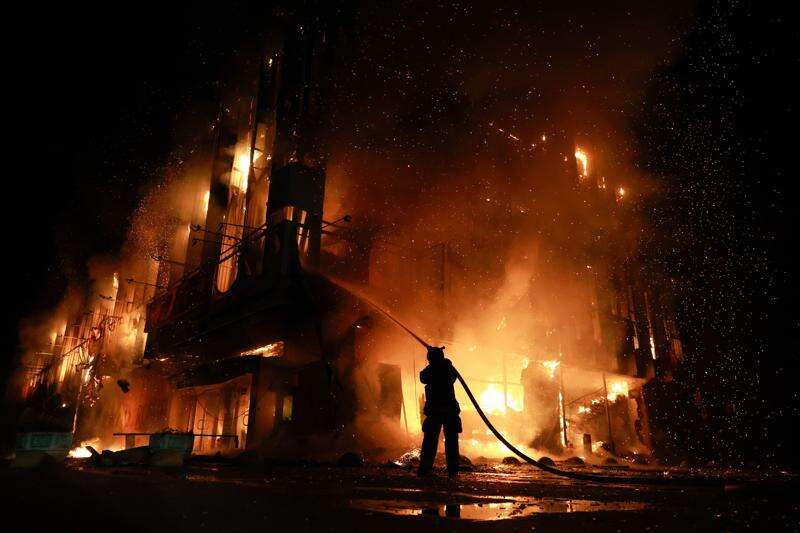
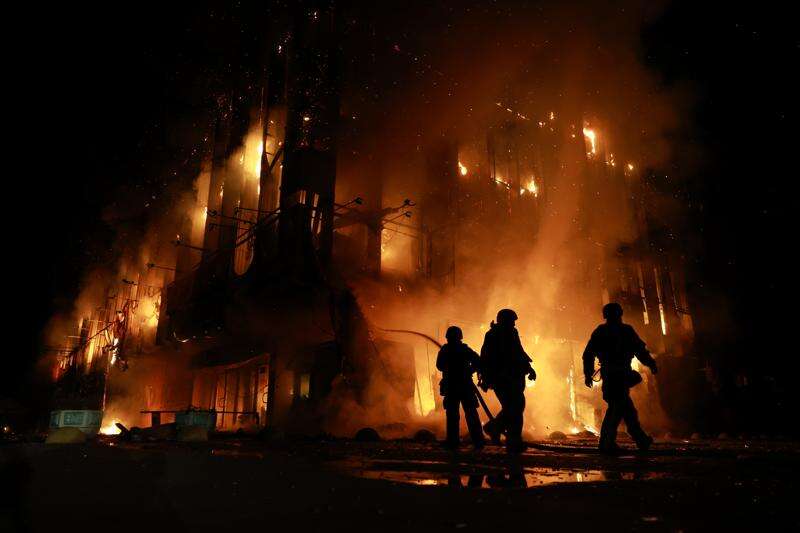
Russian strikes hit cities and villages across Ukraine on Monday, September 21, one day after Ukrainian forces launched more than 1,000 drones toward Russia during the final day of the country’s parliamentary election. Regional officials cited by Reuters reported at least five people killed in Monday’s attacks. The Associated Press reported that late-Sunday strikes damaged apartment blocks, a university and the Intrade shopping center in the southern city of Zaporizhzhia.
The order of events makes Monday’s attack the second half of an unusually large weekend exchange. It does not, by itself, establish the purpose of every strike. Russia’s Defense Ministry said its forces targeted Ukrainian logistics hubs, warehouses, ports and other military-related sites. Ukrainian officials reported damage to homes and civilian buildings. Reuters said it could not independently verify attacks from either side, and noted that both Russia and Ukraine deny targeting civilians.
Why this matters: the exchange compresses three pressure campaigns into one cycle. Ukraine is trying to reach Russian military and energy infrastructure at long range. Russia is continuing large-scale attacks across Ukrainian territory. Both are making interception and targeting claims that cannot be fully reconciled from public reporting. At the same time, political leaders are gathering for the United Nations General Assembly in New York, where they will argue over peace while events on the ground point toward continued escalation.
The human toll across five regions
Reuters reported that regional officials put Monday’s death toll at at least five. Prosecutors in the northeastern Kharkiv region said a drone struck the town of Lozova, killing one person and injuring three. The Associated Press, citing Ukraine’s State Emergency Service, reported that a 45-year-old woman was killed when a drone hit a home and that her 13-year-old son was seriously injured. The two accounts describe the same local toll at different levels of detail; both depend on Ukrainian authorities.
In the Dnipropetrovsk region, a drone killed a driver in a car in Nikopol, according to the regional officials cited by Reuters. In the Donetsk region, a strike badly damaged an apartment building in Kramatorsk and killed one person, while another person was reported killed in a nearby village. In the southern Mykolaiv region, a sustained attack on a village killed a 3-year-old child, regional officials told Reuters.
Zaporizhzhia added a separate injury toll and a visible record of damage. President Volodymyr Zelenskyy said on social media Monday that five people were wounded after apartment blocks, a university and a shopping mall were hit. He also said Russia struck nine other Ukrainian regions. Those figures and target descriptions are attributed to the Ukrainian president; no independent site-by-site assessment covering all ten regions was available in the cited reporting.
Two air-defense totals that measure different attacks
Russia’s Defense Ministry said Russian air defenses downed 244 Ukrainian drones overnight over Russian regions and the Black Sea. Ukraine’s air force said it shot down or suppressed 148 Russian drones in the overnight attack on Ukraine. Neither number has been independently verified.
The figures should not be treated as a score of 244 against 148. They refer to different incoming waves, different air-defense systems and potentially different counting rules. “Downed” can mean a drone was physically destroyed; Ukraine’s phrase “shot down or suppressed” also includes aircraft diverted or disabled through electronic warfare. Public claims rarely disclose how many drones reached targets, were decoys, failed mechanically or were counted more than once across tracking and interception reports.
What the numbers do show is the scale of resources required on both sides. Hundreds of drones force defenders to identify targets, assign interceptors, operate electronic warfare and protect a wide geography at once. Even a high claimed interception rate can coexist with lethal impacts because a small fraction of a large wave can still reach homes, transport nodes or industrial sites. Monday’s reported deaths and the Zaporizhzhia fires are the clearest reminder that aggregate claims do not describe individual outcomes.
From Moscow and the election to Ukraine’s cities
The weekend began with a Ukrainian barrage involving more than 1,000 drones sent toward Russia from Saturday into Sunday, including attacks aimed at Moscow. The attack coincided with the third and final day of Russia’s parliamentary election. Russian authorities reported interceptions and disruption, while Ukraine’s campaign again brought the war’s physical effects closer to the capital and to energy infrastructure.
Monday’s wave across Ukraine does not erase the distinction between the two operations. The Ukrainian barrage was directed into Russia and included pressure on refineries. The Russian attack spread across multiple Ukrainian regions and, according to Russia’s Defense Ministry, focused on logistics, warehouses, ports and other military-related sites. Ukrainian officials’ casualty and damage reports describe consequences in residential areas. Establishing whether any particular civilian site was intentionally targeted would require evidence not contained in the available reports.
Compared with earlier strike rounds, this exchange stands out less because drones are new than because both sides claimed triple-digit defensive totals within the same overnight cycle, immediately after a 1,000-plus-drone Ukrainian operation. The volume makes saturation part of the strategy: a defender can intercept most of a wave and still face damaging penetrations. It also makes retaliation harder to contain because leaders can point to each preceding round as the reason for the next.
Refineries, diesel and Trump’s changing pressure
Ukraine’s long-range campaign against Russian refineries forms the economic background to the weekend attacks. Kyiv’s stated logic is that energy infrastructure supports Russia’s war effort and government revenue. Moscow describes attacks on its territory as terrorism or strikes on civilian infrastructure, depending on the incident. Specific target and damage claims require separate verification.
President Donald Trump called the war “ridiculous” in a Monday social-media post and said Russia had “unfortunately lost control” of its diesel oil production as Ukrainian strikes hit Russian refineries. Earlier in September, Trump urged Ukraine to halt the refinery campaign, citing global shortages and price spikes. His two positions reveal the policy tension: refinery attacks can impose costs on Russia while also affecting fuel supply and prices outside the immediate battlefield.
Zelenskyy responded that Kyiv had offered “dozens of diplomatic proposals” for ending the war, guaranteeing security and preventing another Russian invasion. He said Ukraine’s energy sector, critical infrastructure and food exports must stop being targets, which would lead to matching de-escalation steps by Ukraine. That is Kyiv’s proposed sequence, not an agreed ceasefire framework.
Who benefits, who loses and the argument over pressure
Russia’s government can present Monday’s attacks as proof that it retains the capacity to answer a large Ukrainian operation and strike claimed military-support targets across Ukraine. That message may matter after drones reached toward Moscow during a parliamentary election. The cost is that civilian deaths and damage reported by Ukrainian officials strengthen Kyiv’s case for more air-defense support and additional pressure on Moscow.
Ukraine’s government can argue that the weekend operation demonstrated long-range reach and put pressure on Russia’s refinery system. It also faces the practical cost of a subsequent strike wave across its own regions and the diplomatic challenge of defending a campaign that Trump had earlier urged it to stop. A military gain at a refinery does not protect a home in Lozova or an apartment building in Kramatorsk.
Civilians and emergency workers bear the most direct losses. The reported deaths include a driver and a 3-year-old child; a teenager was seriously injured; rescue workers confronted the fire in Zaporizhzhia. Residents in both countries also absorb transport disruption, alarms and uncertainty even where defenses succeed.
A central criticism of both deep-strike strategies is that repeated large waves make escalation easier to justify and harder to interrupt. Supporters of Ukraine’s refinery campaign argue that pressure on fuel production can constrain Russia’s war capacity. Supporters of Russia’s stated targeting policy say logistics, warehouses and ports are military-related infrastructure. The factual test is not the label each side uses but what was hit, whether the object was a lawful military target, what precautions were taken and what civilian harm followed. The cited reports do not answer those questions for every location.
The risk beyond Ukraine: Moldova and Romania
Moldova’s Ministry of Defense said an aerial object entered Moldovan airspace shortly after midnight and that part of the country’s northern airspace was temporarily closed. The Associated Press reported that drone debris has been found on Moldovan territory in recent weeks and that drone incursions into Romania’s airspace have also increased.
The identity of the object that entered Moldova was not established in the AP report. Electronic jamming can send drones off course, and the reporting did not determine whether the aircraft was Russian or Ukrainian. That uncertainty is itself a security problem: neighboring governments may have only minutes to decide whether an object is lost, hostile or headed elsewhere.
Moldova is not a NATO member; Romania is. An incursion does not automatically mean an intentional attack, and no such intent is established here. But repeated crossings raise the chance of debris causing casualties, air-defense action near a border or a political crisis over attribution. The more aircraft placed in the sky, the greater the burden on regional surveillance and deconfliction.
Diplomacy in New York meets the battlefield
Zelenskyy said Monday that Russia was “not backing down from its escalation” and was sending signals that it was prepared to expand the war. He said Ukraine would use the U.N. General Assembly’s high-level week to discuss how peace could be achieved through joint efforts. Russia has not accepted that characterization of its intentions.
The Ukrainian president said he expected to meet Trump in New York. A meeting would create an opportunity to clarify whether Washington’s immediate priority is pressure on Russia, limits on Ukraine’s refinery campaign, a ceasefire sequence or some combination. Expectations alone do not guarantee that a meeting will occur or produce an agreement.
The diplomatic difficulty is visible in Monday’s chronology. Each government presents its own strikes as connected to military necessity and the other’s as escalation. Trump wants movement toward an end to what he called a “ridiculous” war, yet his refinery remarks acknowledge that battlefield pressure and global energy stability can pull policy in opposite directions. The General Assembly can provide meetings and public commitments; it cannot by itself verify targets, stop launches or enforce a reciprocal pause.
What happens next
Three indicators matter more than the next round of rhetoric. First is the tempo of launches: whether the 1,000-plus-drone weekend and Monday’s triple-digit waves subside or establish a new operational baseline. Second is target selection, especially whether attacks continue against refineries, ports and logistics networks while residential damage accumulates. Third is diplomacy: whether a Trump–Zelenskyy meeting occurs and produces a specific, reciprocal proposal rather than another exchange of public demands.
Regional airspace will be the fourth test. Moldova’s temporary closure and increased incursions reported around Romania show that even attacks aimed within the Russia–Ukraine theater can create decisions for neighboring states. Clear attribution, rapid notification and restraint near borders would reduce the chance that a stray aircraft produces a wider confrontation.
The responsible conclusion is narrower than either side’s narrative. A very large Ukrainian drone barrage was followed by a broad Russian strike wave. Officials reported civilians killed and wounded in Ukraine. Both governments claimed major interception totals, and Russia described its targets as military-related. Independent verification remains incomplete. The immediate strategic result is not a demonstrated advantage for either side, but a faster retaliation cycle entering the same week in which leaders say they will discuss peace.
Sources and reporting notes
- Reuters, September 21: “Five dead in Russian attacks across Ukrainian regions, officials say”
- Associated Press, Samya Kullab, September 21: reporting from Zaporizhzhia and other affected regions
Reporting cutoff: September 21, 2026. Casualty, target and interception figures are attributed to the governments, emergency services and regional officials that reported them. Reuters said it could not independently verify attacks from either side; both Russia and Ukraine deny targeting civilians. This is a fixed reporting snapshot and does not update automatically.