Qantas Sydney New York non-stop flights
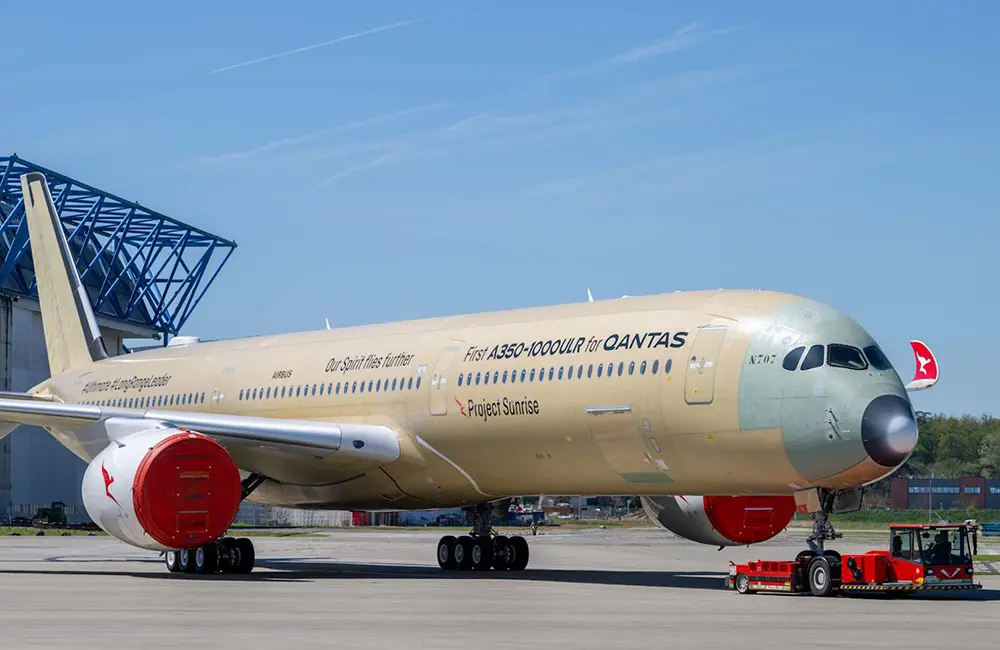
Qantas Sydney New York non-stop flights will begin in mid-2028, the airline announced Wednesday at an event in New York, opening the first non-stop commercial air link between Australia and New York. Tickets are scheduled to go on sale in August 2027. The 9,950-mile journey from Sydney to John F. Kennedy International Airport is expected to take about 18 hours eastbound and around 20 hours westbound, cutting more than three hours from the fastest present one-stop itinerary.
The route is the second confirmed destination in Qantas's Project Sunrise program. Sydney to London is due first, in October 2027; New York follows with the same specially configured Airbus A350-1000ULR. Qantas plans 238 seats across four cabins, an unusually low density for an aircraft of this size, plus a dedicated Wellbeing Zone and a lighting sequence inspired by Australian landscapes to help passengers manage the physical stress of spending most of a day in the air.
Qantas Group chief executive Vanessa Hudson called the announcement a “defining moment” and framed the project as the culmination of the airline's ambition “to conquer the tyranny of distance.” The language is grand, but the strategic problem is plain: Australia is far from the largest pools of business traffic and tourism demand. Qantas is trying to turn that geographic disadvantage into a product competitors cannot easily replicate.
Why Qantas Sydney New York non-stop flights matter
Three hours is not transformative on a short trip. On a trans-Pacific journey, it can be. The current daily Qantas service reaches New York through Auckland on a Boeing 787-9, which means descent, a stop on the ground, another boarding sequence and another climb. A single flight eliminates the vulnerable connection in the middle: no missed onward sector, no terminal transfer, no baggage handoff between legs and no interruption just as a passenger has settled into a long-haul rhythm.
That convenience has a measurable commercial audience. Qantas says intent to book ultra-long-haul flights has risen to 70 percent overall and 80 percent among premium travelers. Demand for its flights into and out of New York has nearly doubled since 2023, while U.S. visitor arrivals to Australia are up 5 percent year on year. Those are company-presented demand signals rather than a guarantee that every 238-seat departure will earn a premium, but together they explain why New York, not a less valuable long-distance market, became Project Sunrise's second destination.
For a time-sensitive traveler, the value is not simply the scheduled hours saved. It is the predictability of a one-seat journey and the ability to work, sleep or recover without a forced midpoint. Qantas is effectively asking corporations and affluent leisure travelers to price the cost of one interruption. If enough of them regard Australia as “one sleep away” from New York, the airline can command a yield that compensates for the fuel, crew and aircraft time consumed by such an extreme mission.
Project Sunrise's second destination completes a decade-long wager
Project Sunrise has been promoted for roughly a decade as a final frontier of scheduled aviation: direct connections from Australia's east coast to London and New York. The sequence now has dates rather than aspirations. Qantas expects its first A350-1000ULR in April 2027, plans to begin Sydney–London non-stop service in October 2027, and says Sydney–New York will start in the middle of 2028 after enough aircraft arrive.
The fleet plan reveals the operational discipline underneath the publicity. Qantas has ordered 12 of the aircraft, but it says it needs five to open New York: two assigned to each of the two Project Sunrise routes and one spare. That spare is not excess. On a schedule built around aircraft being away from base for much of a day, a mechanical problem or late inbound can reverberate across multiple departures. Resilience must be designed into the launch rather than improvised afterward.
The first test aircraft is in the final stages of its flight-test program. In July 2026 it flew from Melbourne to Toulouse without stopping in 24 hours and 24 minutes, a first for a commercial airliner and a demonstration watched online by 3.6 million people. The flight was proof of range and system endurance, not a preview of a passenger timetable. Yet it put a visible marker behind the claim that the hardware can bridge distances that until recently required a fuel stop.
From three stops in 1958 to the first non-stop Australia to New York service
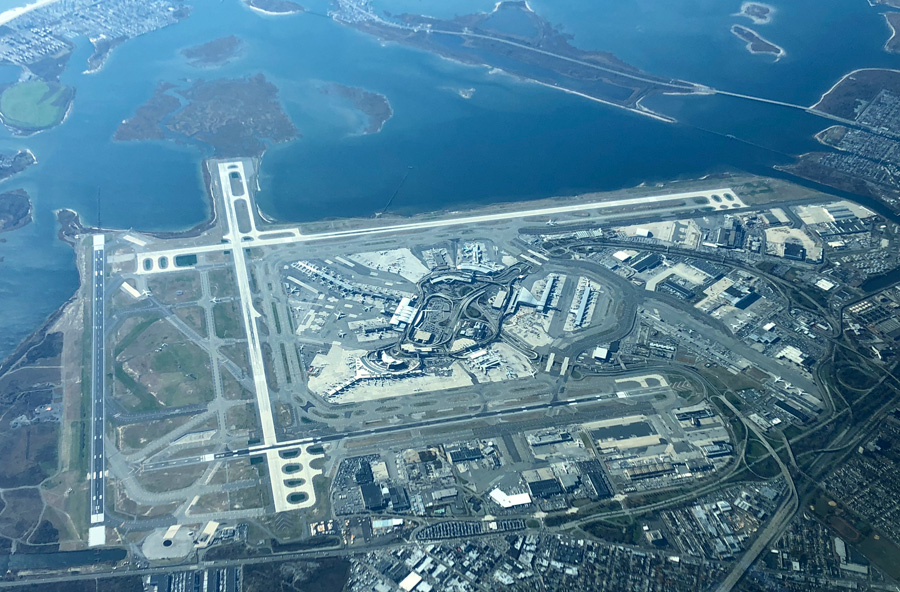
The historical contrast is unusually clean. Qantas first flew to New York in 1958 as part of its inaugural round-the-world service. Passengers reached the city by way of Fiji, Honolulu and San Francisco. Nearly 70 years later, the airline is planning a single flight from Sydney to JFK. The distance has not changed; aircraft range, navigation, crew planning, cabin design and the economics of premium travel have.
Even after the non-stop begins, Qantas says it will retain the existing Sydney–Auckland–New York service. That is a useful reminder that speed is not the only product. The one-stop flight can carry different fare levels, connect New Zealand traffic and provide a fallback when the non-stop's limited inventory is expensive or full. Keeping both services also lets Qantas test whether Project Sunrise creates new demand or merely pulls the highest-paying passengers away from its present route.
Inside the Airbus A350-1000ULR built for endurance
The aircraft is the enabling technology. Qantas's Airbus A350-1000ULR carries an additional 20,000-liter fuel tank, giving it a range of more than 16,000 kilometers and the ability to remain airborne for up to 22 hours. Yet fuel alone does not make a viable 20-hour service. An ordinary high-density cabin would increase revenue seats, but it would also increase weight and intensify the physical challenge for passengers and crew.
Qantas chose 238 seats across four cabins, substantially fewer than many conventional A350-1000 layouts. That makes the aircraft a statement about yield: a larger share of space must earn more revenue per passenger. It also creates room for the Wellbeing Zone, where travelers can stand, stretch and exercise rather than treating the aisle as the only place to move. The zone is a small piece of floor area, but symbolically it acknowledges that ultra-long-haul flying is an endurance event.
The Australian-landscape-inspired lighting program serves the same purpose. Carefully timed light can help cue wakefulness and sleep, but it cannot abolish jet lag or make every body respond identically. Meals, movement, hydration and individual sleep patterns still matter. Qantas's challenge is to make these interventions feel useful rather than cosmetic—and to prove that passengers in every cabin, not only first and business, arrive in meaningfully better condition.
Where the 18-hour Sydney New York flight sits among the world's longest flights
At 9,950 miles, Sydney–New York is expected to rank as the world's second-longest scheduled commercial flight. The only longer service will be Qantas's own 10,573-mile Sydney–London route. Direction matters: winds are why the airline expects roughly 18 hours eastbound and about 20 westbound. A timetable can therefore market one city pair while delivering two noticeably different experiences depending on which way a passenger is traveling.
The comparison with today's itinerary is more important than the record book. Removing a stop trims more than three hours from the fastest current journey, but passengers will spend that saved time inside the same aircraft rather than breaking the trip on the ground. Some will prefer continuity; others will value a chance to walk through a terminal. Qantas is betting that enough customers will choose control and speed over a scheduled pause.
Its evidence includes the existing Qantas ultra long haul routes from Perth to London, Rome and Paris and from Melbourne to Dallas. The airline says these services receive the highest satisfaction scores in its international network. That does not prove a 20-hour westbound sector will satisfy every passenger, but it weakens the argument that long duration alone makes a route unacceptable.
Who wins: Qantas, the business corridor and Australian tourism
Qantas gains the clearest competitive advantage. A carrier that operates the only non-stop can charge for time saved, defend premium corporate accounts and make its home geography part of its brand. The 238-seat configuration concentrates that strategy: fewer passengers, more space and a product built to support higher fares. Success would also make the rest of the 12-aircraft order more valuable by demonstrating that Project Sunrise is a repeatable network proposition rather than a prestige route.
New York–Sydney business travel gains a simpler schedule, particularly for travelers whose destination is the U.S. East Coast rather than a western hub. Australian tourism gains a story that is easier to sell: no stop, one aircraft, one arrival. With U.S. visitor arrivals already reported 5 percent higher year on year, even a modest increment matters to hotels, restaurants, attractions and domestic connections beyond Sydney.
JFK also gains a distinctive long-haul link, while Airbus gets a showcase for the A350-1000ULR's range. The Melbourne–Toulouse 24-hour test flight gave the aircraft technical theater; a reliable commercial schedule will matter more. The winner that receives less attention is the passenger who currently avoids Australia because the journey feels too fragmented. Project Sunrise is designed to convert that psychological barrier into a straightforward purchase.
Who loses—and why the Auckland flight is staying
The most exposed traffic is the premium passenger currently routed through Auckland, Los Angeles or San Francisco. Rival one-stop carriers can still compete on price, schedules, loyalty benefits and onward connectivity, but they lose the cleanest claim: fastest way between Sydney and New York. Auckland may lose some through-passenger spending and the operational value attached to being Qantas's midpoint, although the retained one-stop service protects New Zealand-origin demand.
Qantas itself faces cannibalization. If the non-stop merely moves high-yield customers off Auckland without attracting new travelers or higher fares, the airline will have added complexity rather than created value. Retaining both products lets it segment the market, but two overlapping services also require careful capacity management. The crucial question is whether the network can fill the non-stop's premium seats without hollowing out the 787-9 route.
The critics' case: comfort, emissions and access
The strongest criticism is physical. Twenty hours in a pressurized cabin is not a neutral experience. A Wellbeing Zone provides a place to move, but access can become constrained when many passengers want it, and a lighting plan cannot remove fatigue. Travelers in economy will judge the service by seat comfort, cabin movement, meal timing and how they feel on arrival—not by the novelty of holding a distance record.
There is also an environmental question. Flying non-stop removes the fuel burned in an additional takeoff and landing and avoids a detour, but an ultra-long sector must carry fuel to transport fuel over thousands of miles. The low-density layout spreads the flight's total emissions across only 238 passengers. Qantas has not supplied enough detail in Wednesday's announcement to settle an emissions-per-passenger comparison with the one-stop alternative, so confident claims in either direction would run ahead of the evidence.
Access is the third issue. A bespoke aircraft with extensive premium space must produce premium revenue. If fares are set far above one-stop options, Project Sunrise may be historic without being broadly accessible. That would not necessarily make it a commercial failure; airlines routinely build products around customers with high willingness to pay. It would, however, complicate the promise that non-stop flying fundamentally changes travel between two countries rather than chiefly improving it for an affluent segment.
Qantas New York tickets in August 2027 will reveal the real strategy
The next decisive moment is not the first flight but the first fare. When Qantas New York tickets go on sale in August 2027, the gap between non-stop and one-stop pricing will show how aggressively the airline intends to monetize time. Premium-cabin prices will reveal whether the route is being positioned as a rarefied flagship; economy availability will show how much of the wider market Qantas believes it can capture.
Before then, the first aircraft is expected in April 2027 and Sydney–London is scheduled for October. That first Project Sunrise route will supply operational lessons on crew patterns, ground time, passenger behavior and reliability. New York launches only after Qantas has five A350-1000ULRs, giving London several months to expose weaknesses before the second city joins the system.
What could still change before mid-2028
The timeline depends on certification, aircraft deliveries and a test program that is still being completed. Delays in any one of those areas can affect both London and New York because the opening plan requires a precise fleet count. Fuel prices also matter: a route with exceptional fuel exposure can look different if energy costs rise sharply between the ticket launch and first departure.
Three scenarios now stand out. In the strongest, deliveries arrive on time, London proves the operating model and New York launches with enough premium demand to sustain attractive fares. In the middle case, the route begins as announced but Qantas adjusts frequency, inventory or the balance between non-stop and Auckland service. In the downside case, certification or delivery delays push the start beyond mid-2028 and erode the advantage of announcing early.
For travelers, the practical watchpoints are simple: April 2027 for the first aircraft, October 2027 for Sydney–London, August 2027 for New York fares and mid-2028 for the inaugural service. For investors and competitors, the deeper signals will be reliability, premium-cabin load factors and whether the Auckland flight remains commercially healthy after the non-stop enters the market.
The distance becomes the product
Qantas is not making Sydney and New York closer in any literal sense. It is removing the interruption that has defined travel between them. That distinction is the essence of Project Sunrise: distance is no longer only a penalty to endure, but a scarce capability the airline can package and sell.
The wager will be judged after the celebration, when five aircraft must sustain two of the longest routes in commercial aviation and 238 people at a time decide what a missing stop is worth. If the operation is reliable and the fare premium holds, Qantas will have turned the “tyranny of distance” into a moat. If comfort, cost or delays overwhelm the advantage, the record will remain impressive while the business case narrows.
Related coverage
Read our report on the FAA outage that disrupted Northeast flights, our analysis of the second NATS outage and UK cancellations, and our Samarkand travel guide.
Sources
- Concrete Playground: Qantas Sydney to New York non-stop flights coming mid-2028
- One Mile at a Time: Qantas's 9,950-mile Sydney–New York A350 flights
- Fly Stay Points: Qantas confirms non-stop Sydney to New York flights from 2028
- TravelMedia.in: Australia to New York, non-stop
- 50SkyShades: Qantas advances Project Sunrise
- Economy Class & Beyond: Qantas sets its second Project Sunrise destination
- LinkedIn News Australia: Qantas unveils 18-hour NYC flight
Reporting basis: Fixed September 23, 2026 snapshot. Launch dates, times, distance, fleet details and demand figures are based on Qantas's announcement as reported by the linked outlets. Analysis and scenarios are identified as such.