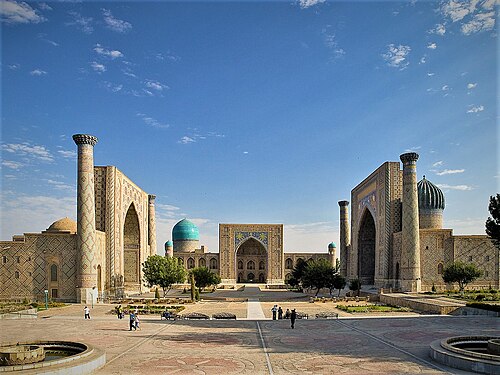
Why Samarkand, why now
The 46th FIDE Chess Olympiad runs from September 15 through 27, 2026, bringing a record 398 teams — up from 380 in Budapest in 2024 — around 2,000 players and more than 200 national federations to Samarkand. The United States entered as the top seed, India second and host Uzbekistan third, led by Javokhir Sindarov and Nodirbek Abdusattorov. A 41-team Olympiad for People with Disabilities and the 97th FIDE Congress are taking place alongside the main event.
The setting is part of the story. Samarkand was the capital of Timur's empire in the 14th and 15th centuries and has more than two and a half millennia of Silk Road history. The tournament places contemporary Uzbekistan's global ambitions inside a city built from earlier networks of trade, scholarship and power.
The essential sights
The Registan is the defining square, framed by the Ulugh Beg Madrasa, built from 1417 to 1420; the Sher-Dor Madrasa, from 1619 to 1636; and the Tilya-Kori Madrasa, from 1646 to 1660. Plan to see it twice: in daylight, when the tilework is legible, and after dark, when the complex is floodlit. Reported admission is about 50,000 Uzbek som, roughly $4. Arrive before 9 a.m. or after 4 p.m. for softer light and fewer groups.
Shah-i-Zinda is a lane of 11 mausoleums built between the 11th and 19th centuries around the shrine associated with Qusam ibn-Abbas. Its blue tilework is among the richest in the Islamic world. Published visitor guidance lists daily hours around 7 a.m. to 7 p.m. and admission around 40,000–50,000 som, but hours and prices can change; allow two to three hours and verify locally. It remains an active religious site, so cover shoulders and knees and move quietly.
Pair the monumental Bibi-Khanym Mosque, generally opening around 8 a.m., with the neighboring Siab Bazaar. Add Gur-e-Amir, Timur's mausoleum, and the remains of Ulugh Beg's Observatory for the city's scientific history. With a third day, consider Shahrisabz, about 90 minutes south by road.
How to get there
For many international visitors, the simplest route is to fly into Tashkent and take the Afrosiyob high-speed train to Samarkand. The journey is about two and a half hours, with trains capable of speeds around 130 mph. Seats can sell out in busy periods, especially around a major event, so booking ahead matters. Samarkand station is roughly ten minutes by taxi from the Registan; the Yandex app is widely used for local rides.
Uzbekistan offers visa-free entry to many nationalities, while others can apply for an e-visa reported at about $20 with processing commonly taking two days. Rules depend on citizenship and can change, so check the current official requirement before travel. The currency is the Uzbek som, or UZS. ATMs are widespread in central areas, but small-denomination cash is useful at markets and smaller sites.
When to go and how long to stay
April to May and September to October offer the most comfortable conditions, often in the 60s and 70s Fahrenheit. Summer temperatures can exceed 100°F; winter is cold but comparatively quiet. Two full days cover the central monuments without turning the city into a checklist. Three days allow a slower pace or the Shahrisabz excursion.
During the Olympiad, September 22 is the scheduled rest day and therefore the obvious sightseeing window for participants and spectators — also a reason to expect the headline sites to be especially busy. Visitors arriving after the tournament closes on September 27 may find the same early-autumn weather with fewer event-related constraints.
Safety, etiquette and what to bring
Uzbekistan is generally regarded as one of Central Asia's safer destinations for visitors, but ordinary precautions still apply: keep valuables secure, use established transport and confirm official advice before departure. At mosques and mausoleums, dress modestly, remove shoes where requested and ask before photographing people or worship.
Bring sun protection, broken-in walking shoes, a refillable bottle, modest layers and small cash. Uzbekistan uses 220-volt electricity and European-style two-pin plugs, so many travelers will need an adapter. The old city rewards walking, but uneven stone and summer heat make footwear and water more than minor details.
Why this matters
Uzbekistan is using sport as a tourism strategy. Samarkand hosted the 2023 World Rapid and Blitz championships; the 2026 Olympiad is much larger and gives the country nearly two weeks of sustained global exposure. The challenge is converting event viewers and participants into return visitors without flattening a living city into a backdrop.
Chess itself makes the setting unusually apt. Forms of the game traveled through the same broad networks that made the Silk Road a conduit for ideas as well as goods. Staging the largest Olympiad in history where caravans once rested turns a modern mega-event into a kind of homecoming.
Who gains, who loses
Hotels, guides, restaurants, transport operators and craftspeople gain from the event's immediate demand and from the destination marketing that follows. Travelers benefit from improved connections and international attention to visitor infrastructure.
The pressure points are familiar to heritage cities: congestion, rising prices and wear on monuments that cannot absorb unlimited foot traffic. Residents gain most when investment extends beyond a tournament zone and when conservation, public space and everyday transport improve with visitor numbers rather than being displaced by them.
What happens next
The Olympiad closes September 27, with departures scheduled for September 28. Late September and October combine favorable weather with post-event availability, making them a practical window for travelers less interested in the competition itself.
The longer test is whether Uzbekistan can turn event tourism into sustained visitor growth. Watch hotel occupancy and rail capacity after the delegations leave, and whether preservation funding keeps pace with promotion. A successful strategy will make Samarkand easier to reach without making its greatest sites harder to experience.
Sources
FIDE, "Invitation: 46th Chess Olympiad, 3rd FIDE Chess Olympiad for People with Disabilities & FIDE Congress 2026": Read the invitation
World Chess, "Chess Olympiad 2026: Everything You Need To Know," September 2026: Read the guide
Wikipedia, "46th Chess Olympiad": Read the overview
Seeking the Now, "Your Ultimate Guide to the Shah-i-Zinda": Read the guide
Charlie's Wanderings, "12 Spectacular Things To Do In Samarkand Uzbekistan": Read the guide