Two Detained in Germany Over Poland Starlink Fire as Warsaw Blames Russia
Track it live: Ukraine war map — live tracker
The Poland Starlink fire case crossed a border on Monday. Poland's interior minister, Marcin Kierwinski, its special services minister, Tomasz Siemoniak, and its national police chief, Marek Boron, announced in Warsaw that German services had detained two citizens of Turkey in Germany in connection with the fire that gutted the power system of a Starlink ground station in the village of Wola Krobowska, in Poland's Mazovia region, on the night of September 23-24. According to Polish reporting of the announcement, the arrests were carried out by Germany's Federal Criminal Police Office, the BKA, working from material assembled by Polish police counter-sabotage units together with the Internal Security Agency (ABW) and Polish prosecutors. The two men are being held in Germany and, Polish police said, await transfer to Poland under a European Arrest Warrant.
Warsaw did not present the detentions as an ordinary arson investigation. Kierwinski said the two would face charges in Poland of carrying out sabotage on the instructions of a foreign intelligence agency. Poland's National Prosecutor's Office, as reported by Polish media, describes an investigation covering acting on behalf of a foreign intelligence service against Poland, diversion, and an offence of a terrorist character, with a stated suspicion that the perpetrators acted on the orders of Russian special services. Prosecutors believe the intended target was larger than one building: the suspected aim, they say, was to disrupt the operation of the Starlink system in Poland and in other states of Central and Eastern Europe, and to cause property damage on a large scale. Prime Minister Donald Tusk, posting on X on Monday, called the fire another act of hybrid war and said those responsible for the sabotage would answer before Polish courts.
What happened in September
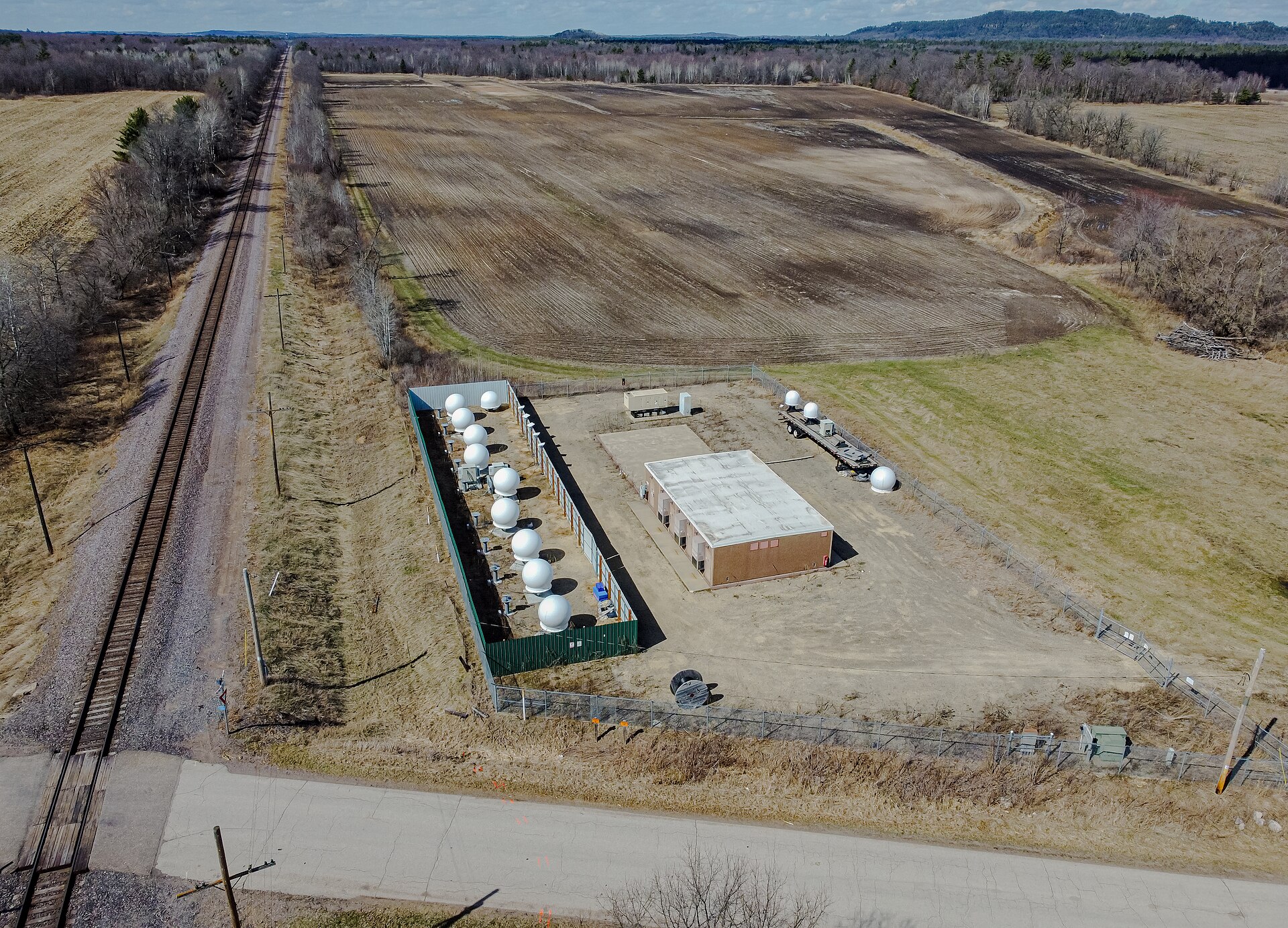
The station at Wola Krobowska, roughly 200 miles from Poland's border with Ukraine, is a ground gateway: a fenced compound of antennas, a power supply and a backup generator that routes internet traffic between SpaceX's Starlink satellites and the terrestrial network, including traffic to and from Ukraine. On the night of September 23-24 it caught fire. The blaze engulfed the power system and the backup generator — the two components a gateway can least afford to lose. Nobody was reported hurt, and Polish officials said at the time that the systems were back in operation, but the shape of the damage convinced investigators quickly that this was not an electrical accident. Deputy Prime Minister Krzysztof Gawkowski said in September that the fire was deliberately designed to disable the station and cut internet access for institutions including the Ukrainian military, and the ABW opened a sabotage investigation within days. Our September report covered that first phase: a government treating an unexplained fire at a satellite station as an act of war by other means, before it could say whose act it was.
What Monday added is people. Until this week, Poland's case was an inference from a burn pattern and a target selection. It is now, at least in Warsaw's telling, a chain: a fire, an investigation that identified two suspects, material passed to German police, arrests on German soil, and a planned extradition into a Polish courtroom. The suspects' names, ages and alleged individual roles have not been released, and Polish officials have not publicly laid out the evidence — communications, payments, travel records or forensic material — connecting the two men either to the fire or to any intelligence service. That gap matters, and it is where the story now splits into what is established and what is asserted.
Warsaw's accusation, and Moscow's answer
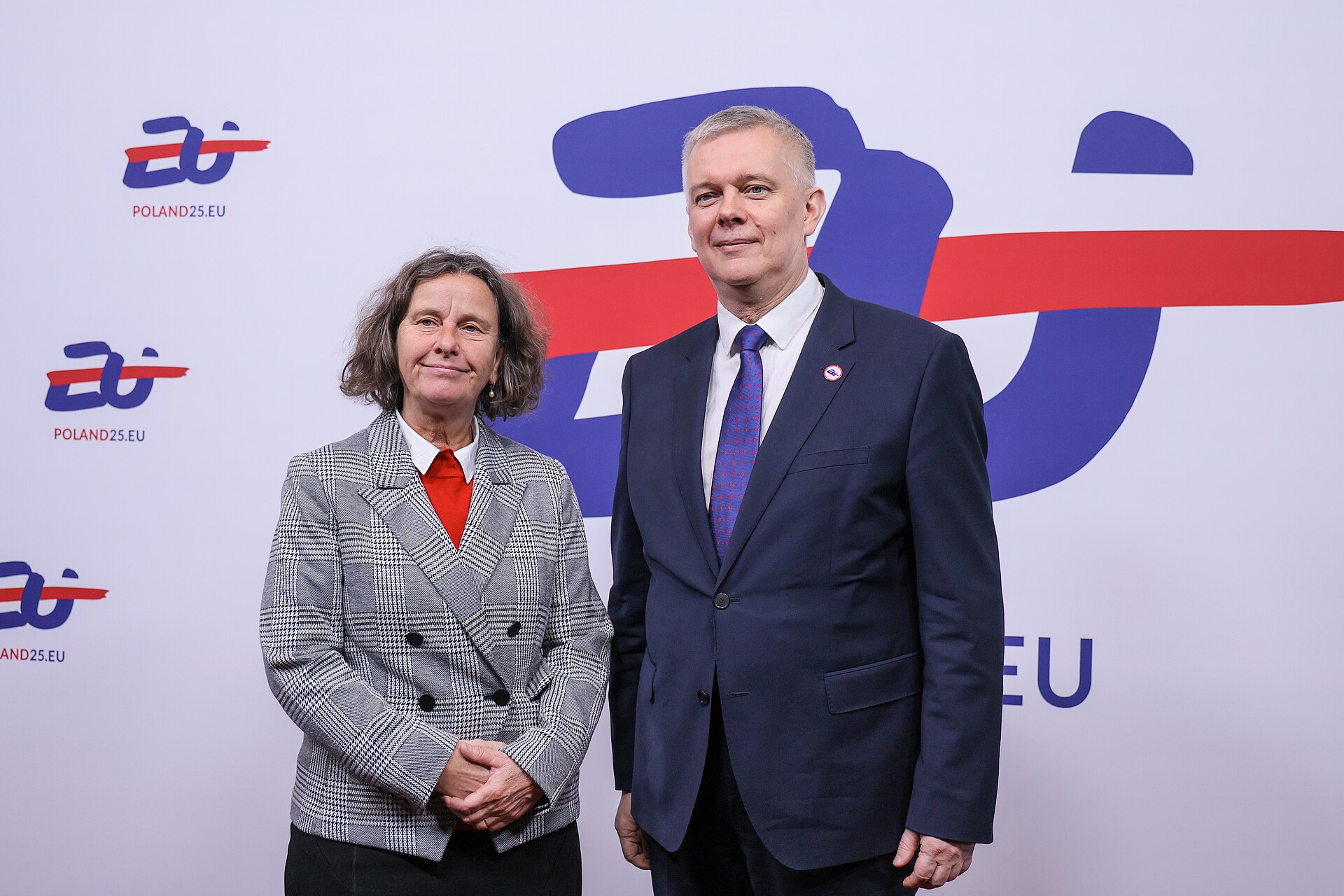
Siemoniak, the minister who coordinates Poland's special services, left no room for ambiguity about where Warsaw believes the order came from. Polish officials have no doubt, he told the news conference, that Russian services are behind the act of sabotage — and he added a detail that may outlast this case: that Russian services are increasingly turning to individuals linked to the criminal underworld to carry out such work. That recruitment pattern, using proxies with no formal connection to the state, has been described by security officials in several European countries investigating fires, parcel bombs and vandalism aimed at Ukraine-linked logistics over the past two years. It offers the sponsor distance and deniability, and it offers investigators a harder chain to prove.
Russia's position, for the record, is denial. The Russian embassy in Warsaw did not immediately respond to Reuters' request for comment on Monday's announcement. Moscow has repeatedly rejected European sabotage accusations in general, describing them as baseless and as anti-Russian hysteria — a formulation Reuters noted again in its Monday report. No Russian official has commented on these two detentions specifically, and neither man detained in Germany has been convicted of anything: they are suspects, entitled to the presumption of innocence, and the Polish account of Russian direction remains, at this stage, an allegation that a court would have to test against evidence not yet shown in public. Readers should hold both halves of that sentence at once, because Polish officials are clearly asking their allies to act on the first half before the second half is resolved.
Why this matters
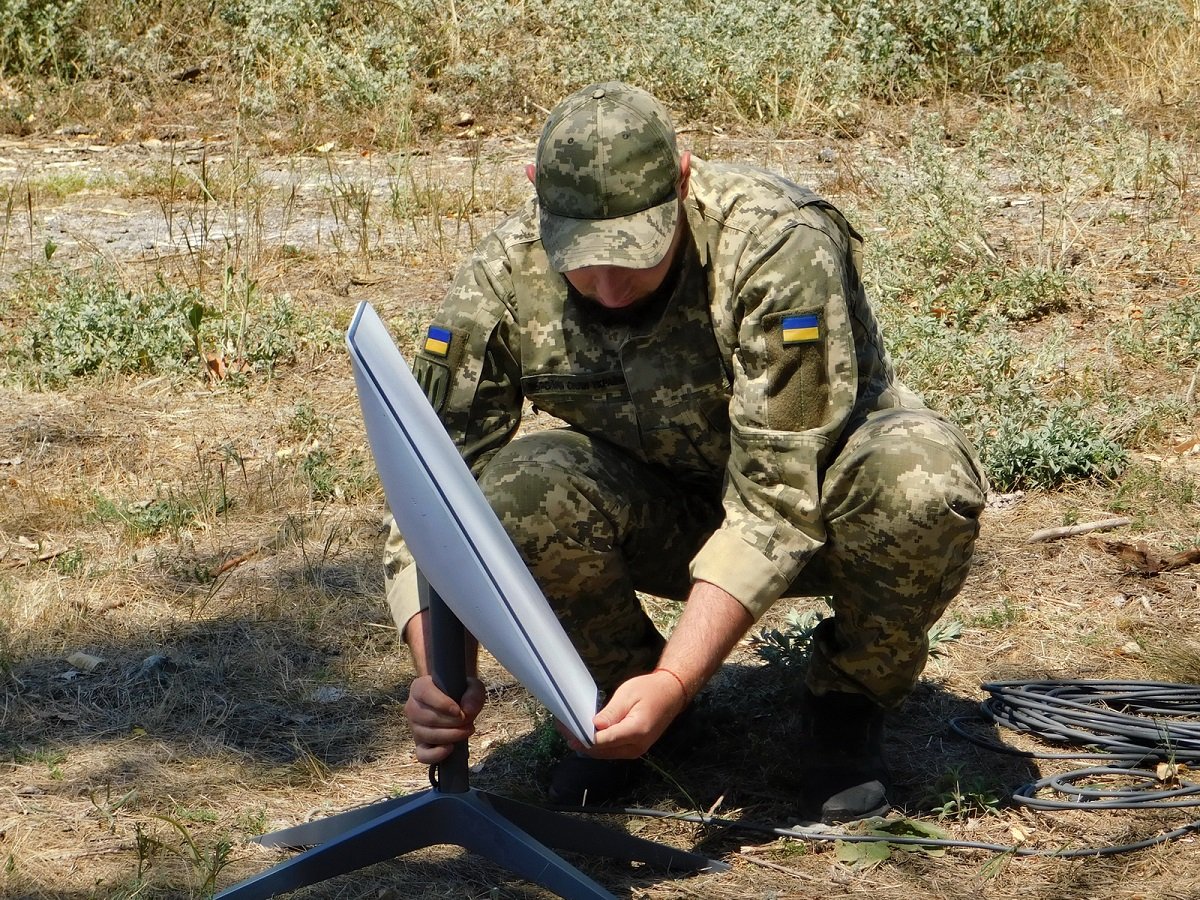
Start with the physics of the target. Satellites are hard to attack; the ground stations that feed them are not. A Starlink gateway is a fixed, findable site whose critical machinery — power distribution and a generator — sits at ground level, and Ukraine's war effort runs through this infrastructure. Starlink was switched on over Ukraine in the first days of Russia's full-scale invasion in 2022, Poland has said it pays for Ukraine's Starlink subscription, and Ukraine's armed forces now rely on tens of thousands of terminals for battlefield communications and some drone operations. Knocking out one gateway does not silence that network — traffic reroutes, and this station was restored — but the arithmetic of sabotage is not about one night's outage. It is about forcing an ally to spend money and manpower guarding every fence line, warehouse and generator between the Baltic and the Carpathians, and about reminding voters in those countries that supporting Ukraine carries a domestic price.
The second reason this case matters is legal, and it is the genuinely new part. Europe's hybrid-war debate has produced many attributions and few courtrooms. Incidents are announced, blamed and denied, and then absorbed into a general warning. A prosecution is different: it requires evidence that survives cross-examination, and it converts an intelligence assessment — "we have no doubt" — into findings a judge has signed. If Poland's case reaches trial with the Russian connection intact, it becomes the reference prosecution for the proxy-sabotage era, the one other capitals cite. If it collapses, or if the Russian link quietly drops out of the charge sheet, it becomes the reference for the opposite argument: that hybrid-war attribution runs ahead of proof. Either outcome will be used. Warsaw, by announcing the arrests at ministerial level with the prime minister amplifying them the same day, has raised the stakes of its own investigation considerably.
The numbers, in context
The timeline is worth laying out plainly, because it shows both the capability and the limits of the response. The fire burned on September 23-24. The arrests came on October 12, nineteen days later, in a second country, executed by that country's federal police on the first country's evidence — a speed that European counter-sabotage cooperation has often promised and rarely demonstrated. Against that, set the scale asymmetry: the target was one station among the gateways serving a network of tens of thousands of Ukrainian terminals, the damage was repaired, and the alleged instrument was not a missile or a hacking unit but two men and, prosecutors suspect, a fire. Hybrid operations are cheap to mount and expensive to defend against; the cost-exchange ratio, not the single outage, is the strategic fact. Siemoniak's remark about criminal-underworld recruitment points the same way: a sponsor who can rent arsonists does not need to risk officers, and a defender who arrests the arsonists has still not reached the sponsor.
Who gains, who loses, and what critics say
Warsaw gains the most, if the case holds. Poland is Ukraine's principal logistics corridor and has argued within the EU and NATO that the hybrid campaign is a single theatre with the war itself; a prosecuted sabotage case on Polish soil, aimed at infrastructure serving Ukraine's army, is that argument made tangible. Ukraine gains a precedent that attacks on its connectivity are treated as attacks on the alliance's own infrastructure. Germany gains quietly: the BKA's role demonstrates the cross-border machinery working. The losers, if the charges prove out, are the two men in custody — and, in reputational terms, Moscow, which loses a layer of deniability each time a proxy case reaches a courtroom.
The critical questions are real, and they come from lawyers and sceptics rather than from Moscow's statements. Polish officials have not said what the two men are alleged personally to have done — set the fire, scouted the site, driven a car — nor published the evidence of Russian tasking. Recruiting through criminal networks, the very pattern Siemoniak described, is precisely the pattern that makes the final link hardest to prove: a payment chain that ends in cash or cryptocurrency may establish that someone paid, without establishing who. There is also a proportionality question European governments are debating openly: how to respond to a campaign designed to stay below the threshold of armed attack, when each individual incident — a fire, a cut cable, a parcel — looks small and the pattern looks like war. Denmark's intelligence service warned in September that it expects the Russian hybrid campaign to escalate in the coming months; Monday's arrests will be read in that frame whether or not the court case is finished before the next incident arrives.
What happens next
The immediate path is procedural. Under the European Arrest Warrant, German courts will decide on transferring the two men to Poland; contested surrenders can take weeks. In Poland they would be formally charged, and the National Prosecutor's Office will have to decide how much of the intelligence material behind Siemoniak's certainty can be shown in open court. Watch for three signals: whether the charge sheet, as filed, names the foreign-intelligence element or retreats to arson and property damage; whether further arrests follow, in Poland or elsewhere, since a two-man team with a cross-border support structure is rarely the whole structure; and whether Warsaw carries the case into EU and NATO forums as evidence for collective counter-hybrid measures — funding for infrastructure protection, shared watchlists for proxy recruitment, or a common attribution standard. Russia's formal response, absent on Monday, will also set a tone: silence, a demand for consular access to be someone else's problem, or a counter-accusation. The fire at Wola Krobowska was small. What is now being built on top of it — a prosecution, an alliance argument, and a public claim about how Russia fights its shadow war — is not.
Related coverage
Sources
Reuters, "Poland says two Turkish nationals detained in Germany over Starlink station fire" (Oct 12, 2026), https://www.reuters.com/world/poland-says-two-turkish-nationals-detained-germany-over-starlink-station-fire-2026-10-12/ ; USA Today, "Poland accuses Russian intelligence of sabotaging Elon Musk's Starlink" (Oct 12, 2026), https://www.usatoday.com/story/news/world/2026/10/12/poland-accuses-russian-intelligence-of-sabotaging-elon-musks-starlink/92223528007/ ; Polsat News reporting via Rydzyna24, "Suspects in Starlink station arson detained in Germany" (Oct 12, 2026), https://rydzyna24.pl/z-kraju/podejrzani-o-podpalenie-stacji-starlink-zatrzymani-w-niemczech-jnqd ; Rzeczpospolita reporting via DigitalNexus, "Arson of Starlink station in Mazovia: two Turks detained in Germany" (Oct 12, 2026), https://digitalnexus.pl/polska/podpalenie-stacji-starlink-na-mazowszu-w-niemczech-zatrzymano-dwoch-turkow/ ; Kresy.pl, "Two Turks detained over Starlink station arson in Poland — Tusk: an act of hybrid war" (Oct 12, 2026), https://kresy.pl/wydarzenia/dwaj-turcy-zatrzymani-za-podpalenie-stacji-starlink-w-polsce-tusk-akt-wojny-hybrydowej/