Philippines largest POGO bust 2026
- Philippines largest POGO bust 2026
- POGO raid Zamboanga Sibugay
- Anti-POGO Act of 2025
- POGO human trafficking investigation
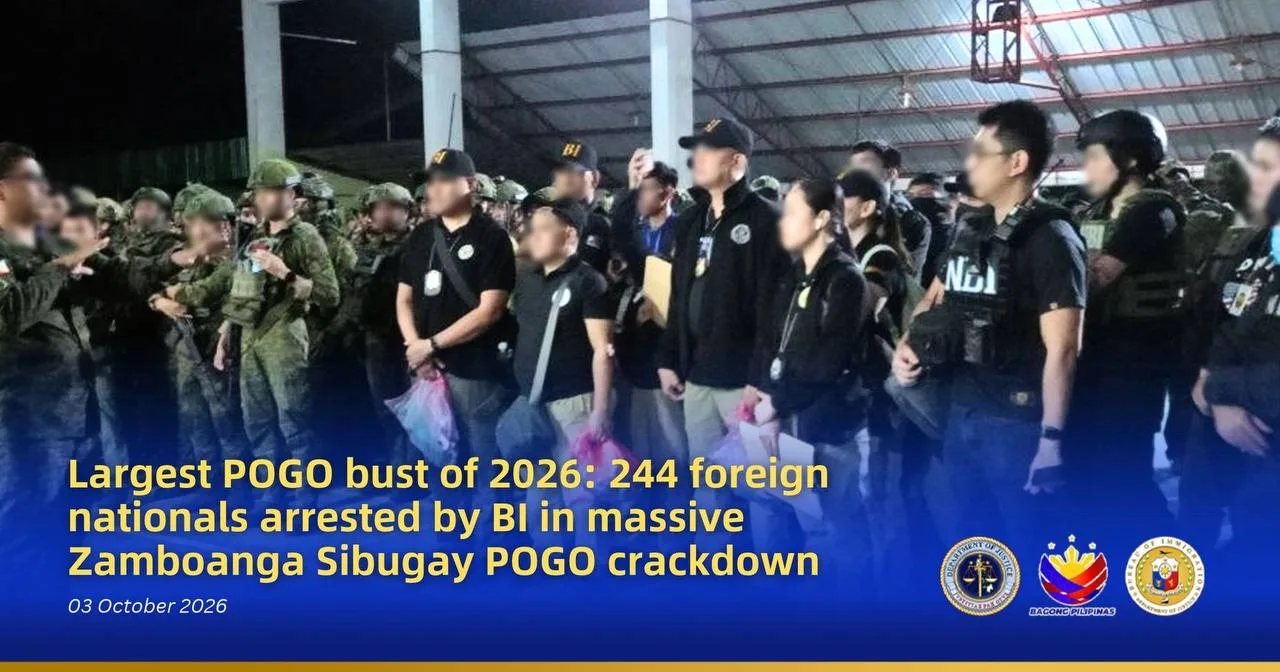
The Philippines largest POGO bust 2026 unfolded far from the capital on October 2, when the Bureau of Immigration, working with the National Bureau of Investigation and the Armed Forces of the Philippines, moved simultaneously on suspected offshore-gaming operations in two Zamboanga Sibugay communities. Agents apprehended 244 foreign nationals — most of them Chinese — in Barangay Kimos in Siay and Barangay Tandiong Muslim in Alicia.
The official breakdown is unusually precise. The Siay operation produced 113 detainees: 110 Chinese nationals, two Cambodians and one Hong Kong national. In Alicia, authorities apprehended another 131 people, described as mostly Chinese, alongside nationals from Malaysia, Indonesia and Myanmar. The Bureau of Immigration's Alien Registration Division is still checking identities and nationalities, an important qualification in a case where immigration status will shape what happens next.
At the Casa de Coco Pension House compound, authorities recovered roughly 3,000 mobile phones, 78 computer monitors, laptops, cellular SIM cards and other technical equipment believed to have been used for online scams. The inventory does not by itself establish what every person did. It does, however, point to something much more organized than a few individuals working informally from rented rooms.
Why this matters
This is where a policy declaration becomes an enforcement test. Executive Order No. 74, issued in 2024, ordered an immediate ban on Philippine offshore gaming operations. Republic Act No. 12312, the Anti-POGO Act of 2025, then prohibited offshore gaming operations and the establishment or operation of POGO sites. A ban written in Manila is only as strong as the state's ability to detect and dismantle activity after operators change names, move equipment or relocate beyond the capital's glare.
The geography is therefore as consequential as the arrest count. Zamboanga Sibugay is in Mindanao, far from the office towers and gated compounds that once made POGO a highly visible metropolitan controversy. A large operation there suggests that pressure in one region can disperse activity into another. The raids send a clear message to syndicates: distance from Manila is not immunity, and provincial compounds are not guaranteed safe havens.
For the Philippine state, credibility now rests on what follows. Confiscating hardware and detaining people is the visible phase. Proving immigration violations, tracing organizers, identifying local facilitators and separating possible trafficking victims from willing participants are the harder tasks. A dramatic raid can disrupt a site; only careful casework can show whether the network behind it has been dismantled.

What is POGO — and how we got here
POGO stands for Philippine offshore gaming operator. The sector grew around online gambling businesses serving customers outside the Philippines, particularly in mainland China. That distinction mattered legally and commercially: the operations were based in the Philippines, but their games and customers were offshore.
Over time, the POGO label became entangled with a broader set of concerns about illegal online activity, immigration violations and human trafficking. Those concerns drove the shift from regulation toward prohibition. Executive Order No. 74 in 2024 ordered the immediate ban; the Anti-POGO Act of 2025 gave the policy a statutory foundation by outlawing offshore gaming operations and POGO sites.
The Zamboanga Sibugay case shows why the question “what is POGO in the Philippines?” can no longer be answered only with reference to gambling websites. Investigators are now confronting compounds whose equipment may support other online schemes. The institutional problem is not merely closing a licensed industry that has been banned. It is finding the networks, workers, devices and money flows that remain after the formal business model disappears.
That broader context also makes the human-trafficking inquiry essential. The Bureau of Immigration says it is coordinating with other law-enforcement agencies regarding possible trafficking-related violations. Investigators are examining whether some detainees may themselves have been subjected to exploitation, coercion or restricted movement. Those possibilities are not side issues; they determine whether a person should be treated primarily as an immigration offender, a witness or a victim.
The numbers: what 3,000 phones and 78 monitors tell us
Three thousand phones divided by 244 detainees works out to roughly 12 devices per person. That ratio is not proof of a particular scam. It is, however, consistent with the hardware footprint associated with industrialized online deception: many accounts, many identities, rapid message turnover and constant contact with potential targets across platforms and borders.
Phone-heavy operations can support SIM farms and so-called “phone farms,” including romance and investment fraud commonly described as pig-butchering schemes. The 78 monitors, laptops and SIM cards add another layer. Together, they suggest a workflow built around teams, account management and technical coordination rather than casual gambling by customers at a pension house.
The Casa de Coco compound also matters as an operating environment. Concentrating people and devices at one site can make supervision easier, communications faster and movement more controllable. That same structure can serve criminal management while also creating conditions in which workers are monitored or coerced. Hardware explains scale; it does not explain consent. Investigators will need interviews, digital evidence and employment records to tell those stories apart.
The multinational makeup of the detainees — involving people identified initially as Chinese, Cambodian, Malaysian, Indonesian, Myanmar and Hong Kong nationals — points to the cross-border character of the suspected operation. Recruitment, financing, technical management and victims can all sit in different jurisdictions. That is why a Bureau of Immigration POGO crackdown is necessarily also a regional organized-crime problem.

Who benefits, who loses
The immediate beneficiary is Philippine state legitimacy. A government that banned POGOs must be able to show that enforcement reaches beyond the capital and beyond operators who remain easy to see. Potential scam victims around the world also benefit whenever a high-capacity site is interrupted and its devices are taken offline.
Regional cooperation stands to gain as well. The nationalities involved span several ASEAN states, while the large Chinese presence creates a practical opening for cooperation with China on cross-border crime. No single country can map a network whose workers, victims, communications and financial routes cross multiple borders. Evidence-sharing and victim referrals matter more than public claims of a one-off victory.
The obvious losers are organizers and syndicates that invested in the compound, equipment and recruitment pipeline. Local enablers may also face scrutiny: landlords, brokers, transporters or others who knowingly helped sustain illegal operations. But the category “worker” cannot safely be treated as synonymous with “criminal.” Some detainees may have knowingly joined illegal operations; others may have been deceived, trafficked or prevented from leaving.
That leads to the central question critics will ask: were the detained people screened carefully as possible trafficking victims before deportation proceedings advanced? The government can enforce immigration law and investigate trafficking at the same time, but only if agencies share information and avoid a one-size-fits-all disposition. Deporting a victim without documenting coercion could erase evidence and protect the recruiters who built the operation.
A second question is whether the ban is eliminating POGO-linked crime or merely moving it. The location of this bust suggests geographic dispersion. If enforcement concentrates on known urban compounds while networks move into remote municipalities, the map changes without the enterprise disappearing. The lesson of Siay and Alicia is that future enforcement must follow equipment, connectivity, recruitment and financial patterns — not yesterday's addresses.
What happens next
The 244 foreign nationals are under investigation for several alleged immigration violations: working without proper visas under Section 37(a)(7) of Commonwealth Act No. 613, undesirability linked to illegal POGO-related online activity, undocumented status and, in some cases, illegal entry. The Bureau of Immigration says they will undergo deportation proceedings. Once deportation orders are issued, their names are expected to be placed on the blacklist, barring re-entry.
Those administrative steps are only one track. The BI's coordination with law enforcement on possible human-trafficking violations could produce different outcomes for different people. Victim identification may reveal coercion, restricted movement or exploitation. Digital forensics may clarify who controlled the devices, which accounts were used and whether managers at the compound linked to a larger network.
Immigration Commissioner Joel Viado framed the operation as a continuing commitment: “We will continue to enforce our immigration laws against foreign nationals who violate the conditions of their stay and ensure that the Philippines is not used as a base for illegal activities.” The credibility of that pledge will be measured not just in the next raid, but in the clarity of the prosecutions, deportations and trafficking determinations that emerge from this one.
The wider regional implication is equally stark. Banning a business category does not automatically dissolve the infrastructure or personnel around it. Networks can fragment, rebrand and relocate. The Philippines has now shown it can find one large suspected hub in Mindanao. The next test is whether investigators can use the phones, SIM cards, computers and testimony to identify the organizers and stop the operation from simply reappearing somewhere else.
Related coverage
- Philippines-China Batanes maritime dispute: Manila rejects Beijing's claim
- Duterte ICC trial: court admits protected witness statement
- Philippines DOJ finalizes Quiboloy extradition petition