US · New York · Transit
One disabled train in a Hudson River tunnel snarled NJ Transit’s Monday evening commute at Penn Station — delays of up to an hour for the worst-hit trains, 35 trains affected in an independent tally, and thousands of commuters stranded on the concourse on the first weekday regular schedules returned after five weeks of detours. No injuries were reported.
NEW YORK, November 16, 2026 — A single disabled train in one of the Hudson River tunnels brought the evening commute at Penn Station to a crawl on Monday, delaying NJ Transit trains in and out of New York by up to an hour, cancelling others outright, and stranding thousands of commuters on the concourse — on the very first weekday that regular schedules returned after five weeks of detours. No injuries were reported.
NJ Transit issued its first alert at 7:41 p.m. ET, warning that trains into and out of Penn Station New York were subject to delays because of a disabled train in one of the Hudson River Tunnels — the pair of century-old, single-track tubes under the river that carry every NJ Transit and Amtrak train between New Jersey and Manhattan. At the peak of the disruption, the railroad warned of delays of up to 30 minutes across the system, while some individual trains ran as much as 60 minutes late.
What happened, hour by hour
The first alert landed at 7:41 p.m. ET, in the thick of the evening peak, when Penn Station's concourses are at their fullest and the departure boards turn over every few minutes. As the disabled train blocked one of the two tunnel tubes, trains in both directions had to be threaded through the single remaining tube — a bottleneck that turns one stalled train into a system-wide queue within minutes.
An independent tally by the transit-tracking site njt.live counted 35 trains affected by the disruption, with four cancelled or cut short, over an incident window running from about 7:41 p.m. to 8:50 p.m. ET. Among the cancellations was Northeast Corridor train #3735. NJ Transit has not said why the train became disabled, and no cause should be assumed: the agency's alerts identified the problem only as a disabled train in the tunnel.
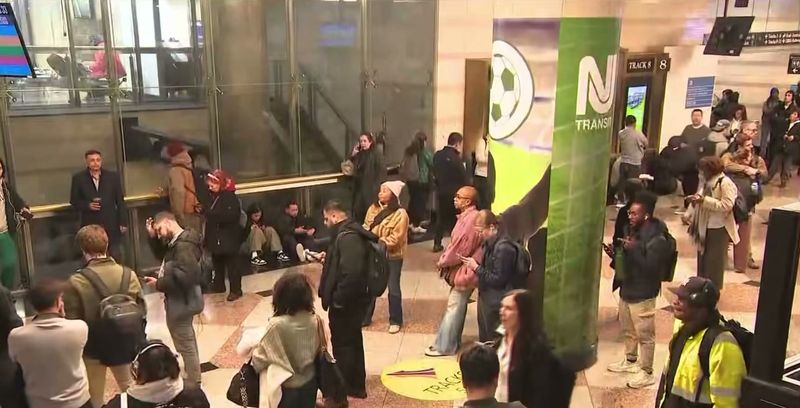
By 10:04 p.m. ET, NJ Transit said service was operating on or close to schedule, with residual delays — the long tail of a bad evening, as late trains and displaced crews worked their way back into the pattern. For the commuters who had spent the peak hours watching the boards, sitting on the concourse floor, or crowding around the NJ Transit pillars in the station, the recovery came too late to salvage the commute home.
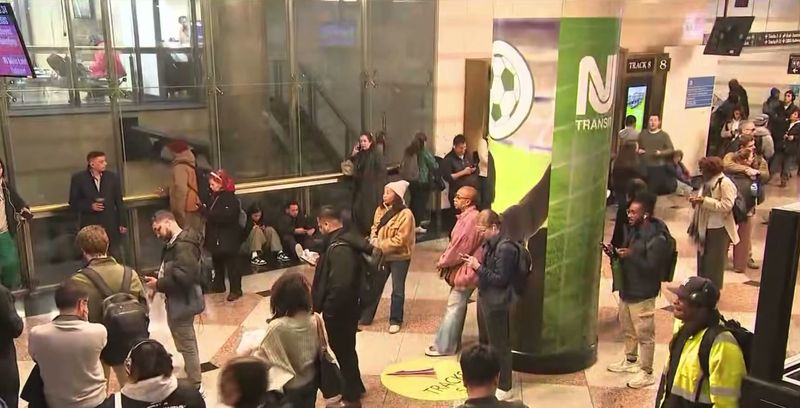
On the concourse, the scene was the familiar choreography of a Penn Station meltdown. Commuters packed the NJ Transit waiting areas shoulder to shoulder, eyes fixed on the departure boards, phones in hand, some giving up on standing altogether and settling onto the floor with their bags beside them. Footage from inside the station showed crowds stretching past the Track 8 gates as each new alert pushed departure times further back. It is a scene New Jersey riders know well — and one they had particular reason to resent on Monday, the day the detours were supposed to be over.
The numbers behind the meltdown
The figures tell the story of a system with no slack. NJ Transit's own alerts put system-wide delays at up to 30 minutes; the worst individual trains ran up to an hour behind. The independent njt.live tally — 35 trains affected, four cancelled or cut short, in a window of barely more than an hour — shows how quickly a single blockage propagates when every train in both directions depends on the same two tubes. One disabled train did not just delay its own passengers; it consumed the capacity of the busiest rail crossing in the region at the busiest hour of the day.

Why this matters
Monday's disruption was not a freak event so much as a stress test the region keeps failing. The North River Tunnels opened in 1910 — 116 years ago — and they remain just two single-track tubes feeding Penn Station. There is no third tube, no alternate rail route under the Hudson, and no spare capacity at the peak. When one tube is blocked, the railroad does not have a degraded option; it has half a railroad, asked to carry a full evening's demand.
That fragility is the central fact of New York–New Jersey commuting, and Monday night demonstrated it again in miniature: a single train, a single tube, and within the hour the delay figures were being counted in dozens of trains. Every commuter standing on that concourse was, in effect, waiting on infrastructure designed before the First World War to absorb a failure it was never built to absorb.
The first day back
The timing sharpened the frustration. Monday was the first weekday of restored regular NJ Transit schedules after the five-week Portal North Bridge cutover, the construction project that had sent Midtown Direct trains on detours to Hoboken for five weeks. That morning, those trains returned to Penn Station, and riders returned with them — back to the station, back to the routines the cutover had suspended.
By evening, the homecoming had curdled. The first full day of the restored service ended with the region's commuters learning, again, that the weakest link in the trip home is not the bridge work just completed but the tunnels that have carried the load since 1910. The cutover was temporary by design; the tunnel constraint is permanent until something replaces it.
What happens next
The long-term answer on the table is the Gateway Program, whose new Hudson River tunnels would finally give the corridor the capacity the 1910 tubes cannot — allowing the old tubes to be repaired without throttling the region every time something goes wrong. Until those tunnels exist, the arithmetic of Monday night does not change: two tubes, one failure away from a ruined commute, at the mercy of the oldest infrastructure on the busiest corridor.
In the short term, NJ Transit riders will be watching Tuesday's commute for aftershocks — and the agency for any explanation of what disabled the train. None had been offered by late Monday. What Monday already established is simpler, and it is the question every stranded commuter was asking on the concourse: how many more evenings like this one the 116-year-old tunnels have left in them.
There are two ways the coming years can go. In one, Gateway's new tubes arrive on something like their planned schedule, the 1910 tunnels finally get a partner instead of a prayer, and nights like Monday become rarer and shorter. In the other, the old tubes keep carrying the full load deep into their second century, and the region keeps re-running Monday's experiment — one disabled train, one blocked tube, a concourse full of people sitting on the floor — whenever the machinery of 1910 decides to remind everyone how old it is. Monday night was not the worst version of that failure. It was simply the latest proof that the margin for error under the Hudson is already gone.
Reporting based on NJ Transit's official service alerts for the evening of November 16, 2026, and the independent incident tally published by njt.live. Social-media posts described the incident in stronger terms — including claims of two trains stuck in the tunnel — that NJ Transit's account does not support; the agency attributes the disruption to one disabled train, and this article follows the official account.
Sources
NJ Transit, official service alerts for the evening of November 16, 2026 (first alert 7:41 p.m. ET; service operating on or close to schedule, with residual delays, by 10:04 p.m. ET) · njt.live, independent incident tally for the disruption (35 trains affected, four cancelled or cut short, incident window about 7:41–8:50 p.m. ET; Northeast Corridor train #3735 cancelled).