Overnight fighting along the southwestern border between Pakistan and Afghanistan left at least 13 Afghan Taliban personnel dead, Islamabad said Friday, in a claim Kabul immediately denied. It was the sharpest ground escalation between the two neighbors in months, capping a week in which drones were intercepted, airstrikes were launched, and both capitals hardened their language — and it left behind the one thing that has become the hallmark of this conflict: two irreconcilable stories about the same night.
Pakistan’s Information Ministry said in a post on X that its forces had repelled what it called an “attempted Afghan aggression” in the Gulistan sector of Qila Abdullah district, in southwestern Balochistan province. “As per actual facts, an attempted Afghan aggression in the Gulistan sector was thwarted on night 24/25 September and during the process and subsequent heavy punishment inflicted on opposing Taliban posts, at least 13 Afghan Taliban personnel were killed and several injured,” the ministry said. It also rejected as “fake and fabricated” an Afghan claim that a Pakistani post near the southern Afghan border town of Spin Boldak, opposite the Pakistani city of Chaman, had been destroyed.
In Kabul, Afghanistan’s Defense Ministry told the opposite story: its personnel had destroyed a Pakistani post on Thursday, it said in a post on X, and Afghan forces had suffered no casualties. It described Pakistan’s account of the fighting as false.
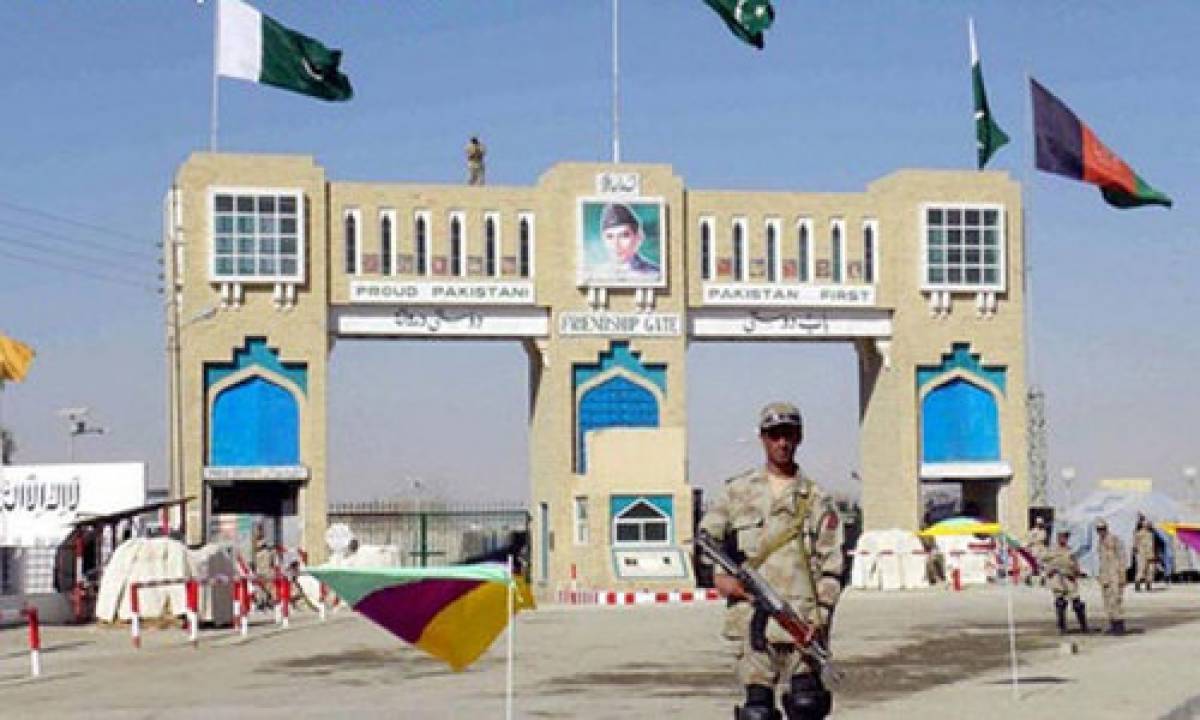
What is not in dispute is that heavy weapons were fired for hours. Residents in Chaman said the exchange of fire continued for hours on Thursday night. Pakistan’s Information Ministry posted videos it said showed Pakistani troops firing artillery at Afghan positions. The Associated Press, which reported the claims from both sides, said it could not independently verify the footage or the casualty claims by either side. An uneasy calm prevailed along the border Friday, with no new fighting reported.
What we know — and what nobody can prove
Strip the dueling communiqués down and the verified core is thin but significant: an artillery and small-arms engagement took place on the night of September 24–25 in the Gulistan sector of Balochistan’s Qila Abdullah district, audible in Chaman; both governments say the other side struck first; both claim victory; neither claim can be independently confirmed. The AP’s inability to verify either account is not a footnote — it is the story’s central fact.
Pakistan’s version has one more layer of specificity: an attempted incursion, a thwarted attack, and retaliatory fire against Taliban posts, with a precise toll of “at least 13” killed and “several injured.” Kabul’s version is vaguer — a destroyed Pakistani post, zero Afghan casualties, no numbers offered — but vagueness is not falsity. What is certain is that each government’s domestic audience heard a story of its own forces prevailing. In information terms, the night was a draw at 1–1, played in front of two entirely different crowds.
Why this matters
This is the most serious ground engagement on the Pakistan–Afghanistan border since the major clashes of February, and it arrives at a moment when the entire escalation ladder — drones, airstrikes, artillery, competing X-post casualty claims — is being exercised at once. The danger is not that either side wants a full war. It is that the machinery of deniable, unattributable, unverifiable violence has no governor on it.
Consider the geography. Qila Abdullah and Chaman sit in Balochistan, the province that hosts the heart of the China–Pakistan Economic Corridor. Gwadar, the corridor’s crown jewel, is hundreds of kilometers to the south, but instability anywhere in Balochistan reverberates through Beijing’s calculations about the security of its investments — and through Islamabad’s already-frayed relationship with a province where separatist violence simmers in parallel with the Afghan frontier. A border war and a separatist insurgency in the same province is a two-front security problem Pakistan can afford to ignore in neither.
Then consider the timing. The clash unfolded while Pakistani diplomats were at the UN General Assembly in New York, where Foreign Minister Ishaq Dar has been working the diplomatic circuit — including Organization of Islamic Cooperation channels — on the Afghanistan file. The contrast is the point: the negotiating track and the firing track are running simultaneously, which means each side believes it can negotiate better with guns still warm. That is rational statecraft right up until the moment it isn’t.
A week of escalation, step by step
The Gulistan battle did not come from nowhere. The sequence of the past days reads like a rehearsal for exactly this kind of confrontation:
Earlier this week, Pakistan said it intercepted and shot down eight drones that entered its airspace from Afghanistan — four in areas near the Torkham border, four in the mountainous areas around Kohat. Kabul denied launching any drone attack. On Tuesday, Pakistan responded with what Information Minister Attaullah Tarar described as precision air and drone strikes at 10 locations inside Afghanistan, aimed at drone launch sites and militant infrastructure. Thursday, Balochistan officials were already warning that any infiltration attempt toward Qila Abdullah from Afghanistan would receive a strong response — Babar Yousafzai, an adviser for media to Balochistan’s Home Department, said Pakistan would not tolerate violations of its territorial sovereignty. Thursday night, the guns opened up in the Gulistan sector.
This is the pattern the February clashes established: provocation, denial, retaliation, competing casualty claims, calm — then a repeat, each cycle slightly hotter. In February, Pakistan said 12 of its soldiers and 274 Taliban were killed while the Taliban said 13 of its fighters and 55 Pakistani soldiers died; the Taliban also reported 19 civilians killed and 26 wounded in Khost and Paktika; Pakistan’s Defence Minister Khawaja Muhammad Asif declared that “our cup of patience has overflowed” and described the fighting as “open war.” Reuters could independently verify none of the February claims either. The fog is not a bug of this conflict. It is the terrain on which it is fought.
Two capitals, two wars
The information war deserves analysis as a weapon in its own right. Pakistan’s Friday messaging was maximalist and multimedia: a formal ministry statement, a numbered body count, released combat footage, and the flat accusation that the Taliban are “habitual liars.” Kabul’s was minimal but pointed: we destroyed your post, we lost nobody, your account is false. Both approaches serve domestic politics perfectly. Pakistan’s military gets to demonstrate vigilance and firepower after a bruising stretch — the Kohat Police Lines attack, one of the deadliest of 2026, is still fresh in public memory. The Taliban government gets to project calm competence to its own constituency while denying Islamabad the propaganda victory of a confirmed toll.
The loser in this arrangement is the truth, and that is not a philosophical point — it is a strategic one. When casualty claims can never be verified, each side can credibly tell its public that it is winning, which lowers the domestic cost of the next escalation. Both governments are, in effect, subsidizing the war with propaganda, and the subsidy never runs out. Analysts of the February round noted the same dynamic: unverifiable claims on both sides meant nobody paid a political price for fighting, so nobody had a political reason to stop.
There is also the question of who actually pulled the triggers. Pakistan’s stated grievance is specific and longstanding: that the Pakistani Taliban (TTP) — a distinct organization from the Afghan Taliban, waging an insurgency against the Pakistani state since 2007 — operates from sanctuaries on the Afghan side of the Durand Line. Kabul denies harboring them. The ambiguity is structural: the Afghan Taliban government’s relationship with the TTP is opaque, its control over border fighters is incomplete, and every denial preserves room for both cooperation and defiance. Thursday night’s battle may have involved regular forces on both sides, border militias, or some mix — and the official statements are designed to leave that unanswered.
Who benefits, who loses
The short-term winners: Pakistan’s military establishment, which can show a public rattled by the Kohat attack that the western border is defended with heavy weapons and no hesitation; and, perversely, the TTP, for whom every Pakistani strike inside Afghanistan and every artillery duel is recruitment material for the narrative that Islamabad is the aggressor. Kabul’s leadership also banks a domestic win: standing up to Pakistan plays well with an Afghan public that has never accepted the Durand Line.
The losers: the civilians of Chaman, Qila Abdullah, and the Afghan districts across the line, who slept — or didn’t — through hours of artillery fire; the traders and truckers who depend on the Chaman–Spin Boldak crossing, a commercial lifeline that freezes with every escalation and thaws slowly; and the already-thin prospect of counterterrorism cooperation between two capitals that cannot agree on who fired first. Also losing: China’s patience. Beijing has repeatedly pressed Islamabad to secure Balochistan for CPEC; every flare-up on the Afghan frontier is a reminder that the corridor runs through a province under stress from two directions at once.
Strategically, nobody benefits. That is the tragedy embedded in every round of this cycle: both governments are playing to domestic audiences while the underlying problem — militants operating across a disputed, porous border that one side does not recognize and the other cannot fully seal — remains untouched by artillery and press releases alike.
The numbers behind the spiral
- 13: Afghan Taliban personnel Pakistan says were killed on the night of September 24–25 — a figure Kabul calls false and the AP could not verify
- 10: locations inside Afghanistan Pakistan says it struck with precision air and drone attacks earlier this week, per Information Minister Attaullah Tarar
- 8: drones Pakistan says it intercepted and shot down entering its airspace from Afghanistan — 4 near Torkham, 4 around Kohat
- Hours: how long residents of Chaman said Thursday night’s exchange of fire continued
- 274 vs 55: the wildly contradictory death tolls from the February round — Pakistan claimed 274 Taliban killed; the Taliban claimed 55 Pakistani soldiers dead; Reuters verified neither
- 2,640: approximate kilometers of the disputed Durand Line, the colonial-era boundary Afghanistan has never formally recognized — the geographic fact underneath every clash
Context: The TTP has been waging an insurgency against the Pakistani state since 2007, and cross-border attacks have risen sharply since the Taliban’s 2021 return to power in Kabul. Pakistan has repeatedly carried out strikes inside Afghanistan — each one deepening the diplomatic freeze. The pattern is now a full cycle: drone incursions, denials, retaliatory strikes, artillery exchanges, competing casualty claims, and a calm that lasts until the next round.
What happens next — three scenarios
Managed de-escalation through back channels
The most likely outcome, historically. Both sides have now demonstrated resolve — Pakistan with heavy weapons and a body count, Kabul with defiance and a counter-claim. The standard playbook from February and earlier rounds is a quiet cooling period, possibly with Gulf intermediaries carrying messages, while the UNGA diplomacy track gives both capitals a face-saving forum. Islamabad’s engagement with OIC channels this week suggests it prefers the diplomatic track once the military point is made.
Continued tit-for-tat, each round slightly bigger
The cycle is already running: drones, then airstrikes at 10 locations, then an artillery battle. The structural risk is that deniability — the ambiguity that keeps things small — eventually fails. An artillery shell lands on a village in Qila Abdullah, a drone hits a populated area, or a verified casualty list emerges, and domestic pressure forces a response neither capital currently wants. The February precedent, when a defence minister used the words “open war,” shows how quickly rhetoric can outrun control.
A larger Pakistani operation inside Afghanistan
If another mass-casualty attack on the scale of Kohat occurs, the pressure on Islamabad to act “decisively” will be enormous. Pakistan has struck inside Afghanistan before in limited operations, but a bigger operation risks drawing in a Taliban regime that has shown — in February and again on Thursday night — that it will fire back. That is the road to a genuine border war, and both militaries know it. The one wildcard that could accelerate this scenario: if Kabul’s denials harden into open defiance and Islamabad concludes the diplomatic track is exhausted.
The bottom line
Thirteen claimed dead, zero admitted dead, hours of artillery, and two governments that cannot agree on who attacked whom. The Pakistan–Afghanistan conflict is not the world’s most watched confrontation — it lacks the cameras of Gaza or the geopolitics of Ukraine — but it is one of its most combustible: two states, a disputed 2,640-kilometer border, a resilient insurgency, and an escalation ladder with no agreed rules and no independent referee. Thursday night’s battle did not start this cycle, and it will not end it. But the tempo is quickening — drones, airstrikes, artillery, all within a week — and quickening tempos are how accidental wars begin.
Sources
- Associated Press via LA Post: Pakistan says 13 Afghan Taliban personnel killed in overnight border clash; Kabul denies the claim
- The News: Pakistan says 13 Afghan Taliban personnel killed after border aggression thwarted in Gulistan sector
- Terror Monitor: Pakistani security forces foil alleged border incursion in Balochistan
Read our earlier coverage: Pakistan shoots down eight Afghan drones as the border war escalates, Pakistan retaliates with airstrikes on Afghan drone launch sites, and Pakistan–Afghanistan airstrikes: the escalation so far.
Reporting cutoff: September 25, 2026 at 3:05 p.m. PDT. The casualty figures and the sequence of the overnight fighting are attributed to the Pakistani and Afghan governments respectively; Kabul denies Pakistan’s account and Pakistan rejects Kabul’s. Neither account has been independently verified. Analytical judgments are identified as Signal Post News analysis.