Operation Free Skid Row
Federal agents and Los Angeles police launched synchronized dawn raids and a roughly 100-vehicle street sweep, charging 28 defendants with trafficking fentanyl, methamphetamine and other drugs around Skid Row.
Operation Free Skid Row brought federal and local officers into downtown Los Angeles in two waves Thursday, arresting 23 of 28 people charged in federal criminal complaints with drug trafficking in and around Skid Row. The FBI, Drug Enforcement Administration, Bureau of Alcohol, Tobacco, Firearms and Explosives, and Los Angeles Police Department took part in the takedown, which authorities described as an opening move rather than a one-day show of force.
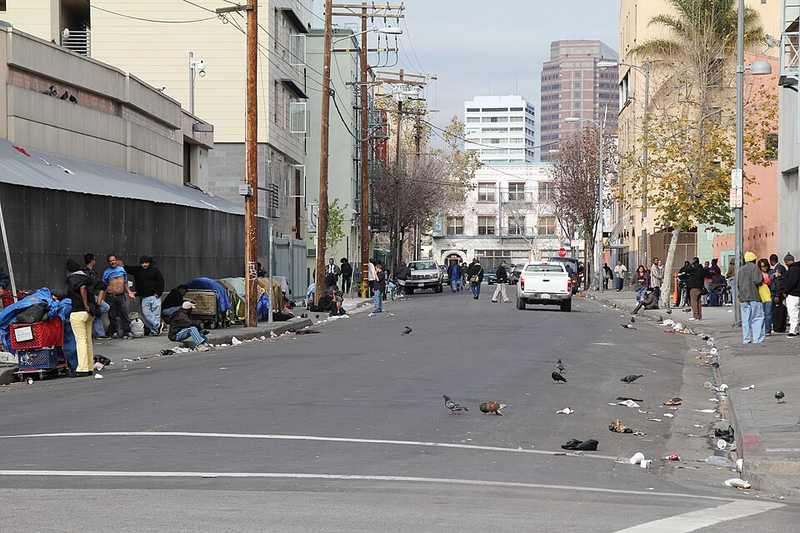
What happened Thursday
The first wave began before sunrise at five locations. FBI SWAT vehicles converged on a Pasadena home tied by investigators to Manuel Vaughns, an alleged cocaine dealer. Officers used flash-bang devices while clearing the property, and four people were called out. The complaints also name alleged figures including “Popeye” of Watts, Irigia Bowman, 58, of Los Angeles, and Kevin Fountain, 38, of Helendale. All are defendants, and the allegations have not been proven in court.
By midmorning, a convoy described in on-scene reporting as roughly 100 law-enforcement vehicles moved into Skid Row. Officers cordoned off blocks and parks identified as drug hot spots, arrested street-level suspects and searched locations covered by warrants. Authorities reported finding a gun in one tent and seizing drugs, firearms and luxury vehicles during the broader operation.
The U.S. Attorney's Office for the Central District of California said 28 people were charged in federal criminal complaints and 23 were arrested. Some defendants were listed as residents of communities outside downtown, including West Covina and Studio City, underscoring prosecutors' argument that the networks serving Skid Row do not begin and end on its sidewalks.

The playbook inside the tents
The complaints and reporting describe an adaptable retail system designed to blend into the neighborhood. Prosecutors allege that dealers sold from a Mercedes, storefronts and tents; used single-room-occupancy units and low-income housing as stash points; and, in some cases, presented themselves as homeless-service workers or social workers. Some tents that looked like shelter were allegedly used as sales points.
Investigators reportedly built the cases with intercepted calls, undercover officers and drone surveillance. That combination matters because it suggests the government is pursuing networks and suppliers, not merely people encountered with small quantities on the street. It also ensures that the surveillance methods, warrant affidavits and chain of evidence will receive close scrutiny in court.
The distinction between an allegation and a finding is essential here. A criminal complaint states the government's case at the charging stage; each defendant is presumed innocent unless proved guilty. That principle is especially important in a neighborhood where poverty, addiction, informal commerce and organized trafficking often occupy the same few blocks.
Why Skid Row, why now
Skid Row covers roughly 50 blocks in downtown Los Angeles and is home to as many as 6,000 unhoused people. Reporting cited by the operation's planners says the area has historically accounted for about one-fifth of the city's drug arrests. For law enforcement, that concentration makes it both a humanitarian emergency and a market where predatory sellers can find a steady stream of highly vulnerable customers.
The timing also fits a broader federal strategy. Thursday's sweep follows a similar operation around MacArthur Park earlier in 2026 and arrives as Los Angeles prepares for the World Cup and the 2028 Olympics. Federal officials can argue that disrupting open-air drug markets improves safety for residents, service workers and businesses. Critics will ask whether the same resources are being committed to treatment, housing and due-process safeguards after the cameras leave.
U.S. Attorney Bill Essayli framed the action as a beginning: “It's a massive effort. We're going after the dealers who prey on the homeless. This is just the first salvo.” The phrase raises the central test. A first salvo implies follow-through — more cases, more prosecutions and a plan for what fills the space when a market is displaced.
Who wins, who loses
The law-enforcement case
Residents who have endured violence, theft and the daily threat of fentanyl contamination stand to benefit if the operation removes dealers with access to larger supplies and firearms. Outreach workers may also gain breathing room when service sites are not shadowed by sellers. The strongest case for the sweep is narrow and practical: target people accused of exploiting vulnerable residents, preserve evidence and prosecute them in open court.
The civil-liberties and harm-reduction concern
The risk is that a large tactical footprint sweeps up people whose primary condition is homelessness or addiction, disrupts trusted outreach and moves the same market a few streets away. Flash-bangs, drones, tent searches and block-wide cordons invite legitimate questions about proportionality, warrant scope and collateral harm. Civil-liberties advocates will watch whether searches were individualized and whether seized property belonged to charged defendants rather than bystanders.
The political balance
Federal muscle in a heavily Democratic city carries its own symbolism, especially before the World Cup and Olympics. If the prosecutions are evidence-driven and followed by treatment access, the operation could become a model for coordinated enforcement. If arrests become the visible endpoint while supply and addiction remain unchanged, it will look like a costly reset button that leaves the neighborhood with the same crisis.
What happens next
The arrested defendants will move through initial appearances and arraignments, where prosecutors must support detention requests and defense lawyers can begin testing the complaints. Five charged defendants remained outside Thursday's arrest count, leaving fugitive searches and additional warrants likely. Any indictment would then replace the initial complaints and define the charges that proceed toward trial.
Three outcomes are plausible. The strongest for authorities is a durable disruption in which supplier links are prosecuted and follow-up enforcement prevents quick replacement. A mixed result would see convictions in individual cases but a new group refill the same retail spaces. The weakest would be suppression disputes or evidentiary gaps that narrow the cases while street supply returns.
The wider drug-enforcement context is not confined to downtown. Signal Post News has also examined the U.S. strike on an alleged drug vessel in the Eastern Pacific and the arrest of Bolivia's attorney general in a drug-bribery sweep. Together, the cases show how the anti-narcotics campaign reaches from street distribution to international supply and corruption allegations.
For Skid Row, however, the meaningful measure is local: fewer overdoses, less coercion and safer access to shelter and services. Arrest totals show the operation's scale. They do not yet show whether the neighborhood will be freer after it.
Sources
- U.S. Attorney's Office, Central District of California — October 8, 2026 release
- New York Post with California Post on-scene reporting
- Fox News video report
Charges and allegations described in this report have not been proved in court.