North Korea missile launch October 2026
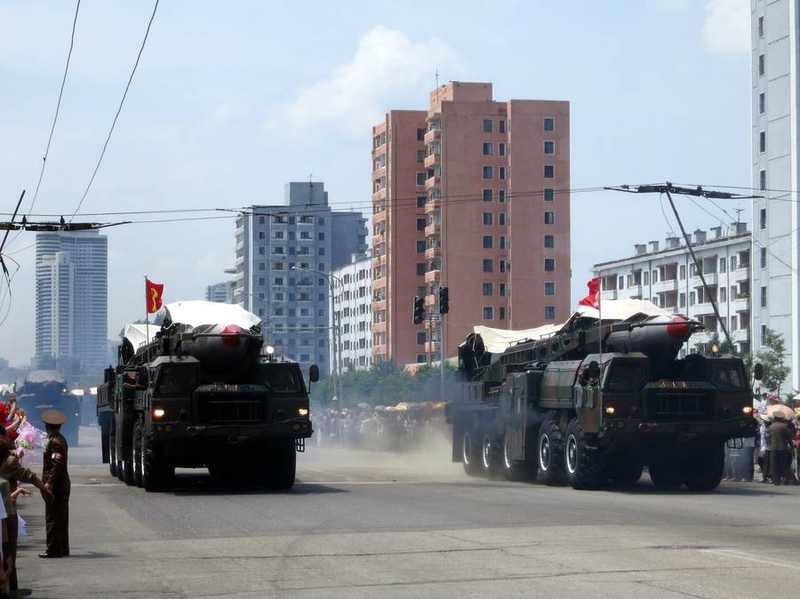
SEOUL — The North Korea missile launch October 2026 sent a ballistic missile more than 700 kilometers from Wonsan toward the East Sea at about 6:30 a.m. Saturday local time, South Korea's Joint Chiefs of Staff said. Japan measured a roughly 680-kilometer flight with an apogee near 90 kilometers and said the weapon fell outside its exclusive economic zone. No damage was reported.
The launch is verified; the missile's identity is not. Seoul, Washington and Tokyo did not confirm a type. Kim Yo Jong, the influential sister of leader Kim Jong Un, claimed afterward that the event was an intermediate-range strategic missile drill overseen by her brother and conducted by what she called “a firepower sub-unit undertaking an exclusive special mission.” Her description is a North Korean government claim, not an independently established technical finding.
That distinction matters because a weapon's political value can exceed what one flight proves. Pyongyang wants its adversaries to plan against the most dangerous interpretation. Regional militaries, by contrast, must separate the trajectory they tracked from the capability North Korea says it displayed.
What happened: one flight, two official measurements
South Korea detected the launch at approximately 6:30 a.m. Saturday, or 2130 GMT Friday, from the Wonsan area on North Korea's east coast. The Joint Chiefs of Staff said the missile traveled more than 700 kilometers before splashing down in the East Sea, also known as the Sea of Japan. Seoul raised surveillance and said it was sharing intelligence with the United States and Japan.
Japan's Defense Ministry offered a slightly different reconstruction: about 680 kilometers of travel and a peak altitude around 90 kilometers. Those figures are not inherently contradictory. Tracking networks observe different phases of flight, use different sensors and may define endpoints differently. Kim Yo Jong mocked the discrepancy and added, “There is no way to avoid this attack.” The boast is propaganda, not proof that defenses were defeated.
Tokyo said the missile landed outside Japan's exclusive economic zone. Japan protested through its embassy in Beijing, and Prime Minister Sanae Takaichi issued instructions to collect information and protect public safety. The U.S. Indo-Pacific Command said the launch posed no immediate threat to American personnel, territory or allies. South Korea's presidential National Security Council met in emergency session, while the presidential national security office urged Pyongyang to stop and called the launch a violation of U.N. Security Council sanctions.
Why this matters
The first signal is timing. The launch came one day after Kim Yo Jong rejected Seoul's demand for an apology over the September 21 mine blast near the Military Demarcation Line. President Lee Jae Myung has tried to reopen space for dialogue; Pyongyang answered the overture with a military demonstration and a statement framing the South as an adversary that cannot shield itself.
“Seoul called for easing tensions, but Pyongyang answered by escalating them,” Yang Moo-jin, a former president of the University of North Korean Studies in Seoul, told AFP. The sentence captures the immediate diplomatic imbalance. A government seeking talks must keep offering off-ramps; a government seeking leverage can profit from refusing them.
The second signal is the intermediate-range claim. If the weapon truly belongs to the 3,000-to-5,500-kilometer IRBM class, it would place Guam—the central U.S. military hub in the western Pacific—within theoretical reach. Yet the observed flight covered only about 700 kilometers. That could describe a shorter-range Hwasong-11 family weapon, or a longer-range system flown on a depressed trajectory. One test, without confirmed telemetry or imagery of the launch system, does not settle the question.

From the DMZ mine blast to the Wonsan launch
The immediate political context began at the border. On September 21, an explosion occurred roughly 10 meters south of the Military Demarcation Line. South Korea and the U.S.-led United Nations Command concluded that North Korean mines caused the blast and that the incident violated the armistice. Pyongyang denies responsibility.
The casualty record must be handled carefully. South Korean officials say three soldiers were seriously wounded; Reuters reported two soldiers on a reconnaissance mission. Those accounts should not be collapsed into one unattributed number. What is clear is that Seoul demanded an apology and Kim Yo Jong rejected it on Friday, immediately before the missile launch.
Read alongside our detailed report on the DMZ mine-blast and armistice dispute, the sequence shows how quickly a localized border incident can become a national-level missile confrontation. Each side is now defending not only its facts but its credibility.
Wonsan is also familiar launch ground. North Korea fired two short-range ballistic missiles from the area on September 20, widely read as a protest against an International Atomic Energy Agency resolution on denuclearization. Our earlier report traced those September Wonsan ballistic-missile launches. Saturday's longer reported range raises the operational stakes even if the missile ultimately proves to be another tactical system.
The deeper backdrop is Pyongyang's abandonment of unification as a policy goal and its designation of South Korea as its “primary foe.” Lee's call for renewed dialogue therefore runs into more than bad timing. It confronts a doctrine that treats separation and confrontation as permanent. The dispute also intersects with Seoul's wider regional posture, including its handling of North Korean prisoners of war captured in Ukraine.
Who benefits and who loses
Pyongyang gains leverage and domestic theater
North Korea benefits from ambiguity. Calling the missile intermediate-range compels planners to consider Guam even when the observed flight remained regional. Publicly placing Kim Jong Un at the drill also supports domestic messaging: the leader is shown supervising strategic forces while foreign governments argue over measurements.
The launch further turns an apology demand into a contest of deterrence. Instead of answering the mine allegation on Seoul's terms, Pyongyang shifts the question to whether South Korea and Japan can defend themselves. That does not erase the DMZ issue, but it changes the news cycle and the negotiating terrain.
Seoul's engagement strategy loses room
Lee's government now faces the classic pressure on engagement policy: every conciliatory signal can be portrayed by domestic critics as inviting more coercion. An emergency National Security Council meeting and increased surveillance show that dialogue does not displace deterrence. But each launch raises the political cost of keeping an offer on the table.
Regional markets also absorb another increment of risk. A single missile outside Japan's EEZ, with no reported damage, is unlikely by itself to reprice the region. Repetition matters. Airlines, shipping companies, insurers and manufacturers respond not only to an individual trajectory but to the perceived probability of miscalculation and a larger escalation cycle.
Skeptics have reason to test the IRBM story
A true IRBM can travel 3,000 to 5,500 kilometers. A 700-kilometer flight is therefore far short of the class's nominal range. A depressed trajectory—flatter and lower than an energy-maximizing path—can deliberately shorten travel and complicate interception, but it also imposes different thermal and structural stresses. Japan's reported 90-kilometer apogee is consistent with a relatively low path, not by itself proof of a Guam-range weapon.
Analysts are consequently split between two broad readings: a Hwasong-11 tactical missile of the kind North Korea has tested repeatedly, or a longer-range system deliberately flown short. The technical assessment cited below argues the 700-kilometer result could mask a longer-range strike capability. That remains analysis. Until governments release more sensor data or North Korea provides verifiable launch imagery, the responsible label is ballistic missile, type unconfirmed.

The numbers in context
More than 700 kilometers: South Korea's figure is enough to cover all of South Korea from Wonsan and reach parts of western Japan. It is substantially longer than the approximately 450- and 600-kilometer flights reported in the September 20 Wonsan sequence, reinforcing why Seoul and Tokyo are examining whether a different weapon or flight profile was used.
About 680 kilometers and 90 kilometers high: Japan's estimate is close to Seoul's on range and adds the most consequential publicly reported vertical measure. A 90-kilometer apogee sits near the conventional boundary of space and is low for a full-range IRBM test. It supports scrutiny of the depressed-trajectory theory, but does not identify the missile.
3,000 to 5,500 kilometers: that is the standard range band for an intermediate-range ballistic missile. Guam lies within that envelope from North Korea. The gap between the band and Saturday's measured flight is precisely why Kim Yo Jong's claim cannot be repeated as settled fact.
No immediate threat, no reported damage: those official assessments limit the event's immediate harm. They do not diminish the legal and strategic dispute. Seoul treats ballistic launches as violations of U.N. Security Council resolutions, and every test supplies data that can improve training, command procedures and reliability.
What happens next
Scenario one: another launch clarifies the system. North Korea could publish photographs, name the missile or fire a second round with a more revealing trajectory. That might strengthen the IRBM case—or show that Saturday's rhetoric exceeded the hardware demonstrated.
Scenario two: the U.S.–ROK–Japan response stays calibrated. Intelligence sharing, missile-defense tracking and exercises are likely to intensify without an immediate military strike. This is the default ladder: surveillance, diplomatic protest, visible readiness and a warning designed to deter the next step without creating one.
Scenario three: the DMZ dispute produces a new border incident. The mine blast remains unresolved. Additional patrol activity, loudspeaker operations or force movements could create another flashpoint even if missile testing pauses. The most dangerous pathway is not necessarily a planned attack; it is a localized encounter that national leaders feel compelled to answer.
Scenario four: the U.N. argument hardens but does not resolve. Seoul will press the sanctions-violation case. New Security Council action is uncertain given major-power divisions, making statements and unilateral measures more likely than a binding new resolution.
The indicators to watch are concrete: any official identification of the missile; launch photographs that reveal the transporter or airframe; updated range and apogee estimates; new Wonsan preparations; changes in allied readiness; and movement around the DMZ blast site. Until then, the central finding is narrow but serious: North Korea demonstrated a 700-kilometer ballistic-missile flight, claimed much more, and used the uncertainty itself as strategic pressure.
Sources and reporting notes
- Reuters, reported by Heejin Kim: launch timing, regional responses and DMZ context (October 3, 2026)
- Sky News via Capital FM: Kim Yo Jong's intermediate-range missile claim
- AFP via The Insight International: Joint Chiefs statement and Yang Moo-jin analysis
- Army Recognition: technical assessment of range, apogee and possible depressed trajectory
- Nation Press: regional response roundup
Reporting note: Signal Post News distinguishes the tracked ballistic-missile flight from North Korea's claim about the weapon type. Seoul, Washington and Tokyo had not confirmed an intermediate-range missile. Differing casualty accounts from the September 21 DMZ blast remain attributed to their sources. Range comparisons, beneficiaries, market effects and escalation scenarios are analysis.