Netanyahu nuclear image over Tel Aviv: the prime minister posts an AI-generated mushroom cloud over his own largest city and amplifies a warning of a 'second Holocaust' — two days before Israel's October 27 election.
Two days before Israel's parliamentary election, Prime Minister Benjamin Netanyahu posted an AI-generated image of a nuclear explosion over Tel Aviv alongside a long statement by right-wing commentator Yuval Blumberg arguing that Israel is in "real and tangible existential danger," that it has "another two years of Trump to finish the work in Iran," and that every other controversy in Israeli politics is "one giant smokescreen." The post drew fury from opposition leaders, a fact-check note from X itself — and, according to Israel's N12, quiet alarm in the White House, where officials worried Tehran might read the image as a signal that an Israeli strike was imminent.
Track it live: the Iran war tracker follows the military standoff behind this election in real time.
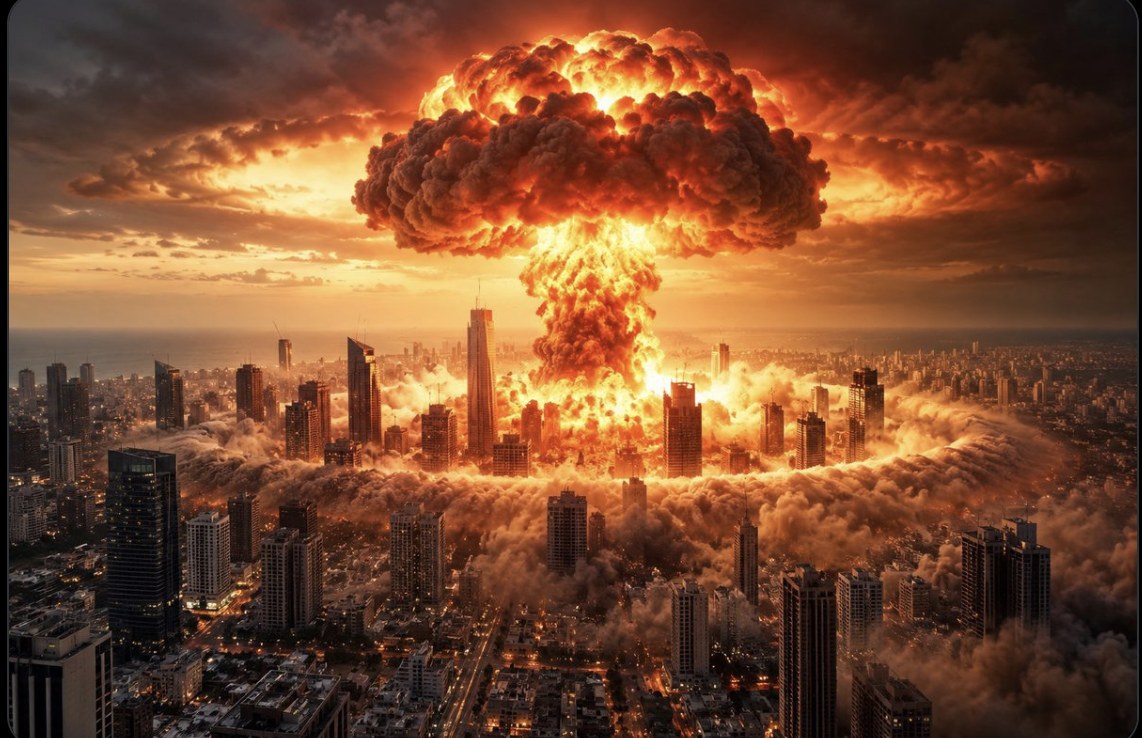
The post: 'Read Yuval Blumberg's important statements'
Netanyahu introduced the text on his Hebrew-language X account with a short instruction: "Read Yuval Blumberg's important statements." What followed was one of the starkest texts ever amplified by a sitting Israeli prime minister in the closing days of a campaign.
"The State of Israel is in real and tangible existential danger," the statement begins. "If the Iranians acquire nuclear weapons, nothing will ever be the same again. Everything is so trivial compared to the existential threat of Iran and the Shiite axis." It argues that "the staged and fabricated storms that crop up every so often are designed to divert attention from the one thing that matters most: completing the work in Iran," and that the threat "touches on the physical existence of every single person here."
Then comes the passage that turned a campaign post into an international story — an explicit argument that Israel's window is defined by the American electoral calendar: "We have another two years of Trump to finish the work in Iran, and there's no telling what will come after that — whether it's Kamala Harris or some other mediocre figure. This is the window of time we have left to complete the necessary work to ensure our physical existence for the coming years. All the required resources of the state must be invested in this mission."
The statement waves away the controversies dominating the campaign — "Qatar, Haredim, Urik, conscription, alerts. It's all one giant smokescreen to hide the single issue that towers above everything else by a margin" — and asks, in the passage reported by Haaretz, "If two atomic bombs were to fall on central Israel, who would care about all these meaningless controversies?" It adds that the mission "won't happen with a prime minister who can't pick up the phone and have a continuous, intimate conversation with Trump," warns that future generations "will not forgive us if we miss this historic window of opportunity," and — in Newsmax's summary of the full text — cautions that voters who choose a leader unable to stop Iran risk a "second Holocaust." Israeli outlets described the accompanying mushroom-cloud image over the Tel Aviv skyline as AI-generated.
Washington's worry: Tehran might misread it
The post did not land only in Israeli politics. According to N12, as reported by The Media Line and the Times of Israel, White House officials expressed concern that Tehran could interpret the image — a nuclear blast over Israel's largest city, posted by its prime minister — as signaling that an Israeli strike on Iran was imminent, potentially prompting Iran to strike first and reigniting a war both sides fought as recently as this year. N12 reported that President Donald Trump's statement on Sunday that there would be no strike on Iran today may have been intended, at least in part, to reassure officials in Tehran.
That reading is an interpretation by Israeli media, not a confirmed account of the president's motives, and the White House has not publicly commented on the post itself. But the concern it describes is concrete: in a region where leaders monitor each other's social media for operational signals, a prime ministerial post depicting a nuclear detonation is not received as mere campaign art. It arrives in the same weekend that Trump issued a second endorsement of Netanyahu and that Israeli media reported a confrontation between Netanyahu and IDF Chief of Staff Lt. Gen. Eyal Zamir over an Iran-linked operation — a report Netanyahu denied on Channel 14, saying "there is no confrontation," while also telling viewers he had instructed the Mossad and the military to work toward toppling Iran's government.
Signal Post News reported the endorsement and the reported Zamir clash in full here: Trump endorses Netanyahu again as Israel's army chief is reported to resist an Iran order.
The opposition erupts — and X adds a note
Gadi Eisenkot, the former IDF chief of staff who leads the Yashar party and is Netanyahu's principal challenger, responded within hours. "Netanyahu, you're in a hysteria," Eisenkot wrote on X, accusing the prime minister of the same "method of lies and scare tactics" as every previous campaign — "this time you are threatening Israeli citizens with mass destruction, and this after you failed to achieve the goals of the war in Iran." Eisenkot noted the shift from promises of "absolute victory" to the slogan "We will not surrender," and predicted voters would deliver their verdict at the ballot box.
Yair Golan, chair of the Democrats, was blunter: "The prime minister of Israel posted a picture of an atomic bomb over Tel Aviv," he wrote, urging that Netanyahu be kept away from social media. "The man and his surroundings have lost it. On Tuesday, we will replace those spreading panic and restore security and rationality to Israel."
X itself attached a reader-added context note to Netanyahu's post pointing out the tension at the center of the opposition's case: after Israel's summer 2025 strikes on Iran, Netanyahu had described Iran as no longer an existential threat — he said last year that Israel had "avoided the threat of nuclear annihilation." The post the prime minister amplified on Sunday argues the opposite: that the threat is total, current, and worth subordinating every other question in Israeli life to eliminating.
Why this matters
The Blumberg text is not a gaffe; it is the Likud closing argument, stated without euphemism. It tells Israeli voters that the election is not about the Qatargate affair, the Haredim draft, the cost of living, or the October 7 reckoning that hangs over Netanyahu's government — the subject of Signal Post News' earlier coverage of an election fought in the shadow of October 7 — but about a two-year window, defined by Donald Trump's remaining time in office, in which Israel must "complete the work" in Iran or face annihilation. Netanyahu did not write the words, but a prime minister who instructs his followers to "read" a text adopts it; the distinction between quoting and saying has not survived contact with any Israeli headline.
Three things make the post consequential beyond the campaign. First, the signal problem: a nuclear-blast image from a head of government is read in foreign capitals as communication, not commentary, and N12's report suggests Washington spent part of Sunday managing exactly that risk. Second, the commitment problem: Netanyahu has now publicly tied his re-election to finishing a war mission in Iran within Trump's term — a promise that will be quoted back at him by supporters and adversaries alike whatever Tuesday's result. Third, the precedent: an AI-generated image of mass destruction over the country's own largest city, deployed as campaign material two days before a vote, marks a new floor in what democratic campaigns consider usable imagery — one reason the reaction from Eisenkot, a former general not given to rhetorical excess, was so sharp.
The numbers explain the desperation on both sides. The final projections published before Friday's polling gag showed continued gridlock: public broadcaster KAN put Eisenkot's bloc at 52 seats and Netanyahu's at 50 in the 120-seat Knesset, with neither the coalition nor the opposition able to form a government on those numbers. In a race that tied, Netanyahu has reached for the issue he has owned for three decades — Iran — and stated the stakes in the most absolute terms available to him. Whether voters read the mushroom cloud as a warning or as fear-mongering is, quite literally, the question Tuesday will answer.
What happens next
Israel votes on Tuesday, October 27, under a party-list proportional system with a 3.25 percent threshold. If Netanyahu's bloc edges ahead, expect the Blumberg framing — a mandate to finish the Iran mission inside the Trump window — to become the government's stated basis for whatever comes next with Tehran, and expect Washington's miscalculation worry to become a standing feature of the alliance. If Eisenkot's bloc wins, Sunday's post will be remembered as the moment the campaign turned existential and still lost. Either way, the image is now part of the record: Tehran, Washington, and Israel's voters have all seen it, and none of them can unsee it. Follow the military backdrop on the Iran war tracker and the wider regional picture on the Israel war map coverage.
Sources
- Benjamin Netanyahu, X post, October 25, 2026: the AI-generated Tel Aviv nuclear-blast image and the full Yuval Blumberg text ("Read Yuval Blumberg's important statements"), read in full from the post itself.
- The Times of Israel, October 25, 2026: the AI image; N12's report of White House concern over an Iranian miscalculation; the Zamir meeting context; KAN's final poll (Eisenkot bloc 52, Netanyahu bloc 50).
- The Media Line, October 25, 2026: N12's reporting on U.S. officials' fears and the reading of Trump's no-strike-today statement as reassurance to Tehran.
- Newsmax, October 25, 2026: the "second Holocaust" framing; Eisenkot's and Golan's reactions in full; the X reader context note.
- Haaretz, October 25, 2026: the "two atomic bombs" and "trembling hands" passages; the historic-window warning.
- ANI (syndicated), October 25-26, 2026: the complete Blumberg text including the Trump phone-call passage; Trump's second endorsement; the October 23 final projections showing gridlock.
- Jerusalem Post, October 25, 2026: Netanyahu shares the AI-generated image two days before the election; the Zamir report and Netanyahu's Channel 14 denial.