World / Africa — The Eastleigh building collapse in Nairobi on Friday, October 23, 2026, brought down a multi-storey building under construction on Yusuf Haji Avenue, in the 9th Street commercial district, while shops on its ground floor and in its basement were open for business. Interior Cabinet Secretary Kipchumba Murkomen said all 67 construction workers on the site had been accounted for, but seven people were reported missing, rescuers had made contact with survivors trapped inside, and no deaths had been confirmed in the reports available as the search continued into the night.
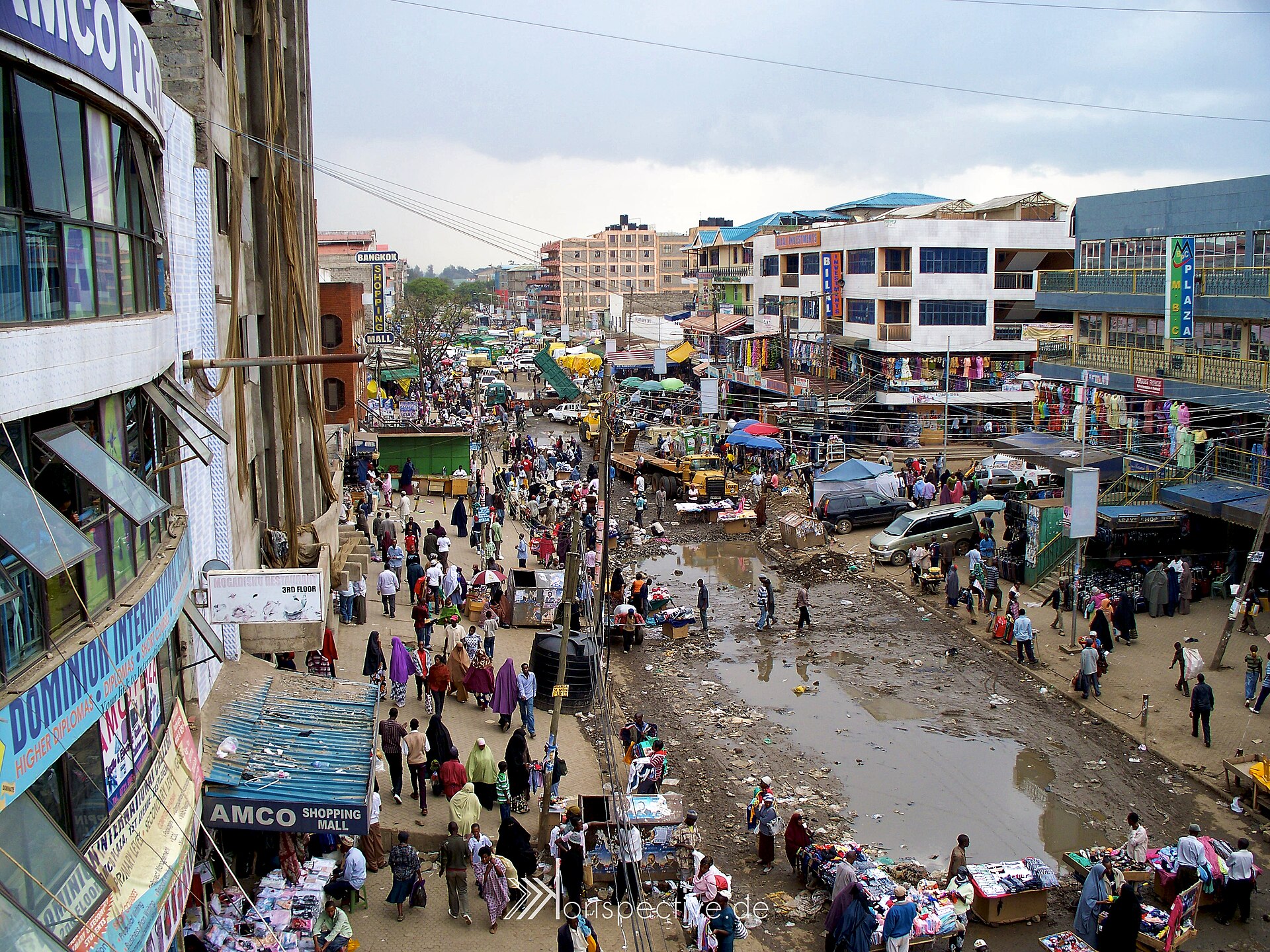
The Eastleigh building collapse happened at about 1 p.m. on Friday along Yusuf Haji Avenue on 9th Street in Eastleigh, one of the busiest trading districts in the Kenyan capital, Reuters reported. Reuters described a 12-storey building under construction; Nairobi police chief Issa Mohamud told the Associated Press the building had more than 10 upper floors under construction, and other reports from the scene put the height as high as 18 storeys — a range officials had not reconciled by Friday night, and one this article carries as reported rather than settled. What is not in dispute is the manner of the fall: the Associated Press reported that the building left “a huge mound of concrete and more than a dozen floors stacked like pancakes, with little space between them,” the kind of pancake failure that leaves few survivable voids and makes the first hours of searching a race conducted largely by hand.
The ground floor was occupied, the Nairobi County governor’s office said in a statement reported by Reuters, and people were reported trapped beneath the rubble. By nightfall the operation had drawn in the Kenya Defence Forces, the General Service Unit, regular police, the Anti-Terrorism Police Unit, the Bomb Disposal Unit, the National Youth Service, the Kenya Red Cross, the National Disaster Management Unit and Nairobi City County teams, with excavators and sniffer dogs working the site, The Eastleigh Voice reported. No deaths had been confirmed in any of the reports reviewed for this article, and the cause of the collapse had not been established.
A plasterer who walked out last, and a voice that went silent
The human margin of the Eastleigh collapse is measured in seconds. Joseph Kaula, a plasterer working on the fifth floor, told the Associated Press he heard screams and saw other workers rushing outside, shouting that the building was collapsing. “I was the last person to walk out before it collapsed and the whole area was filled with dust,” Kaula said. He suspected a few of his colleagues were trapped in the basement. Police chief Mohamud said one injured woman was rescued and taken to hospital, and that another person who had been crying for help had gone silent. He also warned of a possible secondary collapse, because the fallen building was leaning against its neighbour.
The early rescue was improvised in a way that will feature in every inquiry that follows. The Associated Press reported there was little heavy equipment immediately available: hours after the collapse, rescuers in hard hats were using poles stripped from trees to probe the pile, and a single excavator had arrived to move steel-bound concrete so crews could reach the basement and ground level — floors that had been rented out for an electronics shop, a butchery and a grocery while construction continued above them. “We are expecting more machines so that we remove those boulders,” Mohamud said. Residents told AP that some loved ones trapped inside had phoned for help immediately after the collapse, but their phones later became unreachable.
Rescue operations were also complicated by the crowd. Police fired tear gas at people who had begun looting neighbouring shops, AP reported, as officers tried to clear access for emergency teams; AFP journalists at the scene likewise saw police use tear gas to disperse crowds, and Kenyan reporting described onlookers blocking ambulances before being moved back. In a district as dense as Eastleigh, the perimeter is part of the rescue.
The numbers, and why they kept moving on Friday night
By late evening, Interior Cabinet Secretary Kipchumba Murkomen gave the clearest official accounting yet at a press briefing at the site. All 67 construction workers who had been on site were accounted for: 66 had escaped unhurt and one was injured and recovering in hospital, People Daily reported. “I am also informed that there were 67 workers on site, and all the 67 workers have been accounted for,” Murkomen said. Seven people, however, were reported missing. Murkomen disclosed that about 11 shops in the basement and on the ground floor had been occupied, and authorities were working to establish whether the seven missing people were among those inside. An Eastleigh Voice account of Murkomen’s remarks put the unaccounted-for at about 11 people believed to have been inside the shops — a figure that appears to track the 11 occupied shops rather than a separate missing-persons count, and which People Daily’s more detailed briefing report separates out. This article anchors on the later, more specific formulation: 11 occupied shops, seven people reported missing, with the count still being established.
Two other figures explain why the missing list shrank through the evening. The Kenya Red Cross said two injured people had been rescued and taken to Kenyatta National Hospital, and that 26 people who had earlier been reported missing had been traced and accounted for, The Eastleigh Voice reported. A tracing desk was set up at the site, and the Red Cross and Murkomen both urged anyone who believed a relative or acquaintance might have been inside to call the toll-free line 1199. Most importantly for the families waiting on 9th Street, Murkomen said responders had established contact with some survivors still trapped inside: “The good news is that from the rescue team, which include national government, county government, and Red Cross, it is reported that they have made contact with some of the survivors who are still trapped inside. Every effort is being expended to make sure that they are rescued alive. That communication gives us the hope that all of them will be rescued alive. We will keep that hope alive.” Nairobi Senator Edwin Sifuna likewise said the Red Cross had reported being in communication with people trapped inside. Police commander Mohamud said a woman had been heard crying from beneath the rubble. One local account carried by The Eastleigh Voice described a mother on nearby 10th Street who had managed to speak by phone with a relative trapped inside hours after the collapse.
Approved to build, never certified to occupy
The fact that will define the accountability fight is a certificate that did not exist. Nairobi Governor Johnson Sakaja said the building had received county construction approval but did not have an occupation certificate, so the shops trading at its base were operating before the building was legally occupiable. “The building was approved for construction, but did not have a certificate of occupation, so opening shops on the ground floor was against the law,” Sakaja said, in the Associated Press account, arguing that Kenya’s county governments need stronger enforcement powers and that lenient penalties for non-compliance are just a “slap on the wrist” for developers who violate regulations.
Sakaja went further on enforcement, in remarks reported by The Eastleigh Voice: “Whenever we see such an incident, an enforcement notice is issued, but it is not followed up, people get low fines, and they continue doing this.” He called for counties to regain prosecutorial powers, and appealed to architects, engineers and other professionals to report developers who dismiss them after securing approvals: “We are appealing to all professionals that once you are given an approval and later fired, you must report to the regulators as well as the county government, because from the look here it appears like there was no professional on site.” That sentence — an approved building apparently rising without its approved professionals — is the allegation investigators will have to prove or disprove.
Who built it: the regulator names names
The National Construction Authority (NCA) moved unusually fast to put the project’s paper trail on the record. In a statement reported by The Eastleigh Voice, the NCA said the development on 9th Street in Eastleigh, Kamukunji Sub-County, was registered on July 30, 2025. It listed 9th Street Plaza Limited as the developer and Stromax Holdings E.A Limited as the contractor, named Emmanuel Mwangi Maina as the project architect and Joseph Muturi Mugu as the structural engineer, and said the site had been cordoned off with a multi-agency team coordinating rescue and preliminary investigations. The authority did not state whether it had inspected the building before the collapse, whether any violations had been recorded, or whether enforcement action had been taken — the three questions at the centre of the case.
Police commander Mohamud said investigators would establish who was responsible for any criminal negligence, warning in The Eastleigh Voice’s account that “whoever is the owner, whoever authorised the building, all of them may be charged appropriately, but that will come after thorough investigations are done,” and that if deaths resulted from negligence, those responsible could face murder charges. Murkomen struck the same note from the government side: “At this point, we cannot pass judgement on anything concerning the integrity of the building or the cause of the disaster,” he said, adding, “We must all be concerned about the integrity of our buildings, and we must get to the bottom of it. Those found culpable must face the full force of the law.” None of the named companies or professionals had publicly responded in the reports reviewed for this article.
Why this matters
The Eastleigh building collapse is not, on the verified facts, a story about an illegal building. It is a story about a legal one — registered with the national regulator in July 2025, approved by the county, built by a named contractor to a named architect’s and a named structural engineer’s designs — that was nonetheless trading from its basement and ground floor without an occupation certificate while its upper floors were still rising. Every checkpoint in the system existed on paper. The collapse asks what any of those checkpoints physically did.
The location multiplies the stakes. Eastleigh is one of the most densely built and heavily traded districts in Kenya: the 2019 census counted 152,484 people in 6.9 square kilometres, a density of about 42,330 people per square kilometre, and its avenues carry thousands of traders and shoppers on an ordinary Friday. AFP, reporting from the scene, described a neighbourhood in the grip of a rapid construction boom where high-rises are appearing across the district, and quoted local resident Abdi Aziz, 25, on the culture that boom has produced: “There were some businesses in the basement and workers who were busy building. But as it was (the Friday prayer), a lot of them were at the mosque. I think few people died because no one was living there,” he told AFP, adding, when asked about flaws in the construction process: “Everyone rushes to build in this neighbourhood.” If the Friday-prayer timing did thin the crowds inside, then the difference between this collapse and a far deadlier one may have been the hour of the week, not the safety of the building.
There is also a pattern, and Nairobi knows it. In January, a 14-storey building under construction in Nairobi’s South C estate collapsed, killing two security guards; the NCA said that project, too, had been registered but was non-compliant when it fell, and in June the Office of the Director of Public Prosecutions approved charges against 37 people linked to the South C incident, including public officials and construction professionals, with proposed charges including manslaughter and neglect of official duty — a case that is still ongoing, The Eastleigh Voice reported. Less than a week before Eastleigh, a demolition-related collapse on Moi Avenue injured four workers and led Nairobi County to order a structural safety assessment before further work. Three incidents in one year describe a system, not a run of bad luck.
What happens next
First, the rescue: crews were still working into the night with sniffer dogs and excavators, in contact, officials said, with survivors inside a pancake-collapsed structure that was leaning against a neighbouring building. The missing count — seven reported missing on the latest official accounting, against 11 occupied shops and an earlier, larger list being traced person by person — will move again, in either direction, and each revision should be read against the tracing desk’s work rather than as confusion. Second, the investigation: the NCA’s register entry, the county’s approval file, the inspection record the NCA has not yet described, and Sakaja’s claim that no professional appeared to be on site are the documents that will decide whether this becomes a prosecution like South C’s or another enforcement notice with a low fine. Third, the politics: leaders across the spectrum — National Assembly Speaker Moses Wetang’ula, Kamukunji MP Yusuf Hassan, Embakasi East MP Babu Owino, Kiharu MP Ndindi Nyoro, Wiper leader Kalonzo Musyoka and People’s Liberation Party leader Martha Karua, who demanded an urgent audit of buildings across Nairobi — have already converged on the same demand, an investigation with names attached. Whether that convergence survives contact with the approval chain is the test. For continuing Kenya coverage, see our reporting on Kenya’s Ebola cases, and for another building collapse examined through its enforcement record, our coverage of the Delhi building collapse in New Seemapuri.
Sources
- Reuters: Building collapses in Kenyan capital, rescuers on the scene — the 12-storey description, the governor’s office statement that the ground floor was occupied, and the excavator and crowd at the scene.
- Associated Press (via The Oldham Times): Many feared trapped as tall building collapses in Kenya’s capital — the pancake collapse, Joseph Kaula’s account, the rescued woman and the voice that went silent, the secondary-collapse warning, the tree-pole rescue, the electronics shop, butchery and grocery, the looting and tear gas, and Sakaja’s “slap on the wrist” remarks.
- People Daily: Murkomen confirms 67 workers accounted for, 7 missing in Eastleigh building collapse — Murkomen’s briefing: all 67 workers accounted for (66 unhurt, one injured), seven people reported missing, 11 occupied shops, contact with trapped survivors, and the 1199 appeal.
- The Eastleigh Voice: Interior CS Murkomen says 11 people missing after Eastleigh building collapse — Murkomen at the scene, the shop occupants unaccounted for, and his refusal to prejudge the cause.
- The Eastleigh Voice: Two people rescued as search operations continue after Eastleigh building collapse — the Kenya Red Cross update: two injured people taken to Kenyatta National Hospital, 26 earlier-reported missing traced, the tracing desk and the 1199 line.
- The Eastleigh Voice: Construction Authority names developer, contractor and engineers behind collapsed Eastleigh building — the NCA statement: registration on July 30, 2025, 9th Street Plaza Limited, Stromax Holdings E.A Limited, architect Emmanuel Mwangi Maina and structural engineer Joseph Muturi Mugu.
- The Eastleigh Voice: Collapsed Eastleigh building had no occupation certificate, Sakaja says as leaders call for probe — Sakaja’s enforcement remarks, the leaders’ responses, and the South C precedent with its 37 approved charges.
- AFP (via GlamTush): Uncompleted multi-storey building collapses in Nairobi — AFP’s scene reporting, resident Abdi Aziz’s account, the Friday-prayer timing and the Eastleigh construction boom.