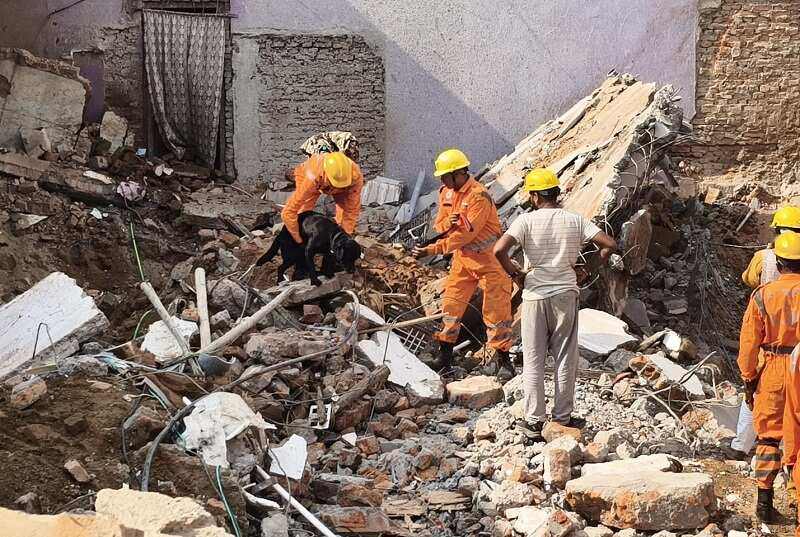
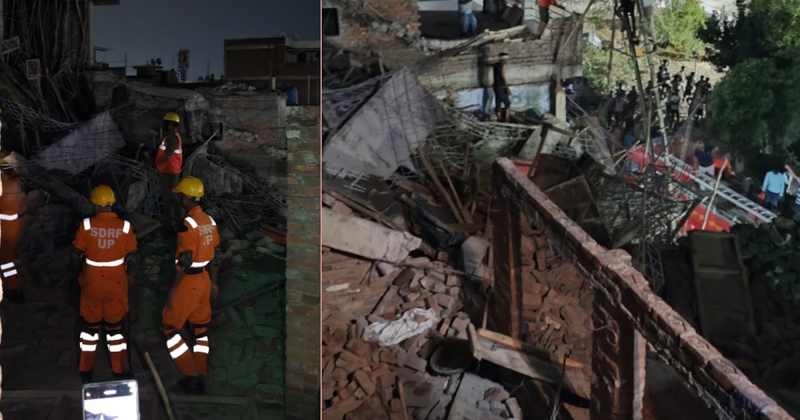
NEW DELHI— A four- to five-storey residential building collapsed near Idgah Machhli Mandi in New Seemapuri, northeast Delhi, at about 3:30 p.m. IST on Wednesday. Officials confirmed three deaths: a girl believed to be about 12, 21-year-old Gulafsa, who was approximately four months pregnant, and a child around 18 months old whose identity had not yet been confirmed.
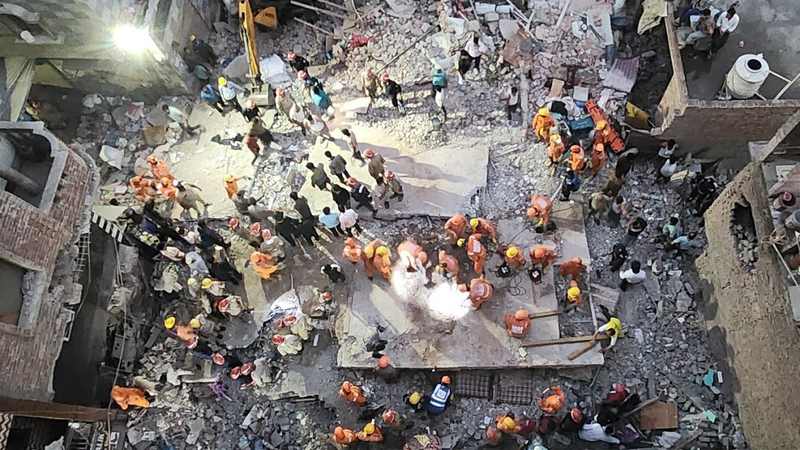
Eight injured people were taken to Rajiv Gandhi Super Speciality Hospital in Tahirpur. Local reporting identified them as Momin Mirja, 56; Abdaan, 3; Abdul Rehman, 28; Devruddin, 28; Salma, 50; Chote, 34; Sakina, 35; and Samad, 30. Authorities said 11 people had been rescued while teams continued checking the unstable debris for anyone else trapped.
Delhi Police, Delhi Fire Service, the Delhi Disaster Management Authority, the National Disaster Response Force, the Municipal Corporation of Delhi and the Delhi Urban Shelter Improvement Board were involved. The number of agencies reflects the difficulty of a dense-neighborhood collapse: rescuers must remove weight without triggering a second fall, keep access lanes open, identify residents and move injured people quickly through crowded roads.
What happened in the New Seemapuri building collapse
Rescuers worked around visible survivors and unstable concrete
Shahdara Deputy Commissioner of Police Rajendra Prasad Meena told PTI during the operation that five or six people had been taken to hospital and that two or three people could still be seen inside and were communicating with rescuers. Those early figures evolved as teams reached more of the wreckage; the later toll recorded 11 rescues and eight injured.
The sequence matters in a fast-moving disaster. Initial official statements describe what crews can confirm at one moment, not a final accounting. Search teams must balance speed against the risk that cutting a beam or moving a slab will shift a void where a survivor is sheltering.
A resident named Saleem told PTI that his son-in-law and daughter were among those brought out. Jhilmil municipal councillor Pankaj Luthra said the building was 40 to 50 years old. That observation raises a structural concern, but age alone does not establish why the block failed.
Traffic restrictions around Seemapuri Gol Chakkar
Delhi Traffic Police advised motorists to avoid Seemapuri Gol Chakkar, DLF Bhopura and adjoining roads while emergency operations continued. Congestion around a rescue site is not a secondary inconvenience: blocked approaches can delay ambulances, cranes, fire tenders and specialist teams carrying search equipment.
Residents also described cracks they said appeared after tremors from an Uttarakhand earthquake the previous night. Officials cautioned that it was too early to establish any link. The claim should therefore be treated as a lead for structural investigators, not as a confirmed cause. Engineers will need to examine the debris pattern, foundations, columns, load paths and any recent alterations.
Why this is bigger than one building
Delhi building collapse deaths form a persistent pattern
Delhi recorded 1,133 building-collapse incidents between 2022 and 2025, with 98 deaths, according to figures cited in coverage of the New Seemapuri disaster. Spread over 36 months, that is roughly 31 collapse incidents a month—nearly one every day. The average conceals seasonal spikes and differences in severity, but it shows that structural failure is not an exceptional risk.
The New Seemapuri collapse also followed another fatal building failure in Satya Niketan in early September. The neighborhoods and structures differ, and one case cannot prove the cause of another. Together, however, repeated collapses force a policy question: why are unsafe conditions so often discovered only after a wall tilts, a floor gives way or an entire structure comes down?
Delhi's housing pressures help explain the exposure without excusing it. Families need affordable space near work, transit and established communities. Owners may add floors or divide rooms to meet demand. Municipal bodies face a vast building stock, overlapping jurisdiction and limited capacity for repeated physical inspections. Residents with few alternatives may remain in a visibly deteriorating property because relocation would disrupt jobs, schooling and family support.
The background: age, alterations, drainage and enforcement
Aging Delhi buildings need evidence-based structural audits
A 40- or 50-year-old building is not automatically unsafe. Properly designed and maintained structures can remain sound for much longer. Risk rises when water penetrates concrete, steel reinforcement corrodes, foundations settle, load-bearing walls are removed, extra floors are added, or adjacent excavation changes ground support.
Monsoon rain can expose those weaknesses. Saturated soil may reduce foundation stability; clogged drains can keep water against walls; repeated wetting can accelerate corrosion and masonry decay. Yet weather should not become a blanket explanation. A post-collapse investigation has to distinguish an immediate trigger from the vulnerabilities that allowed that trigger to become catastrophic.
Unauthorized construction is a system problem, not a verdict on this site
Delhi's recurring disputes over unauthorized construction involve several actors: owners seeking more usable space, contractors working without adequate engineering, officials responsible for permits and inspections, and political systems that sometimes regularize or tolerate violations after neighborhoods are already built. Tenants and low-income residents often carry the greatest physical risk while having the least control over structural decisions.
There was no final official determination on Wednesday that unauthorized work caused the New Seemapuri collapse. Responsible coverage must keep that distinction clear. Investigators should establish the approved plan, actual floor count, construction materials, maintenance record, ownership, notices, complaints and any changes made shortly before failure.
Who bears responsibility—and who pays the price
Legal responsibility can be divided among a building owner, a contractor, an engineer, municipal officials or others depending on what the evidence shows. Public accountability is broader. A safety system fails when residents cannot easily verify whether a building has been inspected, when complaints do not produce visible action, or when evacuation orders come without realistic temporary housing.
The costs fall first on residents: deaths, injuries, lost homes, documents, income and community ties. Rescue workers then accept substantial risk entering an unstable site. Hospitals absorb a sudden emergency load. Nearby businesses and families lose access while roads are closed. Taxpayers fund rescue, demolition, shelter and litigation after prevention has failed.
Officials also face genuine constraints. Delhi's built environment is enormous and legally complex, with municipal, development and shelter authorities holding different responsibilities. A city cannot inspect every room every day. That reality strengthens the case for risk-based targeting rather than excusing inaction: older multi-storey blocks, prior complaints, visible tilting, recent additions, water damage and dense occupancy should move to the front of the queue.
What a credible investigation should answer
The first obligation is a complete search and a transparent casualty list. The next is preservation of evidence. Authorities should document the debris before removal, collect building plans and permits, interview residents and contractors, and commission an independent structural analysis. Findings should explain the failure sequence in plain language and identify who had notice of any danger.
A credible inquiry should answer at least five practical questions:
- Was the structure built and occupied according to approved plans?
- Were floors, walls or columns added, removed or altered?
- Did residents report cracks, leaning or other warning signs, and what response followed?
- Did rain, drainage, neighboring construction or tremors act as triggers?
- Which authority had the power to inspect, evacuate or order repairs before the collapse?
Those answers should not disappear into a file. Publishing inspection findings, notices and compliance deadlines allows residents in comparable buildings to understand what to look for and prevents institutional lessons from being lost between agencies.
What structural safety reform would look like
MCD structural safety needs a risk register residents can see
A meaningful audit program would begin with a citywide risk register rather than a one-time sweep after a tragedy. Buildings could be prioritized by age, height, construction type, occupancy, prior notices, visible defects and neighborhood soil or drainage conditions. The public-facing record should show the date of the last inspection, the professional responsible and whether repairs were completed.
Audits also need enforcement teeth. A notice without follow-up does not reduce risk. Where immediate evacuation is necessary, authorities need safe temporary accommodation and support for tenants, or residents may have little practical choice but to return. DUSIB's involvement is therefore not peripheral; housing alternatives are part of whether a safety order can work.
NDRF and DDMA can improve readiness, but they cannot replace prevention
NDRF, DDMA, police and fire services are designed to rescue people after failure. Their capabilities—search cameras, listening equipment, trained dogs, medical triage and controlled debris removal—can determine survival. But better response times do not make an unsafe building safe.
Prevention belongs with building owners, qualified engineers and civic authorities that approve, inspect and enforce. The clearest performance measures are not how many teams arrive after a collapse, but how many high-risk buildings are identified, repaired or safely vacated before one.
What residents can watch without carrying the whole burden
Warning signs can include new diagonal cracks, doors that suddenly jam, floors that slope, concrete that sheds pieces, exposed or rusting reinforcement, persistent water intrusion and unusual sounds. Residents who see a rapid change should move away from the affected area and contact emergency and municipal authorities rather than attempting structural repairs themselves.
That advice has limits. Residents are not engineers, and safety cannot depend on tenants recognizing hidden column failure. Nor should reporting a concern expose a family to homelessness without assistance. Public policy has to connect complaint channels to prompt professional inspection and, when needed, temporary housing.
What happens next in New Seemapuri
Authorities must finish the search, stabilize or demolish remaining dangerous sections, identify every victim and support displaced households. Investigators then need to establish the ownership and approval history of the structure and explain whether age, modification, material failure, ground conditions or an external trigger contributed.
The municipal response will be judged beyond this one address. Nearby buildings with similar age and construction should receive rapid screening, especially if residents report cracks. Delhi's next monsoon cycle will test whether drainage repairs and structural audits move from announcement to execution.
The New Seemapuri deaths make the stakes concrete. A city recording roughly one collapse incident a day over three years does not face a rare accident problem; it faces a recurring safety-management problem. Accountability means determining the specific cause here without guessing—and using that evidence to prevent the next failure before rescuers are called.